

Most weekly reviews fail because they turn into cleanup duty. A weekly review in 15 minutes is enough to catch what slipped and stop Monday from starting blurry.
What matters is leaving with one real priority and a first move. We don't need a bigger ritual; you need a reset that still works when your week was messy.
A few checks help:
- Repeated carryovers usually mean the task is too vague.
- Bad estimates point to a planning problem, not an effort problem.
- Pick your first Monday block before you stop. Then Monday is handled.
Why a 15-Minute Weekly Review Works
A weekly review is just a short, structured pause. You look back at the last seven days, close what needs closing, and decide what matters next. That's it.
The point of a weekly review in 15 minutes isn't to build a perfect life dashboard. It's to make sure Monday starts with direction instead of drift. Most people don't need a bigger system. They need a cleaner handoff between one week and the next.
A lot of weekly reviews fail for a boring reason: people start with the advanced version before the habit exists. They borrow a full ritual with inbox clearing, project audits, calendar sweeps, waiting-fors, someday lists, and a light existential crisis by minute 43. Then they quietly stop doing it.
Traditional long-form reviews can be useful. If you run a complex workload, there are seasons when a deeper pass makes sense. But a 60 to 120 minute review becomes a thing you have to brace for. Real life tends to beat that kind of ritual by the second or third week.
Short reviews make a better trade. Less scope, more consistency.
There's also a practical reason to keep it brief. Reflection works. Rumination doesn't. Research on deliberate reflection has found that even 15 minutes can materially improve performance, with one study showing a 23 percent improvement over practice alone. The useful part isn't the time spent fiddling with tools. It's the moment where you notice what worked, what didn't, and what to change.
A good review creates clarity. A bad one creates paperwork.
Structure matters because it keeps you out of your own fog. A simple checklist stops the review from turning into self-criticism or random admin. You're not there to judge the week. You're there to extract signal.
That signal usually looks like this:
- what got done that actually mattered
- what stayed open and still deserves space
- where your plan was unrealistic
- what you should stop dragging into next week
Done properly, a weekly review is both planning and emotional cleanup. It reduces the drag of unfinished tasks. It turns vague guilt into specific next actions. Sometimes it tells you something better: that an item can be dropped entirely, which is often the most efficient review technique available.
The Weekly Review in 15 Minutes: A Step-by-Step Process
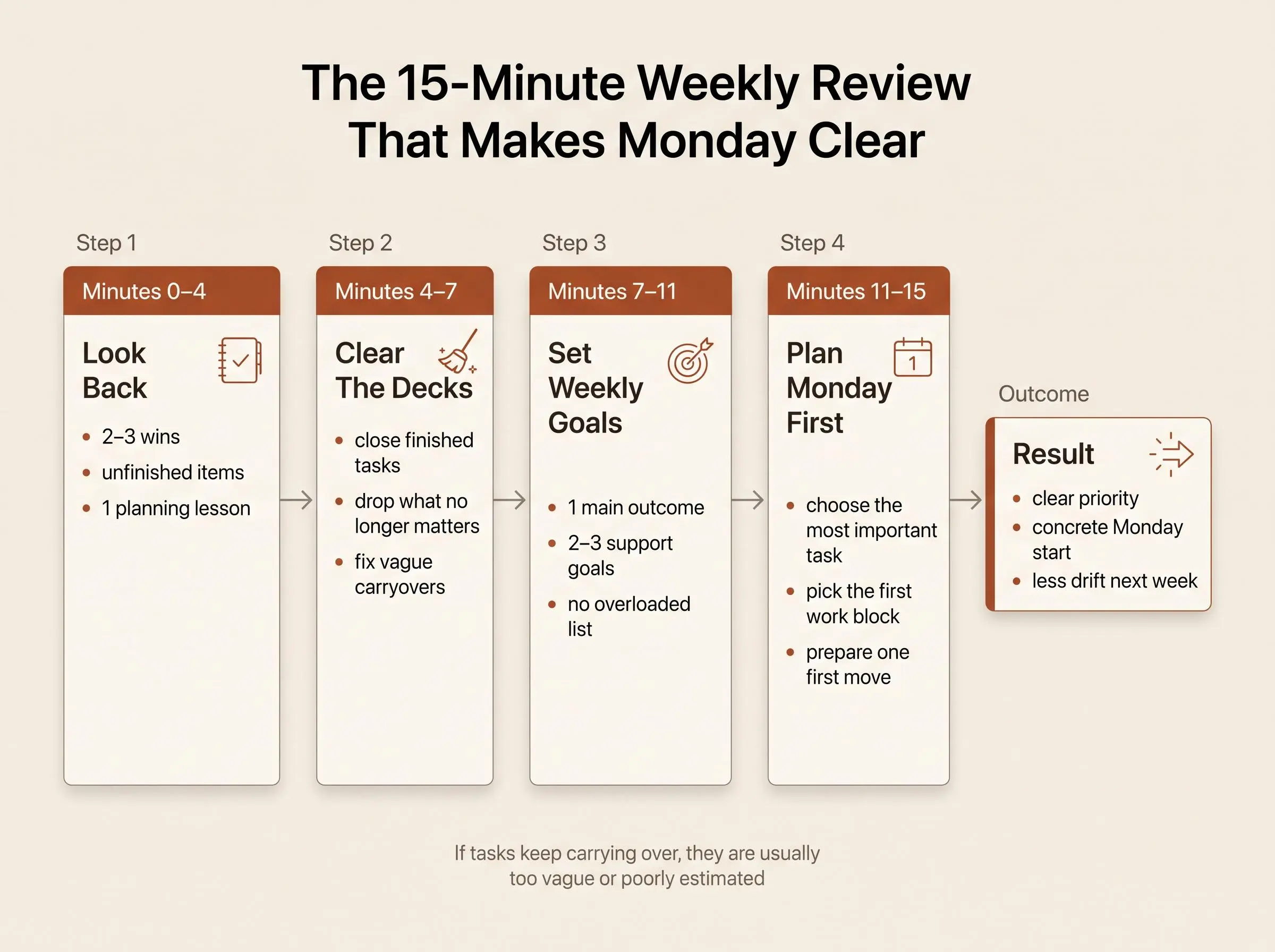
This is the version we recommend for students and knowledge workers who want weekly planning tips without adopting a heavyweight system. It's quick enough to repeat and structured enough to be useful.
Before you start, set up one small workspace:
- open your calendar
- open your task list or notes
- keep one place to capture decisions
- set a 15-minute timer
Then move.
1. Minutes 0 to 4: Look Back
Start with the facts of the week, not your feelings about the week. Scan your calendar and task list. Ask a few blunt questions:
- What got done that actually mattered?
- What didn't get done, and does it still matter?
- What took longer than expected?
- What was quicker than expected?
If you track focus blocks or work sessions, check estimated versus actual time. This is one of the most useful time management strategies because it replaces guessing with evidence. A task that kept slipping may not be a motivation problem. It may simply have been a two-session task pretending to be a one-session task.
Keep the output tiny:
- 2 to 3 wins
- 2 to 3 unfinished items
- 1 planning lesson
Write in fragments. No essays. You are not applying for a grant.
2. Minutes 4 to 7: Clear the Decks
Now shrink the mess.
Close finished items so they stop occupying mental space. Drop tasks that no longer matter. Reschedule only the unfinished items that still deserve room next week. Capture loose follow-ups, decisions, and waiting-for items in one place.
This is where a lot of hidden friction lives. Duplicates, stale tasks, old reminders, half-relevant notes. They all make next week's list look bigger than reality. Cleaning that up is not performative neatness. It's load reduction.
A useful test here is simple: if a task has survived three reviews unchanged, something is wrong.
It may be:
- too vague
- too large
- blocked by someone else
- not actually important anymore
The point isn't discipline theater. The point is organizing weekly tasks so your future self isn't staring at a landfill.
3. Minutes 7 to 11: Set 3 to 5 Goals for the Coming Week
Choose outcomes, not a hopeful pile of tasks. Three to five goals is enough for most people. Often it's better to choose one clear primary goal and a few supporting goals.
Weak goal: make progress on project
Better goal: finish first draft of project proposal
Specificity matters because vague goals don't guide action. They just sound responsible. In actual planning, the important thing gets buried fast if you don't name it clearly.
For most weeks, this is enough:
- one main outcome
- two or three support goals
- maybe one admin task that genuinely needs a deadline
That's it. Not fifteen. Not every area of your life represented equally like a school display board.
Narrowing the list protects the important from being flattened by the urgent. It's one of the quietest but most effective quick review methods we know.
4. Minutes 11 to 15: Plan the First Day
Don't end your review with abstract intentions. Pick Monday's most important task. Then decide the first one or two work blocks that support it.
Check your calendar for obvious collisions, deadlines, or prep needs. Note one thing to prepare in advance, maybe a file, reading, meeting note, or message. You want the week to begin with a visible starting point, not a blank page and a vague promise to "get organized."
This final step matters more than people think. A review without a first move still leaves you paying decision costs on Monday morning.
Move quickly through the whole process. Write in fragments, not paragraphs. The review should feel like a reset, not homework.
A Copyable Weekly Review Template and Checklist
You can copy this into notes, a paper planner, or any app. The format matters less than keeping the output short and usable.
Weekly review checklist
- What were my 2 to 3 biggest wins last week?
- What did I not finish, and does it still matter?
- What did I underestimate or overestimate?
- What can I close, drop, or defer?
- What are my 3 to 5 goals for next week?
- What is Monday's most important task?
- What is the first work block I will start with?
A practical output format looks like this:
- Wins
- Carryovers
- Planning lesson
- Weekly goals
- Monday first move
Here's a realistic example for a knowledge worker:
- Win: sent client draft
- Carryover: revise deck, still matters
- Planning lesson: research task needed two sessions, not one
- Weekly goals: finish deck, prepare Wednesday meeting, submit expense report
- Monday first move: 9:00 AM revise slides for 25 minutes
And one for a student:
- Win: completed reading summary
- Carryover: lab outline, still matters
- Planning lesson: writing always takes longer than expected
- Weekly goals: finish lab outline, study two chapters, email professor
- Monday first move: 8:30 AM draft lab intro
Efficient review techniques usually look a little plain. That's fine. The goal is not a beautiful archive of your thoughts. The goal is a short record that helps you act.
Common Mistakes That Turn a Good Review Into a Chore
Starting with a giant system. Diagnosis: Copying a full GTD-style review before you have the habit makes the ritual too fragile.
Quick fix:
- Limit the scope to essentials for 15 minutes; pick 2–4 core steps.
- Grow the process only after it’s consistent for several weeks.
Blank page / no prompts. Diagnosis: No checklist causes overthinking or avoidance.
Quick fix:
- Choose 1–3 prompts (e.g., inbox decisions, top goals, Monday plan).
- Keep the same short checklist each week.
Inbox-zero trap. Diagnosis: Trying to clear everything eats the whole review and gives little direction.
Quick fix:
- Defer full cleanup; capture only decisions and items that affect next week.
- Turn others into backlog items to triage later.
Too many priorities. Diagnosis: Listing everything as important leaves you without a clear focus.
Quick fix:
- Choose 1 primary goal + up to 4 supporting goals for the week.
- Use those to filter tasks and commitments.
Skipping the estimate vs actual check. Diagnosis: Without checking estimates you mistake poor forecasting for low motivation.
Quick fix:
- Compare 1–2 recent estimates to what actually happened.
- Note one adjustment to improve next week’s estimates.
Treating the review like self-judgment. Diagnosis: Unfinished tasks become moral failures instead of useful data.
Quick fix:
- Turn each unfinished item into either a next action, a split task, or drop it.
- Remember unfinished tasks are signals, not verdicts: https://flocus.org/blog/how-to-focus-on-one-thing-instead-of-switching-tasks/
Forgetting to plan the first day. Diagnosis: Without a concrete Monday start, you open the week in decision fog.
Quick fix:
- Pick Monday’s first time block before you stop the review.
- Make that block a concrete, doable action.
Letting the review expand over time. Diagnosis: Adding extra steps every week turns a short habit into a chore.
Quick fix:
- Set a hard 15-minute timer and stop when it rings.
- If something needs more work, schedule a separate planning slot.
A review should lighten the week ahead. If it makes you feel behind before Monday starts, the process is off.
How to Make the Habit Stick Every Week

The most important rule is simple: same day, same time, every week. Consistency beats the perfect slot.
Sunday evening works well for a lot of people because the coming week feels concrete. Friday afternoon can work too, but energy is often lower and the gap before Monday can blur your plans. There's no sacred day here. Pick one you'll actually keep.
Keep the ritual short on purpose. The discipline isn't adding more steps. The discipline is stopping at 15 minutes. That's the part people resist, usually because they mistake duration for seriousness.
A few habits make this easier:
- use the same checklist every time
- keep one trusted place for the output
- anchor it to an existing routine
- pair it with daily planning
Anchoring helps more than motivation. Tie the review to the end of Sunday tea, your final laptop session, or the moment after you tidy your desk. The cue should already exist. You're borrowing reliability from something else.
Pairing the review with daily planning matters too. The weekly review chooses direction. Daily planning decides what to do today. Together, they reduce drift without forcing you into a full productivity religion. We talk more about that in our Daily Planner, but the principle works anywhere.
If you're short on time, don't skip the week entirely. Run a seven-minute rescue version instead:
- what mattered last week?
- what carries over?
- what is Monday's first move?
This is how habits survive real life. Not by being perfect, but by being resumable.
Over time, this changes your identity a bit. You become someone who closes loops. Someone who starts the week clear. That's more useful than any heroic planning sprint.
How Flocus Makes the Weekly Review Easier Without Making It Bigger
If you want a home for this ritual, Flocus is built for exactly this middle ground. More structure than a plain timer, less ceremony than a complicated productivity system.
Inside Flocus, the Weekly Reset supports the review-to-plan ritual in one place. You can review the past week, set up to five weekly goals, and plan the next week without stitching together separate tools. Weekly goals and the Weekly Reset are free.
The fit here is practical. Our planner is built around choosing one most-important task for the day, then turning that into actual focus blocks. That means your weekly review doesn't end as a nice thought. It carries forward into daily choices and scheduled work.
One detail matters a lot for this method: estimate-versus-actual tracking. When your sessions are attached to planned tasks, your weekly review gets more honest. You can see where your plans were realistic and where they weren't. Most planning problems get less mysterious when the numbers are sitting there.
If you want deeper review data, the fuller weekly recap with extra stats and retrospective insight is part of Pro. Helpful, yes. Required for the 15-minute method, no. The method works fine without the extra layer.
FAQ
A few questions come up every time, so let's keep them plain.
What is a weekly review?
A weekly review is a short planning session where you look back at the past week, close open loops, and decide what matters next.
How long should a weekly review take?
For most people, 15 minutes is enough. It's long enough to reflect, prioritize, and set direction, but short enough to repeat consistently.
What is the difference between a weekly review and a daily review?
A weekly review looks at patterns, carryovers, and next week's priorities. A daily review helps you choose what to focus on today and close the day cleanly.
Do I need an app to do a weekly review?
No. A notes app, paper planner, or simple checklist works fine. An app becomes useful when it reduces friction and helps connect weekly goals to daily action.
What if I miss a week?
Do a shorter reset instead of waiting for the next perfect Sunday. Review what still matters, choose a few priorities, and plan your next work block.
Conclusion
A weekly review doesn't need to be long to be effective. It needs to be structured, short, and repeatable.
The basic method is enough:
- look back
- clear the decks
- set 3 to 5 goals
- plan the first day
That's the shift. Stop trying to manage everything. Start building a calm ritual that helps you close loops and begin the week with intention.
Try the 15-minute version this Sunday. If you want a lightweight place to run it and connect it to daily action, Flocus and the Daily Planner are there. No grand reinvention required. Just a cleaner start to the week.
Article Record
ReferencesPrimary sources used for this article
Update HistoryMeaningful revisions to this article
- Reformatted the common mistakes section into clearly labeled problem-and-quick-fix pairs.
- Made the section faster to scan and easier to apply during a weekly review.
- Preserved the existing links, tone, and key information.