

The most important task method sounds obvious until 10:17 a.m., when chat, email, and a quick request have eaten the useful part of your brain. A timer can record that drift; it cannot tell you what deserved the hour.
Used properly, this is daily planning with teeth: choose work that moves something real, make it small enough to start, and protect a block before the day gets loud. We’re not trying to win the to-do list.
Keep these rules close.
- Pick an outcome, not a project label.
- Estimate the focus blocks before you begin.
- When the day derails, shrink the task and still move it forward.
What the Most Important Task Method Actually Means
The most important task method is a daily planning practice with a very plain idea at the center: choose the one to three tasks that would make the day count, then do those before the rest of the noise takes over.
That sounds almost too simple. Usually that's a good sign.
In practice, the method is less about speed and more about direction. A long list can keep you busy for ten hours and still leave the real work untouched. The most important task method corrects that by forcing a ranking. Not everything gets top billing. Something has to go first.
When people talk about MIT task productivity, MIT usually means "most important task." It has nothing to do with building a giant system or color coding your life into submission. That's part of the appeal. It's a lightweight form of single priority planning for people who want clarity without turning their week into an admin job.
A useful way to phrase it is this:
Decide what would make today count, then protect time for it first.
The word "important" matters here. It doesn't mean easiest, newest, loudest, or most recently requested. It means the task with the biggest payoff. Sometimes that's a piece of writing. Sometimes it's studying for the exam that's still five days away. Sometimes it's finally making the proposal usable instead of tinkering with slide fonts like a person hiding from their own priorities.
That's why one important task daily often feels better than a bigger plan. The day stops being a pile. It gets a center.
Why This Method Feels So Different From a Normal To Do List
A normal to do list has a quiet flaw. It treats tasks as neighbors when they aren't. "Reply to landlord" sits next to "finish chapter draft" as if they carry the same weight. They don't.
The most important task method fixes that by keeping the priority list intentionally short. Not "everything for today." Just the few things that actually deserve protected attention.
A crowded list creates low grade stress all day. You keep scanning, renegotiating, avoiding, and pretending that checking off five small items somehow cancels the one thing you know you should be doing. That's exhausting in a very specific way.
A defined MIT changes the emotional math:
- the win condition is clear
- the hard decision happens once, early
- finishing the MIT turns the rest of the day into bonus work, not a referendum on your worth
That last part matters more than people admit. Many readers don't need another system. They need relief from the feeling that they are always behind, even on days when they were working the whole time.
With one important task daily, the day becomes easier to read. You can tell whether you moved something real forward. And if you did, the guilt loses some of its leverage.
Important Is Not the Same as Urgent
This is where most days go sideways.
Urgent work usually arrives with pressure attached. Messages. Calendar invites. Slack pings. Somebody waiting. A blinking red badge that seems to imply civilization will end if you don't respond in four minutes.
Important work is different. It often connects to bigger goals and longer timelines. Because of that, it can be postponed with disturbing ease.
A few examples make the split obvious:
- Finishing a proposal draft is important. Replying to five low stakes emails is urgent.
- Studying for a final project is important. Answering a class group chat feels urgent.
- Preparing a strategic plan is important. Attending every optional check in can feel urgent.
Most people choose urgency over importance again and again, even when they know better. We don't think that's a moral failure. It's a design problem. The brain reacts fast to social pressure and deadline anxiety. Quiet work with long term payoff doesn't yell loudly enough on its own.
The most important task method helps because the choice happens before the flood. You decide while your head is still your own.
If you don't choose importance on purpose, urgency usually chooses for you. It rarely chooses well.
Why Prioritizing One Thing First Works So Well
The logic behind "prioritize one thing first" is pretty unromantic. Early hours tend to hold better attention, better judgment, and more tolerance for hard work. Later in the day, the mind gets more negotiable.
So we use the good attention on the work that actually needs it.
There is also a mental load issue. Unfinished priority work sits in the background all day, draining energy even while you're doing other things. Once it's done, or at least meaningfully advanced, the whole day feels lighter. Not magically better. Just less split.
Single priority planning also cuts down on switching costs. If you've spent a morning bouncing between tabs, threads, documents, and half-started tasks, you know the feeling. You can be busy and weirdly absent at the same time.
A first block on the right task changes the tone of the day. Not because motivation arrived on a white horse, but because progress started before fragmentation did.
This isn't perfectionism. We're not saying your whole day must be pure deep work in monk-like silence. We're saying the first protected block is expensive. Spend it well.
For students and knowledge workers, this matters even more because the valuable work often has no alarm bell. Reading, writing, planning, analysis, problem sets, research, design. These can all be delayed indefinitely if you let the day become reactive.
Fewer promises, more evidence. That's the whole thing.
Should You Choose One Task or Three
There are two common versions of the most important task method. One MIT gives maximum clarity. Two or three MITs give the day a bit more structure.
Both can work. The trick is knowing when each version stops helping.
Use one MIT when:
- your attention is scattered
- energy is low
- the work is deep or mentally heavy
- you keep postponing the same meaningful task
Use two or three when:
- each task is realistically completable today
- the day includes a mix of deep work and necessary admin
- you need a fuller shape without rebuilding a bloated task manager
Three is often the upper limit for a reason. It's enough to define a solid day. Past that, you're usually back to list making with better branding.
A common mistake is choosing a project instead of a task. "Write the report" is not a daily MIT unless it's a very short report and a very unusual day. Better to choose a slice you can finish:
- bad MIT: write the report
- better MIT: draft the introduction and first analysis section
- better for a student: solve questions 1 through 5 and submit by noon
If a task can't fit into a defined work block, it probably isn't ready to be an MIT yet.
How to Choose a Real MIT Instead of a Convenient One
Convenient tasks wear convincing disguises. They feel productive because they are clean, visible, and easy to start. They are also often a way to avoid work that matters more.
A better selection process is slower by about three minutes and saves you a lot of drift.
Try this filter:
Choose the right task
- Review priorities
Review your larger goals, active projects, and real deadlines.
- Identify impact
Ask which task would make the biggest difference if completed today.
- Filter busywork
Check whether it moves a goal forward or just clears noise.
- Make it workable
Make sure it can be acted on in a defined work block.
A few questions help sharpen the choice:
- If you only finished one thing today, what would you be relieved or proud to have done?
- What creates the most leverage for the rest of the week?
- What are you avoiding because it matters?
At least one MIT should connect to meaningful progress, not just maintenance. Admin has its place. It should not quietly eat the whole week.
It also helps to keep the MIT list separate from your full task list. Once the priority is buried among twenty-seven smaller items, your brain starts bargaining again. And your brain is a very creative lawyer.
When to Decide Your Most Important Task
The two best times to choose tomorrow's MIT are the night before or first thing in the morning.
Choosing it the evening before works well for a lot of people because the day's context is still fresh. You can see unfinished work clearly. You can capture open loops before they start rattling around overnight. Most of all, you avoid beginning the next day in reaction mode.
Morning planning can work too, but only if it happens before email, chat, and notifications. Once those get a vote, they tend to win.
The worst time to choose is after the day has already started dictating terms.
A simple end of day ritual is enough:
- review what moved forward today
- capture loose ends
- choose tomorrow's MIT
- estimate how many focus blocks it will take
We're not strict about the timing. Some people think better at 5:30 p.m. Others need fresh morning judgment. The method isn't fragile. The point is to decide before the rest of the world starts making choices for you.
How to Turn the MIT Into a Workable Plan
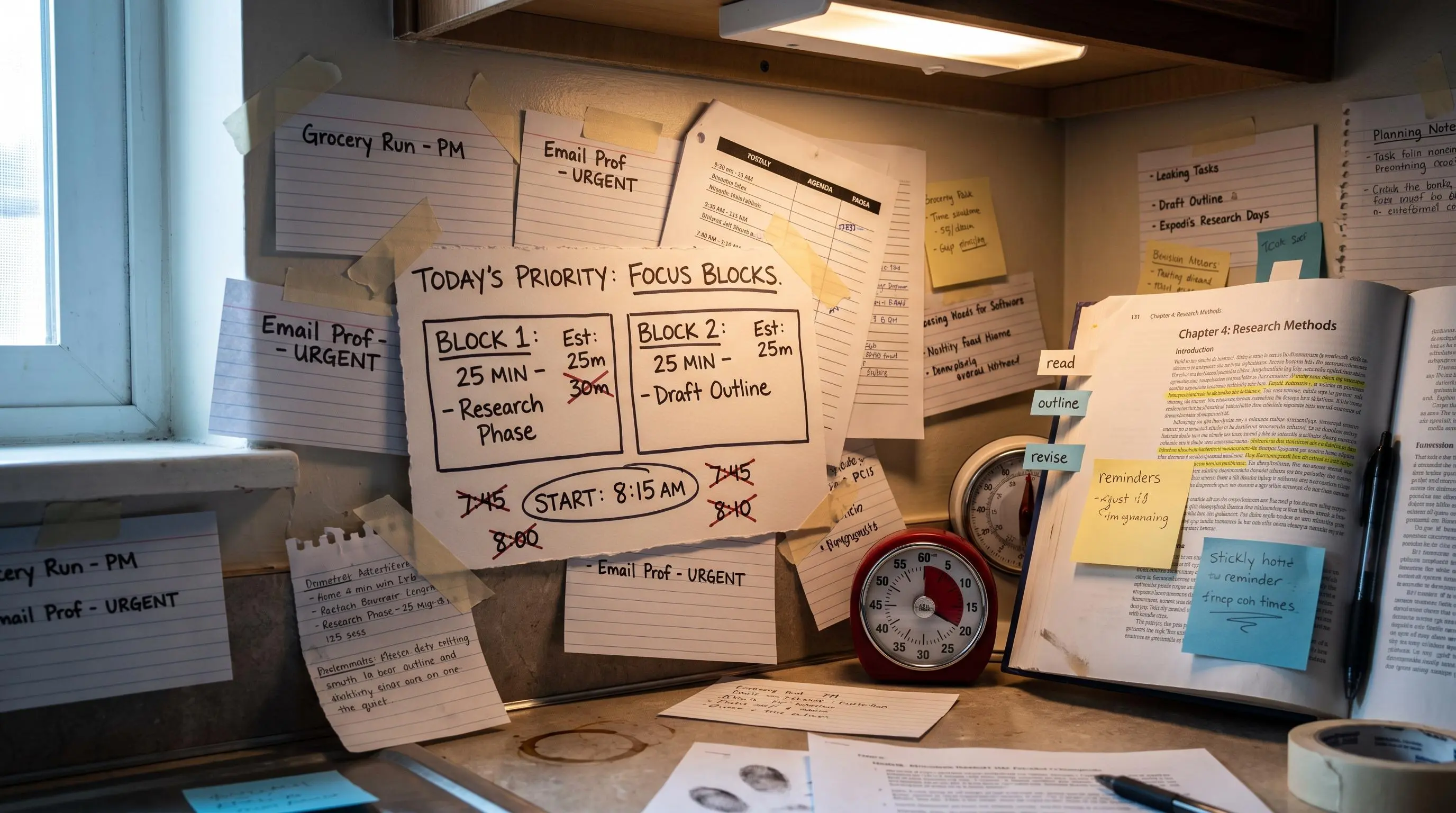
This is where many good intentions die. People choose a worthy priority, feel briefly virtuous, then never turn it into something startable.
A real plan answers four questions:
- what exact outcome are you trying to finish today
- how many focused blocks will it take
- how long do you think that is
- where and when will you begin
Timed focus blocks help because they reduce friction. A 25 minute session is small enough to start and long enough to matter. You don't need to finish the whole project in one push. You need to begin in a defined way.
Examples help here:
MIT: prepare for a client meeting
Plan: 2 focus blocks for agenda, notes, and deck revisionsMIT: study chapter 4
Plan: 3 focus blocks for review, problem solving, and summary notes
The plan should be concrete enough that starting requires almost no new decision making. If you still need to ask "wait, what exactly am I doing?" at the start of the block, the MIT is not ready.
How the Most Important Task Method Works With Pomodoro and Time Blocking
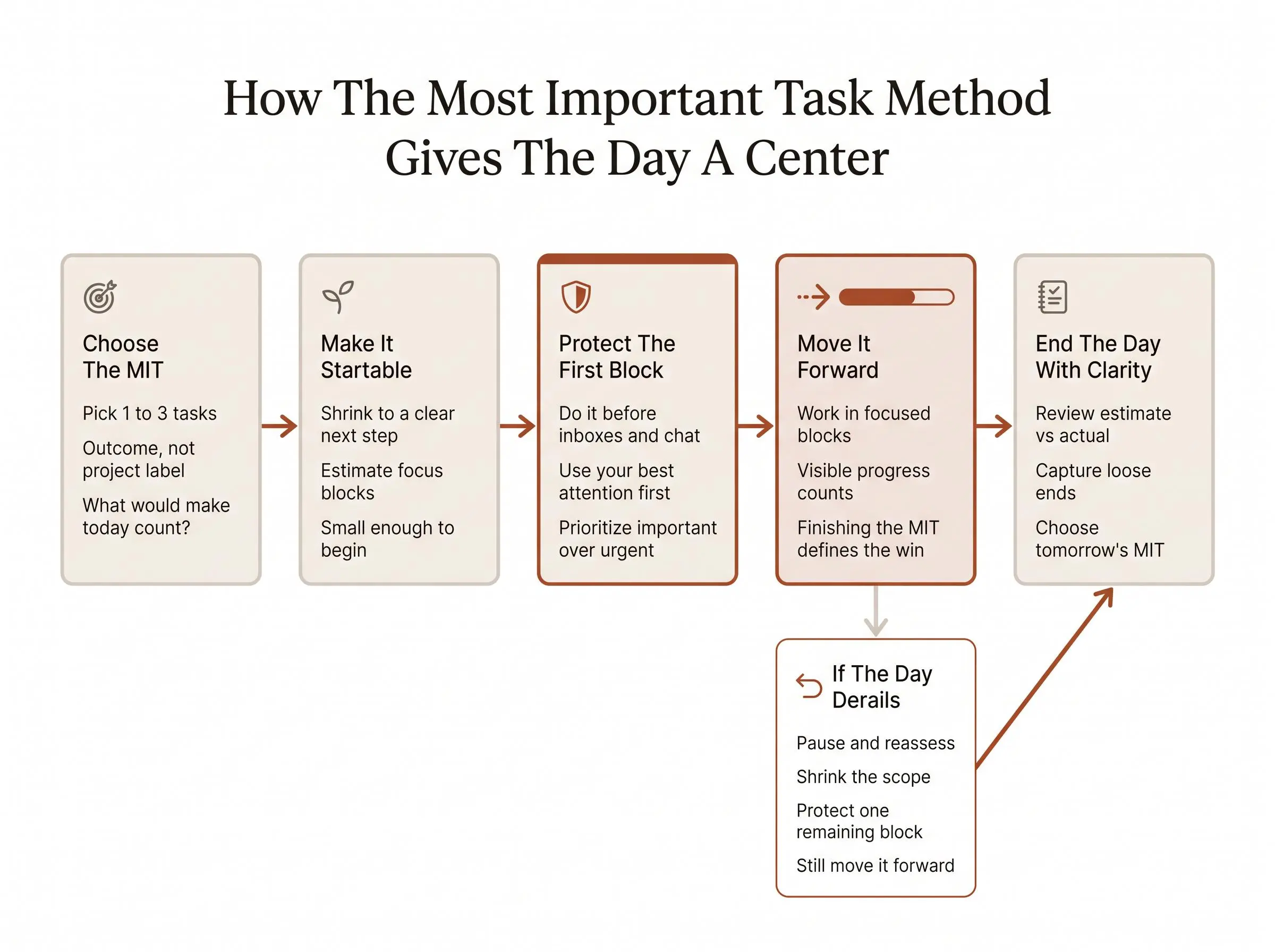
The most important task method answers what to work on. A timer or time block answers when and for how long. You usually need both.
A timer alone often falls short because it can measure committed time without checking whether that time went to the right thing. That's how people end up proudly logging sessions on tasks that didn't matter much.
Pairing MIT selection with focus blocks gives you direction and structure at the same time. The task is chosen. The work window is protected. Now the day has a shape.
Artificial deadlines can help too. Many people do better when the goal is to finish the MIT by late morning rather than "sometime today," which often translates to 4:40 p.m. panic.
This is also the approach we built into Flocus. Our Daily Planner is designed around choosing one most important task and keeping the list short on purpose. Then the Focus Timer starts directly from that planned task, so your work block isn't floating around disconnected from the day. The estimate versus actual time comparison matters more than it sounds. It tells you whether the problem was planning, task size, or interruptions. That's useful. Logged minutes by themselves are often a little flattering.
A Simple Daily Workflow You Can Repeat Without Burning Out
The best workflow is the one you'll still use on a tired Wednesday.
Here's a simple version:
Use it through the day
- Pick the MIT
Choose the MIT.
- Set next action
Define the next concrete step.
- Estimate blocks
Estimate the number of focus blocks.
- Start before distractions
Do the first block before email or meetings if possible.
- Pause briefly
Take short breaks between blocks.
- Reassess progress
Reassess only after a meaningful chunk is done.
- Mark the day successful
Count the day as successful once the MIT is complete.
That sequence builds trust because it doesn't depend on mood. Some days the MIT will be done in one block. Other days it will take most of the morning. Fine. The method isn't asking for drama. Just return to the task until the important part of the day has actually happened.
Visible completion helps more than people expect. A finished block. A checked task. A closed progress ring. Tangible progress makes the habit stick because your brain can see the day wasn't imaginary.
Common Mistakes That Make the Method Fail
Most failures are mechanical, not mysterious. A few come up constantly.
- The task is too large or vague. Fix it by shrinking scope until the first block is obvious.
- Urgent admin becomes the MIT every day. Keep at least one MIT tied to a larger goal.
- Everything is labeled important. Cap the list at one to three. Less if you're overloaded.
- You start with inboxes or meetings. Protect one early block before the day gets chopped up.
- You choose a category, not a task. "Work on thesis" is fog. Choose a visible chunk.
- You don't estimate time. Add a rough block count. Planning without time is basically wishful thinking.
- One bad day ends the method. Return the next morning. Consistency is mostly recovery speed.
- The MIT turns into a guilt weapon. Use it as a focus anchor, not proof that you're failing.
A hard truth here: the method breaks when it becomes a performance. It works when it becomes a routine.
How the Method Compares With Similar Productivity Approaches
A few related methods overlap, but they solve different problems.
The daily highlight method is close. Both ask you to define the day around one meaningful outcome. The difference is tone. MIT language feels more priority based. Daily highlight feels a bit more reflective. If you respond better to calm framing, you may prefer that language. The behavior is largely the same.
Classic Pomodoro helps you sustain effort in short intervals. Good tool. But it doesn't choose the target for you. The most important task method makes sure those intervals land on the right work.
Time blocking works at the calendar level. It reserves attention in advance. MIT selection decides what deserves the best block first. Without that step, time blocking can become a neat schedule for doing low value tasks on time.
Larger task systems can be useful, especially when work is complex and collaborative. They can also create overhead for people who mostly need a clear daily starting point. If your main problem is overwhelm and drift, single priority planning is usually the cleaner fix.
What to Do if Your Day Gets Derailed
Real life does not ask permission.
A meeting runs long. A child gets sick. A manager drops something urgent on your desk at 9:12. The answer is not to abandon the method the first time the day becomes inconvenient.
Use a reset protocol instead:
- pause and name what changed
- decide whether the original MIT is still the highest value task
- shrink the scope if needed
- protect one remaining focus block for the best available version of the task
Some days completion won't happen. Meaningful progress may be the honest win, especially when the interruption is real and nonnegotiable. That's still better than letting the day dissolve completely.
The skill here is returning on purpose. Not performing perfectly.
How to Measure Whether the Method Is Actually Helping
You don't need a grand theory. Look for a few signals over a couple of weeks.
- priority work gets done before reactive work more often
- daily tasks line up better with weekly goals
- time estimates get less wrong
- you stop ending the day wondering where your attention went
A short daily review is enough:
- Did I finish the MIT?
- If not, what blocked it?
- Was the scope realistic?
- What time of day gave me the best focus?
Estimated versus actual time is especially useful. It tells you whether the problem is poor planning, interruptions, or tasks that were bigger than they looked. Memory is bad at this. The data is usually less polite.
In Flocus, the daily planner and review features make these patterns visible over weeks instead of leaving you to guess. And for readers who already own a compatible Muse headband, Flow Tracking adds another layer by showing focus quality during sessions, not just logged minutes. That's not required for the method. It's just a more measured way to notice when your best work actually happens.
Who Benefits Most From This Method
This approach works especially well for people whose important work is easy to postpone.
That includes:
- students doing self directed study
- knowledge workers buried in chat, meetings, and small requests
- creative workers who need a gentle structure to start
- people who dislike heavyweight productivity systems
- anyone trying to recover from all or nothing work habits
Some roles need adaptation. Highly reactive support work may only allow a smaller protected MIT block instead of a full morning. Teams with dense meeting schedules may need to choose the MIT the night before and defend a shorter early window.
Still, the principle holds. Even in messy jobs, one protected block can change the day more than another hour of reactive tidying.
Conclusion
The most important task method works because it turns focus into a repeatable practice. Choose what matters. Protect time for it. Let visible progress count for something.
That shift is bigger than it looks. Busy becomes deliberate. Scattered effort becomes one clear aim. Self blame gets replaced by simple evidence.
Tomorrow, choose one meaningful task before the day starts. Give it the first protected work block you can. Then notice how different the day feels when it has a center.
Article Record
ReferencesPrimary sources used for this article
- Purpose Your Day: Most Important Task (MIT)
- Does time management work? A meta-analysis
- A field experiment on the effects of weekly planning behaviour on work engagement, unfinished tasks, rumination, and cognitive flexibility
- The Illusion of Urgency
- Boosting productivity and wellbeing through time management: evidence-based strategies for higher education and workforce development
- Most Important Tasks (MITs) - The Personal MBA
- Master the MIT Method: Identify Your Most Important Tasks