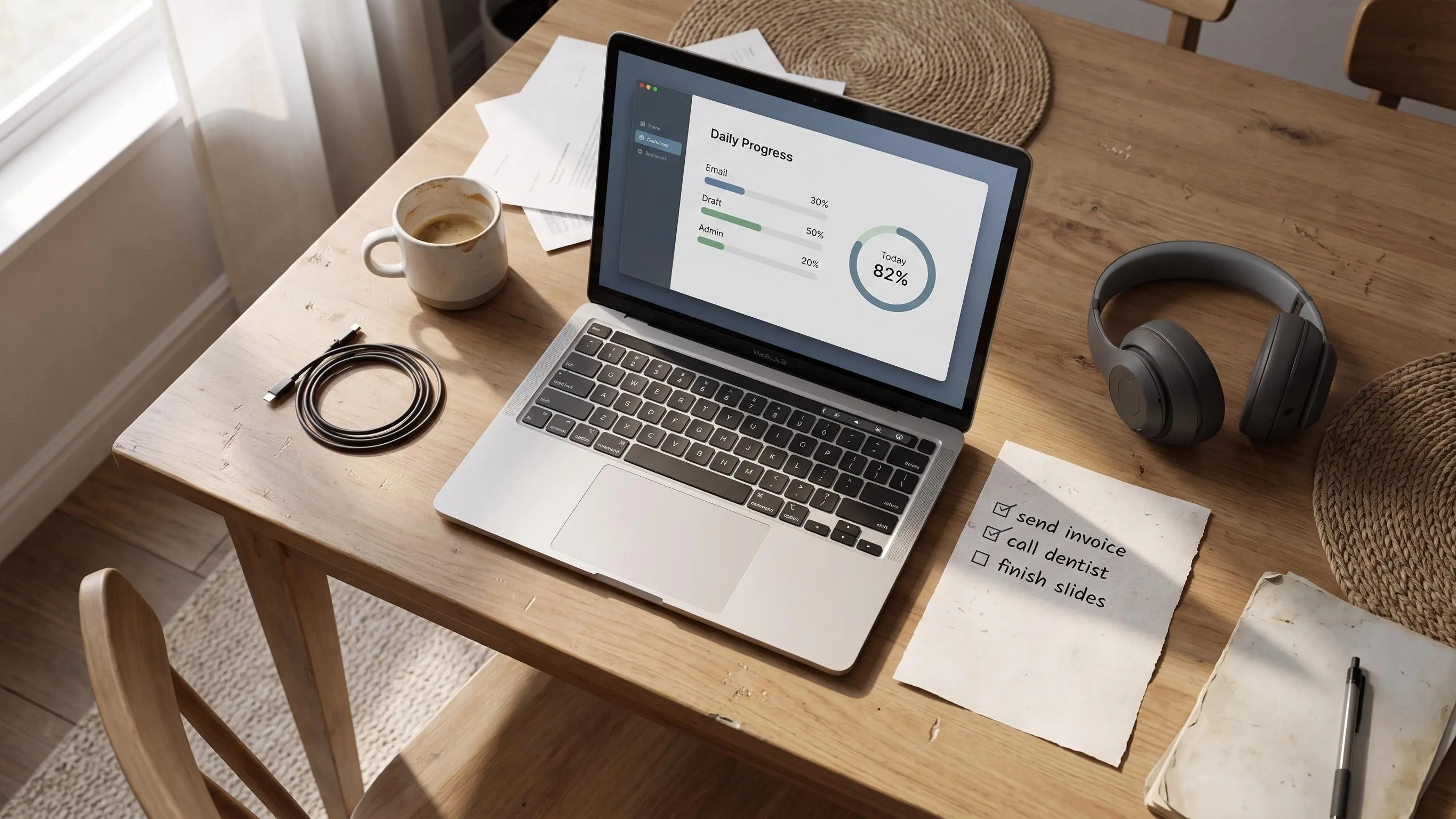
Most people don't need a longer workday. They need a cleaner finish. Daily reflection for work matters when the day felt full, your tabs are still open, and you still can't tell whether the real task moved.
What helps is plain: review what actually got done, name what pulled you off track, and leave one clear starting point for tomorrow. That closes the loop instead of dragging work into the evening.
A few things to check before you log off:
- Did the main task actually move, or did messages eat the day?
- What got finished that your brain is quietly refusing to count?
- What is the first concrete step for tomorrow?
What Daily Reflection for Work Actually Is
Daily reflection for work is a short end-of-day review. Not a diary entry. Not a vague journal dump. And definitely not a little tribunal where you prosecute yourself for answering Slack at 2:17.
A useful daily reflection for work does four things:
- reviews what you actually did
- checks what mattered most
- pulls out one lesson
- sets up the next move
That’s it.
For students and knowledge workers, this matters because a lot of work is invisible while you’re doing it. You can spend eight hours moving between docs, tabs, messages, and meetings, then hit 5 p.m. with the strange feeling that you were busy but not sure you moved the right thing. A good reflection closes that gap.
The goal isn’t to replay the whole day. It’s to create closure and a clean handoff into tomorrow. That means you review completed tasks, not just what was on the plan, and then extract one or two useful next actions or lessons.
Productivity works better as a feedback loop than as a feeling.
That’s the shift. A daily progress review turns “I think today went okay?” into something you can actually see and use.
Why an End of Day Review Works Better Than Just Working Longer
Working longer feels responsible. It often isn’t. Past a certain point, you’re mostly adding tired minutes and calling it discipline.
There’s a reason reflection keeps showing up in research. In one workplace training study, workers who spent 15 minutes reflecting performed about 23 percent better than peers who used that time for more practice. That’s not because reflection is magical. It’s because practice without feedback turns sloppy faster than people admit.
Progress monitoring also reliably helps people reach goals across many domains. That supports the basic case for an end of day productivity review. Memory is patchy. Mood is worse. If you rely on either, you’ll misread the day.
A short review also supports engagement, not just output. When you notice progress, effort, and real wins, work feels less like a blur of demands. Structured positive reflection on daily work achievements has also been shown to improve work engagement in app-based interventions.
A 2025 randomized trial of 600 Japanese workers puts useful numbers on that claim. Participants used a smartphone diary for two weeks: they set a weekly goal and recorded work achievements at the end of each day. Compared with a wait-list group, the diary produced a small improvement in work engagement immediately after the intervention and at a three-week follow-up. The standardized effects were d = 0.11 and d = 0.12, respectively.
That size matters for interpretation: this was a measurable but modest change in engagement, not evidence that a diary alone will transform task output or a workday.
Standardized difference in work engagement between the reflection-diary and wait-list groups in a 600-worker randomized trial, measured immediately after the intervention and three weeks later.
Source: Tokita et al., 2025
- The trial measured work engagement, not task completion, output, or long-term job performance.
- Participants were Japanese workers recruited through a web survey company; results may not generalize to all occupations or countries.
- Follow-up was three weeks after the two-week intervention, so longer-term effects remain unknown.
View chart data
| Measurement time | Effect size |
|---|---|
| Immediately post-intervention | 0.11 |
| Three-week follow-up | 0.12 |
A healthy review sounds more like this:
- finished the draft section
- underestimated admin by 30 minutes
- focus was best before messages
- tomorrow starts with revision
Not this:
- failed to stay consistent
- should have tried harder
- need to be more disciplined
One gives you information. The other gives you a headache.
For our audience, the practical payoff is simple: fewer forgotten commitments, less open-loop stress, and a clearer sense of whether your attention went where it was supposed to. Plain timers can count minutes. They can’t tell you whether those minutes served the day.
The result is encouraging, but it is not a promise that a diary will transform a workday. The effects were small, and the study tracked engagement rather than task output. Still, it supports a practical point: a short, repeatable end-of-day record of what went well can produce a measurable—if modest—benefit without asking people to work longer.
The Real Problem Most People Have at 5 P.M.

By the end of the day, the problem usually isn’t lack of effort. It’s lack of closure.
You know the feeling. Mentally noisy. Oddly unfinished. You did a lot, but you can’t quite point to the shape of it. That’s common in knowledge work because progress is fragmented. A task gets split across messages, edits, meetings, reminders, and “quick” requests that are never quick.
The most important task is especially vulnerable. It doesn’t usually lose to laziness. It loses to urgency, inboxes, and work that arrives with other people’s timestamps on it.
Without a review, work follows you into the evening because nothing feels closed. You keep carrying half-decisions in your head:
- Did that task actually move?
- What was I supposed to pick up tomorrow?
- Did I forget to send something?
- Why am I tired if I can’t name what got done?
This is where people often object that reflection sounds like more admin. Fair concern. If the process takes 25 minutes and requires color coding, then yes, you’ve built yourself a small office job after your office job.
A proper review is lighter than that. It reduces friction because it stops the day from leaking into the next one. The question isn’t how to optimize everything. It’s how to review your workday in a way that creates clarity instead of more overthinking.
What to Review Before You Log Off
A good review covers a few specific things. Not everything. Enough to see the day honestly.
Here’s the core of an effective end-of-day check:
- Completed tasks: Look at what actually got finished, not just what was planned.
- Main priority: Was the most important task completed, advanced, delayed, or quietly avoided?
- Planned vs. actual work: Compare what you meant to do with what really happened.
- Attention quality: When was focus strong, and where did it break down?
- Open loops: Capture unfinished items that will create evening stress if they stay vague.
- One lesson: Note what made focus easier or harder.
- Tomorrow’s starting point: Define one concrete first step.
That balance matters. A daily progress review that only counts output misses the actual story. You want tasks, attention, and energy in the same frame.
One operator rule we trust: if tomorrow’s first step is still fuzzy when you close the laptop, the day isn’t really closed.
A Simple 10-Minute Workday Shutdown Ritual
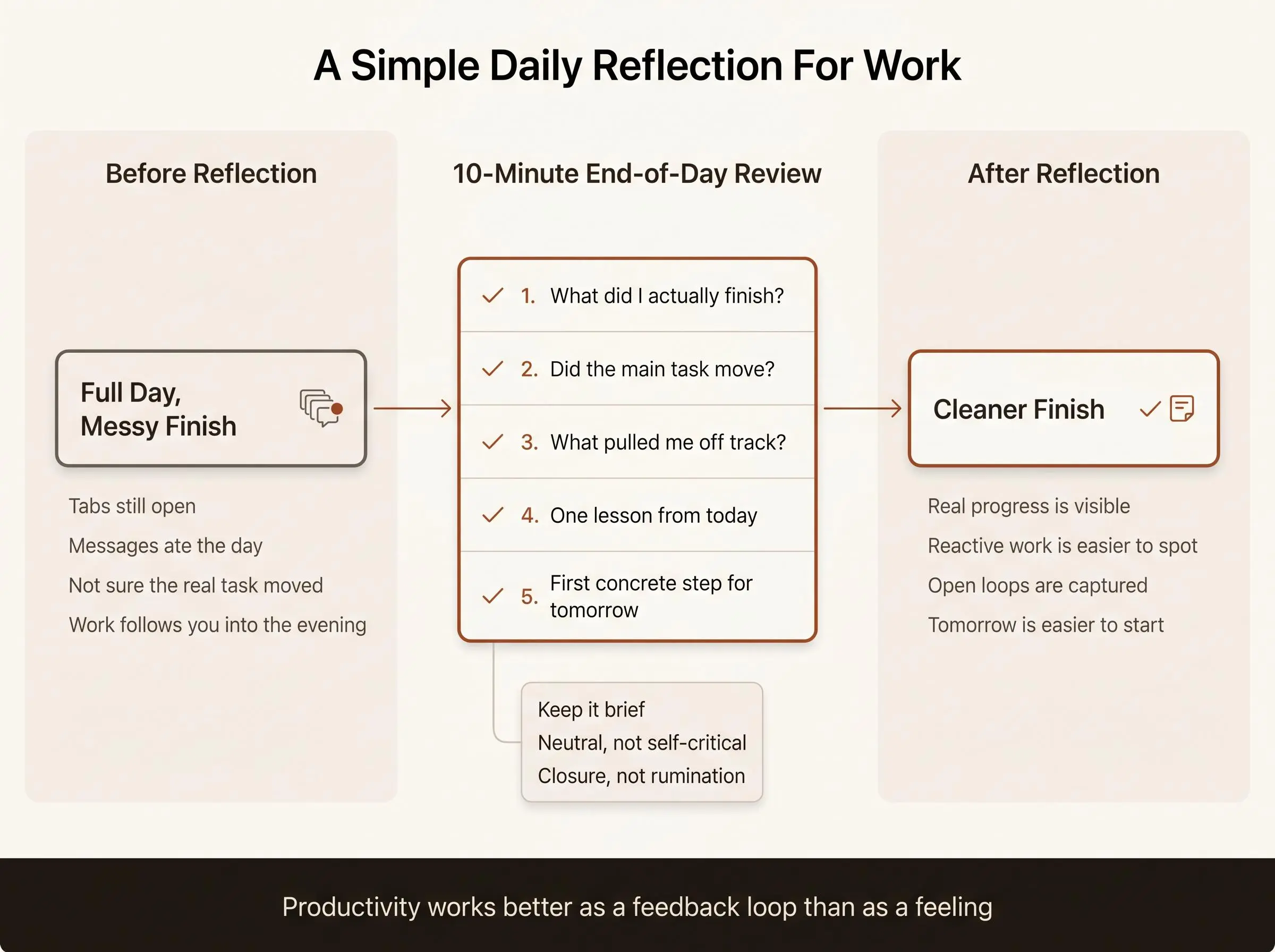
Your workday shutdown ritual should be short enough to keep doing on a random Wednesday when your brain is already half gone. Ten minutes is plenty.
Try this sequence:
Stop adding new work.
No fresh tabs. No “one last quick thing.” Gather the day in one place.Review completed tasks.
Mark what is fully done versus partly done. Partial counts, but don’t round up emotionally.Check the main priority.
Did today’s most important task move in a meaningful way? Not theoretically. Actually.Name what pulled the day off course.
Interruptions, weak estimates, task switching, vague planning, reactive messages. Be specific.Capture one win, one lesson, one carry-forward action.
Keep it plain. “Started deep work before inbox” is better than “had a productive morning.”Set tomorrow’s first meaningful step.
Not the whole plan. Just the next move that gets you started without negotiation.Signal that work is over.
Close tabs. Clear the desk. Shut down work apps. Write one final line if that helps.
The ritual should feel like a landing, not a second shift.
If you dread doing it, it’s too elaborate.
How to Review Your Workday Without Turning It Into Rumination
Reflection helps. Rumination just replays the damage in higher definition.
The difference is pretty simple. Productive reflection creates distance, interpretation, and a next step. Rumination loops around mistakes and treats the day as a verdict on you.
Use plain, neutral observations:
- missed estimate
- started late
- context switching after lunch
- inbox opened too early
Avoid personality labels dressed up as insight:
- bad at focus
- lazy today
- no discipline
- always behind
Focus on patterns, not personality. Most bad workdays are not identity statements. They’re a mix of timing, friction, unclear planning, and attention getting pulled around by whatever beeped last.
A few prompts keep the review grounded:
- What happened?
- Why did it likely happen?
- What should change tomorrow?
Structured reflection usually works better than a blank page because it points your attention somewhere useful. Open-ended journaling has its place, but if you already tend to overthink, a blank page can become a very efficient machine for making yourself feel worse.
Guardrails help:
- keep it brief
- skip self-punishment
- end with a concrete next step
That last part matters more than people think. Closure is often just specificity.
The Five Questions That Make a Daily Reflection Useful
If you use different prompts every day, the habit gets harder and the signal gets weaker. Keep the questions stable for a couple of weeks. Patterns show up faster when the frame stays still.
Use these five:
- What did I actually finish today?
- Did I protect the most important task or let reactive work take over?
- When did focus feel easiest, and what conditions helped?
- Where did momentum break, and what likely caused it?
- What is the clearest next step for tomorrow?
That’s enough for most days.
When the day felt emotionally heavy, add one or two optional prompts:
- What felt harder than expected?
- What helped me recover?
- What deserves a lighter plan tomorrow?
Semi-structured prompts beat a blank page for a reason. They reduce friction, but they also make your notes comparable across days. By the second week, you’ll usually start noticing the same trouble spots. Late starts. Messages before deep work. Too many tiny tasks dressed up as progress.
Useful, if mildly annoying.
What a Good Daily Progress Review Looks Like in Practice
Let’s make this concrete.
A knowledge worker plans to finish a client presentation. The day starts well. Two focused blocks go into the main deck before messages open. Then an admin detour appears, stretches longer than expected, and one follow-up task has to be carried forward.
The review might look like this:
- completed two meaningful blocks on presentation
- finished admin task, though it took longer than planned
- did not complete follow-up email
- main priority was meaningfully advanced
- focus was strongest before chat and inbox
- afternoon drift followed fragmented communication
- tomorrow starts with final slide edits before messages
Nothing dramatic there. But that’s the point. The review shows progress that may not have felt satisfying in the moment. You didn’t “finish everything.” You still moved the right work.
Now the rougher version.
A student planned to study a chapter and draft notes. Instead, the day got chopped up. One short study block happened, then errands, messages, and low-grade distraction took over. By evening, it feels like a write-off.
A useful review still doesn’t need self-criticism:
- completed one study block and rough notes on first section
- main task was touched, but not protected
- started late and switched contexts too often
- studying was easier before checking phone
- tomorrow begins with 25 minutes on chapter summary before anything else
Bad day, decent lesson.
That’s the real function of reviewing work. Not to prove you were impressive. To turn even messy days into information.
Use Light Metrics to Make Reflection More Honest
By the end of a long day, memory becomes strangely theatrical. You either feel like you did nothing, or you convince yourself that being overwhelmed was the same as making progress.
Light metrics help.
A few are enough:
- planned time versus actual time
- number of focus blocks completed
- whether the main priority was touched early or late
- visible task completion
Estimated versus actual time is especially useful because it exposes planning optimism. Most of us are worse at estimating than we think. That matters because bad estimates create fake pressure, scope creep, and the kind of plans that look noble in the morning and ridiculous by 3 p.m.
Visible completion markers help too. A streak, a progress ring, a simple done list. Not as a scoreboard. As evidence.
In Flocus, we pair one most-important-task plan with timed focus blocks and a visible daily completion ring. Each block logs estimated versus actual time, which keeps planning honest. That changes the review. You’re not guessing how the day went. You’ve got a clean record of what got attention and for how long.
For neurotech-curious readers, there’s also an optional deeper layer. If you use a Muse headband with Flocus, you can review flow-state patterns alongside tasks. That gives you another angle on the day: not just time spent, but when focus seemed measured rather than assumed.
Still, the principle stays the same. Honest feedback, not self-surveillance.
The Best Time to Reflect and How Long It Should Take
The best time for daily reflection for work is at the natural end of your workday, before evening life starts swallowing the boundary.
Do it while the details are still fresh. Wait too long and the day turns into a vague mood report.
For most people, 5 to 15 minutes is enough. Shorter is often better at first because consistency matters more than depth. A four-minute review you actually do beats a beautiful 20-minute ritual you abandon by Thursday.
If your schedule is irregular, use the end of the working stretch, not a fixed clock time. That could be:
- after your final study block
- after your last client task
- before commuting home
- before shifting from paid work to family time
The point isn’t perfect timing. It’s a reliable boundary. Reflection works best when it marks work as complete.
Common Mistakes That Make Daily Reflection Feel Pointless
When people say reflection doesn’t work, the problem is usually the setup.
Watch for these mistakes:
- waiting for a perfect uninterrupted routine instead of doing a short version
- turning the review into a list of failures
- reviewing only what went wrong and ignoring completed tasks
- writing vague takeaways like “do better tomorrow”
- tracking too many things at once
- rewarding task volume over movement on the most important task
- using a blank journal when you already know you overthink
- treating the ritual like another performance test
The big one is this: confusing motion with progress. A full day can still be a misdirected day.
And if the review leaves you feeling judged rather than clearer, something has drifted. The practice is supposed to build self-trust. Not become another place where work grades you after hours.
How to Build the Habit So It Sticks
Start smaller than your ambitions suggest. Under five minutes for the first week is fine.
Attach the review to something that already happens:
- shutting down work apps
- ending the final focus block
- packing your bag
- clearing your desk
Keep the format stable. Same prompts. Same order. Same place. The less you have to invent each day, the more likely you are to keep going when you’re tired.
A visible checklist helps more than willpower does. Quiet systems usually beat dramatic intentions.
After several days, do a brief weekly pattern review. Not a life audit. Just notice what keeps repeating. App-based reflection methods that pair a weekly goal with end-of-day achievements have shown promising effects on work engagement, which makes sense. Daily notes become more useful when they connect to a simple weekly direction.
If you dislike heavy productivity systems, keep the structure light. In Flocus, the day already has a main priority, tracked focus blocks, and a natural place to close the loop, which makes the habit easier to maintain without turning it into a project.
When a Tool Helps and What to Look For
A notebook can work. A notes app can work. A planner can work. The right tool is the one that lowers friction instead of adding ceremony.
Look for a few things:
- one clear daily priority
- easy task completion tracking
- a place to log focused work
- a simple reflection field
- some way to see daily progress without digging
This is where timer-only apps often fall short. They count sessions, but they don’t tell you whether those sessions served the right plan. Minutes are not meaning.
If you’re choosing a tool, ask:
- Do I want minimal friction?
- Do I need visible daily progress?
- Do I want planning and focus in one place?
- Do I want optional deeper feedback on attention?
Flocus is useful for readers who want the planning layer as well as the timer. You can set one most-important task, run focus blocks, compare estimated versus actual time, keep reflections, and review weekly insights. If you own a Muse headband, there’s also optional flow-state tracking. None of that is required. The point is fit, not feature collecting.
Conclusion
Daily reflection for work isn’t about squeezing more out of the day. It’s about ending with clarity, noticing what actually moved, and making tomorrow easier to start.
The method is simple: review completed tasks, check the most important task, notice what shaped your focus, extract one lesson, and set one next step. That’s enough to turn a noisy ending into a clean one.
Try a simple workday shutdown ritual for one week before you change anything else about your system. Don’t optimize it yet. Just do it.
And if you want a little more structure, use a planner that connects priorities, focus blocks, and reflection so the day is easier to review honestly. That part matters. You can’t reflect clearly on a day that was never made visible in the first place.
Article Record
ReferencesPrimary sources used for this article
- Effects of a Smartphone-Based Positive Reflection Diary on Work Engagement Among Japanese Workers: Randomized Controlled Trial
- JMIR mHealth and uHealth - Effects of a Smartphone-Based Positive Reflection Diary on Work Engagement Among Japanese Workers: Randomized Controlled Trial
- A daily positive work reflection intervention for psychological distress among Chinese nurses: a pilot randomized controlled trial
- Building Positive Resources: Effects of Positive Events and Positive Reflection on Work Stress and Health
- The Search for Meaning at Work: A Randomized Controlled Trial of a Cognitive Crafting Intervention | International Journal of Applied Positive Psychology | Springer Nature Link
Update HistoryMeaningful revisions to this article
- Added a chart to show how daily work reflections and weekly goals improved work engagement in a study of 600 Japanese workers.
- Made the research findings easier to understand in the section on reviewing the workday.
- Added a chart to show the small but statistically significant engagement benefit found in a large two-week worker study of daily positive-reflection diaries.
- Clarified why a brief end-of-day reflection can support engagement more effectively than simply working longer.