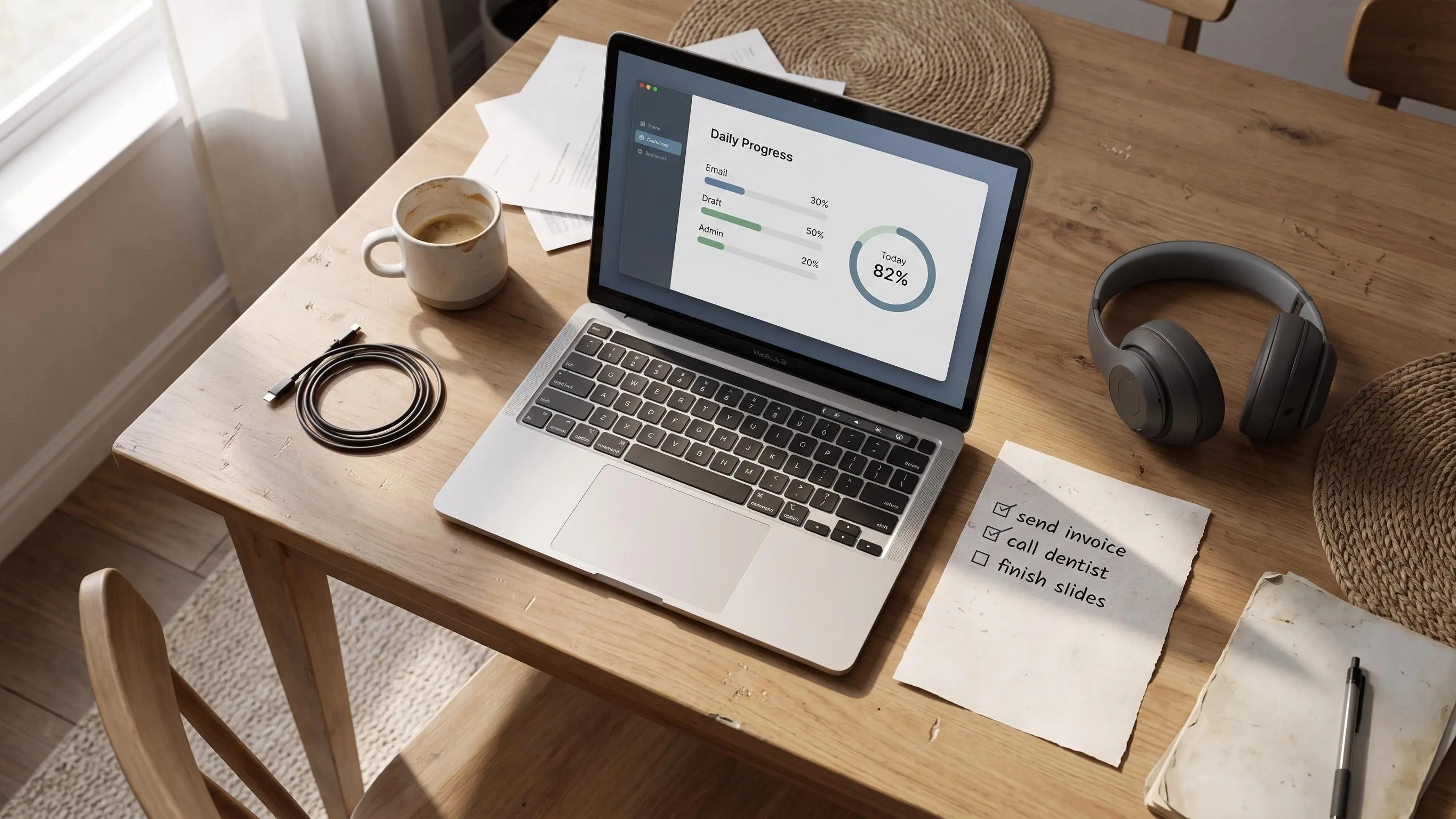

Planning fallacy examples look almost silly on paper, but they're usually why your day blows up by lunch. You block an hour, then forget setup, replies, rewrites, and the odd little tasks that pile on.
What matters is simple: the plan has to match real work, not the tidy version in your head. Most missed days aren't a discipline problem.
They're a planning problem you can fix.
What the Planning Fallacy Actually Is and Why It Feels So Personal
The planning fallacy is simple and annoying: we underestimate how long our own future tasks will take, even when similar work took longer before. Smart people do this constantly. Motivation doesn't protect you.
The usual mistake is the inside view. You picture how the task should go if things stay clean and orderly. The outside view asks a less flattering question: how long do tasks like this usually take in real life?
Research shows the bias gets stronger when the task is yours. Outside observers often give longer estimates, and they're often closer. The classic thesis example makes the point well. Students predicted they would finish in about 33.9 days on average. They actually took about 55.5. Even their poor-outcome estimate was 48.6 days, still too short.
It gets worse when people assign probabilities. Only 13% finished by the date they said was 50% likely. Only 19% made their 75% date. Even at a supposed 99% confidence date, just 45% finished on time.
That stings because a late day feels moral. You tell yourself you were distracted or undisciplined. Often the real issue started much earlier. The plan assumed ideal conditions.
A bad estimate can look like a character flaw if you only see the missed deadline.
The examples below help you spot where time disappears so you can estimate work duration better without turning into a robot about it.
1. The Two-Minute Email That Becomes an Hour
Everyone knows this one. You open your inbox to send one quick note, then the chain reaction starts.
The estimate covers the visible action, not the mess attached to it. You reread old threads. Hunt for the right file. Rewrite a sentence because one recipient needs warmth and another needs precision. Then someone replies right away and your clean little task becomes live admin triage.
For students, managers, freelancers, and anyone working through other people, email is rarely one isolated unit. It behaves like a session.
A more honest approach:
- batch email into a defined block
- estimate the whole session, not the first reply
- expect recovery time before you return to focused work
If email touches coordination, it isn't two minutes. It's a window in your day.
2. The Reading Assignment That Ignores Note-Taking and Re-Reading
A chapter or report looks short, so it gets dropped into a 30-minute slot. Then the slot disappears.
Reading time is easy to underestimate because people count word intake, not comprehension. Dense material slows you down. So do unfamiliar terms, highlighting, margin notes, and the small pauses where you realize you don't actually understand the paragraph you just read.
There's also a difference between finishing pages and learning from them. Students feel this most sharply, but knowledge workers do it too with reports, briefs, and research papers.
Try estimating in layers instead of one flat block:
- skim
- read for understanding
- annotate
- summarize
That's how you improve time estimates for reading. Not by pretending your brain is a scanner.
3. The Writing Task Planned Around a Perfect First Draft
Writing invites optimism because the output looks compact on the calendar. "Draft memo, 1 hour." That line has ruined a lot of afternoons.
The estimate usually assumes fluent writing. Real writing includes false starts, restructuring, dead sentences, fact-checking, and deleting half the thing because the point changed midway through. Ambiguity stretches time. Mechanical tasks don't wobble like that. Writing does.
Even worst-case estimates stay oddly cheerful when you're attached to the plan. You've already decided it should fit.
If you want to improve task timing accuracy, split writing into separate blocks:
- idea generation
- drafting
- revision
Experienced operators do this almost by instinct. Thinking on the page is work. Editing the thinking is different work.
4. The Focus Block That Starts Without Setup Time
A 25-minute or 50-minute focus block looks clean in a planner. Real life usually burns the first 10 to 15 minutes getting ready to begin.
Setup hides everywhere: finding the right document, reopening tabs, locating notes, clearing a desk, deciding where to start, and getting past the quiet resistance to hard work. A plain timer doesn't solve that. The timer may start on schedule while your actual deep work starts later.
Realistic time blocking includes the ramp-up. It doesn't pretend output begins at minute one.
A simple fix is to build a pre-block ritual:
- open the file
- write the first action
- clear one distraction
- start the block
That ritual should be estimated too, especially for cognitively heavy work. Starting clean is part of the task.
5. The Calendar Packed With Back-to-Back Meetings or Classes

A packed calendar looks efficient right up until the day begins.
Meetings and classes don't live inside their time boxes. They create prep, note capture, travel, bathroom breaks, and mental reset costs. A schedule with edge-to-edge commitments assumes perfect timing and infinite attention. Neither tends to show up by Tuesday afternoon.
This is one of the clearest planning fallacy examples because outsiders can usually spot the problem in seconds. The person building the calendar sees only the visible blocks. Everyone else sees the collisions.
Leave room for transitions. Treat them as real work.
If your day has no whitespace, your plan is already late.
Buffers feel unproductive when you're planning. They feel civilized when you're living the day.
6. The Group Project Scheduled as if Everyone Replies Immediately
Group work runs on waiting more than most people admit.
A class project, launch plan, shared deck, or collaborative report depends on coordination, clarification, and rework. You may estimate your own contribution well enough, but the timeline is still governed by unanswered messages, conflicting schedules, fuzzy ownership, and version confusion.
Individual productivity is not the same as collaborative throughput. Groups move slower and less cleanly.
When estimating group work, include:
- waiting time
- one extra review loop
- time to clarify who's doing what
- time to merge everyone's work into one final version
The hidden cost of collaboration isn't effort. It's dependency.
7. The Simple Admin Task That Hides a Decision Tree
Admin work looks trivial on a to-do list. Then it opens seven tabs and asks for a document you haven't seen in a year.
Forms, travel booking, expense submission, profile updates, course registration, all of them expand through branching decisions. A checkbox leads to a policy question. A login leads to password recovery. A submission leads to a missing attachment.
These tasks feel especially demoralizing because the headline sounds small. When they overrun, people blame themselves.
They're not simple execution tasks. They're decision-heavy tasks with fragmented attention.
If a task involves forms, systems, approvals, or logins, estimate for uncertainty. Not keystrokes.
8. The Errand Run Planned as One Item Instead of Seven Micro-Tasks
"Get groceries" sounds like one item. It is not one unit of time.
There's leaving, parking, finding items, waiting in line, grabbing the forgotten extra thing, driving back, unloading, and putting everything away. The mind compresses the sequence into one neat label, and the day pays for it later.
This matters more than it seems for students and remote workers because life admin competes with focused work in the same day. One underestimated errand can wipe out your best work window.
Estimate errands like a mini-project:
- start and travel
- task itself
- return
- reset
List language is often dishonest. Lived duration isn't.
9. The Home Reset or Desk Cleanup That Eats Your Work Window
Cleaning before work feels sensible. That's why it slips past your defenses.
You expect ten minutes. Then the desk reminds you about the kitchen, the kitchen points at the laundry, and suddenly your clean start has become the morning. Sometimes it's genuine setup. Sometimes it's procrastination dressed as responsibility. Usually it's a bit of both.
The planning fallacy shows up because the estimate assumes a stopping point that feels tidy. Real cleanup keeps offering one more satisfying improvement.
Set the boundary before you begin:
- one surface
- one load
- one timer
If you don't define "done" first, cleanup will borrow time from the harder task waiting behind it.
10. The Revision Cycle That Pretends Feedback Will Be Minor
A draft feels nearly done, so you assign a short final pass and move on. That confidence is often expensive.
Revision gets underestimated because people picture light edits. In practice, feedback may expose missing data, structural issues, unclear logic, or conflicting preferences. Approval-based work is especially vulnerable. One comment can reopen the entire piece.
There is also a risk problem here, not just a time problem. We overestimate how smooth the handoff will be.
Keep separate blocks for:
- review
- revision
- final polish
Calling a first draft "basically finished" is one of the oldest scheduling mistakes around.
11. The Day Built on Constant Context Switching
A fragmented day looks manageable on paper because each task is short. The brain experiences it differently.
Study, Slack, a document, a meeting, a call, an errand, then another study block. Every switch costs attention, memory, and momentum. You don't return at full speed. You return with residue.
This is where task timing accuracy falls apart. Even well-estimated tasks run long when they're surrounded by switches.
A calmer structure helps more than people expect:
- one most-important task
- a few supporting blocks
- shallow work grouped together
- interruptions kept out of deep work windows
A timer helps you start. It doesn't stop your day from becoming confetti.
12. The To-Do List That Treats Best-Case Energy as Normal
Some plans are not just too long. They're built for an idealized version of you.
The list assumes clear thinking, stable mood, easy motivation, and high focus all day. That's not realism. That's best-case energy pretending to be normal capacity. Then the guilt loop begins. You miss the plan and decide the problem is personal weakness.
This pattern also shows up when a daily list leaves no room for interruptions, rabbit holes, or unexpected problems. In an account of his own planning-fallacy experience, David Epstein describes repeatedly carrying unfinished tasks into the next day after building lists around a best-case scenario. His practical adjustment was to put one meaningful task at the top of the day's list and leave room for everything else.
Realistic time blocking includes energy forecasting. High-focus work belongs in the hours when you tend to have real cognitive strength. Lower-energy periods can carry admin, errands, or cleanup.
Choose one truly important task first. Let the rest compete for remaining capacity.
Equal priority is usually another name for hidden overload.
13. The Big Project Broken Into Unrealistically Small Daily Chunks
This one is tidy, hopeful, and often wrong.
A thesis, redesign, exam plan, report, or portfolio gets divided into neat daily slices. The math looks reassuring. The slices assume a steady pace, equal difficulty, no blocked days, no setbacks, and no revision spillover. Real projects don't behave that politely.
Large projects often overrun even when people have direct experience of similar delays. That's the part worth noticing. Experience alone doesn't fix the bias.
Clean daily quotas feel good because they remove uncertainty. They also spread the original bad estimate across every day that follows.
Use historical pace if you have it. Add non-completion days. Add contingency. Don't fill the project plan right to the edge and act surprised when life arrives.
How to Get Better at Estimating Task Time and Build Realistic Time Blocking
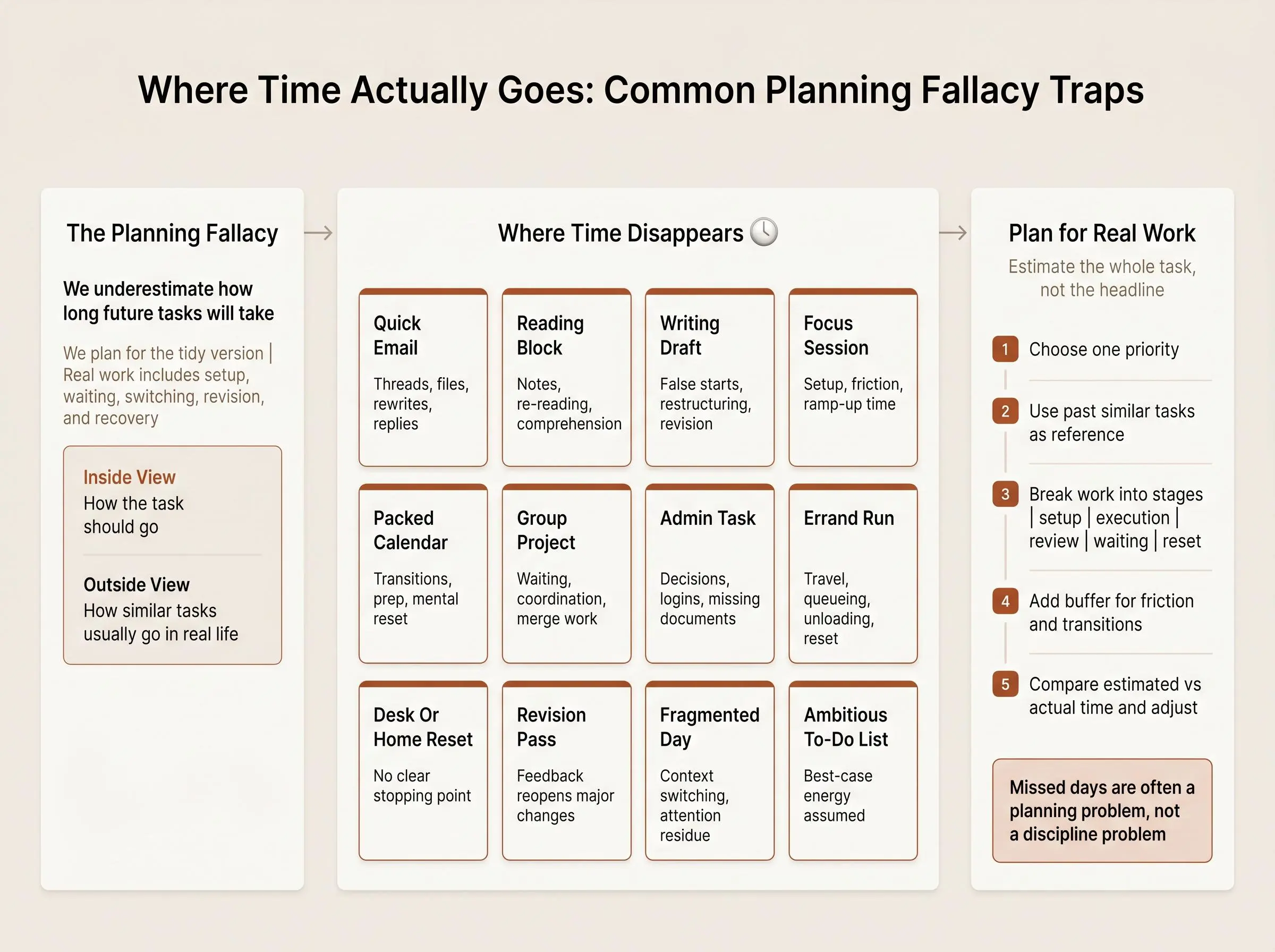
Awareness helps, but it doesn't solve much by itself. Plenty of people know about the planning fallacy and still build optimistic days. You need a method.
Start with reference-class thinking. Before estimating, ask how long similar tasks actually took you, or people like you, in ordinary conditions. Not ideal conditions. Ordinary ones.
Then track evidence. Compare estimated versus actual time. Impressions are flattering. Data is useful. This is one reason we built Flocus around planning, not just a timer. You choose one most-important task, work in timed focus blocks against that plan, and log estimated versus actual time. Over time, optimism has fewer places to hide.
Break work into stages:
- setup
- execution
- review
- waiting
- reset
For example, don't write "finish the report — 90 minutes." Write down:
- 10 minutes to find the source files and outline the sections
- 45 minutes to draft
- 20 minutes to check facts and revise
- 15 minutes for interruptions or a delayed response
If the task is collaborative, put the waiting time on the calendar instead of pretending it does not exist. If the work finishes early, the spare time is useful. If it does not, the estimate had somewhere for reality to go.
For uncertain tasks, use three estimates: ideal, likely, and friction-filled. Plan from likely or friction-filled, especially for collaborative or ambiguous work. That's how you estimate work duration better without becoming cynical.
If you're neurotech-curious and use a Muse headband with Flocus, flow-state tracking can add another useful signal. Not magic. Just more evidence about when your focus tends to be naturally stronger or weaker, which can improve time estimates beyond guesswork.
A simple framework is enough:
- choose the priority
- estimate honestly
- protect the focus block
- compare actual versus estimated time
- adjust tomorrow
A timer helps you start. A planner helps you choose the right amount of work for the time you actually have.
Conclusion
These planning fallacy examples aren't proof that you're lazy or bad at time management. They're evidence that human prediction leans toward ideal conditions, especially when the task belongs to us.
The practical fix is less dramatic than people expect. Estimate the whole task, not the headline. Use past results instead of optimism. Build realistic time blocking around one meaningful priority instead of trying to win the day through volume.
Tomorrow, pick one most-important task. Give it a more honest time estimate than feels comfortable. Then watch what changes when your plan starts matching reality.
Article Record
ReferencesPrimary sources used for this article
- Why You Should Plan To Get Less Done
- Planning fallacy - Wikipedia
- Planning Fallacy — Meaning, Examples & How to Overcome It (Bias Spotter Test Inside)
- Overcoming Planning Fallacy
- Planning Fallacy — LessWrong
- The Science of the Planning Fallacy: Why We Always Think Things Will Take Less Time — Plan With AI
Update HistoryMeaningful revisions to this article
- Added a practical example to show how to estimate task times and create more realistic time blocks.
- Added insights from David Epstein to explain why planning around best-case energy can lead to unrealistic to-do lists.
- Made the example more useful by connecting it to practical planning challenges readers may face.