

Most daily plans fail before lunch because the time math was wrong. Task duration estimation is the part people skip, then they blame focus when a quick task eats 47 minutes and knocks the rest of the day sideways.
What matters is sizing the work you can actually finish, not the work you'd like to finish. You need focused blocks, a clear done point, and a little slack for setup, switching, and cleanup.
Start here:
- Estimate the outcome, not the activity.
- Count research, revision, and admin edges before you count blocks.
- Compare estimated time with actual time so tomorrow fits in a real day.
Why Daily Plans Break Even When Motivation Is High
A lot of days fail before the first task starts. Not because you're unmotivated, but because the plan was built on polite fiction.
You write a short list in the morning. It looks reasonable. By mid-afternoon, one task has sprawled, two others haven't started, and the small admin bits have somehow multiplied in the corners. Then comes the familiar nonsense: scattered attention, tab-hopping, a creeping sense that you should be moving faster.
Usually, the real problem isn't discipline. It's estimation failure.
Plain timers don't fix that. They measure time after you've already committed. Useful, sure, but late. If the day is overloaded at 9:05, a timer won't save it at 2:40.
For most students and knowledge workers, bad estimates don't just create missed tasks. They create mood damage. You switch tasks because you're behind. You feel guilty because the list looked possible. The day feels stolen, even when you've worked hard.
Realistic daily planning is quieter than that. It's not about squeezing output from every minute. It's about protecting attention so the day has shape.
In this guide, we'll show a repeatable way to do task duration estimation, estimate pomodoros per task, and plan work sessions you can actually finish.
A good plan is not a wish list with timestamps.
What Task Duration Estimation Really Means in Daily Planning
Task duration estimation sounds more formal than it is. In practice, it means predicting how much focused working time a task will need before it's complete enough for today.
That last part matters. Not complete forever. Complete enough for today's goal.
The main distinction is simple:
- Calendar time is the window you have available
- Working time is the attention you can actually apply
Those are not the same thing, especially in knowledge work. A two-hour block on your calendar may include setup friction, messages, mental restarts, and ten minutes of staring at a sentence that refuses to improve. That still counts as real work, but it isn't two clean hours of concentration.
This is why task duration estimation is different from a few nearby ideas:
- Effort estimation asks how hard something feels
- Time tracking records what happened after the fact
- Scheduling decides when work will happen
- Prioritization decides what deserves the time
Estimation sits earlier in the chain. It helps you decide what fits, what doesn't, and what your one meaningful priority should be.
We prefer using focused work blocks or pomodoros as the planning unit. Not because the timer is sacred. It isn't. A block is just easier to reason about honestly than "maybe an hour or two." Vague hours let optimism sneak in wearing a nice shirt.
Why Our Brains Are So Bad at Estimating Tasks
Most of us estimate by imagining the smooth version of the task. Open file, think clearly, make progress, finish. That's the planning fallacy in plain clothes.
We underweight friction. We forget hidden steps. We assume our future brain will be cooperative.
Bias doesn't only work in one direction, though. On multi-day tasks, people can also overestimate time spent afterward, especially when the work was fragmented across several sessions. In one study of multi-day programming assignments, participants reported a median of 1.45 hours for every actual hour worked. That's not trivial. It means memory can make a project feel heavier than it was.
A few things make estimates better. Higher-performing participants in that research were more accurate, which suggests task understanding matters. Clarity helps. Skill helps. Familiarity helps. None of that is dramatic, but it's real.
Anchoring is another problem. An early number sticks.
- Someone says, "This should take an hour"
- You think, "Probably two blocks"
- You guessed quickly before understanding the task
Any of those can become the estimate you keep defending. Even after you've done similar work before.
Breaking tasks into parts can help, but it's not magic. If the breakdown exposes hidden work, good. If it overemphasizes an unusual long step or a weird short step, it can distort the whole picture. We've seen people unpack the least typical part of a task and then act surprised when the estimate goes sideways.
The practical lesson is blunt: break down tasks to reveal reality, not to perform precision.
Estimate Tasks in Focus Blocks, Not in Vague Hours

Hours sound precise, but they often hide the thing that matters most: the quality of attention inside them.
Focused blocks are better because they match how work actually happens. You start. You warm up. You push through a knot. You stop before your brain turns into warm wallpaper paste. Then you come back.
That makes pomodoro task sizing useful. It bridges intention and execution.
Three planning styles show the difference:
- Vague hour guesses: "I'll spend two hours on the report"
- Task lists with no time assumptions: "report, inbox, reading, review, outline"
- Block-based planning: "report draft needs 3 focus blocks, inbox needs 1 shallow block"
The first ignores attention quality. The second ignores time entirely. The third forces a tradeoff before the day gets crowded.
This is also the simplest way to answer questions like how many pomodoros for one task. You're not asking how long the clock will run. You're asking how many honest work sessions the task deserves.
That small shift changes everything. A day with six available blocks is a real boundary. You can negotiate with it. You can't negotiate with "I'll try to get a lot done."
How Many Pomodoros for One Task
There isn't a universal number. Anyone who gives you one is selling mood, not planning.
The right estimate depends on four things: how clearly the task is defined, how familiar it is, how cognitively heavy it is, and what "done" means today.
A better framework looks like this:
- Define the deliverable, not the activity
- Decide whether the work is shallow, mixed, or deep
- Ask whether you've done something similar before
- Include setup, research, revision, and decision costs
Bad estimates usually start with vague verbs. "Study biology" is nearly impossible to size. "Read chapter 3 and answer the review questions" is much easier. "Work on proposal" is fog. "Draft project brief" gives you something to aim at.
It also helps to separate creation from cleanup. These are often different tasks wearing one label:
- drafting
- checking
- formatting
- submission or sharing
Start friction deserves respect too. Deep work tasks often consume a meaningful chunk of the first block just getting properly underway. If you need to read notes, gather source material, and rebuild context, that's not failure. That's part of the task.
A useful rule of thumb:
If you can't picture the task clearly, it's too large to estimate as one block.
And the inverse is handy too. If a task can be finished in one sitting with a visible outcome, it's usually sized well for daily planning.
Good prompts sound like this:
- How many focus blocks would it take to get to a complete first draft?
- How many work sessions are needed to finish the analysis, not just open the file?
- What would count as done by the end of the next block?
A Pomodoro Planning Method That Survives Real Life
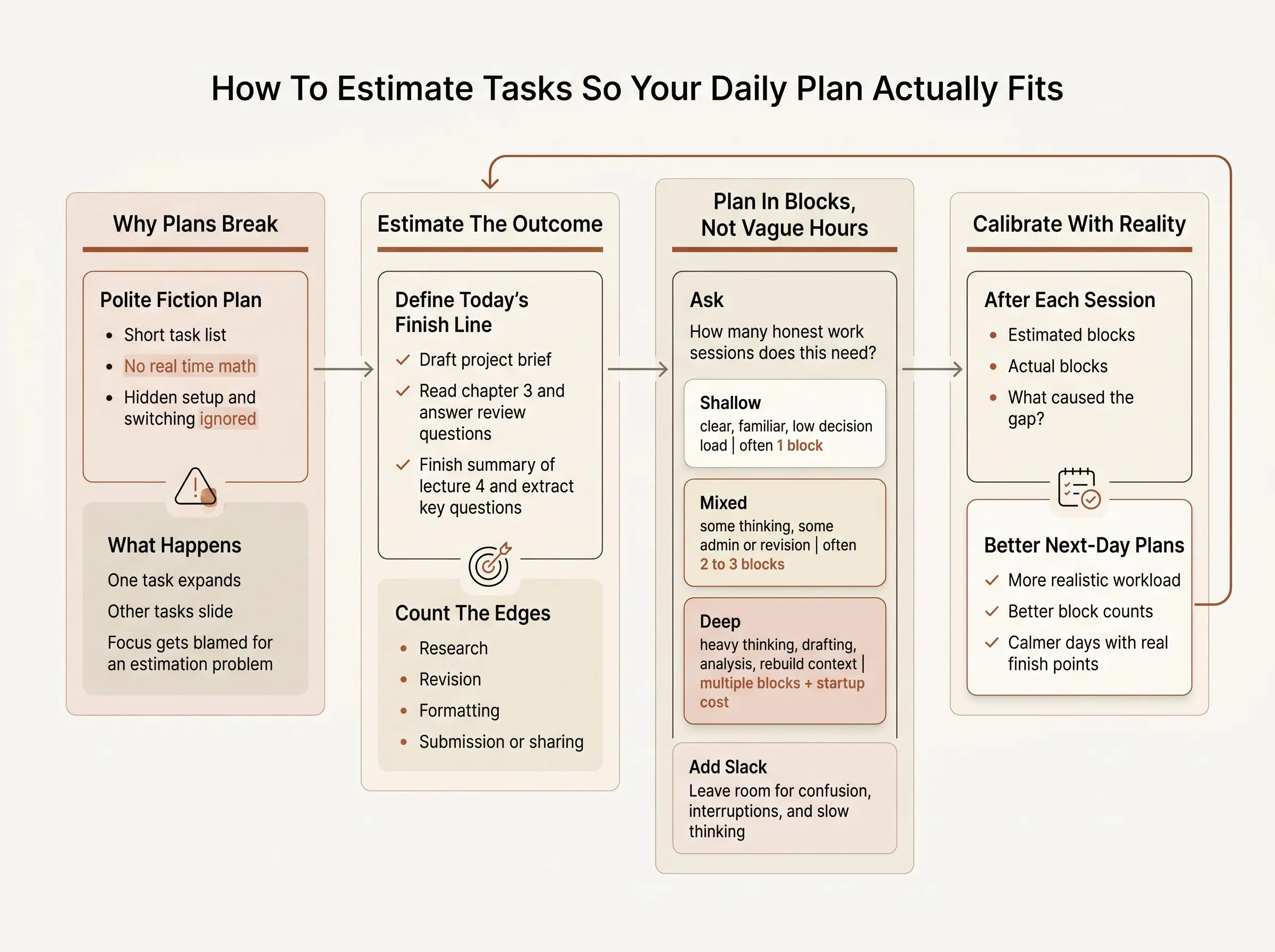
This is the version we trust because it works on ordinary days, not fantasy weekdays where no one messages you and your brain behaves perfectly.
1. Choose one meaningful priority
One anchor task gives the day a center. Without it, everything becomes equally urgent and equally interruptible.
2. Define today's finish line
Turn the project into a concrete outcome. Not "make progress on notes." More like "finish summary of lecture 4 and extract key questions."
3. Do a light breakdown
Break the task apart only until the estimate becomes clearer. Stop there. Over-unpacking can create fake precision and weird distortions.
4. Estimate the number of focus blocks
Count the main work and the edges around it. Research, revision, cleanup, admin handoff. The edges are where estimates quietly die.
5. Add uncertainty space
Leave room for confusion, interruptions, or slow thinking. Slack isn't laziness. It's what keeps the plan attached to reality.
6. Place blocks where your attention is strongest
Use your best mental hours for the hard part. Don't give deep work the leftovers and call it strategy.
7. Start with the first visible block
Don't begin with the whole mountain in your head. Begin with the next session. Open notes. Outline section one. Solve problem set part A.
8. Review estimated versus actual
After the session, compare the guess with what happened. Use the gap as calibration data, not character evidence.
A worked example
Suppose your priority is to prepare a short project brief. Instead of writing "work on brief," run the method like this:
- Finish line: produce a readable first draft with the objective, audience, proposed approach, and open questions.
- Light breakdown: gather existing notes, outline the sections, draft the content, then do one cleanup pass.
- Initial estimate: 4 focus blocks—1 for notes and outline, 2 for drafting, and 1 for cleanup and sharing.
- Uncertainty space: keep one later block unassigned in case the notes are incomplete or a decision needs more thought.
- First visible action: open the notes and write the four section headings before starting the first block.
- Review: if drafting takes 3 blocks instead of 2, record that the next brief estimate should include more writing time rather than treating the miss as a personal failure.
The point isn't that every brief needs four blocks. The point is that the estimate names the outcome, exposes the edges, and gives you a clear next action.
This is a calm system. It lets you plan work sessions without adopting a giant productivity framework or turning your day into an audit.
Use Historical Data to Make Your Estimates Less Fictional
Better estimation rarely comes from thinking harder in the moment. It usually comes from memory made more reliable.
Research points to a practical lever here: historical information about similar tasks. More detailed task definitions help, and past duration data seems especially helpful for improving accuracy. Interestingly, the timing of that historical information mattered less than the fact that it was available at all.
That tracks with experience. If you know your last two reading summaries took three blocks each, your fresh guess of "probably one" starts to look a bit theatrical.
Your own history is the outside view. Use it.
- How long did the last report draft take?
- How many blocks did the last problem set really need?
- Where did revision or admin work get left out?
- What happened when the task was novel?
Task duration is shaped by content, context, and history. Even large calendar datasets show that duration patterns can be classified surprisingly well. The human lesson is simpler: estimates get better when they use patterns instead of hope.
This is also where a planning layer matters. In Flocus, each focus block logs estimated versus actual time, so over time you build a personal evidence base. Not a perfect one. Just much better than guessing from mood.
For readers who want structure without a heavyweight system, that's the point. A timer counts minutes. A planner helps you stop lying to yourself about them.
Common Mistakes That Make Pomodoro Task Sizing Fall Apart
Most estimation mistakes are boring. That's why they repeat.
Here are the main ones we see:
Estimating activities instead of outcomes
"Work on essay" is too loose to size honestly.Reusing your first guess
Self-generated anchors are sticky, even when they were uninformed.Confusing elapsed time with focused work time
Especially on tasks broken by meetings, messages, and context switching.Breaking tasks down in a distorting way
Highlighting unusual parts can skew the whole estimate.Assuming confidence means accuracy
It doesn't. Feeling certain is not a timing skill.Ignoring completion costs
Revision, formatting, packaging, submission, and communication count.Planning every available block
Energy drops. Days wobble. Leave slack.Using estimates as a moral scorecard
A miss is information, not proof that you're bad at work.
One experienced-operator rule helps here: if a plan requires every block to go well, it isn't a plan. It's a hostage situation.
When a Task Spills Across Several Days
Multi-day tasks need a different posture. You are no longer estimating one unit of work. You're managing a sequence of sessions with changing clarity.
That creates two problems at once:
- How much focused work remains
- How much time you've already spent
The second one is slipperier than it looks. Fragmented work often feels larger in retrospect, which fits the research on retrospective overestimation. When a project has been opened, paused, resumed, and mentally dragged around for three days, your memory tends to charge interest.
So don't estimate the whole thing as one lump. Plan it as a chain of sessions with checkpoints.
Useful checkpoint questions:
- What is complete?
- What remains uncertain?
- What kind of session is needed next: reading, thinking, drafting, editing, or review?
This matters for morale. A project can be unfinished overall while today's planned block is still a clear success. That's not spin. That's how long work actually moves.
Daily progress indicators help here because they reward consistency, not only finished projects. A closed ring or a maintained streak won't write your paper for you, but it does protect the truth that you showed up and advanced the work.
Tools, AI, and Feedback Loops That Support Better Estimates
A good tool should do four things well:
- help you choose the right work
- translate it into realistic sessions
- compare estimated versus actual time
- make patterns visible over weeks, not just one afternoon
That last part is where many focus apps stop short. They give you a timer. Fine. But execution tracking is not the same as planning.
We built Flocus around that missing layer: decide what matters first, focus in timed blocks, then review progress through completion signals and weekly insights. It's browser-based, free to use, and intentionally lighter than project management software. Enough structure to be useful. Not enough to become another task.
AI can help, but it should stay in its lane. Pattern recognition and duration suggestions are useful. Full automation of personal planning is less realistic than it sounds. The better use case is assisting subprocesses, like surfacing past patterns or suggesting likely block counts for similar work.
Just don't accept AI estimates uncritically. An AI guess can become an anchor as easily as your own first guess can.
There's also an optional depth layer for some readers. If you use a Muse headband, Flocus can track flow-state signals in real time while you work. That's not required for good planning, and it shouldn't be treated like gadget salvation. It's a calibration tool. Another way to check whether focused time was actually focused.
The broader principle is simple: the best system helps you see reality more clearly.
A Simple Weekly Calibration Habit for Better Task Duration Estimation
Daily estimates get better when they're part of a weekly loop. Not a dramatic review. Ten or fifteen quiet minutes is enough.
Look back and ask:
- Which tasks consistently took longer than expected?
- Which were easier to estimate because they were familiar?
- When were your blocks strongest?
- Which tasks hid revision or admin work?
- Where did interruptions distort the plan?
Then group the misses into patterns. Usually it's some mix of:
- novelty
- ambiguity
- overpacking
- energy mismatch
- context switching
This is where the pomodoro planning method stops being a tactic and becomes a practice. You adjust future estimates based on recurring causes, not on one bad Tuesday.
Small calibrations build self-trust. That's the real payoff. You start to learn what deep work actually costs for you, at your skill level, in your real life. Not in an ideal week that never arrives.
Task Duration Estimation FAQ
What is task duration estimation?
Task duration estimation is predicting how much focused working time a task will need before it is complete enough for the day's goal. It helps you decide what fits instead of confusing available calendar time with usable working time.
How do you estimate how many pomodoros a task needs?
Define the concrete deliverable, decide whether the work is shallow, mixed, or deep, consider your familiarity with it, and include setup, research, revision, and completion costs. If you cannot picture the task clearly, break it down until the estimate becomes clearer.
How can you make task estimates more accurate?
Use historical data from similar tasks and compare estimated time with actual time after each session. Review those gaps weekly to identify recurring causes such as novelty, ambiguity, overpacking, energy mismatch, or context switching.
How should you estimate a task that spans several days?
Do not estimate the entire task as one lump. Plan it as a chain of focused sessions with checkpoints, asking what is complete, what remains uncertain, and what kind of session is needed next.
Conclusion
Task duration estimation isn't really about guessing perfectly. It's about building a more honest relationship with your time, attention, and limits.
The method is straightforward: define a concrete outcome, size it in focus blocks, use light breakdowns, check against past patterns, and review estimated versus actual without turning it into self-criticism.
Better planning usually feels calmer, not stricter. The day gets smaller in one sense, because fewer things fit. It gets better in the sense that the things you chose have a real chance of happening.
For tomorrow, pick one most-important task before the day starts. Estimate its work sessions. Then let what actually happens become data for the next plan. That's enough to begin.
Article Record
ReferencesPrimary sources used for this article
- Time-on-task estimation for tasks lasting hours spread over multiple days | PLOS One
- [PDF] Task Duration Estimation
- [PDF] Unpacking Estimates of Task Duration - Bournemouth University
- Underestimating the duration of future events: memory incorrectly used or memory bias?
- How to Improve the Accuracy of Project Schedules? The Effect of Project Specification and Historical Information on Duration Estimates
- Anchoring in Project Duration Estimation
Update HistoryMeaningful revisions to this article
- Added four frequently asked questions to help readers plan their daily tasks more realistically.
- Added a realistic Pomodoro planning example to show how to estimate task durations and build a daily plan that can adapt to interruptions.