
You usually aren't bad at focus. You're switching because the work gets fuzzy, and your brain grabs anything easier. If you're stuck on how to focus on one thing instead of switching tasks, it usually starts there.
What helps is plain: pick one target, shrink it, protect one block. Miss that, and the day becomes tab aerobics.
Watch for these:
- A task with no finish line will leak attention.
- If you need to "figure out where to start," the task is still too big.
- Leave one next-step note before you stop. Tomorrow gets easier.
Why Switching Tasks Feels Productive but Usually Is Not
Most knowledge work doesn't suffer from too little effort. It suffers from too many restarts.
When people say they’re multitasking, they usually mean they’re bouncing between a draft, Slack, email, a browser tab, and a half-formed decision about what matters most. That feels active. It can even feel responsible. But it’s usually task switching, not true multitasking.
Your brain can do a few simple things at once. You can walk and listen. You can fold laundry and think about dinner. Complex work is different. Writing, analysis, studying, coding, decision-making. Those tend to run through a narrower channel. One meaningful response at a time.
As James Clear explains, multitasking between complex activities is really rapid switching between them. Each switch carries a performance cost because your attention cannot transition seamlessly from one job to the next.
Every switch has a restart cost:
- you lose speed because you have to reload the task
- you lose quality because details get dropped
- you increase error risk because your mind is split across unfinished goals
That’s the quiet tax on task switching. Productivity doesn’t support the idea that constant toggling makes complex work more effective; frequent switching mostly makes frequent switching feel normal.
That said, not every switch is equally harmful. Moving from a demanding task to a routine one can feel less draining for some people, especially if they already prefer variety. Fine. The problem is not deliberate alternation. The problem is reactive fragmentation.
Your workday keeps asking your attention to restart.
That’s why this feels harder than it should. Not because you’re lazy. Because your attention is getting chopped into pieces.
What Is Really Pulling You Away From the Task in Front of You
The urge to switch usually isn’t random. It’s a response.
A fuzzy task creates discomfort. A difficult paragraph creates friction. A large project creates mild panic. Then your brain goes looking for relief, and the nearest relief is usually a smaller, clearer, easier action. Check email. Open messages. Rearrange notes. Read one more article that you absolutely did not need.
This is where attention residue matters. In plain language, when you leave one task mid-thought, part of your mind often stays there. Then you arrive at the next task half-present. You’re technically working, but badly.
Unfinished work gets especially sticky when:
- there’s no clear stopping point
- you haven’t defined the next step
- the task has no visible sense of progress
You’ve seen the pattern before:
- the main task feels fuzzy, so you open email because it tells you exactly what to do
- you hit one hard paragraph, so messages suddenly seem urgent
- you jump to a small task because checking something off feels better than wrestling with the meaningful thing
- you switch tabs because novelty is easier than depth
Digital work makes this worse because self-interruption becomes frictionless. By the second afternoon of a busy week, scattered attention can start to feel like your normal operating mode. It isn’t. It’s just familiar.
The useful part is this: the urge to switch is diagnostic data. It usually points to one of three problems.
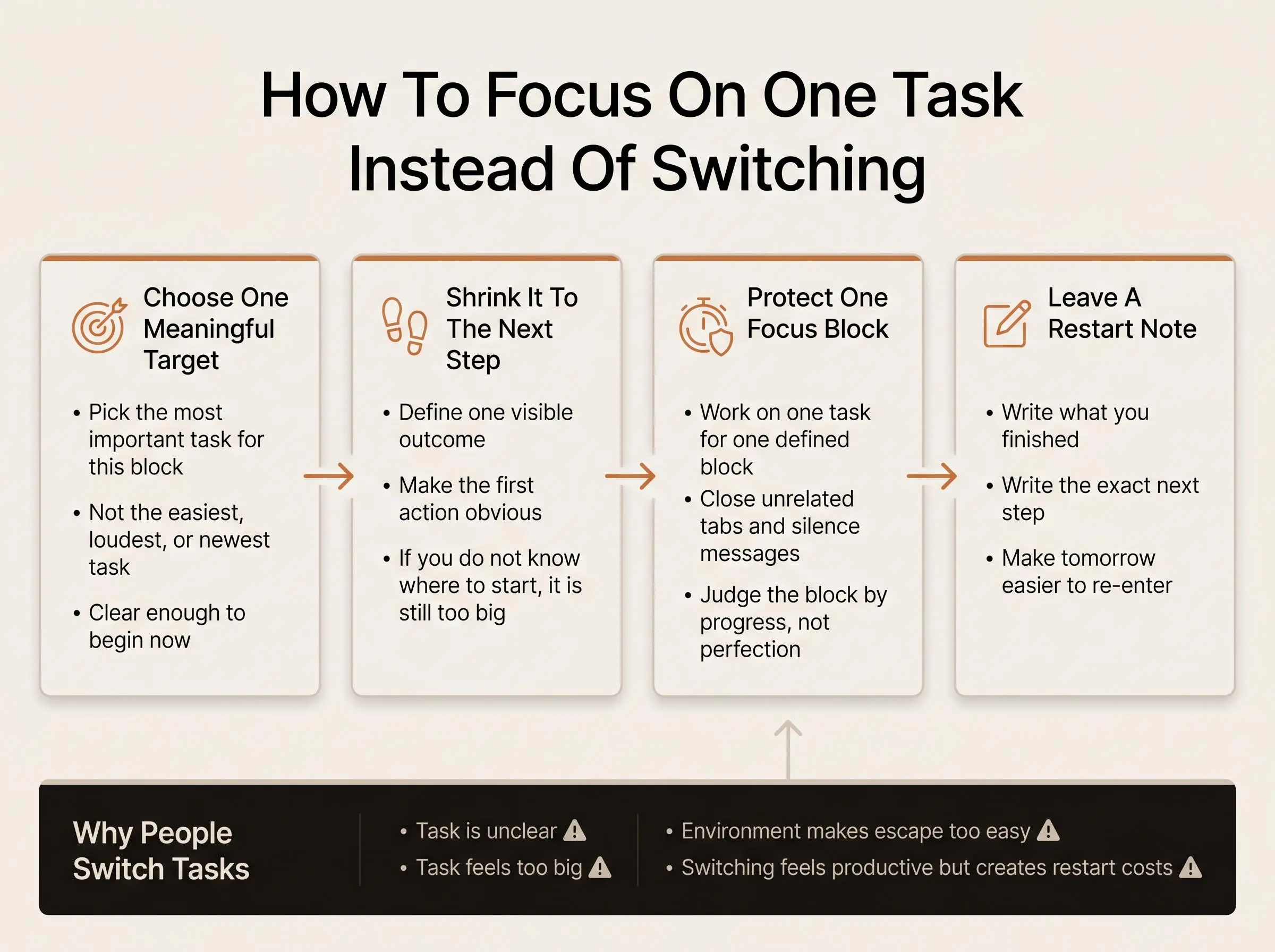
- The task is unclear.
- The task feels too big.
- The environment makes escape too easy.
That’s a better place to start than blaming your character.
What Single-Tasking at Work Actually Means
Single-tasking at work doesn’t mean picking one task at 9 AM and refusing to look up until sunset like a Victorian mill worker. It means committing to one clearly chosen task for one protected block.
That’s a very different standard. Also a sane one.
Healthy single-tasking is not perfectionism. It’s not rigid tunnel vision. It’s staying with one priority long enough to build momentum, while still leaving room for reality. Genuine priorities can change. Fires happen. We’re not pretending otherwise.
The real distinction is between two patterns:
- Reactive switching: driven by discomfort, novelty, and incoming noise
- Intentional sequencing: driven by priority, timing, and natural stopping points
We want the second one. That’s how you reduce context switching without becoming brittle.
In practice, your brain settles down when it trusts three things:
- what matters most right now
- how long it needs to stay with it
- how progress will be recognized
If those are missing, attention starts wandering. Not because your brain is broken. Because it doesn’t trust the setup.
If you want to stay on one task, give your mind a structure it can believe.
Start by Choosing One Meaningful Target, Not a Long To-Do List
A long to-do list looks organized. It often acts like background noise.
Each item sits there competing for attention while you work. Even if you’re not touching the list, your brain knows it’s there. That creates hidden switching pressure. You’re trying to write one report while fifteen other tasks are standing in the doorway.
Instead, choose one most-important task for the next focus block.
Not the easiest one. Not the loudest one. Not the one most likely to produce a quick dopamine pellet. The task should meet most of these conditions:
- delaying it has real consequences
- finishing part of it creates actual progress
- it matches your current mental energy
- it’s concrete enough to begin now
Vague work is where focus goes to die. Convert it into something you can actually do.
- “Work on project proposal” becomes “draft the opening problem statement”
- “Study biology” becomes “complete one chapter summary and practice questions”
- “Edit video” becomes “finish the intro cut”
That visible finish line matters more than people think. If the block has a clear endpoint, your brain is less likely to go looking elsewhere for relief.
This is one reason we built Flocus around a single chosen priority rather than a giant digital pile. Planning works better when the day becomes one meaningful target at a time. Most people don’t need more tasks in view. They need fewer.
Make the Task Small Enough That Your Brain Stops Resisting It
A lot of people choose the right task and still can’t focus. Usually the task is still too big.
“Write paper” is not a task. “Prepare presentation” is not a task. Those are containers for many tasks, and your brain knows it. That’s why resistance shows up before you even start.
Shrink it to the next executable move. Not a full project map. Just the next move.
A practical breakdown looks like this:
- Define the outcome for this block.
- Identify the first visible action.
- Remove any setup or searching that would delay the start.
- Decide what done looks like before the timer begins.
Examples help.
- Knowledge worker: outline three talking points before opening Slack
- Student: solve the first problem set section before checking notes from another class
- Creator: write the hook before researching more references
That third step gets missed all the time. If your first action requires ten minutes of hunting for files, links, notes, or the right tab, you’ve already raised the odds of switching away.
Smaller scope is not lowering the bar. It’s reducing friction so the work can actually begin. High standards still matter. They just matter later, after motion exists.
The easier a task is to re-enter, the easier it is to stay with. That’s also how you reduce attention residue. When a task has a clean shape, your mind doesn’t have to keep wrestling it back into focus.
Use Time Boundaries to Reduce Context Switching
Open-ended work sessions invite drift. If your brain doesn’t know how long the discomfort will last, it starts negotiating for escape.
Defined focus blocks fix that. Pomodoro-style work blocks are useful not because they’re trendy, but because they make concentration feel finite. You’re not committing to finishing the entire project. You’re committing to staying with one task for one block.
That changes the psychology.
Time boundaries help with three common problems:
- Overwhelm: the commitment is smaller than the project
- Perfectionism: the goal becomes progress inside the block
- Drift: the timer creates a clear point to return to
Longer is not always better. If the task is cognitively heavy or your focus has been shredded all week, a shorter block is often smarter. Start with a length you can complete cleanly. Build from there.
At the end of each block, do a quick closure step:
- note what you completed
- write the next step
- decide whether the next block stays on the same task
That tiny shutdown ritual matters. It helps your attention release instead of hanging around in the background.
We use this approach in Flocus on purpose. You plan first, then run Pomodoro work blocks against that plan. Choosing before doing sounds simple. It is simple. It’s also where a lot of focus problems quietly get solved.
Remove the Triggers That Cause You to Switch

Trying to focus in a switch-heavy environment is like volunteering for extra difficulty for no good reason.
Workers can be interrupted roughly every three minutes, and returning fully to the original task can take more than twenty minutes. That’s not a small leak. That’s the floor giving way.
Some interruptions come from outside. Messages, pings, colleagues, notifications. Others are self-inflicted, which is more annoying because we can’t blame anyone else.
Before a focus block, do a quick reset:
- close unrelated tabs
- silence messaging tools
- put your phone out of reach
- keep one document or window as the home screen
- clear visual prompts tied to other tasks
If you can’t go fully offline, use constraints instead of fantasies.
- batch communication into separate windows
- keep a capture note for thoughts that would otherwise trigger a tab switch
- use full-screen mode for demanding work
None of this is performative productivity theater. It’s just removing obvious exit ramps.
One practical rule we like: if a tool isn’t needed for the current task, it shouldn’t be visible. You don’t need heroic discipline when the temptation is already on-screen.
What to Do the Moment You Want to Abandon the Task
The middle of a focus block is where most plans go soft.
Novelty wears off. Friction appears. The work starts talking back. That’s usually when people switch.
Instead of following the impulse immediately, use a short routine:
- Pause before switching.
- Name the urge: confused, stuck, bored, anxious.
- Write down the competing thought.
- Return for a few more minutes with a narrower objective.
That pause creates separation. It lets you see whether the issue is a real blocker or just temporary discomfort. This is also a practical form of inhibitory control: Adele Diamond describes it as controlling attention and overriding an internal impulse or external lure so you can do what the situation requires.
A few useful responses:
- If you’re confused, define the next smallest question.
- If you’re overwhelmed, cut the block scope in half.
- If you’re bored, race the clock to one visible milestone.
- If you’re anxious, define what “done enough” means for this step.
Discomfort is not a scheduling signal.
Single-tasking doesn’t mean forcing deep work through every obstacle. It means learning how to recover when your mind looks for the nearest exit.
Visible progress helps here. Completion rings, streaks, and other cues can replace the craving for novelty with something steadier. Not excitement. Trust.
Know When Switching Is Smart and When It Is Just Relief-Seeking
The goal is not zero switching. The goal is better switching.
Sometimes changing tasks is the right call. If you’re blocked by a missing dependency, if a true higher priority appears, if you’ve reached a natural stopping point and documented the restart, switch. Also fine: using a routine task as deliberate recovery after heavy cognitive work.
That’s intentional sequencing.
Relief-seeking looks different:
- leaving when the task becomes ambiguous
- checking communication tools without a reason
- moving to easy tasks to avoid the meaningful one
- opening research or planning to delay execution
That last one is especially slippery. Research can feel like work while quietly replacing work.
There is nuance here. Alternating between a complex task and a routine task may reduce depletion for some people. Fair enough. But that is not the same as fragmenting attention across three unfinished priorities and calling it flexibility.
Smart task management is mostly about sequencing different types of work cleanly. Not constant toggling. Not endless partial starts.
Build a Daily System That Makes Focus Repeatable
Focus gets easier when it stops depending on a heroic mood.
A simple daily rhythm works better than most people expect:
- Choose the most-important task.
- Define one clear outcome for the next block.
- Run a protected focus block.
- Review what was completed.
- Choose the next step without reopening the whole list.
That last part matters. Reopening the full list after every block is a good way to reintroduce chaos.
It also helps to separate deep work from admin and communication windows. If email and messaging stay open all day, they will keep winning by convenience. Urgent-looking tasks are very skilled at impersonating important ones.
End the day with a short review:
- when did switching happen most?
- which tasks triggered avoidance?
- what environmental changes helped?
This is where tools can support the process instead of becoming another distraction. In Flocus, we use planning, completion rings, streaks, and simple insights to make progress visible. For some people, optional neurofeedback adds another layer. It turns “I think I was focused” into a more concrete signal. Not necessary for everyone. Useful for the curious.
How to Tell if Your Focus Is Actually Improving
You don’t need vague feelings of productivity. You need markers.
Look for signs like:
- fewer unnecessary tab changes
- longer time before self-interruption
- more blocks completed on the intended task
- clearer next steps at the end of sessions
- less mental drag when restarting
Measure both output and experience.
Did meaningful work move forward? Did the session feel calmer? Was it easier to come back after a break?
Hours worked are a poor main metric here. Time can expand while focus collapses. Most people have lived that one already.
Measurement should function as feedback, not surveillance. The point is to give your brain evidence that focus is trainable. Visible proof changes behavior faster than self-criticism does.
Common Mistakes That Keep People Stuck in Task-Switching Loops
Most focus problems are not mysterious. They’re repeated setup errors.
Common ones include:
- choosing too many priorities and calling them all urgent
- starting a block without defining success
- treating discomfort as proof the task is wrong
- leaving tasks without a restart note
- keeping communication tools open during deep work
- confusing research, setup, and organization with progress
- overcorrecting into unrealistic focus goals, then quitting after one messy day
The fix is usually lighter than people expect. You don’t need perfect discipline. You need a lower-friction system where the next right action is obvious.
That’s the whole game, really. Less heroic effort. Fewer unnecessary decisions.
Conclusion
Learning how to focus on one thing instead of switching tasks is rarely about personality. It’s about process.
Choose one meaningful target. Shrink it into a clear next step. Protect it with a time boundary. Remove the cues that invite escape. That’s how you reduce context switching and give yourself a real chance to stay on one task.
The payoff is not just more output. It’s calmer work. Cleaner progress. More trust in your own ability to begin and continue without turning every hard moment into a detour.
Tomorrow, keep it simple. Pick one most-important task, give it one protected block, and judge the session by whether you stayed with it long enough to make real progress. Not whether the whole day looked perfect. It won’t. That’s fine. The block still counts.
Article Record
ReferencesPrimary sources used for this article
- Executive Functions
- Cognitive control in media multitaskers
- Dissociating Task Selection and Response Selection in Dual-Task Contexts: Evidence from a Novel Trial-by-Trial Analysis of Temporal Overlap between Tasks | Journal of Cognition
- Switching between different cognitive strategies induces switch costs as evidenced by switches between manual and mental object rotation | Scientific Reports
- Partitioning switch costs when investigating task switching in relation to media multitasking
- Frontiers | The SwAD-Task – An Innovative Paradigm for Measuring Costs of Switching Between Different Attentional Demands
- Focus: The Ultimate Guide on How to Improve Focus and Concentration
Update HistoryMeaningful revisions to this article
- Added expert-backed guidance to explain why switching tasks can feel productive while reducing focus.
- Made the section more useful by connecting task switching with practical focus advice.
- Added research-based guidance to help readers stay with a task when they feel like switching.
- Strengthened the section on what to do when the urge to abandon a task appears.