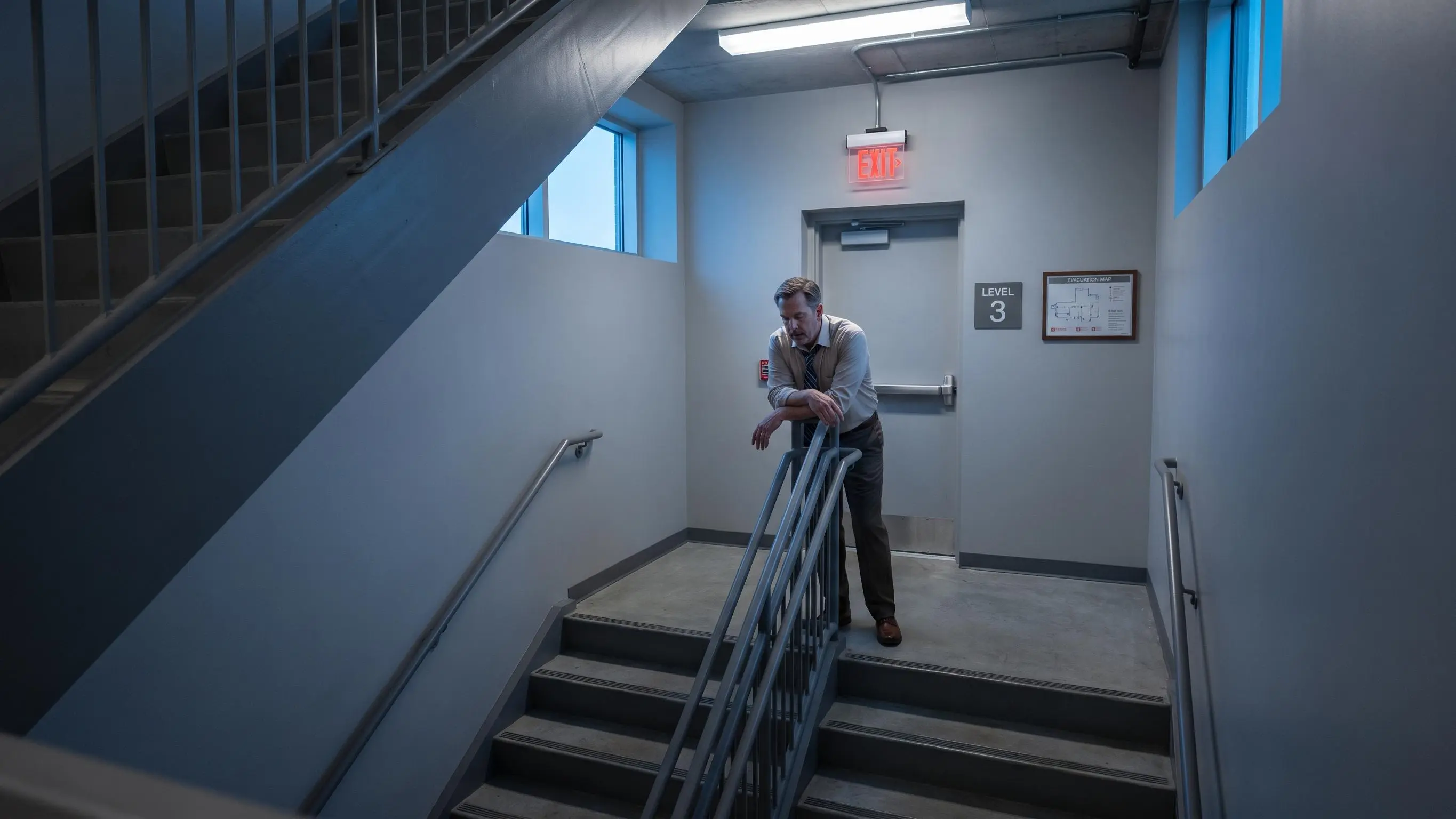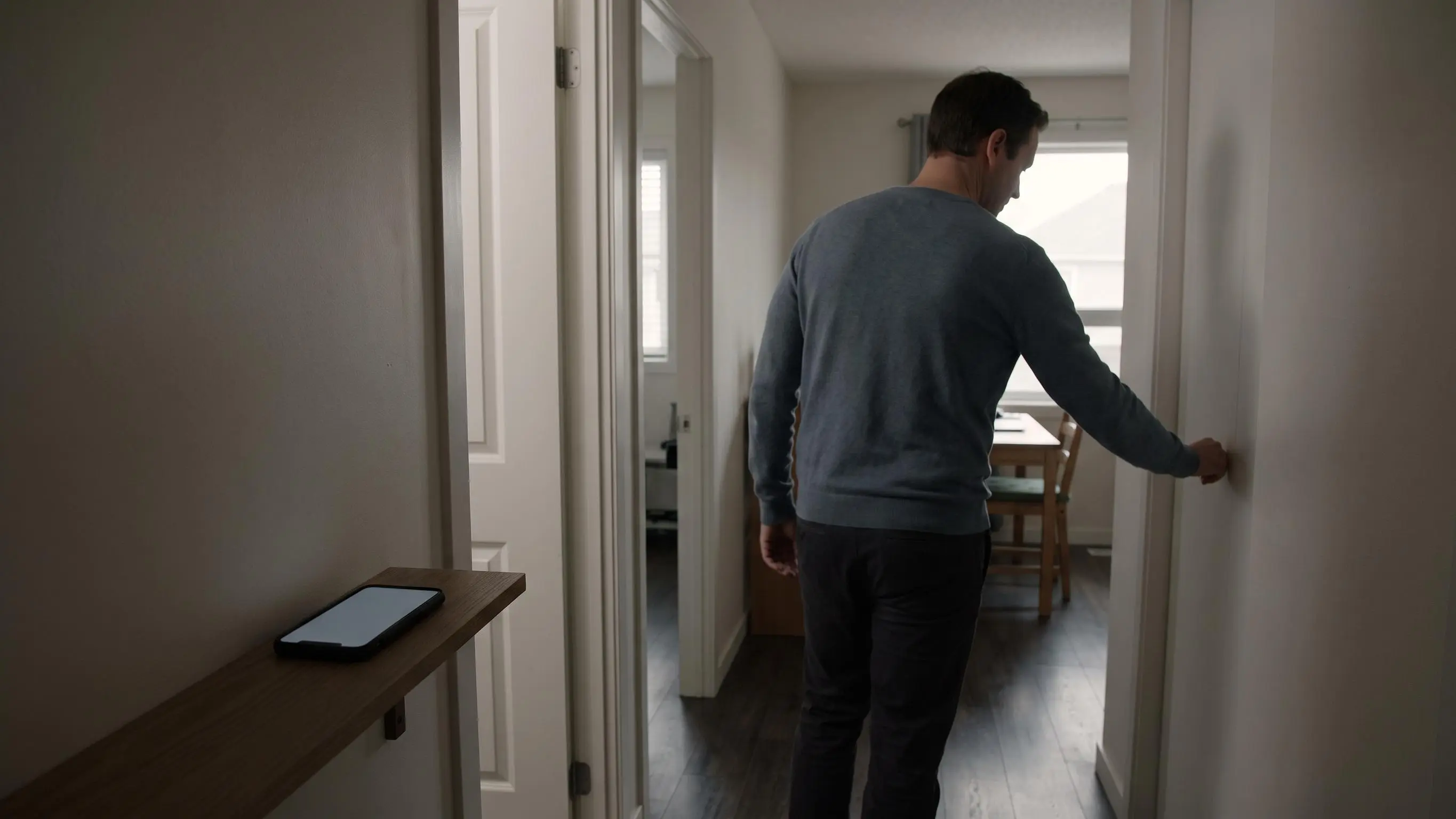

Task switching cost is why a full day can still produce thin work. You check chat, reopen the draft, then waste 10 minutes figuring out where your brain was.
What matters is reducing resets, not squeezing harder. Protect one real block, cut the little detours, and leave yourself a clean way back when you stop (yes, really).
Watch for this:
- A chat reply can cost more than the 20 seconds it took.
- If the task needs context, give it a block long enough to get past setup.
- Before you stop, leave one line on what comes next. Tomorrow gets easier.
What Task Switching Cost Actually Means
Task switching cost is the hidden tax you pay when you stop one task and start another. Not just in time, but in accuracy, clarity, and momentum. You don't simply move on. Your mind has to reload.
That applies to obvious switches like writing and then joining a meeting. It also applies to smaller ones that look harmless on paper:
- spreadsheet to email
- notes to chat
- reading to a notification
- studying to "just checking" a tab
In task-switching research, a consistent pattern shows up: people are slower on switch trials than on repetition trials, even when the tasks are already familiar. The task isn't new. The rules are. Your brain still has to reorient.
That's the part many people miss. Task switching cost isn't the same as being tired, lazy, or unmotivated. Sometimes you are tired. Fair enough. But often the real issue is that you've spent the day repeatedly applying a different set of mental rules.
For students and knowledge workers, this usually shows up as context switching and focus loss. The phrase sounds technical. The experience doesn't. It's that strange feeling of being busy from morning to late afternoon and still not having much that feels properly finished.
Feeling scattered doesn't always mean you need more discipline. It often means your attention has been reloaded too many times.
We've seen this a lot. People blame their character for what is really a workflow problem.
Why Multitasking Hurts Focus More Than It Feels Like It Should
Most people assume quick switches are basically free. A message takes ten seconds. A calendar check takes five. A glance at email can't be the reason your report still isn't done by 4:30.
Unfortunately, that's often exactly the reason.
Multitasking feels productive because it keeps you active, responsive, and mildly stimulated. There's always something moving. The trouble is that motion and progress are not the same thing. A full day can still be structurally empty.
Take a familiar sequence. You're drafting a report. A message comes in, so you reply. While you're there, you check the calendar. That reminds you to send one more note. Then you return to the report and expect to be instantly back at the same level of thought.
Usually you're not.
Research summarized by the American Psychological Association finds that people take longer when they switch between tasks than when they repeat the same task. The extra time can be greater for complex or unfamiliar work, and having more time to prepare may reduce the cost without eliminating it. Switching can also increase the chance of errors, which helps explain why a brief interruption can have consequences beyond the seconds spent answering it.
When people talk about switching between tasks productivity problems, this is the part that matters. Every return asks you to recover your place, remember the thread, rebuild the logic, and get your mind moving in the same direction again. That's a lot of work hiding inside a transition.
This is a big part of why multitasking hurts focus more than it seems like it should. The damage isn't only in the interruption itself. It's in the restart, the lost time, and the possibility of thinner or less accurate thinking.
Some tasks are especially expensive to interrupt:
- writing
- studying
- coding
- analysis
- planning
- anything that depends on holding context in mind
We're not aiming for perfection here. Nobody gets a pristine monastery day. The goal is simpler than that: reduce unnecessary switches so your best attention has a chance to deepen before the next thing barges in.
What Is Happening Under the Surface When You Switch
A switch looks instant from the outside. It isn't. Under the surface, your mind is changing setups.
Research makes a useful distinction here. Preparing for a task is not the same as actually applying it. Studies suggest a large part of switch cost shows up when the new task rules have to be used, not merely when you first see what's coming next.
Plain English version: knowing what you're about to do helps a bit, but the real cost often appears when the work begins.
That's why a neat to-do list doesn't magically solve focus. You can know the next item and still feel sticky when you start it. Your mind has technically arrived, but it hasn't settled.
Some experiments have even found no switch cost after certain cue-only or no-go conditions, though only under specific setups. That sounds niche, but the practical point is useful. Switch cost depends on what kind of mental processing actually happened before the change. If the mind didn't fully engage the old task, there may be less to unwind.
Preparation time matters too. With a short interval, switch costs are more likely to show up after cue-only trials. With longer preparation, those costs can fade faster. So yes, having a rough idea of what's next is better than operating in a fog. It just doesn't fully protect your focus if the day is built from constant fast transitions.
This is also a good place for attention residue explained in normal language. Attention residue is the leftover pull of the previous task when you've moved on in theory but not fully in practice. You notice it in ordinary ways:
- rereading the same line
- restarting a paragraph twice
- second-guessing simple choices
- feeling mentally split for a few minutes
It's not mystical. It's operational. Part of your mind is still standing in the last room.
Why Interruptions Are So Hard to Recover From
Leaving a task is costly. Coming back is often worse.
Interruption research lines up with what people already know from experience: performance drops when resuming a suspended task. That's why something that felt clear before the interruption can feel oddly cold when you return. Same document. Same chair. Different mental state.
The practical problem is resumption cost. After a detour, the original task may feel less obvious, less fluent, briefly blocked. Not because you've forgotten everything, but because the structure isn't loaded in the same way anymore.
This is where small habits do real damage. Notifications. Open tabs. The reflex to check one thing before getting back to work. The famous "just one quick check," which is rarely quick in cognitive terms.
The damage is often invisible because you still complete plenty of micro-actions. Messages answered. Tabs reviewed. Calendar updated. Yet the most important task never receives enough uninterrupted depth to become easier.
There's another wrinkle. Response patterns get messier during switches. Repeating the same response can help when a task repeats, but it can hurt when the task changes. Even simple actions become slightly less reliable when the rule set shifts under them.
That matters because many fragmented days feel efficient on the surface. They aren't calm, but they look active. We wouldn't trust that look.
Fewer returns usually matter more than trying to make each return faster.
If you want to protect concentration, reduce the number of reentries. The brain is decent at continuing. It's less elegant at restarting twelve times before lunch.
Why More Alertness Is Not the Same as Better Focus
When focus gets bad, most people reach for intensity. More urgency. More stimulation. Stronger timers. Louder music. A deadline frightening enough to make the room sharpen.
Sometimes that increases speed. It doesn't necessarily reduce switch cost.
Research on alerting signals found that people can become faster overall without reducing the residual cost of switching. That's a useful correction. Feeling more awake is not the same as being less fragmented.
This matters because a lot of modern productivity advice quietly confuses activation with concentration. They're related, but not interchangeable.
A timer can help you begin. Background stimulation can help you feel less dull. Last-minute pressure can make you move. But none of those automatically help your mind stay with one rule set long enough to do deeper work.
We've seen people become highly activated and still produce a day full of cognitive confetti.
The better question isn't "How do I force more energy?" It's "How do I create fewer resets?" That's a calmer question, and usually a more effective one.
The Simple Way to Protect Your Focus
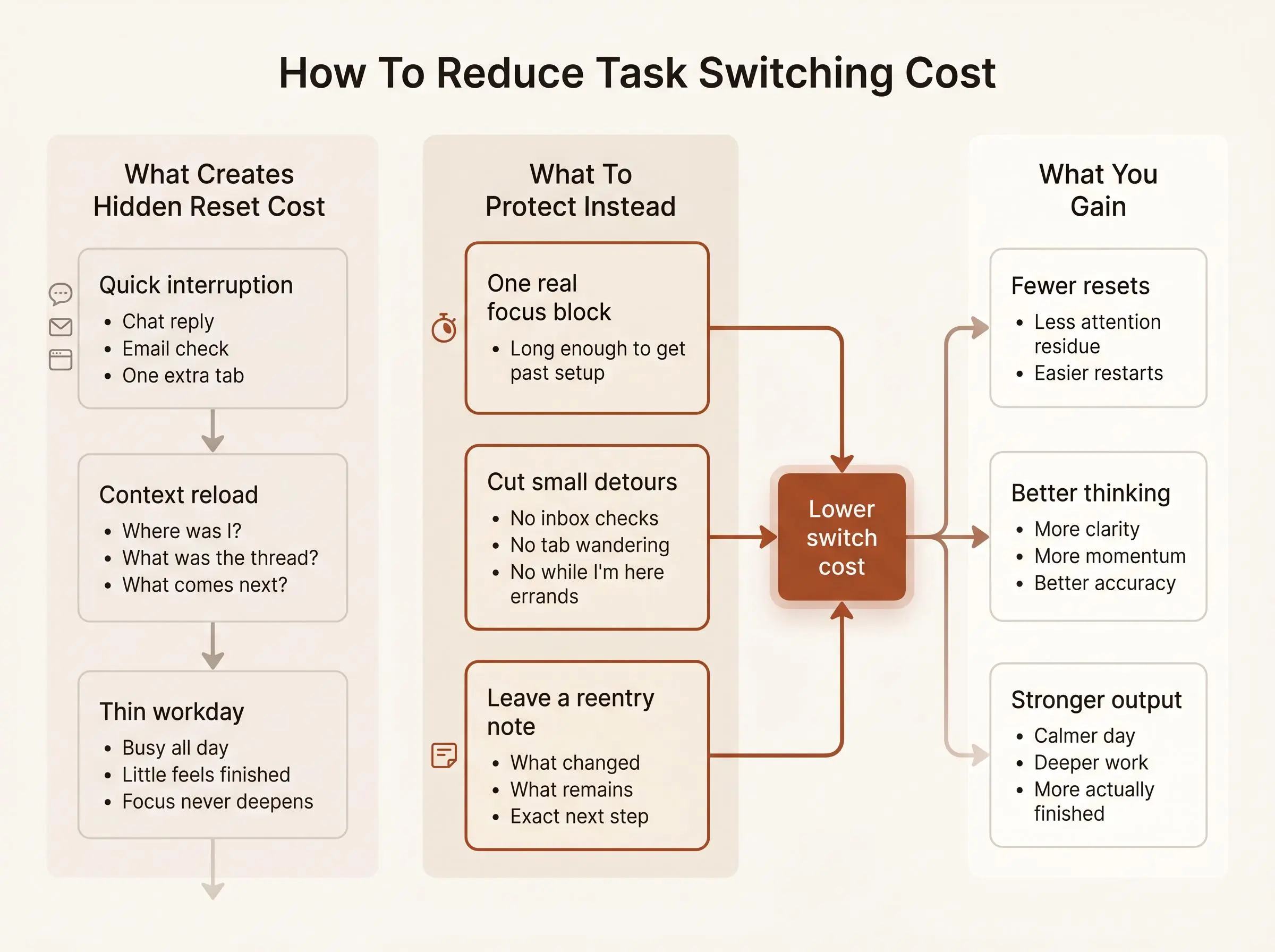
The cleanest fix is not recovering from switches faster. It's causing fewer of them in the first place.
Here's the method we keep coming back to.
Choose one most-important task before you begin.
If you don't decide in advance, you'll renegotiate priority all day. That constant deciding drains attention before the real work even starts.Give it a protected block of time.
Long enough to move past setup and into actual application. Short blocks often capture orientation but not traction.Remove low-value branching points during the block.
No inbox checks, no tab wandering, no "while I'm here" errands. Those tiny side roads are where a lot of focus goes to die.Keep a capture place nearby.
When a stray thought appears, write it down instead of acting on it. Your brain relaxes once it knows the thought won't be lost.End with a reentry note.
Write what changed, what remains, and where to restart next time. A decent reentry note can save a surprising amount of mental friction later.
This works because it targets the real problem. It doesn't ask you to become more intense, more optimized, or more machine-like. It asks you to create fewer costly transitions.
Concentration is easier to defend when priority, time, and boundaries are decided before the session starts. That's how you protect concentration without turning your day into a performance.
A Calm System Beats a Bare Timer
A plain timer can help you sit down. It usually can't tell you what deserves that time. That's why many people bounce off timer-only tools and polished study dashboards. They support starting, but not deciding.
And if the day has no chosen priority, timed work can still become organized drifting.
Our view at Flocus is simple: planning has to come first. One clear most-important task. Then timed focus blocks. Then a visible finish signal so the day doesn't dissolve into blur.
That's why Flocus combines a single priority with focus sessions and daily progress you can actually see. We also log estimated versus actual time for each block. That sounds small. It isn't. It shows where planning was honest, where switching crept in, and where the day quietly overcommitted itself.
A few features help close the loop without hustle-culture nonsense:
- a daily progress ring
- streaks that reflect consistency, not heroics
- reflections
- weekly insights
The point isn't that more features create focus. Usually they don't. The point is that the right structure supports a humane method. You need enough scaffolding to stay oriented, not a second job managing your productivity system.
And if you're skeptical of apps entirely, fair enough. A paper notebook or notes app can do a simpler version of the same thing if it includes three pieces: a true priority, protected blocks, and a clear finish signal.
What This Looks Like in a Real Day
In practice, a focused day often looks almost boring. That's part of why it works.
You start by choosing one priority. You define one work block. You silence nonessential inputs. You work until the block ends. Then you review progress before deciding what comes next.
Not glamorous. Very effective.
Compare that with a fragmented day using the same total hours. You begin with decent intentions, then bounce between tasks, messages, tabs, and small requests. By late afternoon you've touched everything and completed very little that feels solid.
A student version is easy to recognize. You're preparing for an exam, but you keep switching between notes, messages, and side-question research. Two hours pass. You did plenty. The chapter still doesn't feel learned.
A professional version is just as common. You're writing a proposal while monitoring email and chat. The draft feels slow and mentally expensive. Not because you're incapable, but because the document never stays warm long enough.
Tasks that benefit most from protection tend to have one thing in common: continuity. Studying, writing, planning, design, coding, analysis, deep reading. If a task requires remembering where you were, rebuilding logic, or holding several pieces together, don't wedge it between other demands. Give it a dedicated block.
That's the decision rule we'd use out loud.
When Measuring Focus Can Be Useful and When It Is Not Necessary
Some people want more than a timer. They want feedback on whether they're actually settling into focus, not just sitting still while their mind wanders around the furniture.
For those readers, Flocus has an optional connection with the Muse EEG headband that tracks flow state in real time while you work. The useful framing here is modest. This isn't mind-reading, and it isn't gadget theater. It's another signal.
For the neurotech-curious, that signal can help answer practical questions:
- Which session length lets you settle in fastest?
- Does a certain time of day produce steadier attention?
- What kinds of interruptions throw you off most?
Measured focus is optional. It is not the foundation. The biggest gains still come from reducing task switching cost, choosing one real priority, and protecting a work block.
That's worth saying plainly because productivity tools sometimes encourage the opposite impression. Data is helpful when it sharpens reflection, not when it turns attention into another score to obsess over.
If you never measure anything beyond time and completion, you can still make major progress. If you do use EEG-based feedback, pair it with session notes so the numbers connect to lived conditions. Otherwise it's just an interesting chart.
Mistakes That Quietly Keep Switch Costs High
Most focus problems aren't dramatic. They're structural. A few patterns quietly keep task switching cost high even when the day looks responsible.
Starting without a most-important task
Then every spare minute becomes a fresh debate.Treating every notification as urgent
Many inputs feel important because they are new, not because they matter.Using blocks that are too short
If the session ends during orientation, you keep paying setup costs without reaching useful depth.Confusing stimulation with progress
Urgency feels productive. Novelty feels productive. Speed feels productive. None of that guarantees completion.Leaving no reentry notes
Then each return begins with reconstruction.Assuming a quick switch was a cheap switch
Fast on the clock can still be expensive in the mind.Collecting more tools instead of fixing the day structure
Another app won't rescue a workflow built on constant interruption.
The pattern underneath all of these is the same. Too many resets. Not enough protected continuity.
Conclusion
Task switching cost is real, and most of it hides in plain sight. If your day feels full but unfinished, the answer usually isn't more self-pressure. It's fewer unnecessary resets.
The practical method is refreshingly plain: choose one important task, protect a work block, reduce interruptions, and leave yourself an easy way back in when you do have to stop. That's enough to change the texture of a day.
Try it for one day. One priority. One protected focus session. Then notice whether your work feels calmer, clearer, and more complete.
If you want lightweight structure for that routine, Flocus is built for exactly this: one clear priority, timed focus blocks, and visible daily progress, without asking you to adopt a heavy productivity system.
Article Record
ReferencesPrimary sources used for this article
Update HistoryMeaningful revisions to this article
- Added evidence from the American Psychological Association to explain why multitasking can reduce focus.
- Strengthened the section on task switching so readers could better understand how it affects their attention.