

Most days, you do not end work. You just fade out of it, then at 9:40 pm remember the one reply or tab you left hanging. A workday shutdown ritual gives the day a stop, which is the missing part.
What matters is not a long review. It is closing loose ends, checking tomorrow's constraints, and picking the first task before your brain gets slippery.
Start here:
- one place for every follow-up, task, and half-done note
- tomorrow's top task written small enough to start cold
- a final cue that tells your brain: done. You leave work, and tomorrow starts clean
What a Workday Shutdown Ritual Actually Is
A workday shutdown ritual is a short, repeatable end workday routine that helps you stop carrying work around after work is over. It closes open loops, sets up tomorrow, and gives your brain a clear signal that the day is finished.
Most of the time, this takes 5 to 15 minutes. Not 45. Not a heroic life-admin session disguised as planning.
The ritual should create two outcomes:
- nothing important is left floating in your head
- your brain gets a reliable cue that work is done for today
That’s different from just closing the laptop. It’s also different from answering “one last message,” keeping Slack open on your phone, or drifting into the evening while still mentally on call. A shutdown ritual is an actual ending.
This matters more than it used to. Work now lives on personal devices, in bedrooms, on kitchen tables, and inside browsers that never really close. Natural boundaries are weak. If you don’t create one on purpose, the day just smears into the evening.
The goal is not to squeeze out more output at night. It’s to protect tomorrow’s focus by finishing work without stress.
Why It Is So Hard to Stop Thinking About Work
If your brain keeps bringing work back up at 8:30 p.m., it usually isn’t being dramatic. It’s doing what it’s designed to do.
Unfinished tasks tend to stay mentally active until they are either completed or captured somewhere your brain trusts. If that trust isn’t there, the reminders keep coming. Not always loudly. More often as a low-grade hum.
It shows up like this:
- replaying a conversation you need to follow up on
- remembering an email right when you sit down to eat
- feeling vague dread about what to start tomorrow
- staying half-available because something might come in
That background tension costs more than people think. You’re technically off the clock, but attention is still leaking.
There’s a related idea here: people recover better when they can mentally detach from work. A clean boundary helps. Brief end-of-day planning routines have also been linked with less evening rumination and better engagement the next morning. That tracks with real life. The morning feels lighter when you’re not using your best attention to reconstruct yesterday.
This is the important emotional point: if your brain won’t let go, that’s usually not a willpower failure. It’s a systems problem. Loose ends will keep rattling around until they have somewhere solid to land.
Signs You Need a Better End Workday Routine
You usually know this is a problem before you have language for it. The day doesn’t end. It fades out.
A few signs are hard to miss:
- you check messages after dinner “just in case”
- you reopen the laptop because you’re not sure you remembered everything
- you wake up unsure what matters most
- your first hour goes to reconstructing context instead of doing real work
- you felt busy yesterday but can’t point to meaningful progress
Remote work makes this especially slippery. There’s no commute to absorb the transition. No one turns out the lights. You just stop typing for a while and call that done. Your brain may not agree.
Students get a version of this too. You move between classes, study blocks, admin tasks, and maybe part-time work, but there’s no real close. Knowledge workers often finish meetings and inbox work without ever choosing the next concrete step. So the next day starts reactively.
A good daily shutdown checklist helps even when your schedule is messy. That’s the point. You don’t need a heavyweight system. You need a small stabilizer that works on ordinary Tuesdays and slightly chaotic Thursdays.
The Simple Workday Shutdown Ritual in Five Steps
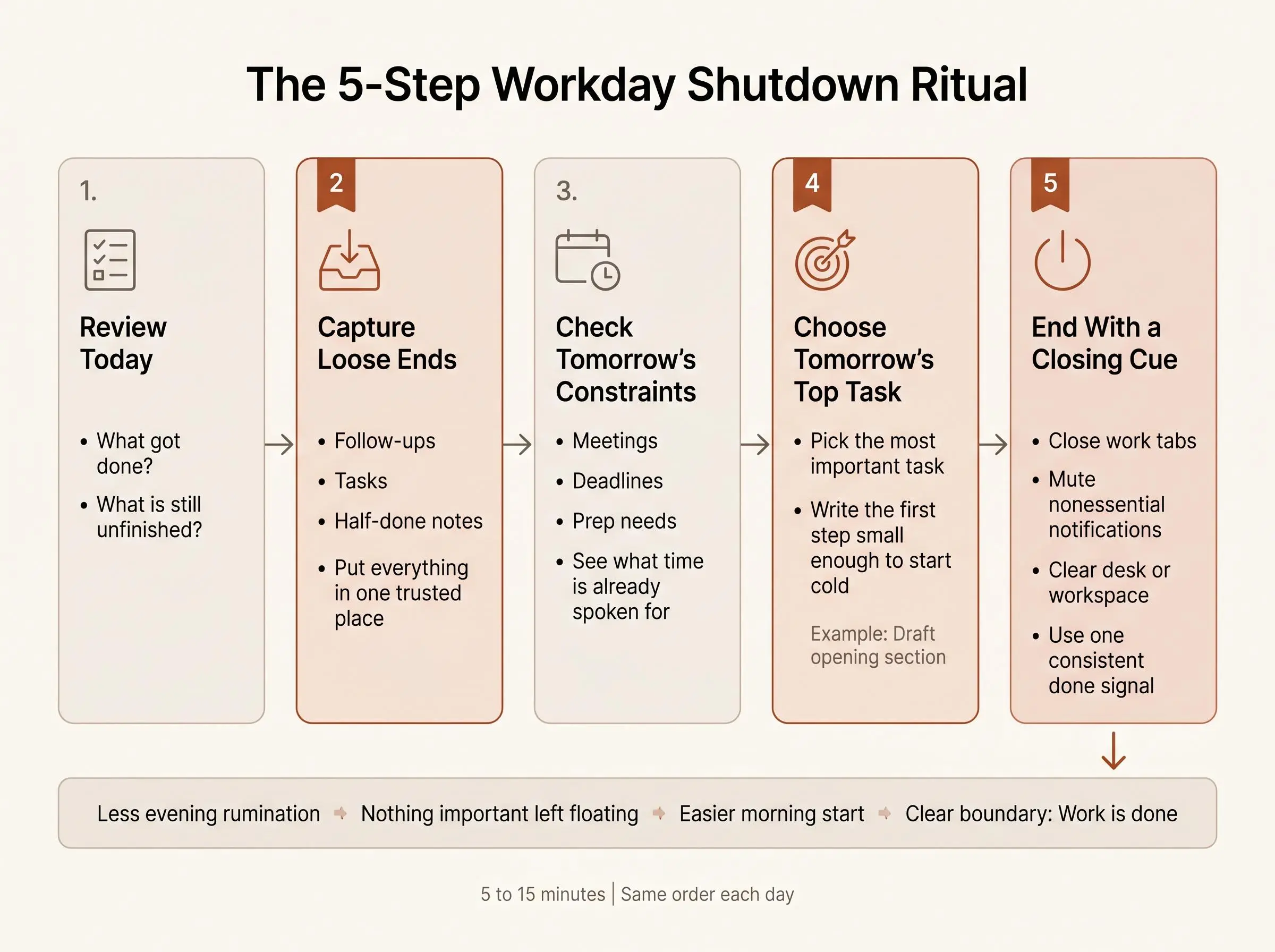
This works best as the same sequence each day. Same order, same basic shape. You don’t want to invent your way out of it at 5:47 p.m.
1. Review what happened today
Look at your task list, notes, and any unfinished work blocks. Check what got done and what didn’t.
Be specific. “Work on report” is not a review. “Drafted section two, still need figures and intro” is a review.
The point is to identify unresolved work instead of carrying it forward as fog.
2. Capture every loose end
Empty notes, inboxes, chat messages, and mental reminders into one trusted place. Record incomplete tasks, promised follow-ups, and decisions you need to make later.
Your brain relaxes when it believes nothing important will be lost. Until then, it keeps backup copies in your head. Poorly indexed, often at inconvenient times.
A lot of people think they have a memory problem. Often they have a capture problem. Cal Newport describes a similar shutdown ritual built around updating task lists and reviewing them so captured tasks can be trusted rather than kept active in his head.
3. Check tomorrow’s calendar and constraints
Scan meetings, deadlines, and prep needs. Notice what time is already spoken for before you decide what tomorrow should look like.
This is where many plans go wrong. People choose priorities in a vacuum, then act surprised when three meetings and a deadline exist. Calendar first. Fantasy second.
4. Choose tomorrow’s most important task
Pick the one thing that matters most if the day gets noisy. Then make the next action concrete enough that you can start without friction.
Not “make progress on proposal.” More like “draft opening section for proposal.”
That small specificity matters. Morning hesitation is expensive. If the first move is unclear, inbox work will volunteer itself.
5. End with a closing cue
Use one consistent final action. It might be:
- clearing your desk
- closing work tabs
- muting nonessential notifications
- shutting down your device
- taking a short walk
- saying a brief phrase out loud
Repetition is useful here. The cue turns the review into a real ending. Newport’s version ends with a spoken phrase, but your cue can be quieter and better suited to your environment.
A ritual without a closing cue is often just planning that wandered into the evening.
A Daily Shutdown Checklist You Can Repeat in 5 to 15 Minutes
If you want this to survive tired days, keep it visible and short. A checklist works better than trying to remember the routine from scratch.
Use this as a starting point:
- Review your task list and today’s notes
- Capture unfinished tasks and follow-ups
- Check tomorrow’s calendar for prep needs
- Choose one top priority for tomorrow
- Close work tools and mute nonessential notifications
- Clear your desk or digital workspace
- Use your final shutdown cue
That’s enough.
A checklist removes one more decision at the end of the day. You don’t need elegant. You need repeatable.
If a step keeps getting skipped, don’t moralize it. Simplify it. The routine is too ambitious if it only works when you feel disciplined and well-rested, which is to say not often enough.
How to Build a Shutdown Ritual You Will Actually Keep
If you’re wondering how to build a shutdown ritual that lasts, start with real constraints. Not your ideal schedule. Your actual one.
Start with a firm stop time
Treat it like a boundary, not a hopeful suggestion. A set endpoint forces prioritization during the day. Without one, work expands until your attention gives out.
Even a rough fixed time helps. The day needs edges.
Keep the ritual light
For many people, 5 to 10 minutes is enough. You’re aiming for closure, not perfect control.
Long shutdown routines feel virtuous for about three days. Then they become a second shift.
Use one trusted capture system
Don’t scatter loose ends across paper scraps, notes apps, email drafts, and memory. Trust is the whole game here. If your brain doubts the system, it keeps checking.
One place. Consistently used. Boring is fine.
Match the closing cue to your environment
Different setups need different endings:
- office work: shut down devices and clear the desk
- remote work: take a short walk to recreate a commute
- student work: close study tabs, pack materials, set the first task for the next session
The cue should fit your life, not someone else’s productivity aesthetic.
Keep the order the same
Repetition lowers friction. Same sequence, same cue, same endpoint. That’s how a review and reset routine starts to feel automatic instead of effortful.
Start minimal. Add journaling or longer planning later if you still want it. Most people don’t need more ritual. They need less improvisation.
What to Include in Your Review and Reset Routine, and What to Leave Out
A useful review and reset routine is narrower than people think. It should help you stop, not tempt you into one more round of fixing everything.
Include:
- unresolved tasks
- upcoming commitments
- tomorrow’s first meaningful action
- a quick environmental reset
Leave out the following, unless you enjoy making simple things oddly difficult:
- trying to finish every open task
- reorganizing your whole system
- clearing every message just to feel complete
- planning evenings and weekends with the same intensity as work
The routine only needs to create enough certainty that you can let go. Not enough control to feel invincible. Those are different standards, and one of them is much more expensive.
There’s a tradeoff here. Completeness feels good in the moment. Sustainability matters more. A slightly imperfect ritual done daily beats an elaborate ritual you start avoiding by the second week.
A practical test helps: if your shutdown routine regularly makes you stay late, it has stopped doing its job.
Common Mistakes That Make a Workday Shutdown Ritual Fail
Most failed routines don’t fail because the idea is bad. They fail because the setup quietly fights the person using it.
A few mistakes come up constantly.
Making it too long
Once the ritual starts feeling like a second shift, you’ll skip it when tired. Which is exactly when you need it most.
Using multiple capture locations
This weakens trust. If your loose ends are spread across apps, sticky notes, and memory, your brain keeps scanning for what you missed.
Leaving tomorrow undefined
If tomorrow’s priority is vague, morning hesitation takes over. Then reactive work wins by default. It always has volunteers.
Ending with channels still buzzing
Open tabs, notifications, and chat pings pull you right back into work mode. Closing tools and silencing alerts aren’t extra credit. They are part of the boundary.
Treating the ritual as optional on busy days
Busy days are the days it matters most. When work is messy, closure matters more, not less.
Confusing productivity theater with closure
Keeping tabs open “for context.” Hovering in Slack. Doing one more tiny task so you can feel useful without actually ending. We’ve seen this movie.
Expecting instant emotional relief
The benefit builds with repetition. Trust in the process grows over time. The first few days may feel mechanical. Good. Mechanical is often how reliable starts.
A Simple Tool Setup That Supports the Ritual Instead of Complicating It
The best tool is not the one with the most features. It’s the one that makes tomorrow clear and today feel contained.
Plain timers can count minutes. Useful, up to a point. But they can’t decide what matters, and they can’t tell you whether the day added up to anything meaningful. That planning layer is usually the missing part.
At Flocus, we built around a calmer method:
- choose one most-important task for the day
- run timed focus blocks against that plan
- compare estimated and actual time so planning gets more honest
- close the ring with visible daily progress, streaks, reflections, and weekly insights
That visible evidence matters. Shutdown is easier when the day feels completed, not just interrupted. You’re not relying on a vague sense that you were “busy.” You can see what moved.
For some neurotech-curious readers, measured focus feedback can be helpful too. If you connect a Muse headband, Flocus can track your flow state in real time while you work. Useful for some people, unnecessary for many. The ritual still does the heavy lifting. Measured focus is interesting. A clear ending is foundational.
What a Good Workday Shutdown Ritual Feels Like After a Few Weeks

After a few weeks, the change is usually practical before it is dramatic. You notice fewer reopen-the-laptop moments. Less evening rumination. Cleaner starts in the morning.
You may also notice a quieter kind of confidence. Important work is being handled. Not perfectly, but deliberately. That feeling matters.
A good workday shutdown ritual doesn’t just improve rest. It improves focus because attention is no longer leaking across the boundary of the day. Recovery gets a chance to do its job.
The broader philosophy is simple:
- choose what matters
- contain work in finite blocks
- make progress visible
- let recovery count as part of the system
Finishing work without stress is not about caring less. It’s about closing deliberately so you can return sharper. There’s a difference between stopping because you gave up and stopping because the day is complete enough.
That second one is much easier to live with.
Conclusion
A workday shutdown ritual is a short practice that captures loose ends, reviews tomorrow, and creates a clear stop signal. It works because your brain stops scanning when it trusts there is a plan. And the best ritual is simple enough to repeat daily, even on the days that went sideways.
Try the five-step routine for one week at the same time each day. Keep the checklist visible. Don’t judge it by how polished it feels.
Judge it by two things: how clearly you can leave work, and how easily you can begin again tomorrow. If those improve, the ritual is working. Quietly, which is usually how the useful things work.
Article Record
ReferencesPrimary sources used for this article
Update HistoryMeaningful revisions to this article
- Added expert-backed guidance to the five-step workday shutdown ritual.
- Made the end-of-day routine more trustworthy and easier to follow.