
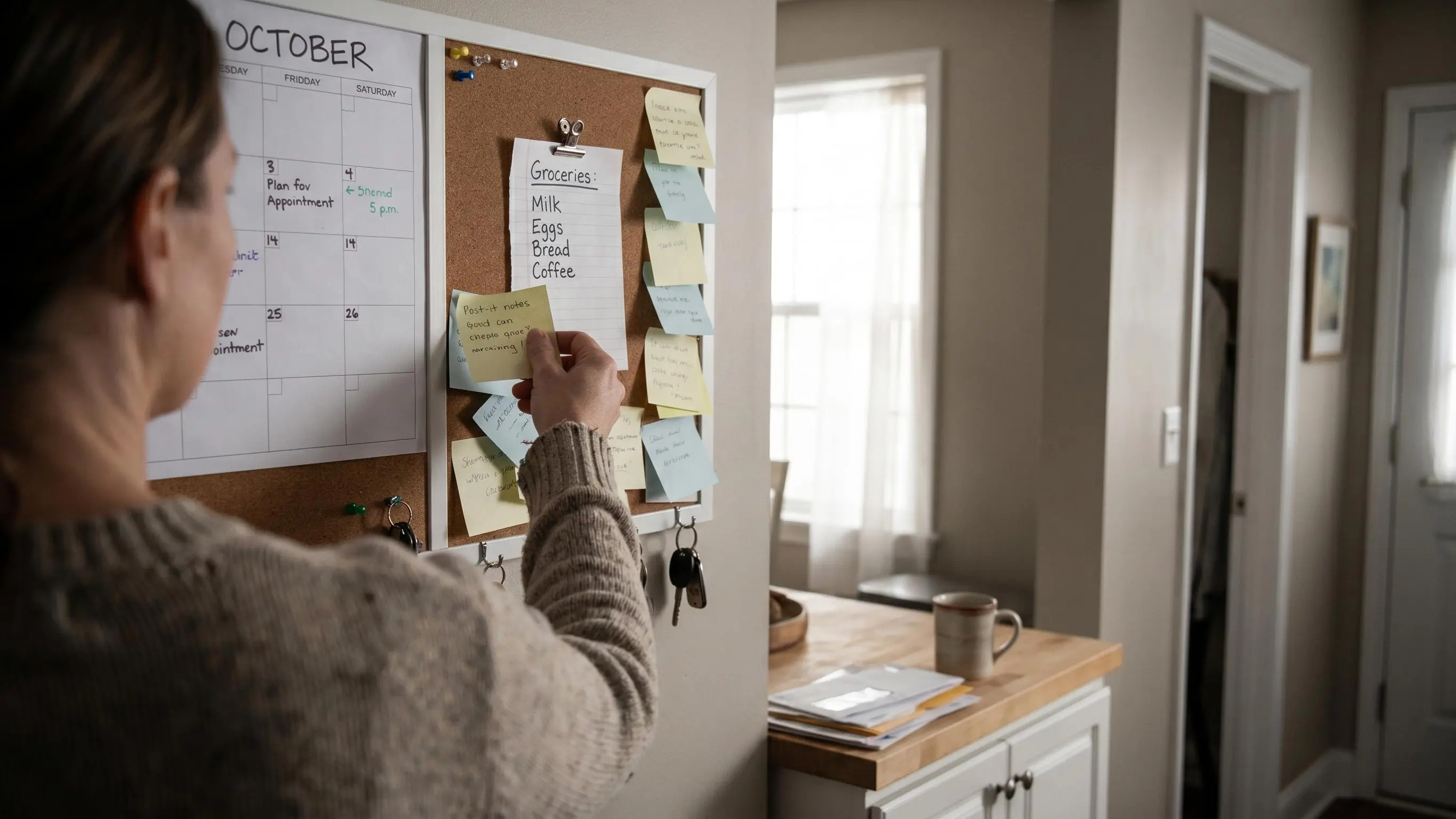
If you're overwhelmed by tasks, the problem is rarely laziness. It is more often a pile of vague jobs, half-decisions, and a list that keeps asking you to remember everything at once.
What matters is getting the pile out of your head, picking one task that genuinely moves the day, and giving it a real block of time. Start here.
- Split storage from today's plan
- Rewrite "project" into one visible action
- Match the task to the time you have left, so the day stops disappearing
What Being Overwhelmed by Tasks Actually Means
Being overwhelmed by tasks isn't just "having a lot on." Most adults have a lot on. Overwhelm starts when the demands in front of you feel bigger than your available time, energy, attention, or clarity.
That's why two people can look equally busy from the outside and have completely different inner experiences. One feels stretched but directed. The other feels like everything is urgent and nothing is startable.
A few signs usually show up together:
- your mind gets noisy
- you feel oddly tired before you've done much
- you freeze, avoid, or drift into low-stakes tasks
- you keep switching without finishing
- you feel guilty even while working
Quiet overwhelm is common. From the outside, it can look like you're answering messages, moving tabs around, and staying "productive." Inside, it feels like static.
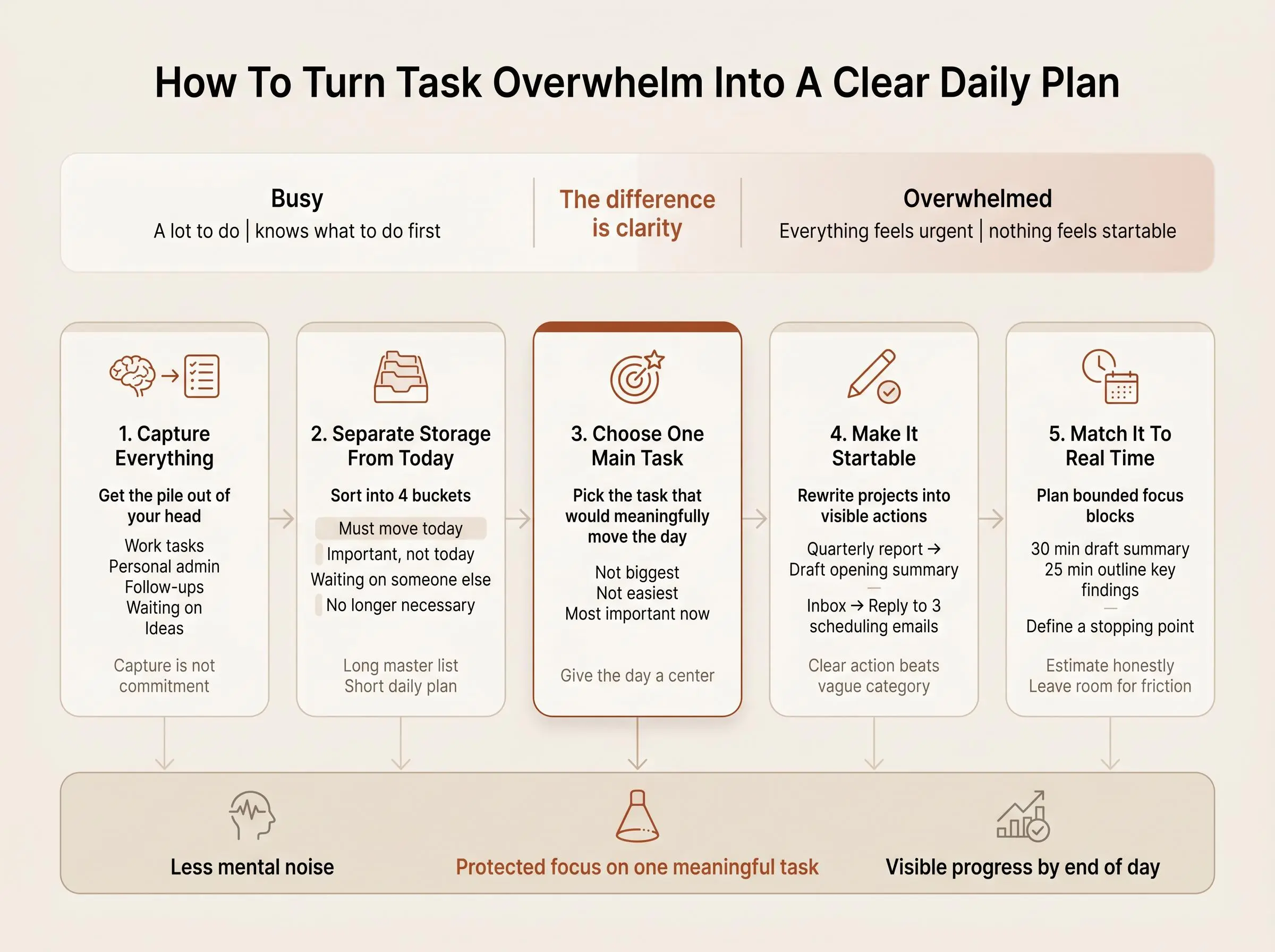
Busy still has a direction. Overwhelmed doesn't. Busy says, "There's a lot, but I know what I'm doing first." Overwhelm says, "If I pick one thing, I'm probably neglecting something worse."
That emotional side matters. The endless to do list problem isn't only logistical. It's also the guilt of unfinished work, the fear of forgetting something important, and the slow loss of trust in your own planning. After a while, the list stops feeling useful and starts feeling accusatory.
The shift we care about is simple, but not always easy:
Clarity doesn't come from keeping every obligation equally alive in your head.
It comes from choosing what matters most and letting the rest wait somewhere safe.
Why Task Lists Feel Overwhelming Even When the Tasks Are Small
If you've ever looked at a list full of minor tasks and still felt crushed by it, you're not broken. Your brain doesn't respond only to task size. It responds to uncertainty, hidden decisions, context switching, and resistance.
A task like "send email" can still feel heavy if you need to decide what to say, how formal to be, whether you're late, and what the reply might trigger. Small task. Large mental load.
This is why task lists feel overwhelming so often. The list isn't just holding tasks. It's holding worries, reminders, half-decisions, and invisible work. At that point, it isn't a plan. It's a storage unit with bad lighting.
A few things make too many tasks anxiety grow faster:
- every item looks equally important
- tasks are vague
- deadlines are implied instead of defined
- deep work, admin, errands, and emotional labor all sit in one pile
- there's no clear stopping point for the day
Modern work makes this worse. Notifications, chat, email, open tabs, and background pings keep competing for the same attention pool. Even when each interruption seems minor, the accumulation is not minor. It reduces mental bandwidth, and usually by the second afternoon you can feel it in your patience.
Frequent distraction also tends to make work feel worse, not just slower. People often assume the problem is inefficiency. Often it's also well-being. Feeling overwhelmed tracks more reliably with poorer work experience and worse psychosocial outcomes than simply feeling underchallenged. In plain English, overload tends to hit harder than boredom.
Then there are unfinished loops. Open tasks keep pulling on attention even when you're not actively doing them. Not because your mind is dramatic, but because it keeps checking whether something important is being missed.
So if your task list overload feels strangely intense, the problem may not be motivation at all. It may be that your prioritization system is overloaded, and your brain is doing emergency sorting all day long.
Why a Timer Alone Rarely Solves Task List Overload
A lot of readers have already tried focus timers, Pomodoro apps, or study dashboards. They can help for a while. Then the same thing happens. You finish a few sessions and still end the day thinking, "Fine, but what did that actually move?"
The missing layer is planning.
A timer can help you stay with a task. It cannot decide what deserves your attention in the first place. And if the wrong task gets a beautiful 25-minute block, it's still the wrong task.
Plain timers usually fail in predictable ways:
- you start with whatever feels easiest, not what matters
- you overfill the day and blame yourself for not fitting inside it
- you switch plans halfway through a block
- the task list stays larger than your actual capacity
This is why our view at Flocus is a little stubborn. Focus doesn't start with the timer. It starts before the timer, with a decision.
We built Flocus as a browser-based planner and focus app around that sequence: choose one most-important task, run timed focus blocks against that plan, and make progress visible so the day doesn't blur into effort without evidence. The timer matters. The planning layer matters more.
Focus is not a personality trait. It's a repeatable rhythm.
Decide. Work. Close the loop. Repeat tomorrow without theatrics.
Step 1: Empty the Pile Without Pretending You Can Do It All Today
Before you prioritize, capture. Get the pile out of your head and into one place so your brain can stop moonlighting as a storage device.
Put in everything that keeps resurfacing:
- work tasks
- personal admin
- follow-ups
- things you're waiting on
- small obligations you've been carrying mentally
- ideas you keep revisiting instead of writing down
Capture is not commitment. That's the important bit people skip.
Your holding list can be long. Your daily plan cannot. Those are different tools, and mixing them creates instant overwhelm.
A simple sort works well here:
- must move today
- important but not today
- waiting on someone else
- no longer necessary
Delete, defer, or delegate before you plan actual work. If you don't, you end up treating every remembered obligation as if it belongs in the same day. It doesn't.
Here's what a messy list often looks like:
- project
- inbox
- study
- prep
- life admin
That list is basically a collection of unfinished categories. No wonder it feels bad. Compare it with something startable:
- draft opening summary for quarterly report
- reply to the three client emails about scheduling
- review chapters 4 to 5 notes for tomorrow's seminar
- book dentist appointment
- send revised agenda to team
One list creates fog. The other creates handles.
Step 2: Simplify Your to Do List Until One Priority Becomes Obvious
If you want to know how to simplify your to do list, start by shrinking the number of things that are allowed to matter today. Not forever. Just today.
Choose one most-important task. The best version of this is not "the biggest task" or "the hardest task." It's the task that would make the day feel meaningfully moved forward if it were completed or substantially advanced.
A useful question from ADDitudeB9s prioritization guidance is: which one task, if completed now, would make you feel better? That prompt can help when every item feels urgent because it moves you from mentally juggling the whole list to identifying the next meaningful relief point.
That single choice reduces too many tasks anxiety because it removes the need to renegotiate importance every fifteen minutes. The day gets a center.
Your list can then support that center with a few secondary tasks, not a second full-time job:
- maintenance work
- quick follow-ups
- one or two smaller actions around the main task
When you're choosing the most-important task, ask:
- what has the highest consequence if delayed?
- what creates the most meaningful progress?
- what needs my best attention, not my leftovers?
- what will reduce stress once I've started it?
If every item still feels urgent, use a simple decision rule: choose the task that is both time-sensitive and capable of moving something else forward. If two tasks meet that test, choose the one with the clearer next action. Put the other task on a secondary list with a specific review point instead of keeping both active in your head.
For example, imagine your list says:
- finish quarterly report
- reply to client emails
- book dentist appointment
- prepare tomorrow's presentation
A calmer version might be:
- Most important: draft the opening summary and outline the three key findings for the quarterly report
- Secondary: reply to the three client emails after the first focus block
- Later: book dentist appointment
- Review point: check whether presentation preparation needs a short block tomorrow morning
The point is not to pretend the other tasks disappeared. They have a place, a boundary, and a time to be reconsidered. That makes the main choice easier to protect.
Vague tasks need rewriting. "Quarterly report" is not a start point. "Draft the opening summary and outline key findings" is.
A calm list should answer three things clearly:
- what matters most
- what can wait
- what done looks like today
There is a tradeoff here. Choosing one priority means you're not optimizing for breadth. Some things won't move. That's the point. The gain is depth, completion, and lower mental friction. Breadth feels responsible right up until it ruins the day.
Step 3: Turn Your Priority Into a Realistic Focus Plan
A priority without a plan is just an honorable intention. Useful for about six minutes.
Once you've chosen the main task, break it into the first visible chunk. Decide where you'll start, what the next action is, and what a reasonable first block could cover. If the task still feels slippery, it's probably still too abstract.
Then estimate the time. Roughly is fine.
This matters more than people think because estimated versus actual time exposes chronic optimism. Most of us don't just misjudge duration once. We do it daily, and then wonder why the day keeps collapsing.
In Flocus, every focus block logs estimated versus actual time for exactly this reason. Over time, planning gets more honest. You stop selecting work as if you have infinite clean hours waiting for you.
Try planning in bounded blocks instead of saying "work on this later." That phrase has ended many fine intentions. A block gives the task edges.
For example:
- Block 1, 30 minutes: draft summary paragraph
- Block 2, 25 minutes: outline three key findings
- stopping point: rough first page completed
Shorter, protected work periods help because the task no longer feels endless. The brain stops interpreting it as an open field and starts seeing a defined effort.
Leave room for friction too. Real work includes transition time, interruptions, and the occasional ten-minute stall where your brain boots slowly. A fantasy plan assumes perfect energy and zero interruption. A grounded plan assumes you're a person.
Step 4: Work in Focus Blocks That Serve the Plan, Not the Other Way Around
Now the timer becomes useful. Not before.
A calm focus block is simple: one defined task, one duration, one visible intention for what progress should look like. That's enough. You do not need a ritual elaborate enough to qualify as stagecraft.
Bounded sessions help task list overload because they narrow the field. You're not deciding among twelve tasks during the block. You already decided. The block is there to protect that choice.
During a block, a few obstacles tend to show up right on schedule:
- the urge to check messages
- remembering unrelated tasks
- discomfort when the work gets cognitively demanding
Treat those as normal, not as evidence that the plan failed. Some practical containment helps:
- park unrelated thoughts in a side list
- finish the block before reorganizing the whole day
- let discomfort mean you're in the real work
That last one matters. People often mistake mental strain for a bad task choice. Sometimes it's just the point where shallow activity ends and actual thinking begins.
Digital overload makes detachment harder, especially when attention is already stretched. Techno-overload is a plain enough term for a plain enough problem: too many tools, too much incoming communication, too little cognitive quiet.
In Flocus, the focus block is tied to the task you chose first, so the timer reinforces the plan instead of replacing it. Small difference on paper. Big difference in practice.
Step 5: Use Visible Proof to Calm the Endless to Do List Problem
Overwhelm shrinks when progress becomes visible. Not because the workload disappears, but because your effort stops vanishing into memory fog.
Completion signals restore self-trust. You can see what moved, not just what remains. That matters on days when the list still isn't finished, which is most days for most people doing real work.
Visible closure helps in a few specific ways:
- it reduces the feeling that the day disappeared
- it turns effort into evidence
- it helps the brain stop scanning for whether enough was done
We like simple feedback loops for this:
- a daily progress ring or clear completion marker
- streaks that reward consistency more than intensity
- brief reflections on what helped or blocked focus
- weekly insights that show patterns in planning and follow-through
For people who feel chronically behind, this is more than cosmetic. Visible proof interrupts the belief that nothing counts unless everything is finished. That's a miserable standard, and not a useful one.
The estimated versus actual time habit supports this too. The more honestly you plan, the less likely your task list is to feel like a moral failure by evening. It becomes a planning problem you can improve, not a character judgment.
What to Do When Even Small Tasks Feel Overwhelming
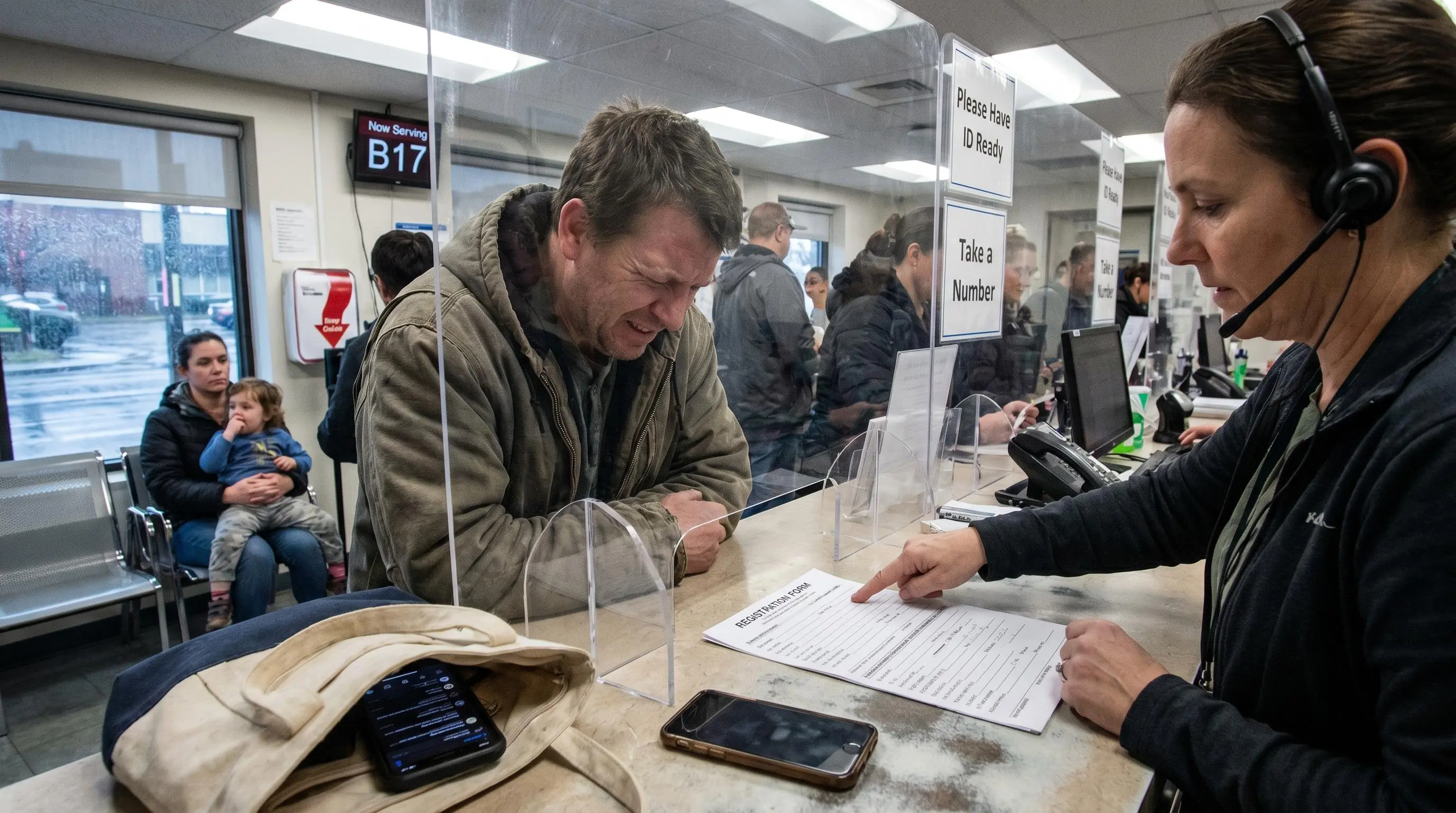
Some days, even basic admin feels absurdly heavy. A form. An email. A routine follow-up. It happens.
Small tasks can still feel overwhelming when your attention is already overloaded, when the task has emotional stakes, when the next step is unclear, or when you've been depleted by invisible work and constant switching. The size of the task is not the full story.
Use a reset sequence:
- pause and stop adding new inputs
- choose the smallest meaningful action
- define what finishing the next 10 to 30 minutes would look like
Then reduce open loops before you begin. Close tabs. Silence notifications. Write down competing thoughts. Give yourself a fair shot at starting clean.
A starter action often works better than a full task. Examples:
- open the document
- draft the first sentence
- sort the materials
- answer the first message
Don't confuse a hard day with a broken system. Not every day will support deep work. That's normal. Even then, choosing one manageable priority protects momentum and trust.
If the overwhelm is persistent, intense, or tied to a workload that is plainly unsustainable, tactics alone may not solve it. Sometimes the issue is deeper than list management, and it helps to treat it that way.
Common Mistakes That Quietly Recreate Task List Overload
Most task list overload comes back through habits that look sensible at first. A few are especially common.
Using one long list as both storage and schedule
Keep a master list, but make a separate daily plan.Making every task look equally urgent
Mark one priority clearly. The rest should know their place.Using vague task names
Rewrite categories into actions with boundaries.Planning for ideal energy
Plan for the version of you who actually shows up at 2:30 p.m.Filling every hour
Leave space for interruptions, recovery, and transition.Rewriting the list repeatedly
Narrow it instead. Reformatting is often avoidance in a cardigan.Bouncing between easy tasks
Motion is not the same as progress. Especially tidy motion.Using timers without a clear priority
Decide first, then start the clock.Ignoring digital noise
Reduce messages, tabs, and alerts during focus blocks.Skipping reflection
Take one minute to note what worked so tomorrow isn't a fresh mistake.
None of these require a dramatic fix. Usually it's a small correction, applied consistently.
For Readers Who Want More Objective Feedback on Focus
This part is optional. You do not need gadgets to regain focus. But some readers want more than a timer or a vague sense that they "probably concentrated okay."
That's where measured feedback can help.
In plain language, real-time focus feedback can help you notice when attention stabilizes or drifts. It makes focus feel more observable and less mysterious. Not magical. Just easier to notice.
Flocus can optionally connect with a Muse headband to track your flow state while you work. We think of this as an extra signal, not a replacement for planning. If your task choice is poor, the measurement won't rescue it. But if you're experimenting with routines, deep work conditions, or attention patterns, the added feedback can be genuinely useful.
It's most relevant for:
- deep work sessions
- testing different routines or environments
- people who want more concrete feedback than minutes logged alone
Measured focus is interesting when it stays grounded. The point isn't gadget theater. The point is learning what helps you return to steady attention.
Conclusion
If you're overwhelmed by tasks, the answer is not to become tougher, busier, or more aggressively optimized. It's to become clearer.
Capture the full pile. Simplify your to do list. Choose one most-important task. Work in bounded focus blocks. Use visible progress to rebuild trust.
Planning and attention need to work together. A plan without focus doesn't move. Focus without a plan wanders.
Try this tomorrow: pick one meaningful priority, give it one protected focus block, and notice what actually happens. Then use what you learn to make the next day a little gentler, a little more honest, and a lot less noisy.
Article Record
ReferencesPrimary sources used for this article
- Dealing with information overload: a comprehensive review - PMC
- Biological stress responses to multitasking and work interruptions: A randomized controlled trial
- Overwhelmed, underchallenged, and distracted at work: associations with psychosocial outcomes | Journal of Public Health | Springer Nature Link
- Frontiers | Reaching point break: understanding the lived experience of being overwhelmed
- JMIR mHealth and uHealth - Development of a Mobile Intervention for Procrastination Augmented With a Semigenerative Chatbot for University Students: Pilot Randomized Controlled Trial
- Q: How Do I Prioritize Tasks and Chores on My To-Do List?
Update HistoryMeaningful revisions to this article
- Added a practical example to show how to narrow a busy to-do list until one clear priority emerges.
- Added expert-backed guidance to the task-prioritization section to help readers simplify their to-do lists and identify their most important task more easily.