

Most people plan by empty time, then wonder why the hard thing lands in the 4:30 fog. Energy based planning fixes that by treating focus like a real limit, not a moral test.
What matters is simpler than it sounds. You match demanding work to your best hours, keep admin for the dips, and stop asking one tired afternoon to do everything.
A few things are worth noticing early:
- Which task actually deserves your best hour
- Which work fits a low-energy slot without causing drag
- Where your estimates keep breaking, so your day finally adds up
What Energy-Based Planning Actually Means
Energy based planning is just planning with a fact most calendars ignore: not every hour of your day has the same cognitive value.
Some hours are good for hard thinking. Some are fine for admin. Some should not be trusted with anything important unless you enjoy turning simple tasks into long, strange ordeals. Daily energy aware planning treats attention, clarity, and recovery capacity as real inputs, not background noise.
That does not mean waiting until you feel inspired. It means matching the work to the state.
Here’s the distinction that matters:
- Calendar-only planning asks, “Where can this fit?”
- Mood-based planning asks, “What do I feel like doing?”
- Hustle-style planning asks, “How much can I force?”
- Energy based planning asks, “What should get my best energy?”
That shift changes everything. When you start focus planning around peaks, you stop giving your best mental hours to inboxes, low-stakes errands, and whatever shouted loudest first. Better focus comes from alignment, not force.
Your best energy is expensive. Spend it on the work that deserves it.
Why Planning by Time Alone Often Ends in Burnout
A packed calendar can look responsible. It can also be quietly reckless.
The problem is simple: time tells you how long a block is, not what kind of work that block can realistically support. The same 60 minutes can produce a clean draft, six tabs of confused scrolling, or a complete stall. The clock doesn't explain the difference.
We see versions of this in other planning problems too. Once energy becomes a real constraint, the “best” schedule changes. The same is true for humans. Runtime alone doesn’t fully explain energy use in systems, and clock time alone doesn’t explain focus quality, mental strain, or recovery cost in people.
Calendar-first planning creates predictable burnout patterns:
- You put deep work into low-energy windows because the space is open.
- You stack meetings on top of mentally heavy tasks and call it a full day.
- You overfill the schedule because every hour looks equally available on paper.
- You mistake visible busyness for meaningful progress.
That last one does damage. A day can feel full and still leave nothing finished that mattered.
Burnout often gets framed as a discipline problem. Usually it’s a mismatch problem. Too much demand placed on too little capacity, repeated often enough, starts to feel personal. It isn’t.
The Three Energy Questions You Should Ask Before You Plan
Before you plan tasks by mental energy, ask three questions. Not twelve. Three is enough.
- What kind of energy does this task require?
- When do I usually have that energy?
- What will this task cost me afterward?
That third question gets ignored a lot. Two hours of concentrated analysis might fit your peak, but it may also flatten the next hour. Good plans account for the aftereffect, not just the task itself.
A practical way to sort demand:
- Deep cognitive energy for writing, coding, studying, problem solving, analysis
- Administrative energy for email, scheduling, logistics, cleanup, routine follow-ups
- Social or emotional energy for meetings, feedback, collaboration, presentations
There’s a fourth lens that’s unusually useful: uncertainty load.
Some tasks drain you less because they are hard and more because the next step is foggy. “Work on project” is tiring before you even begin. “Draft intro paragraph” is easier to approach. Reduce ambiguity and the energy cost often drops with it.
A few grounded examples:
- Drafting a report needs clarity and uninterrupted thought.
- Organizing references usually fits a medium-energy window.
- Replying to routine messages can live in low-energy time without much harm.
Stop calling yourself lazy when the real issue is that you gave a high-demand task to a low-capacity hour. Bad matching feels like a character flaw if you don’t label the task correctly.
How to Spot Your Real Peaks, Dips, and False Peaks
Daily energy aware planning starts with observation, not optimization. For a week or two, don’t redesign your whole life. Just notice what your mind is doing.
Track a few simple markers:
- When do you feel most clear?
- When does starting work feel easiest?
- When can you sustain attention the longest?
- When do you get distractible, impatient, or mentally noisy?
- When do you recover fastest after a break?
A real peak is not just “I feel awake.” It’s a window where focus feels steadier, transitions are easier, and difficult tasks become workable instead of theatrical.
False peaks are trickier. They feel like energy, but the quality is poor.
Common false peaks
- Stress-driven urgency
- A caffeine spike with a crash attached
- Last-minute panic that produces output but raises the fatigue bill
Those states can create motion. They are less reliable for good thinking.
You don’t need complex tracking to learn a lot. Watch for:
- Start resistance
- Depth of concentration
- Task completion quality
- Estimate versus actual time gap
That last one is especially honest. If a task keeps taking twice as long in a certain window, the window is telling you something.
Patterns are personal. Students often peak differently on class days than on free days. Knowledge workers may have their strongest focus before meetings start colonizing the day. Look for patterns, not perfect consistency. Real life is noisy.
How to Plan Around Your Energy, Not Your Calendar
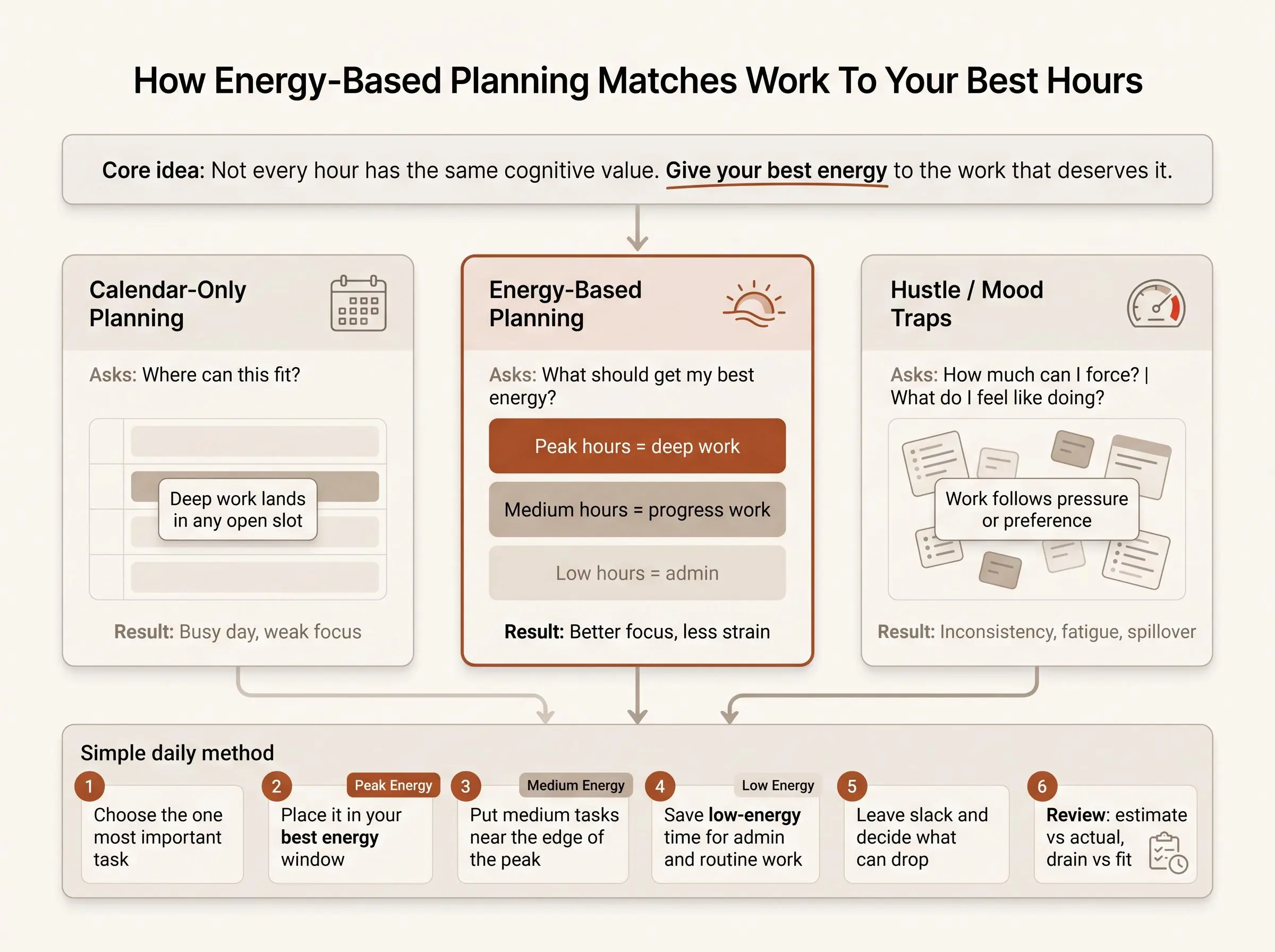
If you want to know how to plan around your energy not your calendar, the method is straightforward. Not effortless, but straightforward.
A simple sequence for tomorrow
Pick tomorrow’s most important task first.
Choose one task that would make the day feel meaningfully used. Keep the list short enough that your attention doesn’t get diluted.Place that task in your best energy window.
Protect the peak before the calendar fills with easier, louder things. Your best hour should not belong to your inbox by default.Build around it.
Put medium-energy tasks near the edge of the peak. Save low-energy periods for maintenance work, review, and simple follow-through.Define the starting move.
Don’t write “work on thesis.” Write “review notes and outline section two” or “solve the first problem set question.” Good plans include the path, not just the target.Leave slack.
Interruptions happen. Mental drag happens. Unfinished tasks happen. A plan without adjustment room is just optimism in a neat font.Choose what gets dropped if energy falls.
Decide this before the day starts. Protect the important work first. Optional tasks can shrink.
A lot of planning failure is really prioritization failure wearing a calendar costume.
How to Schedule Deep Work by Energy
If you want to schedule deep work by energy, stop placing it where it looks tidy and start placing it where your mind can actually carry it.
A strong deep-work block has four qualities:
- the highest-priority thinking task
- the lowest likely interruption window
- your strongest cognitive energy period
- a clear definition of what “done for this block” means
That last part matters more than people expect. A vague deep-work block burns time at the start deciding what to do. Prime energy disappears in setup.
A few rules we trust:
- Give your peak to original thinking, not consumption.
- Do the task that needs judgment before the task that only needs compliance.
- Don’t stack two heavy cognitive blocks back to back if the first one usually empties the tank.
- Pair deep work with a pre-decided break so the effort has a visible edge.
Block length should fit reality
Shorter blocks help when the work feels mentally resistant. They reduce avoidance. Longer blocks can work well if you settle in slowly and can protect uninterrupted time.
This is why a timer is useful only when it starts from a planned task. A disconnected countdown can help you sit still. It can’t tell you whether the block should have been used for drafting, analysis, or email triage. In our own planner, the Focus Timer works best because it attaches to the task you already decided mattered.
A student version might put essay drafting or problem sets into the first strong late-morning window, with admin after class. A knowledge-worker version usually puts writing, analysis, or strategy before meetings and keeps follow-ups for late afternoon.
How to Plan Tasks by Mental Energy Across the Whole Day
Most to-do lists are flat. Your energy isn’t. That mismatch causes more friction than people realize.
Instead, build an energy-matched task stack.
A simple labeling system
- High energy: originality, synthesis, difficult decisions, complex memory load
- Medium energy: progress work that needs attention but not peak sharpness
- Low energy: routine, repetitive, procedural tasks
Examples help:
- High: write chapter, prepare strategy memo, solve technical bug, study a difficult concept
- Medium: revise draft, clean notes, organize research, review slides
- Low: email triage, file management, expense logs, routine updates
Low-value work expands into prime hours unless you assign those hours deliberately. That’s one of the quiet reasons people feel busy but underused. They did work. They just did the wrong kind of work at the wrong mental price.
Task difficulty and task importance are not the same thing either. A fiddly admin job can be annoying without being valuable. Don’t pay for it with your clearest hour.
One more useful adjustment: if a task feels too expensive to start, shrink it to the next knowable action. “Prepare presentation” is vague. “Draft first three slide headlines” is workable. Reducing ambiguity often lowers energy cost more than waiting for motivation.
Revisit your labels weekly. A task that begins as high-energy messy creation often becomes medium-energy cleanup later.
Build a Daily Energy-Aware Planning Routine That Stays Simple
This only works if the routine is calm enough to repeat. If planning becomes its own hobby, the work starts losing by lunchtime.
A useful daily energy aware planning rhythm looks something like this:
- review current commitments
- choose one most-important task
- estimate how many focus blocks it needs
- place it in the strongest energy window
- add only a few supporting tasks
- decide what counts as a successful day
That’s enough. Really.
We’re opinionated here for a reason: short lists are kinder and more honest. In the Flocus Daily Planner, we keep the structure deliberately light because friction compounds fast. A plan is only helpful if you’ll actually follow it when the day gets messy. Connecting planned tasks to actual focus blocks also helps keep the plan honest, especially when you compare estimated versus actual time later.
End the day with a small review
Ask:
- What matched my energy well?
- What drained more than expected?
- What should move earlier, later, or off the list tomorrow?
A humane plan gives your mind two things it badly wants: a clear target and a visible stopping point. Without those, even productive days can feel oddly unfinished.
Use Feedback, Not Guesswork, to Improve Your Plan
Energy-based planning gets better when you review outcomes instead of trusting the story your brain tells at 9:30 p.m.
Look at a few things each week:
- estimated versus actual time
- how many focus blocks the task really needed
- whether a peak window produced deep progress or just looked good on paper
- which tasks keep spilling out of low-energy periods
Time tracked is not the same as focus quality. A completed block can still be shallow. Progress should be judged by both completion and sustainability. If a session “worked” but left you wrecked for the next three hours, the plan needs work.
For readers who are neurotech-curious, we offer Flow Tracking as an optional layer with a compatible Muse headband. It can show live focus quality during sessions rather than just minutes elapsed. Useful, yes. Required, no. Hardware is not necessary to do energy based planning well. Honest observation already gets you most of the way there.
The real value shows up across weeks, not days:
- recurring peak windows
- common overload periods
- tasks that consistently cost more energy than expected
- streaks that feel sustainable instead of forced
Common Mistakes That Make Energy-Based Planning Fail
Most failures here are not dramatic. They’re small distortions repeated often.
The plan usually breaks before the person does.
A few common ones:
Using energy as permission to avoid hard work
Matching is the goal, not endless deferral.Protecting the time but not defining the task
“Work on project” wastes prime hours.Filling every good window with maximum-intensity work
Recovery is part of sustained focus, not a reward for it.Treating low-energy hours as useless
Shallow work still matters when placed on purpose.Copying someone else’s peak schedule
Morning-routine folklore is not evidence about your brain.Optimizing intensity while ignoring strain
Meaningful work should not require sacrificing sleep, basic care, or emotional steadiness.Relying on a timer without a plan
A countdown can help you start. It cannot decide what deserves your best energy.
This is the anti-hustle part, though it shouldn’t need a label. Good planning respects operating limits. Pushing past them occasionally is normal. Building a whole system around pretending they don’t exist is how people end up calling exhaustion “commitment.”
What Energy-Based Planning Looks Like in Real Life

In practice, this is less dramatic than people expect. It just feels cleaner.
A student might notice that late morning is the strongest focus window. So that becomes the slot for reading-heavy study or essay drafting. Class admin, logistics, and messages get pushed into lower-energy gaps. At night, a quick review shows which tasks took more focus than expected.
A knowledge worker might reserve the first clear hour for strategy, writing, or analysis. Meetings get pushed into medium-energy periods where possible. Late-day time becomes follow-ups and cleanup. If deep work stays unfinished, the next step gets written down clearly so tomorrow doesn’t start with reorientation tax.
Bad plan versus better plan
Bad plan:
- six equally “important” tasks
- deep work scattered between meetings
- admin mixed into peak hours
- no definition of what can be dropped
Better plan:
- one priority anchored in the peak
- two support tasks placed around it
- one low-energy admin batch
- the exact next step written for anything unfinished
The emotional difference is not minor. There’s less self-blame, more visible progress, and much less end-of-day confusion about where the time went.
Conclusion
Energy based planning works because it respects a plain truth: your hours are not equal, so your plan shouldn’t pretend they are.
Choose one most-important task. Put it in your best energy window. Match the rest of the day to lower or higher mental demands. Then review what actually happened so tomorrow’s plan gets smarter.
Start with one day, not one month. Let your own evidence decide. If focus improves, important work gets finished more often, and recovery stops feeling like a personal failure, your schedule is finally starting to fit the mind that has to live inside it.