

Most people treat daily intention setting like a mood. Then 9:12 hits, the inbox opens, and the day gets spent on whatever shouted first. If you want clearer plans, you need more than a good sentence.
What matters is giving that intention a job: one real task, one start time, one first move. That's when you stop circling your list and actually begin.
A few things worth fixing early:
- vague intentions that can't tell you what to do next
- a most important task with no time block attached
- plans so wide you dodge them all day
Read this, and your day stops slipping.
What Daily Intention Setting Really Means
Daily intention setting is a small act of direction. It’s the choice of how you want to work, focus, or show up today before the day starts making that choice for you.
That sounds simple because it is. But it’s not the same as writing down what you hope gets done.
A vague wish says, “hopefully I’ll be productive.” A mood says, “I want to feel motivated.” A goal says, “finish the draft this week.” An intention says, “today, I’ll bring calm, focused effort to the draft.”
That distinction matters more than people expect. Goals are usually outcome-focused and longer range. Intentions are present-focused and directional. They tell your attention where to go today.
A good intention narrows attention. It doesn’t expand ambition.
If you often end the day busy but oddly disconnected from what mattered, this is usually the missing piece. You weren’t lazy. You were available to too many things at once.
Daily intention setting works best when it reduces options. Not because your day has to be rigid, but because your attention does. A crowded mind rarely produces a clear day.
Why So Many Good Intentions Never Turn Into Action
Most people know the feeling. You choose the productive version of the day in theory, then messages start, tabs multiply, someone needs something, and by 3:40 you’re doing small tasks with the intensity of a person avoiding one important task.
We tend to blame memory. If only we remembered the plan. If only we had better reminders. But everyday follow-through usually breaks somewhere else.
In studied daily intention contexts, forgetting explained only a small minority of unfulfilled intentions, around 10 to 14 percent. That’s useful because it points to the real problem. People often don’t fail to act because the intention vanished. They fail because priorities shift, time gets squeezed, the task feels harder than expected, or the next step was never clear enough to begin.
Reminders can help. They are not the system.
A notification won’t fix an unrealistic morning, a task that has no starting point, or a plan that depends on feeling inspired at exactly 9:00. Better follow-through usually comes from better planning and less friction, not more self-pressure.
That’s the core idea here. Intentional productivity comes from pairing intention with structure. Otherwise the intention stays morally correct and operationally useless.
The Psychology Behind Daily Intention Setting and Better Follow-Through
Planning does something very practical for the brain. It reduces how often you need to decide in the moment.
That matters because in-the-moment decisions are where good intentions get negotiated away. You sit down, check one message first, open two tabs, remember another task, and now your plan is gone without any dramatic failure. Just drift.
One of the most useful ideas here is the implementation intention, which is a plain if-then plan. If this cue happens, then I do this action. That’s all.
- If it’s 9:00 and you’re at your desk, then you open the draft
- If the meeting ends early, then you use the next 20 minutes to review notes
- If you feel resistance, then you start with the outline instead of editing
When people decide when, where, and how they’ll act, follow-through improves a lot. Difficult projects get done more often because the action is attached to a cue instead of to mood.
The cue does quiet work. A clear situation gives your brain a trigger. “Work on report sometime today” asks for fresh negotiation all day long. “At 9:00, at the desk, draft the first section for 30 minutes” removes most of the argument.
This is also why daily intention setting helps students and knowledge workers in particular. Good planning supports self-regulation, attention control, prospective memory, executive function, and decision-making. In plain language, it helps you remember what you meant to do and start it with less internal debate.
That’s really how to turn intentions into action. Not by becoming stricter. By making the start easier to detect.
Intentions, Goals, and To-Do Lists Are Not the Same Thing
These tools get mixed together, and then people wonder why planning feels busy but not useful.
Here’s the clean version:
- Goal: the outcome you want
Example: finish the draft this week - Intention: how you want to direct yourself today
Example: bring focused, calm effort to the draft today - To-do list: everything competing for attention
Example: reply to email, fix slide 4, book appointment, review notes - Most-important task: the one piece of work that gives the day a center
Example: draft the outline section from 9:00 to 9:30
Long lists create the illusion of order. They capture everything, which feels responsible. But capturing isn’t the same as deciding. A to-do list is inventory. It does not automatically make plans actionable.
The bridge is the most-important task. It takes meaning and gives it a place to land. You’re no longer holding a nice thought about the day. You’re naming the one task that expresses it.
Some people resist this because one priority feels too small. Almost insulting, even. Surely a serious adult can manage seven priorities.
Usually not. Not well, anyway.
When everything is urgent, attention gets shredded. Narrowing focus often increases total output because you stop paying the switching cost all day. One clear priority isn’t a constraint on ambition. It’s how real work survives contact with Tuesday.
A Simple Daily Intention Setting Routine That Takes a Few Minutes

This routine should be short enough to use on an ordinary weekday. If it only works with tea, sunlight, and emotional stability, it’s not a routine. It’s a weather pattern.
Try this:
Pause before opening messages or apps.
Even two quiet minutes helps. Otherwise the first incoming demand becomes your plan by default.Ask one useful question.
What would make today feel meaningfully used, not maximally packed?Write one intention in clear language.
Keep it specific enough to guide behavior. “Today I intend to work with calm concentration on the section that matters most.”Choose one most-important task.
Give the intention a concrete home.Define the first work block.
Pick the start time, duration, and exact starting point.
A decent morning note might look like this:
Intention: work with calm concentration on the draft
MIT: outline section two
Block: 9:00 to 9:30 at desk
Start: open notes and write three bullets
That’s enough. You don’t need a personal retreat before breakfast.
Consistency matters more than duration. Five useful minutes every weekday will beat one perfect planning session followed by three chaotic mornings. This is how intentional productivity starts to feel normal instead of aspirational.
How to Turn Intentions Into Action Before Motivation Fades
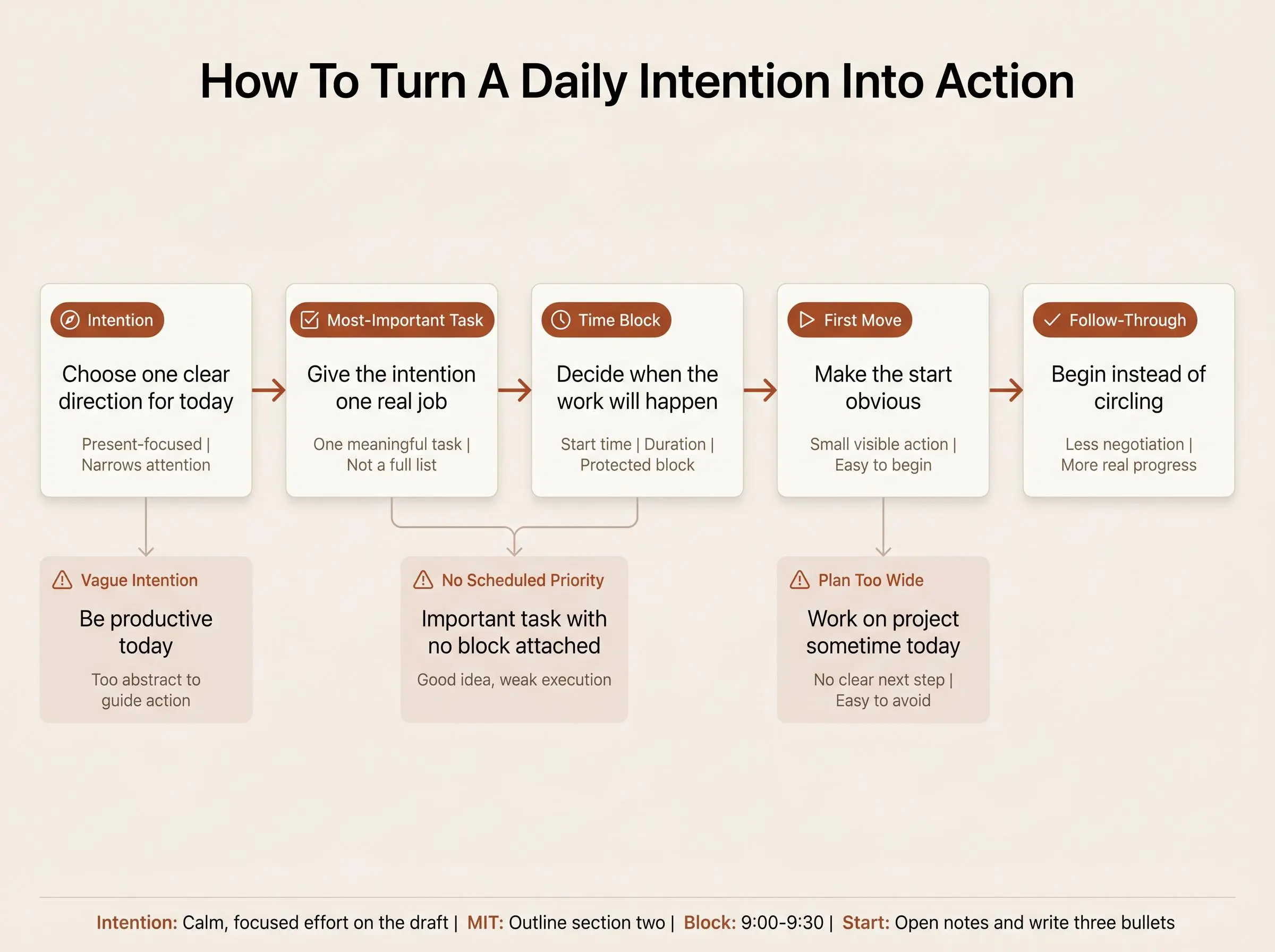
A sentence becomes usable when it gains structure. Otherwise it stays noble and slippery.
Here’s the conversion:
- Intention: what matters today
- Task: what work expresses that intention
- Cue: when and where you will begin
- Block: how long you’ll work
- First step: the smallest visible starting action
- Obstacle plan: what you’ll do when friction shows up
Let’s make that concrete.
Your intention is: Today I intend to make meaningful progress before I start reacting.
That becomes:
- Task: draft the first page of the brief
- Cue: 8:30 at the kitchen desk after coffee
- Block: 30 minutes
- First step: open the notes doc and write the heading
- Obstacle plan: if Slack pings, note it and return after the block
This is how to make plans actionable. The plan needs a trigger, a small opening move, and an answer for the predictable ways the day will push back.
If-then planning is especially useful:
- If it is 9:00 and I am at my desk, then I will open the reading notes and draft the first paragraph.
- If I feel stuck after five minutes, then I will write a rough version instead of editing.
- If a message interrupts me, then I will note it and return after the block.
One non-obvious point here: perceived difficulty often predicts non-completion better than importance. People assume they need to care more. Usually they need to shrink the starting move.
If the first step feels foggy, resistance wins early. Quietly. Before the timer even starts.
From Planning to Doing With One Clear Priority and Bounded Work
The break between planning and doing usually happens for three reasons. The plan is too broad, too crowded, or too dependent on mood.
Bounded work helps because it makes the commitment startable. Thirty focused minutes is psychologically different from “work on this all morning.” One asks for a beginning. The other invites avoidance dressed as flexibility.
One most-important task gives the day a center of gravity. Then timed focus blocks protect actual effort around it. That’s the method we trust because it’s honest. The timer matters less when it’s disconnected from a plan.
At Flocus, that’s the whole point. We built the planner around one most-important task, timed focus blocks, and a visible daily progress ring because focus tools without a planning layer tend to count time without directing it. You can spend plenty of minutes being industrious in the wrong direction.
Another detail matters here: estimated versus actual time. Most daily plans collapse because people are optimistic in a very casual way. A task “should take 20 minutes,” then it takes 55, and the rest of the plan falls over behind it.
Tracking estimated and actual time corrects that over time. Not harshly. Just honestly. By the second or third afternoon, patterns start showing themselves.
From planning to doing is not a motivation problem nearly as often as people think. It’s usually a design problem.
Examples of Daily Intentions for Students and Knowledge Workers
Good examples help because weak intention wording often sounds fine until you try to act on it.
For students
A strong version:
- Intention: today I intend to study with presence instead of panic
- Most-important task: review one lecture and create summary notes
- If-then plan: if I finish breakfast at 8:15, then I will sit at the library desk and study for one 30-minute block
- Obstacle plan: if I reach for my phone, it goes in my bag until the block ends; if I don’t know where to start, I begin with the lecture slides and write three summary bullets
The wording connects values to behavior. Presence becomes notes on a specific lecture, at a specific time, in one bounded session.
For knowledge workers
A useful version:
- Intention: today I intend to finish one meaningful chunk before I start reacting
- Most-important task: draft the project brief
- If-then plan: if it is 9:00 after standup, then I will work on the brief for 30 minutes at my desk
- Obstacle plan: if Slack interrupts, I’ll capture the message and return after the block; if perfectionism shows up, I’ll write a rough first pass
Good intention wording sounds like this:
Today I intend to work with calm concentration on the section that matters most.
Today I intend to finish one meaningful chunk before I start reacting.
Weak wording sounds like this:
- Be productive today
- Get everything done
- Try harder
Those fail because they don’t guide action. They’re moods pretending to be plans.
Common Mistakes That Make Daily Intention Setting Feel Useless
When this practice feels pointless, the issue usually isn’t the idea. It’s the setup.
A few common mistakes do most of the damage:
- Writing intentions that are too abstract to guide behavior
- Choosing three or five “top priorities” and treating them as one
- Using reminders as the whole system
- Setting an intention without deciding when the work will happen
- Picking a task so vague or difficult that resistance wins before the block starts
- Assuming importance will guarantee execution
- Turning reflection into a delay tactic
- Making the practice into a performance of self-improvement
That last one sneaks up on people. You can spend a strange amount of time refining the perfect intention instead of doing the first five minutes of work.
A clean plan should lower friction, not raise the emotional stakes.
If the plan fails, don’t rush to character judgments. Usually the lesson is structural. The block was badly timed. The task was too large. The starting cue was weak. Adjust the design first.
A quick repair checklist can make that adjustment concrete. If your intention was “make progress on the presentation” and the block never started, check the plan in this order:
- Was the outcome turned into one task? Replace “work on the presentation” with “draft the opening three slides.”
- Did the task have a real cue? Replace “sometime in the morning” with “at 9:00, after coffee, at my desk.”
- Was the block bounded? Choose 25 or 30 minutes instead of leaving the duration open.
- Was the first move visible? Write “open the slide deck and add the three slide headings.”
- Was there a predictable obstacle? Decide what happens if a message arrives: capture it, then return after the block.
Then rewrite the plan once and begin. Don’t keep diagnosing it after the first step is clear. The goal is not to create a perfect intention. It’s to remove the next avoidable decision.
How to Review Your Intentions So They Improve Over Time
Daily intention setting gets stronger when it ends with a brief review. Not a dramatic self-audit. Just a clear look at what happened.
At the end of the day, ask:
- Did I act on the intention I chose?
- What helped me begin?
- Where did the plan break?
- Was the task unclear, too large, badly timed, or interrupted?
This is where honest self-knowledge shows up. You start noticing patterns in energy, timing, task size, and overplanning. Some people consistently choose blocks that are too long. Others choose tasks that look specific but still hide the real first step.
Tracking estimated versus actual time helps here too. Over a week, it gives you a better sense of what your plans cost in real minutes, not imaginary ones.
Visible progress helps more than people like to admit. A ring, a streak, or a simple completion log gives the day proof. For readers who often feel like their effort evaporates, that matters.
Weekly reflection is where repeated obstacles become obvious. Maybe your low-energy window is always 2:00 to 3:00. Maybe every failed plan has no clear start cue. Maybe your “quick tasks” are lying to you again.
When Measuring Focus Can Add Another Layer of Self-Awareness
Most people do not need fancy measurement to start. They need one intention and one protected block.
Still, some readers want to know more than whether they sat at the desk. They want to know whether they were actually focused.
That’s a reasonable question. Real-time feedback can help some people notice the difference between deep work and merely occupying a chair. For neurotech-curious readers, Flocus offers optional Muse headband integration that tracks flow state while you work. The appeal is simple: measured focus, not just self-reported focus.
Used well, that adds another layer of self-awareness. You can compare how focused you felt with what the session actually looked like. Sometimes those match. Sometimes they don’t.
It’s worth keeping the framing grounded. Signal data can complement reflection. It doesn’t replace the basics. If the day has no clear intention and no realistic plan, better measurement just tells you that more precisely.
Conclusion
Daily intention setting works when it does three quiet things well: it narrows attention, names one meaningful direction, and translates that direction into a specific start.
The system is simple. Choose an intention. Define one most-important task. Attach it to a cue. Work in a bounded block. Review what happened honestly.
Follow-through is not a personality trait. It’s a process. Plans get easier to keep when they get clearer, smaller, and more grounded in real conditions.
Tomorrow morning, choose one intention and give it one protected block of real work before the day decides for you.
Article Record
ReferencesPrimary sources used for this article
- Setting Intentions: Examples and How To Do It
- Implementation Intentions and Effective Goal Pursuit
- From thought to action: On the relevance of including situational cues in thought about intended actions
- Why do we forget?—A mixed-method investigation of reasons for everyday prospective memory failures | Cognitive Research: Principles and Implications | Springer Nature Link
Update HistoryMeaningful revisions to this article
- Added a practical example to the section on common mistakes, making it easier to recognize what can make daily intention setting feel less useful.