

You can estimate task duration badly in five seconds. Most people do. They picture the clean version of the work, not the setup, the stall, or the file they forgot to open.
What matters is turning a task into work blocks you can fit into a day. We don't need perfect guesses. You need numbers that survive contact with work.
A few things to get right first:
- Estimate the next chunk, not the project.
- Use a similar task, then add time for research, revisions, or waiting.
- After one focus block, update the estimate. Your plan gets honest.
Why Daily Planning Fails Without Time Estimates
Most daily plans don't fail because the tasks were wrong. They fail because the day had no believable shape.
A to-do list can look perfectly reasonable at 8:30 a.m. Five useful tasks. Nothing dramatic. Then by mid-afternoon, you're rushing, skipping steps, or quietly moving half the list to tomorrow. That isn't usually a discipline problem. It's a capacity problem hiding in plain sight.
This is why daily planning fails without time estimates. We choose tasks by urgency, guilt, or importance, but we don't ask the duller question: how much focused work do these actually require?
A list like this is common:
- finish the slide deck
- reply to client emails
- review the reading
- draft the summary
- fix the bug
On paper, that feels like a solid day. In reality, those five tasks might need eight or nine hours of real attention once you include setup, thinking time, and the small delays that make work human.
The result is familiar. You overpromise in the morning, start bargaining with the clock by lunch, carry unfinished work into the evening, and end the day feeling behind. Then you blame your character. Bit harsh, really.
Time estimates for planning are not about getting every task correct to the minute. They exist to give the day a believable structure. A calm planner without estimates is still guessing. Just with better typography.
Honest task planning is a relief because it stops the daily argument with fantasy. You don't need a stricter system. You need one that admits attention is limited.
A plan without time is often just a wish list.
What You Are Actually Estimating
Before you estimate anything, it helps to separate two different questions that people often mash together.
Task duration, in plain language, is the amount of working time the task is likely to require. Not when it will be done on the calendar. Just how much real work it needs.
That means separating:
- Performance time: the actual focused work
- Completion time: the elapsed time until the task is fully done
Performance time is writing the draft, reviewing the notes, fixing the issue. Completion time includes interruptions, waiting on a file, context switching, meetings, and the fact that you rarely get three clean hours in one stretch.
This matters because you can estimate two hours of focused work correctly and still not finish until tomorrow. If the day only had one usable hour left, the estimate wasn't wrong. The calendar was.
A lot of people think they're bad at estimation when they're really mixing these questions:
- How much work is this?
- When will it be finished?
Different question. Different answer.
For daily planning, estimate the work time first. Then check whether your day or week has enough real capacity to hold it. That simple distinction clears up a surprising amount of confusion.
Why Humans Are So Bad at Estimating Time
We're not especially objective about our future selves. That's the short version.
The planning fallacy daily tasks often reveal is simple: we assume today's version of the work will go more smoothly than reality supports. Not always, and not for every person or every task, but often enough to ruin a week.
A few things make this tricky:
- Underestimation is common, especially in work settings, but it isn't a universal law.
- The old idea that short tasks are overestimated and long tasks are underestimated is messier than it sounds. Some of that pattern may be statistical noise, not a deep rule of human nature.
- Experience helps less than people hope, especially when the task is new, slightly different, or wrapped in different constraints.
We've seen this constantly. Someone has done "this kind of thing" for years, but the minute the format changes or the stakes shift, the old instinct stops being useful.
Context matters more than people think. So does wording. Ask "when will this be done?" and you may get a very different answer than "how much focused work will this take?" Same task. Different cue. Different estimate.
The useful part is this: estimation errors are not evidence that you're lazy, flaky, or unserious. They're evidence that the brain is easy to nudge and poor at raw prediction. That's fixable, but not by scolding yourself.
The No-Guesswork Method in One Sentence
Here's the method:
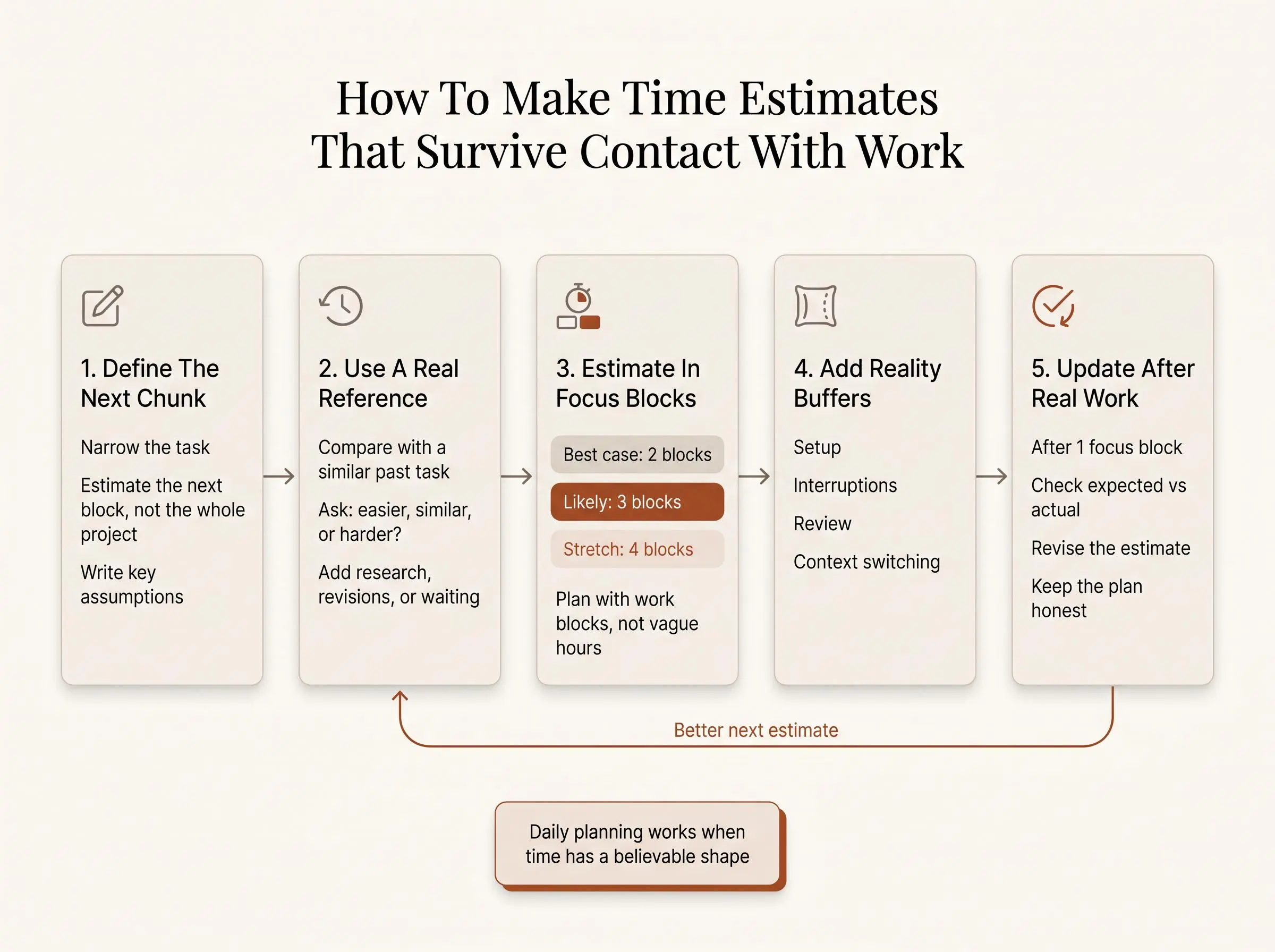
Define the task narrowly, compare it to real past work, estimate in focus blocks, add uncertainty on purpose, then compare expected vs actual time and revise.
That's better than a one-shot guess because it turns estimation into observation plus adjustment. Not intuition dressed up as confidence.
It also stays light. You don't need a heavyweight productivity system or a spreadsheet hobby. If you're a student or knowledge worker who wants a calmer way to plan, this is enough.
The next steps make that usable.
Step 1: Define the Task at the Right Level
Vague task labels create vague estimates. No surprise there.
"Write report" is not a task you can estimate well. It contains research, outlining, drafting, revision, formatting, and maybe the special joy of waiting on someone else's feedback.
A better unit is something you could actually start in the next focus block:
- outline section one
- draft the introduction
- clean up the references
- review comments and revise section two
That level matters. If you can't picture the first few minutes of the work, the estimate is probably fiction.
Research on unpacking is useful here, with one caution. Breaking a task into parts can change the estimate, but not always in the same direction. It depends which parts you make noticeable. If you highlight a long or awkward step, estimates rise. Highlight a quick late-stage step, and estimates can fall. The brain is annoyingly suggestible.
So break the task into the parts you genuinely expect to do, not the parts that make the number feel nicer.
It also helps to write down assumptions. Nothing elaborate. Just the hidden conditions that could break the estimate:
- waiting on a source
- need access to a file
- likely one round of revisions
- requires setup before real work starts
Missing assumptions are often where estimates go wrong. Not the task itself.
Step 2: Use Reference Points Instead of Fresh Optimism
The best starting point is not what the task feels like today. It's what similar tasks actually took before.
Build small personal reference classes. Nothing fancy. Just recurring categories from your real work:
- weekly reading review
- email triage
- lab write-up
- bug fix
- slide deck draft
- literature summary
Then ask a boring but valuable question: what's the closest past task, and is today's version easier, similar, or harder?
That's far more reliable than trying to estimate from mood. Mood is a terrible project manager.
Task attributes, context, and history all correlate with duration. Which is why your own records beat generic productivity advice almost every time. Even machine learning work on task duration finds that useful features vary a lot across datasets. There is no universal formula waiting to save you. Your context keeps winning.
Experience helps most when it's experience with the same kind of task. Years of being busy do not automatically make you better at estimation. They mostly make you better at sounding confident about it.
If you keep records, add one short note after each task about what made it longer or shorter. History without context can still mislead.
Step 3: Estimate in Focus Blocks, Not in Abstract Hours
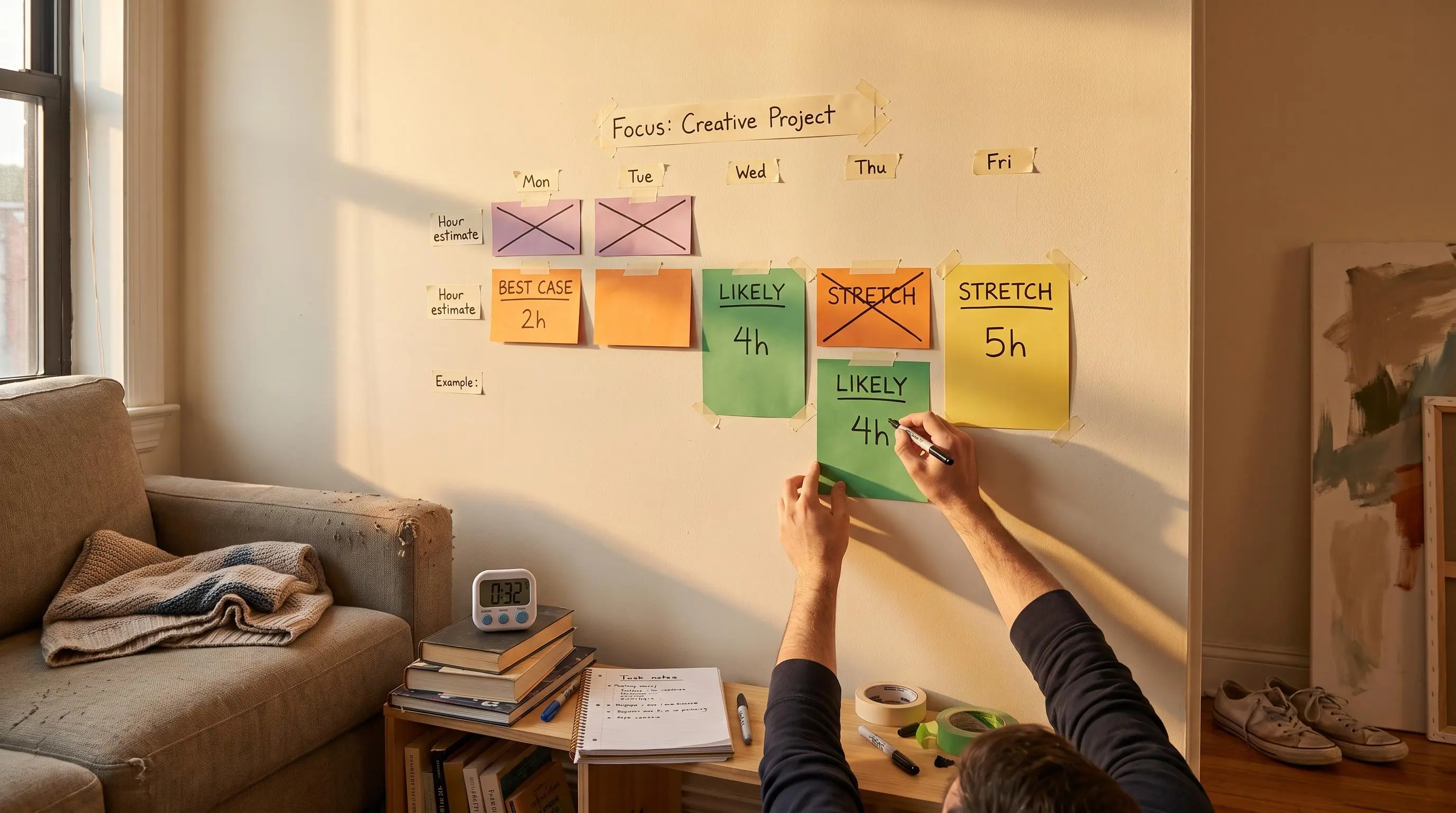
If you want to estimate task duration without guesswork, use focus blocks instead of vague hour totals.
Blocks are easier to plan around because they're concrete. Two blocks feels different from "about an hour." It has edges. It also ties the time to a specific task, which matters if you've bounced off plain timers before. A countdown alone doesn't tell you what the time is for.
A simple process works well:
- Choose the most important task.
- Estimate how many focused blocks it will likely take.
- Decide whether those blocks fit today or need to span multiple days.
- Add room for setup, transitions, or review if the task needs it.
For example, suppose the task is draft the introduction for a research summary. You might plan it like this:
- Block 1: review the source notes and outline the main point
- Block 2: write the first draft
- Block 3: revise for clarity and add missing references
If you are unsure whether revision will be light or substantial, don't force one number. Mark two blocks as the likely estimate and three as the stretch estimate, then check the plan after the first block. If the outline reveals extra research, revise the remaining estimate instead of pretending the original number still fits.
We prefer a range over one brittle number:
- Best case: 2 blocks
- Likely: 3 blocks
- Stretch: 4 blocks
That's more honest, especially for creative, unfamiliar, or slightly messy work.
One practical note. A two-block estimate means two real blocks of attention. Not two hours on the clock while messaging, switching tabs, and replying to one "quick thing" every nine minutes. That isn't work time. That's administrative weather.
Step 4: Add Buffers Where Reality Usually Breaks the Plan
Most overruns aren't dramatic. They're ordinary things you forgot to count.
Starting friction. Gathering materials. A technical issue. Realizing the draft needs another pass. Getting interrupted, then paying the re-entry cost afterward. That's where plans quietly leak time.
Buffering isn't pessimism. It's respect for the full shape of the task.
Different tasks need different buffers:
- Startup buffer for work with high resistance or setup friction
- Coordination buffer when other people are involved
- Review buffer for checking, formatting, or polishing
- Context-switching buffer when the day is fragmented across task types
Complexity and difficulty don't create perfectly predictable estimate changes, which is exactly why buffers matter. Even sophisticated project methods still depend on the quality of the starting estimate. In practice, better assumptions usually beat fancier formulas.
If a task "should only take 30 minutes" but usually needs 45 once you count opening files, reviewing context, and fixing one odd detail, then 45 was the honest estimate all along.
Step 5: Guard Against the Biases That Quietly Distort Estimates
Biases rarely announce themselves. They just slip a number into your head and act like they belong there.
Anchoring is the obvious one. The first number you hear or think about can pull the estimate, even when it has no real value. That anchor might come from a deadline, an old schedule, another person's expectation, or your own first rough guess.
And yes, anchoring can stick around even after you've done similar work before. Awareness helps less than people hope.
There's also deadline contamination. If someone gives a long deadline, people often infer the task must be larger. If the deadline is tight, they may squeeze the estimate down to match it. Available time starts defining perceived scope.
Pause before you estimate and ask:
- What am I comparing this to?
- What assumption is driving this number?
- Am I estimating the work, or reacting to the deadline?
That short pause is usually enough to catch the worst distortions before they settle in.
Step 6: Revise After the First Work Block
The first block is diagnostic. Treat it that way.
Once you've spent 25 to 30 minutes in real contact with the task, uncertainty drops fast. Hidden steps become visible. Resistance shows up. You find out whether the task is what you thought it was, which is often a mildly humbling moment.
Revise early. Don't defend the original estimate out of pride.
A quick mid-task check helps:
- What did I actually finish in the first block?
- What new sub-tasks appeared?
- Is the rest still the same kind of work?
Research suggests that reflecting on previous misestimation can reduce future underestimation, even when the next task is different. But only if you actually reflect. The lesson doesn't install itself.
Updating the estimate is not failure. It's accuracy arriving late, which is still useful.
Step 7: Track Expected vs Actual Time So You Can Learn
This is the feedback loop that matters. Expected vs actual time is how estimation becomes a skill instead of a recurring opinion.
At minimum, record four things:
- task name
- estimated blocks or minutes
- actual blocks or minutes
- short note on what changed
The learning comes from repeated comparisons, not one dramatic overrun that you remember forever. Specific and recent feedback is what improves future estimates. Vague end-of-week guilt does not count as data.
This matters even more for work spread across multiple days. Memory gets slippery. In research on multi-day programming tasks in a natural setting, most self-reports overshot actual measured work time, and the typical self-report was substantially higher than measured time. The stronger performers were also more accurate. Better task contact seems to help.
So log time close to the work. Right after the session is enough. Reconstructing the week from memory usually turns into historical fiction.
Tools help when they reduce friction. In our Daily Planner, each focus block is attached to a task, so expected vs actual time builds up naturally from completed sessions instead of needing a separate ritual. That's the useful part. Not the software badge.
Step 8: Handle Different Types of Tasks Differently
Honest task planning depends on task type. One formula for everything is tidy, but not very good.
For recurring tasks, use past averages and recent patterns. Tighten the range as you go. But watch for scope drift. Weekly review tasks love to quietly become research projects.
For novel tasks, separate the first discovery block from execution blocks. Use wider ranges. Check in early. Compare to the most similar past task, not the most flattering one.
For creative or ambiguous tasks, estimate only to the next concrete milestone. Draft the outline. Produce three options. Review the first version. Trying to forecast the whole thing in one number is usually theater.
For multi-day tasks, separate total focused work from elapsed calendar time. They are not the same. Log sessions as they happen or memory will smear the edges.
For collaborative tasks, distinguish your effort from waiting time. Don't bake another person's response delay into your own work estimate unless you're forecasting completion date.
Different work needs different treatment. That's not inconsistency. That's competence.
Step 9: Build a Personal Estimation System That Gets Better Each Week
The point is calibration, not perfect prediction.
A lightweight weekly review is enough. Ask:
- Which tasks were consistently underestimated?
- Which were overestimated?
- What assumptions kept repeating?
- Which task types now have reliable baselines?
Look for patterns in environment too, not just task labels. The same work behaves differently in different conditions.
A few common ones:
- writing before meetings often takes longer because the day is already fragmented
- research late in the day may need extra startup time
- admin work can expand through switching costs even when each item looks short
Keep the system simple enough to survive a busy week. If your tracking process needs ideal conditions, it won't last long enough to improve your estimates.
We'd rather see a rough but durable system than a beautiful one you stop using by Thursday.
Tools That Make Honest Task Planning Easier
A good planning tool should make estimation easier, not just give you more timer sessions to feel guilty about.
Useful criteria are fairly plain:
- tasks tied directly to focus sessions
- easy estimate entry before work starts
- automatic capture of actual time
- visible daily capacity
- recaps that show patterns over days and weeks
That's the practical reason a browser-based planner like Flocus fits this method. You choose one most-important task, estimate it in focused work blocks, run the session, and compare planned time with actual time afterward. The Focus Timer matters here because it's attached to the task. Planning and doing stay in the same place, which cuts down the usual drift.
If you already use a Muse headband, Flow Tracking adds a different layer. Two equal-length blocks don't always produce equal output. Seeing whether a session was focused, overloaded, or low engagement can explain why. Useful, but optional. The method works without hardware.
The tool doesn't solve estimation. It just makes the feedback hard to ignore.
Conclusion
To estimate task duration well, stop treating time as a guess and start treating it as something you observe, test, and revise.
The method is simple enough to hold in your head: define the task clearly, use past examples, estimate in blocks, add buffers, revise after real contact with the work, and review expected vs actual time.
The payoff is quieter than most productivity advice suggests. Calmer plans. Less end-of-day guilt. More trust in your own schedule. That's plenty.
For the next week, give every meaningful task a block estimate before you start. Log the actual time right after you finish. Review the gaps at the end of the week. That's your first honest baseline, and it's far more useful than another promise to "be more disciplined" tomorrow.
Article Record
ReferencesPrimary sources used for this article
Update HistoryMeaningful revisions to this article
- Added a practical example showing how to estimate work using focus blocks, making task planning easier to apply in real situations.