

Rigid schedules look smart at 8:00 and ridiculous by 1:15. Flexible time blocking works better because your day is not a factory line.
What matters in practice is giving your best work a real slot, leaving slack, and fixing the plan when reality barges in (it will).
A few things worth getting right:
- Block one task that would make the day feel used.
- Leave 15 to 30 minutes between heavy blocks, or the whole plan slides.
- When a block breaks, re-plan the next two hours, not your life, so you still know what got done.
Why Plain Timers Rarely Solve the Real Problem
A timer can get you to start. That's useful. It just doesn't solve the part that usually causes the mess.
Most people who bounce between Pomodoro apps and study dashboards don't actually have a starting problem. They have a direction problem. You can complete four countdowns, feel vaguely industrious, and still shut your laptop wondering what moved.
That's the trap with plain timers. They reward duration more than direction. If the work was important, great. If it was inbox grooming and low-grade avoidance dressed up as productivity, the timer doesn't know and doesn't care.
Minutes are easy to count. Meaningful progress is harder.
The missing piece is the planning layer between intention and action. You need some way to decide, before the day gets noisy, what deserves protected attention. Then the timer becomes useful because it is serving a plan instead of replacing one.
This is where flexible time blocking helps. Not as a stricter schedule. As a calmer one. It connects focus sessions to a realistic shape for the day, which is exactly what plain timers and many time blocking alternatives often leave out. If you've always liked the idea of structure but rarely follow a rigid schedule all the way through, you're not broken. The setup probably was.
What Flexible Time Blocking Actually Means
Flexible time blocking is simple: you assign parts of your day to important work ahead of time, while leaving enough room to adapt when tasks run long or life does what it does.
The point is not to schedule every minute. That usually ends badly by lunch. The point is to pre-decide the shape of the day so you do less drifting, less reactive task switching, and less constant choosing.
A few useful distinctions help:
- Classic time blocking gives specific slots to specific tasks.
- Timeboxing sets a fixed amount of time and you stop when the time is up, finished or not.
- Task batching groups similar tasks together, like email or admin.
- Day theming assigns whole days to categories of work.
- Protected time reserves calendar space to reduce interruptions and give focused work somewhere to exist.
Flexible time blocking borrows from all of these without turning any of them into doctrine. You might protect a morning block for serious work, batch email into one contained slot, and leave a catch-up window in the afternoon because you know your day is not a laboratory.
That's why it feels gentler. It treats the calendar as a guide, not a moral test. Good realistic schedule planning works that way. Gentle calendar planning does too. You're trying to make a day you can actually live inside, not one that looks impressive in a screenshot.
Why Time Blocking Fails for So Many People
If you've searched why time blocking fails or time blocking for people who never follow their schedule, you were probably not looking for theory. You were looking for an explanation that doesn't end with "try harder."
Here's the usual failure pattern. The day gets planned wall to wall. One task runs late. A meeting spills over. A message needs a real answer. Suddenly the rest of the schedule is obviously wrong, and once a plan becomes obviously wrong, most people stop respecting it.
That isn't laziness. It's rational.
Part of the problem is the planning fallacy, which is just the very human habit of underestimating how long work takes. This gets worse with analytical work, writing, studying, design, problem solving, and anything emotionally demanding. The task isn't only the task. There's setup time, friction, decisions, dead ends, and the small recovery gap after hard thinking.
Rigid schedules also assume a level of daily capacity that rarely exists in ordinary life. They forget:
- meetings and messages
- context switching
- commuting and admin
- fatigue by the second afternoon block
- the fact that some hours are technically free but mentally useless
Creative professionals, students, parents, hybrid workers, and operations-heavy roles tend to hit this wall fast because their input is less predictable. Their days don't fail because they lack structure. Their days fail because brittle structures can't absorb normal disruption.
The emotional cost is the quiet part. Once the schedule breaks, people often abandon the whole method and read the failure as a character flaw. That's the wrong lesson.
Scheduling isn't useless. Brittle scheduling breaks trust.
What Research Suggests Actually Helps
There isn't a neat randomized trial on the label time blocking itself. Productivity advice likes neat labels more than research does. Still, the mechanisms behind flexible time blocking are well studied, and they point in a clear direction.
One important idea is implementation intentions. In plain language, you decide in advance what you'll do, when you'll do it, and often where. That sounds modest. It isn't. It reduces the amount of negotiation you need at the moment when distraction is available and your willpower is not feeling heroic.
A meta-analysis covering 94 studies found a medium-to-large effect on goal achievement when people used specific if-then style plans, with an effect size of 0.65. That's not a productivity slogan. It's a useful clue. Specific plans make follow-through easier.
A calendar block works this way. It's not just organization. It's a commitment format.
Research on protected time in hybrid information work points the same way. Workers mainly used protected time for focused work. Those given computer-assisted protected time reported better performance, more job resources, and greater immersion. Their activities were also rearranged in ways that reduced overall work activity.
That last point matters. A good focus system should not simply make you work more hours under nicer lighting. It should help you protect meaningful work and reduce waste.
Better focus isn't always more effort. Often it's less leakage.
The Principles That Make Flexible Time Blocking Work
A system only counts if it still works after the first disruption. That's the bar.
These are the principles we trust because they survive contact with real days:
Protect one most-important task.
If the day has a center, the rest can move without everything becoming meaningless. One real priority is steadier than six "top priorities."Use fewer, larger blocks.
Tiny appointment-like slots create constant transitions. Larger blocks give the work enough room to become work.Separate fixed commitments from movable work.
Classes, meetings, and care responsibilities are one category. Focus blocks are another. Mixing them mentally leads to fantasy planning.Add buffers on purpose.
Slack is not wasted space. It's what keeps a good plan from collapsing after one delay.Treat estimates as experiments.
Most time estimates are guesses wearing formal clothes. Review them, improve them, don't worship them.Build around energy, not just open hours.
A free hour at 9:30 p.m. is not the same as a free hour at 10:00 a.m. Your calendar knows the difference only if you do.Re-block when reality changes.
Once the plan is broken, update the plan. Clinging to an old schedule is mostly emotional.
An experienced operator would say it more bluntly: if your method punishes normal interruption, your method is the interruption.
A Gentle Calendar Planning Method You Can Use Tomorrow
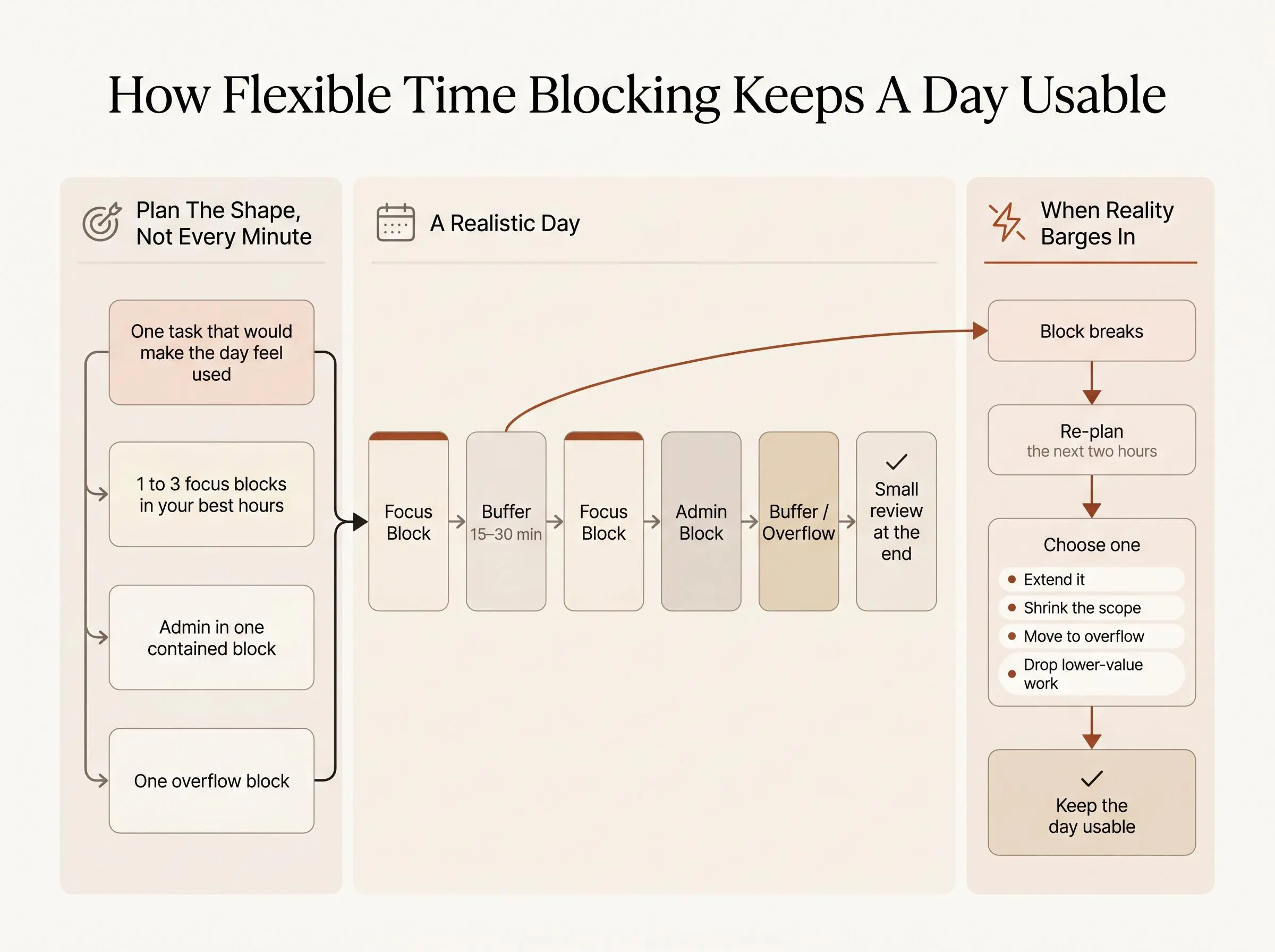
You don't need a full productivity system to try this. You need ten quiet minutes and slightly less ambition than usual.
Use this sequence:
Place non-negotiables first.
Classes, meetings, appointments, commuting, meals, care tasks. Put reality on the calendar before optimism.Choose one most-important task.
Ask what would make the day feel meaningfully used, even if a few other things slip.Keep a short supporting list.
Two to four smaller items is enough. Longer lists are often wish lists with better branding.Estimate in focus blocks.
Think in rough blocks, not false precision. "Two blocks for the draft" is better than "47 minutes."Place one to three focus blocks in your best hours.
Not every open hour deserves hard work. Put the demanding work where your attention usually cooperates.Contain admin.
Batch email, messages, and quick responses into one block so they stop leaking across the day.Add one overflow block.
Unfinished work needs somewhere to go other than the part of your brain that panics.End with a tiny review.
Note what got done, what moved, and what took longer than expected.
Three quick examples make this concrete:
- Student day: classes in the morning, one study block for the hardest subject after lunch, admin and messages later, short overflow block in the evening.
- Meeting-heavy work day: meetings fixed first, one protected morning block for the most important task, admin block after lunch, catch-up block near the end.
- Shifting-responsibility day: only one main block scheduled early, one admin block, larger buffer space because incoming issues are likely.
How to Make Your Schedule Realistic Instead of Beautiful
Most people don't need more ambition. They need better calibration.
Broad estimates usually beat hyper-specific ones for uncertain work. If a task might take 30 minutes or 90, pretending you know the exact number doesn't improve the plan. It just makes the failure arrive with more ceremony.
A realistic schedule starts with capacity, not fantasy:
- Not every open hour is usable for deep work.
- Transitions and mental recovery take real time.
- A short list is easier to finish, trust, and repeat.
This is where estimate-versus-actual review quietly changes everything. When you compare what you thought a task would take with what it actually took, planning gets less theatrical. Over time, your calendar starts reflecting real life instead of preferred life.
Humane expectations help too:
- One major task can be enough for a good day.
- Two strong focus blocks can beat a full day of fragmented effort.
- Admin work counts and should be scheduled openly, not treated as invisible background noise.
The point of flexible time blocking isn't compression. It's credibility. If you can't believe your own plan by 11:15 a.m., it was too ambitious.
What to Do When the Day Goes Off Script

This is where rigid systems usually fall apart. A better system needs a recovery move.
When a block breaks, use a simple decision tree:
- Extend it if the work is still high value and your energy is still there.
- Shrink the scope if the full task no longer fits.
- Move it to overflow if it matters but can't happen now.
- Drop or defer lower-value work without guilt.
For example, imagine you planned a 9:00–10:30 block to draft a report, but a meeting runs until 10:15. Don't try to squeeze the original plan into the remaining day. Ask three questions:
- Is the report still today's most important work?
- What is the smallest useful version you can complete in the next available block?
- If it cannot fit, where will it go in the overflow block?
You might shrink the task from "finish the report" to "write the outline and opening section," protect a 45-minute block after lunch, and move email to the later admin window. If the report is no longer urgent, defer it and use the available time for the next highest-value task instead.
That last one takes practice. People would rather preserve the fiction that everything still fits. It doesn't.
Minimum viable blocks help on chaotic days. If a full session is unrealistic, do a shorter one that keeps momentum alive. Fifteen focused minutes on the right thing is not glamorous. It is often the difference between staying engaged and mentally checking out.
A midday reset also works well, especially after a long meeting or interruption-heavy morning. Take five minutes. Re-block the rest of the day lightly. Don't try to rescue the original schedule. Replace it.
Flexible systems recover by rescheduling, not by pretending.
The emotional benefit is real. Adjustment keeps you moving without the shame spiral that usually follows a broken plan.
Time Blocking Alternatives That Still Protect Focus
Some people dislike tight scheduling on sight. Fair enough. There are good time blocking alternatives that still protect attention.
A few worth using:
Theme blocks
Good for unpredictable schedules. You reserve "deep work morning" or "admin afternoon" without over-specifying each task.Day theming
Useful when your work clusters naturally, like research on one day and meetings on another.Protected focus windows
Strong for hybrid or office work where interruption is the main enemy.Task batching
Best for repetitive, low-intensity work that expands if left scattered.Hybrid task list plus reserved blocks
A practical fit for many people. Keep a task list for everything, but reserve blocks only for the most important items.Rule-based planning
Simple rules like one most-important task, one admin block, one buffer block work surprisingly well when life is variable.
Students often do well with a hybrid approach because classes create a skeleton and study needs real protection. Support and operations roles usually need more buffers and fewer fixed deep-work assumptions. Creative work often benefits from theme blocks because output is variable and the work doesn't respect neat edges.
The best method is the one that stays intact under normal disruption, not the one that looks most disciplined.
What a Better Tool Looks Like Beyond a Standalone Timer
Once you've felt the limits of a plain timer, the next step isn't necessarily a bigger productivity system. Usually it's a better connection between planning and doing.
A useful tool should do a few things:
- attach the timer to a planned task
- show the plan before the session starts
- compare estimated and actual time
- make progress visible in a calm way
- show patterns across real days, not isolated countdowns
That's the category we built Flocus for. Our browser-based Daily Planner helps you choose one most-important task and keep the day intentionally short. The built-in Focus Timer starts from planned tasks, so a focus block is part of your day plan rather than a disconnected countdown. The daily Focus Ring, streaks, and recap-style insights make progress visible without asking you to adopt a heavy system.
It's a better fit for people who are done with aesthetic timers that never change their planning habits. The timer matters. The plan matters more.
For Readers Who Want to Measure Focus, Not Just Count Minutes
This part is optional. Most people do not need hardware to use flexible time blocking well.
Still, for neurotech-curious readers, there is a real difference between logged time and measured attention. Two 25-minute sessions can look identical on a timer while feeling completely different in actual concentration.
Our Flow Tracking works with a Muse headband. It runs a short calibration, then shows a live 0 to 100 flow score during work sessions and classifies states like Flow, Overload, and Low Engagement.
That can help in a few practical ways:
- you can spot which times of day support better focus
- you can see whether longer blocks help or start to drag
- concentration becomes more observable and less mysterious
We keep the positioning grounded on purpose. The planner works without hardware. EEG feedback is only relevant if you specifically want deeper focus measurement. For some people that's genuinely useful. For others, it's unnecessary complexity wearing a sleek face.
Common Mistakes That Undermine Calm Focus
Most calm-focus problems are not dramatic. They're small planning errors repeated daily.
Here are the common ones, with the fix attached:
Planning the whole day at full capacity
Fix: leave buffers and assume interruption is normal.Using the same block size for every task
Fix: match block length to the work. Writing and admin are not the same species.Treating the calendar as fixed when the work is uncertain
Fix: make movable blocks and re-block when things change.Scheduling deep work in low-energy hours
Fix: protect your best attention for your hardest work.Keeping too many priorities active at once
Fix: choose one most-important task and a short supporting list.Separating planning from execution
Fix: use a system where the timer starts from the task you planned, not from a blank countdown.Never reviewing estimated versus actual time
Fix: compare them regularly so your planning gets more honest.
None of this is about being stricter. It's about making your method believable enough that you'll keep using it.
Flexible Time Blocking FAQ
What is flexible time blocking?
Flexible time blocking assigns parts of the day to important work ahead of time while leaving room to adapt when tasks run long or interruptions occur. It creates a guide for the day without scheduling every minute.
Why does rigid time blocking often fail?
Rigid schedules can collapse when a task runs late, a meeting spills over, or an unexpected message needs attention. Once the schedule becomes obviously wrong, it becomes harder to trust. Flexible planning uses buffers and movable blocks so normal disruption does not invalidate the whole day.
How do you start flexible time blocking?
Start by placing fixed commitments on the calendar, choosing one most-important task, and keeping a short supporting list. Then schedule one to three focus blocks during your best hours, contain administrative work in its own block, add an overflow block, and briefly review what happened.
What should you do when the day goes off script?
Extend a block if the work remains valuable and your energy is available, shrink the scope if the full task no longer fits, move it to overflow if it still matters, or defer lower-value work. Re-block the remaining day lightly instead of trying to rescue the original schedule.
Conclusion
Calm focus doesn't come from harsher discipline. It comes from deciding what matters, protecting time for it, and adjusting honestly when the day changes.
That's the heart of flexible time blocking. One clear priority. A few protected blocks. Real buffers. Re-blocking instead of self-criticism. And ideally, a tool that connects planning with the focus session itself so the work is not floating free from the day.
If you want a grounded next step, try this tomorrow: choose one most-important task, block time for it in your best hour, add one buffer block, and review what actually happened before planning the next day.
Keep it that small.
Small plans survive.
Article Record
ReferencesPrimary sources used for this article
Update HistoryMeaningful revisions to this article
- Added four frequently asked questions to help readers understand flexible time blocking more easily.
- Added a practical example to show how to adjust time blocks when the day goes off script.
- Made it easier for readers to apply flexible time blocking during unexpected changes.