

Most people get flow state meaning wrong. They treat it like a rare mood, then wonder why a timer and a clean desk still leave them stuck.
What matters is less mystical and more practical. If you've tried focus apps and still end the day foggy, you need a working definition you can use mid-task.
Three things to notice while you work.
- A vague task keeps your brain busy deciding, not doing.
- A task that's too easy makes you drift, and one that's too hard makes you dodge it.
- If progress is hard to see in the moment, focus breaks fast. Fix that, and you can finish something that matters.
What Flow State Meaning Actually Refers To
When people look up flow state meaning, they're usually asking a simple question: what does this actually feel like in real life, not in a TED Talk. Fair question.
Flow is a state of full absorption
Flow is not a personality trait. It doesn't belong to a lucky subset of naturally focused people. It shows up more often when a few conditions are in place. A review by Joshua Gold and Joseph Ciorciari describes flow as deep absorption in a task, often accompanied by smooth performance and a changed sense of time. It also highlights clear goals, immediate feedback, and a balance between challenge and skill as central conditions.
Clear goals
Your brain settles faster when it knows what success looks like for this block of work. "Work on research" is vague enough to cause drift. "Draft the methods section" is much better.
Immediate feedback
You need some way to tell whether you're moving. That could be solved problems, reviewed pages, a cleaner outline, tested code, or paragraphs on the page. Waiting days to know if a session mattered makes concentration fragile.
Skill-challenge balance
This is the old idea for good reason. Flow likes work that stretches you without flooding you. Too little challenge is dull. Too much challenge becomes avoidance dressed up as perfectionism.
Focused attention
This one's less glamorous and more decisive. Flow depends on sustained concentration. If you're re-entering the task every four minutes after messages, tabs, or context switches, the state usually never has time to form.
A sense of control
Not total control. Just enough. You need some room to decide how you'll approach the task. Over-fragmented work, where every step is externally interrupted or micromanaged, tends to break immersion before it starts.
Intrinsic reward
In flow, the work begins to feel worth doing in itself. Not forever. Not every day. But during the session, the task becomes more than a means to an end.
One useful nuance: effort is not the opposite of flow. Some of the best flow sessions are demanding. You still have to exert yourself. It just feels coherent instead of chaotic.
Signs You Are in a Flow State
The usual question isn't whether flow exists. It's whether you're actually in it or just working quietly for once.
The signs of flow state are usually pretty observable once you stop expecting fireworks.
- You stop checking the clock so often.
- Time feels faster, or at least less jagged.
- Your attention feels less divided.
- You're not negotiating with yourself every few minutes.
- The next step seems clear enough to keep moving.
- Self-consciousness drops. You're doing the work, not monitoring yourself doing the work.
- The task still takes effort, but it feels smoother.
- You feel engaged, not frantic.
- Progress becomes easier to feel in real time.
That last one is useful. Flow has a cleaner mental aftertaste than panic work. Deadline adrenaline can look productive from the outside, but it usually feels sharp, noisy, and a bit ugly. Flow is quieter than that.
If you finish a session and feel mentally used in a good way, not just depleted, that's often a clue.
Flow vs. Deep Focus, Hyperfocus, and Deep Work
These terms get blurred together, which makes the whole topic less useful than it should be.
Deep focus is the broad category. Flow is a specific kind of deep focus state inside that category. It includes absorption, challenge, and a sense that the work is carrying itself forward.
Hyperfocus is different
When people ask what is flow state at work, they usually get examples from sports or music. Fine, but most of us need the office version.
Flow at work can show up while:
- drafting a report or essay section
- coding through a defined feature or bug
- editing a dense piece of writing
- analyzing a dataset with a clear question
- designing a screen or system with visible constraints
- working through a difficult problem set
- doing focused research where each source changes the next move
The common thread is not creativity alone. Structured analytical work can produce flow just as well. Sometimes better, because the feedback is clearer.
Flow at work usually appears when one meaningful task is defined tightly enough to absorb you. It rarely appears in inbox triage, meeting-heavy days, or jobs with fuzzy ownership and vague finish lines. Those modes ask for responsiveness, not immersion.
Autonomy helps too. If you have some control over how to approach the task, concentration settles faster. If every few minutes require checking, responding, or waiting, the state tends to evaporate.
Not every hour needs to be optimized for flow, by the way. Work also includes planning, admin, communication, and recovery. Trying to turn expense reports into a transcendent experience is probably unnecessary.
Why Flow Feels So Rare in Modern Work
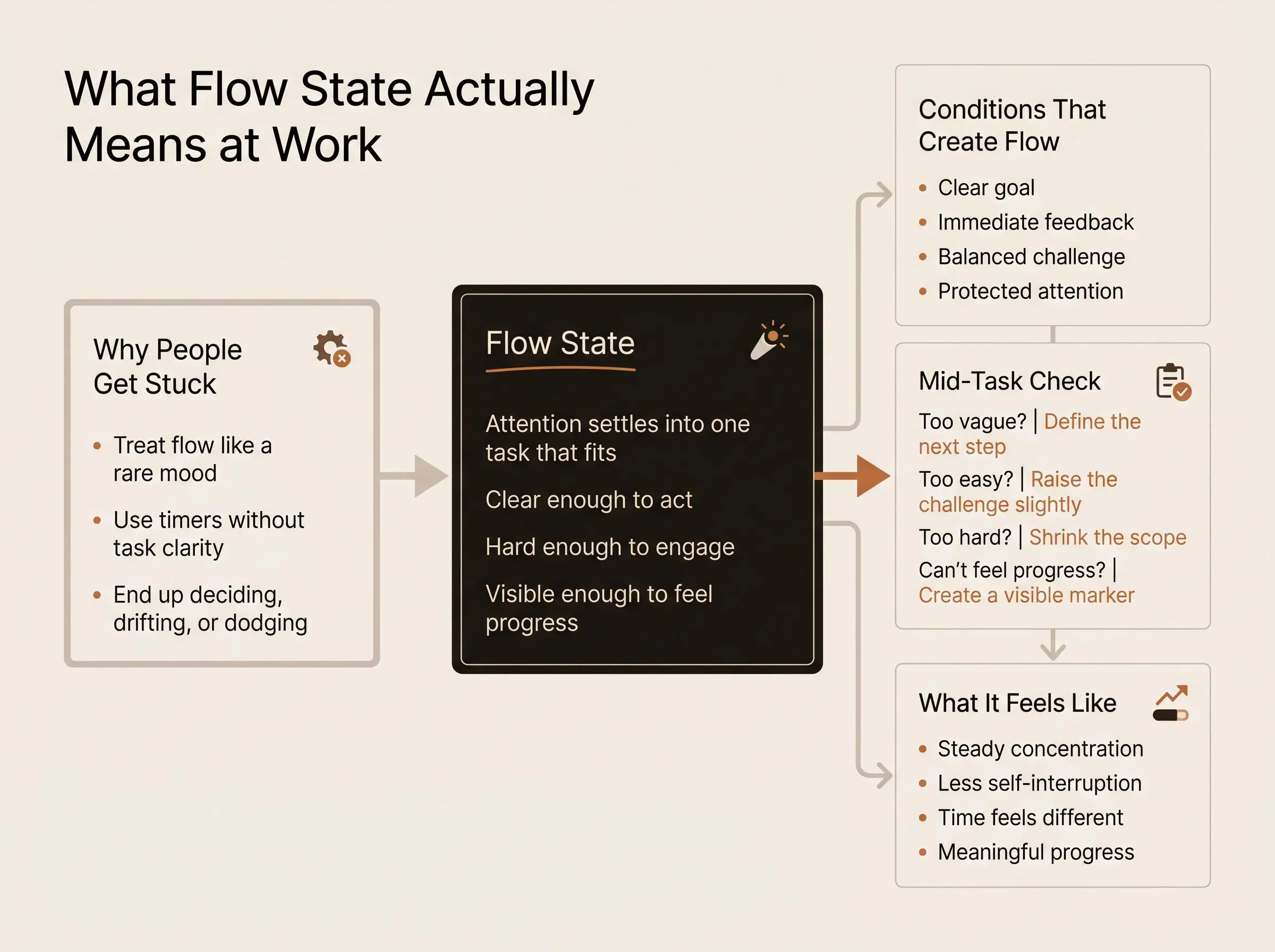
If you've tried a bunch of timers and still feel scattered, you're not broken. Your setup is probably doing what modern setups do.
Flow gets harder when your day contains too many open loops and no single priority. Attention doesn't know where to land, so it keeps hovering.
A few common blockers do most of the damage:
- constant task switching, which forces full cognitive restarts
- unclear tasks, where "done" is undefined
- weak feedback loops, so effort doesn't visibly turn into progress
- challenge that's mismatched to skill, in either direction
- low autonomy and heavy collaboration overhead
- notifications, pings, and ambient digital noise
The emotional trap is that people often read these structural problems as personal failure. They assume they lack discipline, when the real issue is that their work is shaped like interruption.
We've seen this a lot. A plain timer can count minutes, but it can't tell you what deserves those minutes. Without that planning layer, focus stays abstract.
How to Get Into Flow at Work Without Waiting for a Perfect Mood
You don't need a special feeling to begin. You need a repeatable sequence.
- Choose one most-important task. Not five worthy tasks. One destination.
- Shrink it to a visible target. Draft one section. Solve one set. Clean one analysis pass.
- Set a time boundary. Give the session a defined length so resistance stays smaller than the task.
- Remove reentry friction. Open the files, gather inputs, close the irrelevant tabs before you start.
- Build in feedback. Use something you can see moving: word count, pages reviewed, problems solved, sections completed.
- Adjust the challenge. If you're overloaded, reduce scope. If you're bored, raise the standard a little.
- Treat the first minutes as a runway. Early friction is normal. It is not proof the session is failing.
This is where planning-first tools help more than bare countdowns. If a timer alone hasn't changed much for you, that's not surprising. Deciding the task before the session often matters more than the clock itself.
That's part of how we built Flocus. One most-important task, timed focus blocks, and a brief reflection after. Calm structure. Nothing theatrical.
A short, honest session teaches you more than a forced marathon.
How to Adjust the Task When You Are Bored, Anxious, or Stuck
Flow won't appear every time. That's normal. The useful move is to adjust the task, not start judging your character.
If you're bored
Raise the challenge slightly. Tighten the target, improve the quality bar, or compress the time window. Boredom often means the task is too loose, not too small.
If you're anxious
Reduce the challenge. Make the first unit smaller. Review examples. Start with a partial version instead of the whole thing. Overwhelm loves vague scale.
If you're stuck
Improve feedback. Pick a version of the task where progress is easier to see moment by moment. "Research topic" is sticky. "Extract five useful sources and note the claim from each" moves.
If you're resisting
Check whether the task is ambiguous rather than difficult. A lot of "I don't want to do this" really means "I don't know what counts as done."
The sweet spot is usually between boredom and overload, and it moves.
One more nuance worth keeping: needing to exert real effort does not mean you're outside flow. Subjective flow often tracks demanding work. If it feels hard but coherent, you're probably closer than you think.
How to Build a Repeatable Work-in-Flow Routine

One good session is nice. A routine you can trust is better.
Start the day by naming one priority important enough to protect. Then pair it with a limited focus block, not a vague promise to "get to it later." Later is where good intentions go to become browser tabs.
A workable routine usually includes:
- one clear priority
- a defined focus block
- estimated versus actual time tracking
- a visible completion cue
- a brief note at the end so tomorrow's start isn't cold
That time estimate part matters. Planning gets more honest when you can compare what you thought with what actually happened. Otherwise productivity systems become fantasy novels.
Visible closure helps too. A progress ring, a streak, or a short end-of-session note gives the day shape. Closing the loop makes it easier to return tomorrow with less friction.
This is where a lightweight system beats a heavyweight one. In Flocus, the method is simple: choose the most-important task, work in timed blocks, log estimated versus actual time, then close the ring. The free planner is enough to make the structure usable. The point isn't to manage your life with ornate dashboards. It's to make focus happen on purpose.
Can Flow Be Measured or Only Felt
Flow can be felt, described, and sometimes measured, but no single method captures the whole thing perfectly.
Most flow research still leans on self-report because subjective absorption is central to the experience. If someone says they felt deeply engaged, that matters. It's not fluff. It's part of the state.
There are also behavioral clues, like sustained task engagement and reduced switching, plus neurophysiological approaches that try to measure patterns associated with focused work. That's promising, but real-world measurement is still hard and depends a lot on context and task type.
It's also worth being careful here. Sometimes what people report and what one physiological signal shows don't line up neatly. That's not failure. It just means human attention is messier than a single score.
For readers who are neurotech-curious, Flocus can connect with a Muse EEG headband to track flow state in real time while you work. We think of that as a pattern-finding tool, not a verdict. Useful questions are things like: when do you settle faster, what kinds of tasks produce steadier focus, what breaks it by minute twelve?
Measured focus is helpful when it teaches you your conditions. Less helpful when it becomes another number to obsess over.
Common Myths About Flow That Make Deep Focus Harder
Bad assumptions make good work harder than it needs to be.
Myth: flow is magical.
It's not. It's a state supported by structure, challenge, feedback, and protected attention.Myth: flow means zero effort.
No. Good flow often feels demanding. Smooth does not mean easy.Myth: if you're not in flow, the session was pointless.
Wrong standard. Many useful sessions are simply steady and decent.Myth: more hours create more flow.
Usually they create more drift unless the work is shaped well.Myth: only artists, athletes, or naturally disciplined people can work in flow.
Ordinary knowledge work can produce flow all the time when the task is clear.Myth: the right app or gadget can produce flow on its own.
Tools help, but they can't rescue vague goals or scattered attention.
The correction is almost always the same: return to the task itself. Is it clear? Is it the right size? Can you see progress? Can your attention stay with it long enough?
When Flow Is Not the Goal
Not all useful work should aim for peak immersion. Some work just needs doing.
Administrative tasks, coordination, basic review, and early-stage learning often benefit more from consistency than from trying to enter a deep focus state. Recovery matters too. Flow is less likely when you're chronically depleted, even if your planner looks very impressive.
There's also a subtle trap here. Chasing flow every hour can become another form of pressure, which is a reliable way to make concentration worse.
A calmer standard works better: use flow when it fits, use structure when it doesn't, and judge the system by whether it helps you finish meaningful work with less chaos.
That bar is high enough.
Conclusion
The practical flow state meaning is straightforward: one clear task, enough challenge to stay engaged, immediate feedback, and protected attention long enough for your mind to settle.
You don't need to wait for perfect motivation. Deep focus grows from conditions you can shape. The mood often follows the structure, not the other way around.
If you want to test this today, keep it simple. Choose one most-important task. Give it a clear time boundary. Notice what makes concentration easier to hold, and what breaks it. Then adjust tomorrow with slightly better information.
That's usually how flow starts. Not dramatically. Just more reliably than before.
Article Record
ReferencesPrimary sources used for this article
- A Review on the Role of the Neuroscience of Flow States in the Modern World
- Frontiers | A Scoping Review of Flow Research
- A framework for neurophysiological experiments on flow states | Communications Psychology
- Disentangling the effects of task difficulty and effort on flow experience | Psychological Research | Springer Nature Link
- Psychological Flow Scale (PFS): Development and Preliminary Validation of a New Flow Instrument that Measures the Core Experience of Flow to Reflect Recent Conceptual Advancements | International Journal of Applied Positive Psychology | Springer Nature Link
- Flow and the dynamics of conscious thought
- Effects of goal-setting on sustained attention and attention lapses
Update HistoryMeaningful revisions to this article
- Added research-based evidence to the section explaining what flow state means, making the guide more reliable and informative.