
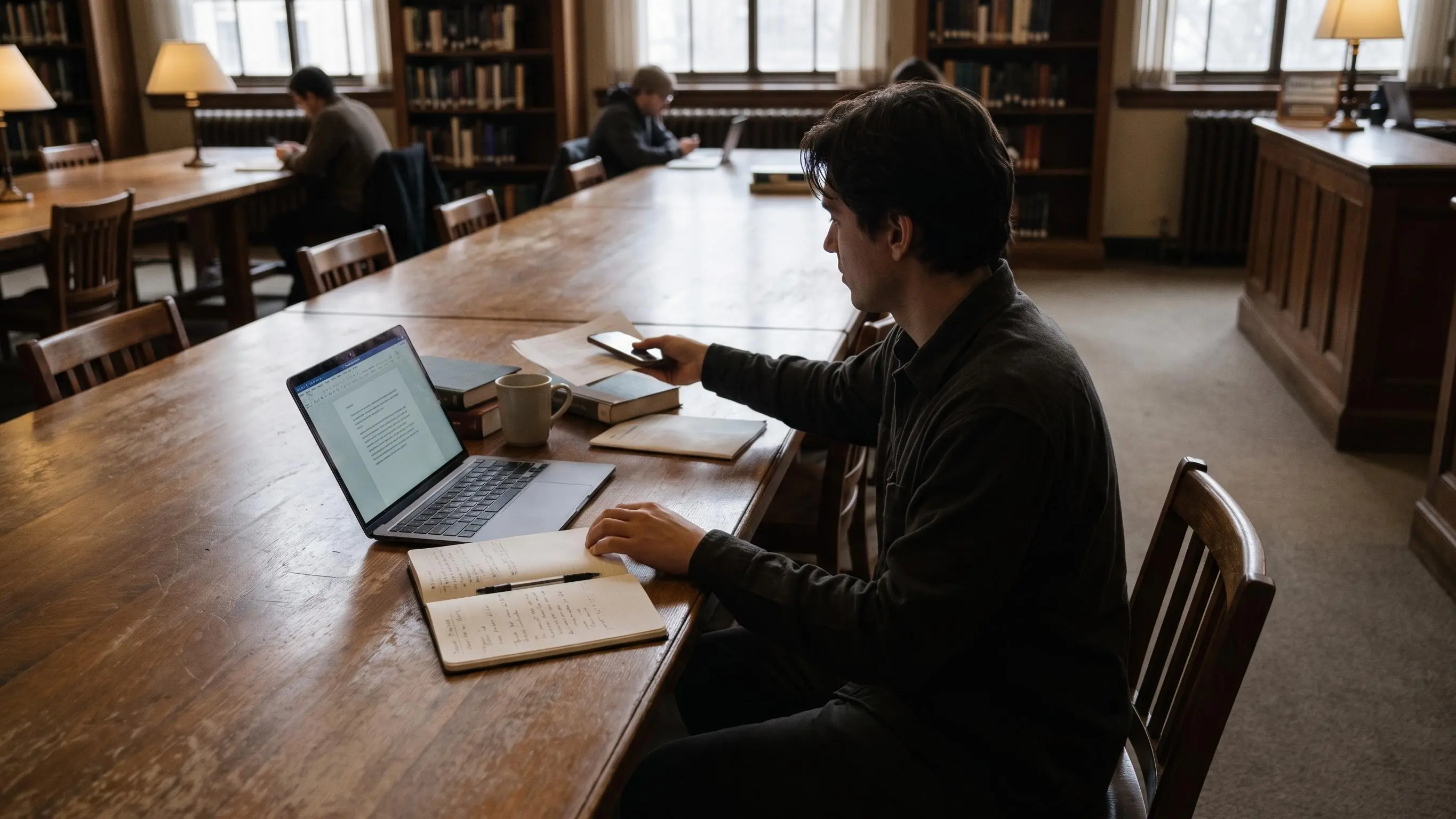
Most advice on how to get into a flow state tells you to try harder, which is usually the problem. You sit down, mean well, then drift into tabs, messages, or fake prep.
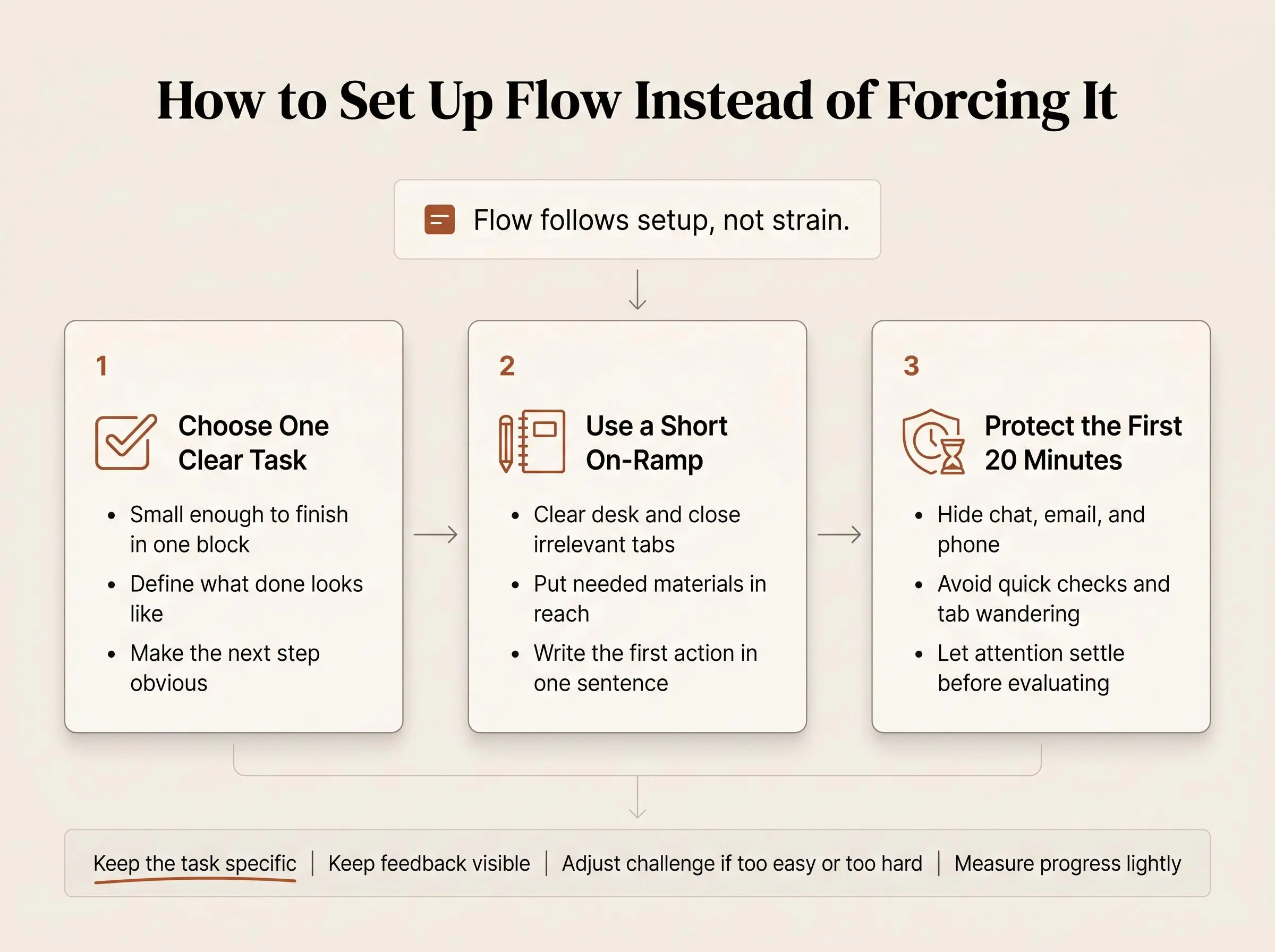
What matters is the setup: one clear task, a short on-ramp, and enough protection for your attention to settle. We don't need intensity. We need less friction.
Start here.
- Pick a target small enough to finish in one block.
- Hide chat, email, and your phone before the first 20 minutes.
- If the work feels vague, make the next step obvious. Then begin.
Why Trying Harder Usually Backfires
You sit down to do something important. You know exactly why it matters. Then, somehow, you're checking messages, rearranging notes, opening a tab you don't need, and telling yourself you'll start properly in a minute.
Most people assume the fix is more willpower. It usually isn't. Flow doesn't show up because you strain hard enough. It tends to appear when friction drops, the task gets clear, and your attention has something clean enough to lock onto.
Forcing focus creates a strange problem. The more you try to make yourself focus, the more you watch yourself trying. That brings in self-monitoring, second-guessing, and irritation. None of those are useful if you're trying to reach deep focus.
Flow likes a clean runway, not a pep talk.
So if you've been wondering how to get into a flow state, the better question is not "How do we command it?" It's "How do we make it easier for attention to settle?"
That's the whole game here. Not intensity for its own sake. Not hustle culture in a nicer font. Just a calmer, more repeatable way to do meaningful work.
What a Flow State Actually Is
Flow gets talked about like it's mystical. It isn't. It's a real, recognizable state of deep absorption where attention narrows, self-consciousness quiets down, and the work starts to feel smoother than it did ten minutes earlier.
It's important to separate the conditions for flow from the feeling of flow itself.
The conditions are things you can set up:
- a task that's challenging but not crushing
- a clear goal
- feedback you can use right away
The experience is what follows if those conditions hold:
- strong concentration
- a sense of control
- less self-judgment
- time feeling a bit strange
That distinction matters because people often chase the feeling and ignore the setup.
Flow also isn't the same as ordinary concentration. You can concentrate on email. That's not the same thing. Deep work is closer, but deep work is a way of structuring work so deeper attention becomes possible. Flow is the state that sometimes emerges inside that structure.
Hyperfocus is different too. It can feel intense, but it isn't always intentional, skill-matched, or even useful. Anyone who's spent 45 minutes obsessing over formatting instead of writing knows this.
Part of why flow feels so different is that the inner commentator gets quieter. You're less busy evaluating yourself, so the task takes up more of the mental space. That's why time can vanish and effort can feel lighter, even when the work is hard.
And flow is rewarding in its own right. That's not a trivial detail. When the work itself starts to feel engaging, persistence gets a lot less theatrical.
The Conditions for Flow You Can Actually Design
Flow is not a personality trait. It is much more responsive to design than people think.
A review by Gold and Ciorciari describes several classic conditions associated with entering flow: a balance between challenge and skill, clear goals, and immediate feedback. That gives the idea a practical shape: instead of waiting for the right mood, adjust the task and its surroundings.
The first condition is the challenge-skill balance. Too easy, and boredom takes over. Too hard or too vague, and anxiety shows up wearing the outfit of procrastination. Flow tends to live in the narrow middle where the task stretches you without flooding you.
Vagueness is a bigger blocker than most people realize. "Write the report" is not a usable target. Neither is "study biology." Your brain can't grip a fog bank.
Compare those with:
- draft the opening section of the report
- finish ten practice questions on cell transport
- outline the three arguments for the proposal
- summarize one lecture from memory
Those are specific enough to begin. Beginning is underrated.
Clear goals and immediate feedback are non-negotiable. You should know what success looks like for the next block, not vaguely by the end of the week. And you should be able to tell whether you're making progress without waiting for external approval.
There's another factor people skip: meaning. Work that feels connected to a real outcome is easier to stay with. Not always fun. Just relevant. That matters more than people admit, especially by the second afternoon.
Recent research also points to effort as part of the picture, not just difficulty. Flow seems to track the effort you're able and willing to invest, not only the objective hardness of the task. In practice, that means the same task can be well-matched on one day and badly matched on another.
So the useful question becomes:
- Is the task clear?
- Is it active?
- Is it the right size for my current capacity?
- Can I tell if I'm progressing?
If not, don't diagnose your personality. Fix the setup.
Start With One Task, Not a Mood
A lot of people wait to feel ready before they begin. That's backwards. Start with one task.
Choosing a single most-important task works because it reduces ambiguity fast. It gives your attention one place to go. That makes it easier to enter flow state while working or studying than trying to summon the right mental weather first.
To shrink a project into a block-sized target, do this:
- Name the next visible deliverable
- Define what done looks like for this session
- Remove side quests
For work, that might be: draft the first two sections of a proposal.
For studying, it might be: solve one chapter's worth of practice problems and mark the ones you missed.
That's enough. Not elegant. Just usable.
One-task focus helps the brain calibrate challenge, cuts down switching, and makes the work feel finite enough to begin. A finite task is less threatening than an ambitious blur.
We also recommend estimating how long the block should take before you start, then comparing estimated versus actual time afterward. It sounds small. It isn't. It makes planning more honest over time. Most people don't just lose focus. They lose track of scope.
This is why our approach at Flocus starts with planning, not just a timer. You choose one most-important task, run a timed block against that plan, and compare estimated versus actual time after. That small loop turns focus from a vague hope into something you can repeat without pretending every day will feel the same.
Use a Short On-Ramp Instead of Waiting to Feel Ready
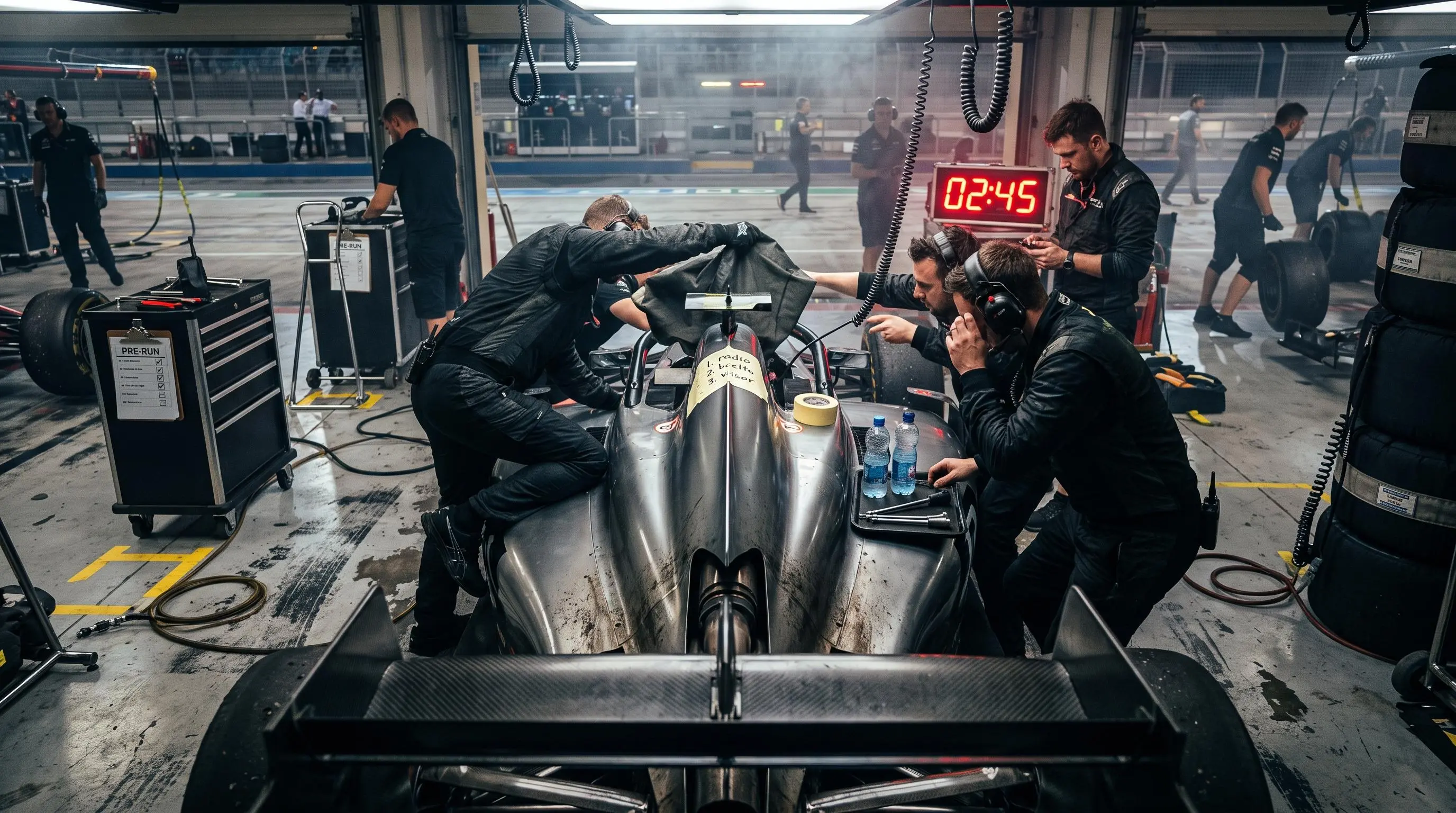
A focus ritual is useful if it reduces friction. If it becomes a performance, it's decoration.
Your on-ramp should be short and repeatable:
- clear the desk
- close irrelevant tabs
- put the needed materials in reach
- set water, headphones, notes, or timer in place
- write the first action in one sentence
That last one does more than people expect. "Open the draft and write the first paragraph under heading two" is much better than "work on draft." Specificity lowers resistance.
The ritual should be simple enough to survive real life. If it takes 18 minutes, requires perfect lighting, and depends on the exact right playlist, it's not a ritual. It's a hostage situation.
The first minutes of hard cognitive work often feel awkward. That's normal. Attention doesn't always click into place at minute one. Many people quit during the ugly part, right before things would have settled.
Use a timer for the start, but use it properly. Commit to the first stretch without evaluating quality. The timer is there to hold the discomfort, not to pressure you into brilliance.
Useful focus rituals for flow tend to be boring in a good way:
- same seat
- same playlist or silence
- same start phrase
- same first action
- same block length when possible
Boring is fine. Predictable is efficient.
Protect the First 20 Minutes Like They Matter
They do matter. Early attention is fragile.
During the ramp-up phase, even small interruptions can be expensive. Research on interruptions often gets quoted because it's memorable, but the practical point is what matters: after a disruption, it can take an average of 23 minutes and 15 seconds to fully re-engage with the original task.
That's not a reason to become monastic. It's a reason to stop pretending quick checks are free.
For the first stretch, keep it plain:
- silence notifications
- hide chat and email
- keep your phone out of reach
- avoid wandering the browser with no defined purpose
You're not aiming for purity. You're trying to avoid resets.
When interruptions are unavoidable, leave a breadcrumb before switching. Write one line that names the exact next step. Not "continue later." Something like "next: compare paragraph three to source notes and cut repetition." Re-entry gets much faster when your past self bothers to be useful.
A lot of focus problems are framed as motivation problems. Often they're environment problems with good PR.
How to Enter Flow State while Working or Studying
The mechanics differ a bit between work and study, but the principle is the same. Make the task specific, active, and feedback-rich.
For knowledge work, a simple playbook works well:
- define the output before the block
- gather the few materials you actually need
- start with a concrete subtask that creates visible movement
- keep feedback close, like a draft expanding or a checklist shrinking
Visible movement matters. A task feels more absorbing once it has shape.
For flow state for studying, active work beats passive review almost every time. Try:
- practice questions
- problem sets
- flashcards
- summarizing from memory
- explaining concepts aloud
Passive rereading often fails because it's too low-challenge. It can feel studious while giving your attention very little to do.
If the task misses the challenge-skill band, adjust it instead of grinding harder.
If it's too easy:
- add a constraint
- set a tighter deadline
- use a harder problem set
If it's too hard:
- narrow the scope
- pull up one example
- do one setup step first
And yes, you can still enter flow state while working in imperfect environments. Negotiate a focus window. Batch responses to messages. Use one block for creation and another for communication. Mixed-mode work is where attention goes to die.
What to Do When Flow Does Not Arrive
A missed flow session is not a failed session. Sometimes the useful win is that you stayed with the block long enough to learn what was off.
The most common blockers tell you something if you listen closely:
- Boredom usually means the task is too easy or too passive
- Anxiety often means it's too large, too fuzzy, or wrong for your current energy
- Restlessness tends to mean unresolved distractions or too many open loops
- Flatness can mean the task feels pointless, or you're simply depleted
The move here is adjustment, not self-criticism.
Try one of these:
- make the target smaller
- clarify the goal
- add feedback
- raise or lower the challenge
- take a real break if energy is the issue
A simple reset decision rule looks like this:
- If you keep avoiding the first step, rewrite the target as one visible action.
- If you start but drift, remove one distraction and make progress measurable.
- If the work feels dull, add a constraint or switch to active problem-solving.
- If you feel tense or stuck, narrow the scope and use one example to get moving.
- If you're rereading the same material or making careless errors, stop and take a real break.
For example, if your plan is to "study biology" and you keep checking your phone, don't demand more discipline. Rewrite the block as "answer five cell-transport questions without notes, then review the missed answers." Put the phone away, start with the first question, and reassess after the block. The goal is not to manufacture flow. It's to make the next attempt clearer and better matched.
Planning and active problem-solving generally support flow better than vague attempts to "calm down and hope." That's not because calm is bad. It's because attention usually responds better to structure than persuasion.
Also, not every block has the same job. Some blocks are for entering. Some are for momentum. Some are for maintaining a state that's already there. Treating all of them like they should produce perfect absorption is a good way to get annoyed for no reason.
Maintain Flow Without Squeezing It Too Hard
Once flow starts, the job changes. You're no longer trying to enter. You're trying not to break it.
Keep feedback immediate. Work from a checklist. Watch the paragraph count grow. Keep the next move visible. Flow likes continuity.
What tends to break the state is over-monitoring. Constantly checking the time, your messages, or whether you're "doing well enough" pulls you back into self-consciousness. That's the wrong direction.
A few small habits help:
- finish the thought before stopping
- note the next step before a short break
- don't switch tasks the second you feel a little progress
That last one catches people. They finally get traction, then celebrate by checking something else. Momentum is easier to lose than to rebuild.
Recovery matters too. Flow is not supposed to last all day without pause. Hard mental effort needs a stop point, a brief reflection, and a reset so the next block is still possible.
Measure Progress Without Turning Focus Into a Scoreboard
Visible feedback helps because it gives the brain direction without requiring constant motivation. You don't need to feel inspired if the path is visible.
Useful metrics are light:
- did you complete the block target?
- how long did it take to settle in?
- what interrupted you?
- did the task feel too easy, too hard, or well-matched?
That's enough to learn from. More data isn't always more clarity.
Simple cues work well too. A completed block. A closed loop. A visual sign that the day moved forward. In Flocus, the daily progress ring, reflections, and weekly insights do this quietly. They help you notice patterns in when focus comes easily and when it doesn't, without turning the whole day into a ranking exercise.
For the smaller group who already own a Muse headband or are curious about measured focus, neurofeedback can be useful as a mirror. Not magic. It won't create flow for you. But seeing your state in real time can help you notice which tasks, times, and setups actually support absorption instead of guessing.
Measured focus is still feedback. It doesn't replace judgment.
Mistakes That Keep People From Reaching Deep Focus
Most focus problems are less dramatic than they look. A few common mistakes quietly ruin the setup.
- Treating flow like a mood you have to chase instead of a condition you can build
- Choosing tasks that sound ambitious but are undefined
- Confusing aesthetic setups or plain timer apps with a full focus method
- Making the ritual so elaborate that it adds friction
- Interrupting yourself during the fragile ramp-up phase for "quick" checks
- Expecting every session to feel effortless from the start
- Ignoring recovery and then assuming you've lost the ability to focus
- Counting minutes without deciding what those minutes are for
That last one deserves a hard look. A timer can track time. It can't choose the right task, size the block, or tell you whether your plan made sense. Minutes are not a method.
Conclusion
If you want to know how to get into a flow state, stop trying to force the feeling. Shape the conditions that let attention deepen on its own.
The method is simple on purpose: choose one meaningful task, define a block-sized target, use a short ritual, protect the first stretch, and let visible progress do some of the work. That's how you build a calmer path to deep focus, whether you're trying to reach deep focus at work or build a better flow state for studying.
Start small today.
Pick one task that matters. Give it one protected block. Notice what helps your attention settle. Repeat the parts that work.
That's usually enough to begin.
Article Record
ReferencesPrimary sources used for this article
- Frontiers | A Scoping Review of Flow Research
- A Review on the Role of the Neuroscience of Flow States in the Modern World
- Disentangling the effects of task difficulty and effort on flow experience | Psychological Research | Springer Nature Link
- Frontiers | Fostering flow experiences at work: a framework and research agenda for developing flow interventions
Update HistoryMeaningful revisions to this article
- Added a practical example to show readers what to do when flow does not come naturally.
- Made the advice easier to apply during moments when focus feels difficult.
- Added research from a named expert source to explain how readers can create better conditions for entering a flow state.