
Most people look for brain training for focus when the real problem is simpler: too many tabs, fuzzy tasks, and no clear finish line. You don't need more pressure. You need a steadier way to start and stay with one thing.
What matters in practice is boring, which is good. Clear priority, one contained work block, and a quick reality check after. Start here:
- Pick one task that actually matters today, not seven "top priorities"
- Estimate the block before you begin, then compare it with what the work really took
- Track drift, restarts, and finish points so your focus gets easier to trust
Why Focus Problems Feel Personal Even When They Are Mostly Structural
If you keep ending the day with twelve tabs open, three half-started tasks, and a vague sense that you were busy but not especially useful, it’s easy to make it moral. You tell yourself you need more discipline. More grit. A better personality, somehow.
Usually, that’s the wrong diagnosis.
Focus is a state. It changes with workload, task clarity, sleep, switching, interruption, and whether your brain has any clean signal about what matters right now. Modern study and knowledge work ask working memory to do too much at once. Hold the goal. Ignore the notification. Remember where you were before the meeting. Recover after checking one “quick thing” that becomes six.
That strain feels personal because you experience it from the inside. But vague to-do lists and constant task switching create mental noise that would rattle almost anyone. A messy workday often gets misread as a character flaw.
Pressure is a poor focus strategy.
The useful shift is this: concentration is trainable, but not mainly through force. Better focus usually comes from better task design and better feedback. When you reduce internal competition, define the work more clearly, and review what actually happened, attention stops feeling random. Not perfect. Just less mysterious.
What Brain Training for Focus Actually Means
Brain training for focus sounds grander than it needs to. In practice, it means repeated practice that improves how you direct and hold attention during real work.
That includes more than brain games. We’d define it more broadly as any repeatable method that helps you stay engaged with a chosen task, resist unhelpful switching, recover after distraction, and notice when effort quality is falling off.
A few parts matter most:
- Working memory: keeping the relevant goal or information in mind long enough to use it
- Inhibitory control: not following every urge to switch tabs, check messages, or rewrite the plan mid-block
- Cognitive flexibility: changing tasks deliberately when needed, not reactively because the current one got uncomfortable
- Fatigue management: noticing when you’re still “working” but the quality has quietly dropped
That last one gets ignored. A lot of people don’t lose focus all at once. They just get steadily fuzzier by the second afternoon block and keep pushing because the timer is still running.
It also helps to separate training the brain from stimulating the brain. Brain training for focus is about building better attention habits and conditions through repetition. It is not the same as trying to jolt yourself into performance with novelty, stress, or gadgetry.
The best form of training is usually specific. If you want to study better, the method should improve studying. If you want to write or analyze better, it should show up there. We’re less interested in promises that make you “smarter overall” and more interested in whether you can start cleanly, stay with the work, and drift less.
What the Research Says and What It Does Not Say
The research here is worth taking seriously, but not worshipping. The honest version is mixed.
Cognitive training studies do show useful effects, especially for tasks close to what people actually practiced. One large review found small overall improvements in working memory after training, around 0.18 standard deviations. That’s not nothing, but it’s modest. When the assessment looked a lot like the training task, effects became much larger, around 1.15 standard deviations. That points to strong near-transfer and a very old problem: people often get better at what they rehearse.
That distinction matters.
- Near-transfer means practice helps on similar tasks
- Far-transfer means practice helps on very different tasks or in broad life performance
Near-transfer shows up more reliably. Far-transfer is much less settled. Broad gains in fluid intelligence have not been found consistently enough to sell brain training as a guaranteed path to becoming generally smarter. We wouldn’t.
A practical summary from Harvard Health Publishing is similarly cautious: evidence for computerized cognitive-training games is mixed. Its guidance also notes that progressively practicing sustained attention may strengthen attention and may translate to everyday life. That supports using repeatable, task-relevant practice without promising that every brain game produces broad cognitive gains.
Some studies do suggest improvements in executive functions like working memory, inhibition, and cognitive flexibility. Some serious game and executive function training studies find that these gains can extend a bit beyond the exact trained task. But the picture doesn’t stay tidy for long. Some adaptive working memory training studies found no meaningful transfer to untrained tasks or brain changes. Other executive n-back studies found broader transfer to things like operation span and task switching, with benefits still visible after three months.
Age and context may shape outcomes too. Younger and older adults don’t always show the same transfer patterns across tasks.
So what do you do with all that? Don’t ask a method to prove that it transforms cognition in some grand way. Judge it by whether it improves actual work. Cleaner starts. Better follow-through. Less drift. Fewer days where your effort disappears into administrative fog.
That standard is less glamorous. It’s also more useful.
Why Most Brain Training Advice Misses the Planning Layer
A lot of focus advice assumes the hard part is sitting still. Often the harder part is deciding what deserves your attention in the first place.
A standalone timer can help with time boxing. It cannot solve confusion about priority, scope, or task definition. If the task is fuzzy, the timer just puts a countdown next to fuzziness. You can spend twenty-five minutes being sincerely unclear.
That’s why we see planning as part of brain training for focus, not a separate admin chore. Good planning reduces cognitive load before the work even starts. When you choose one most-important task, you lower the number of goals competing in working memory. The brain gets a cleaner target.
Estimating work before you begin matters for the same reason. It forces contact with reality. If a task can’t be estimated in blocks or minutes, it’s often too big or too vague to focus on well. “Work on report” is not a task. “Draft the findings section in two blocks” is at least something the mind can grip.
There’s another benefit people miss: comparing estimated time with actual time trains metacognition. You get better at seeing your own patterns. Which tasks expand. Which ones trigger avoidance. Which ones looked small and weren’t.
A planner-first setup helps because it keeps the work block attached to a real task. In the Flocus Daily Planner, the built-in Focus Timer starts from the task you planned, not from a disconnected countdown floating in space. That sounds minor. It isn’t. A timer without a plan often turns into a theatrical version of productivity.
The Calm Method: One Priority, One Block, One Honest Review
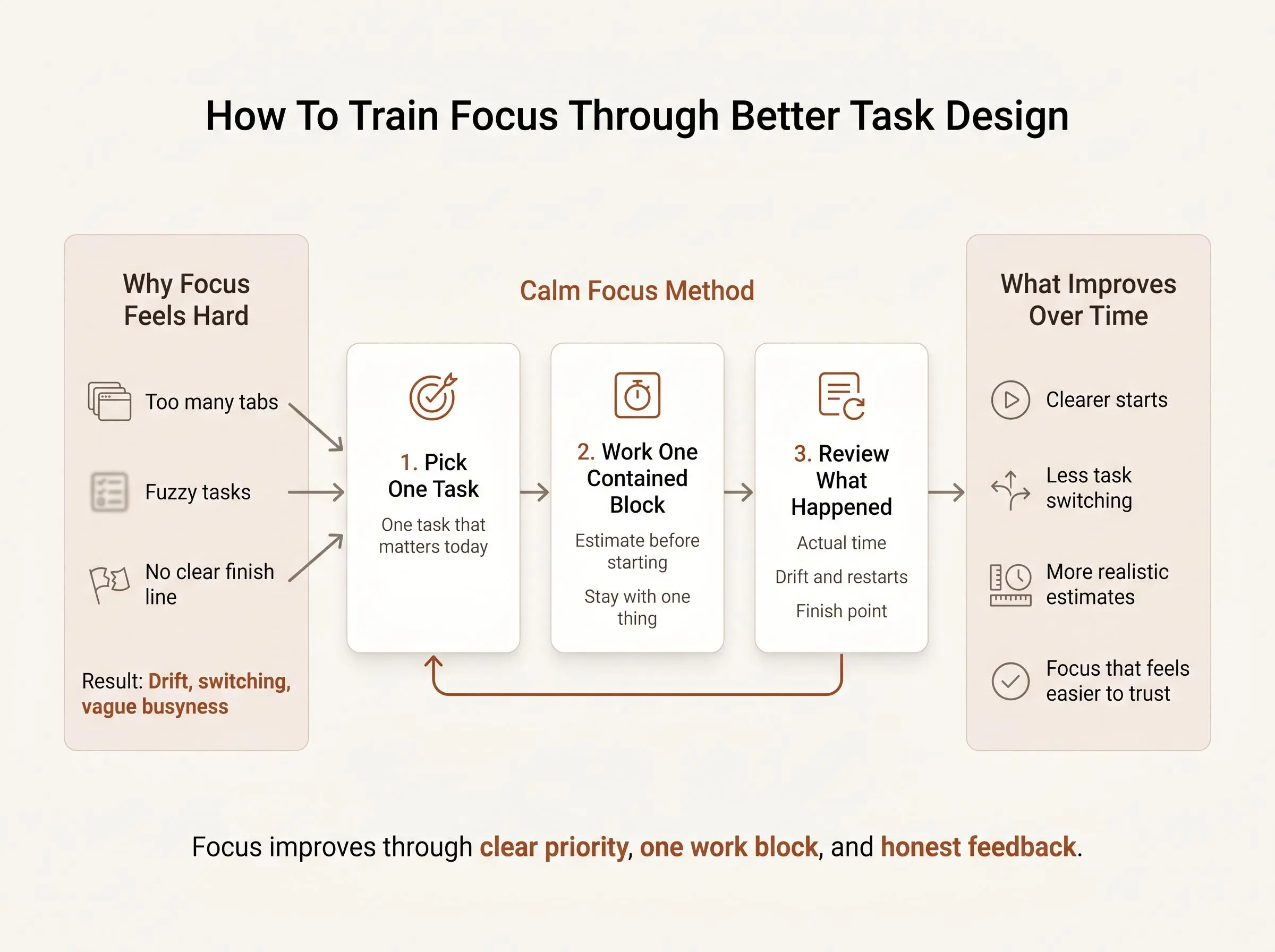
Here’s the method we trust because it works in ordinary study and work, not just in ideal moods.
1. Choose one most-important task
Pick the task that would make the day feel meaningfully used if it moved. Not the easiest task. Not the loudest task. The one that matters enough to deserve your best attention.
Keep the rest of the list short. One to three supporting tasks is plenty for most days. Long lists don’t create ambition. They create background pressure.
2. Estimate it before you begin
Use blocks or minutes. Force a number.
If you can’t estimate it, the task probably needs to be broken down. Estimation creates commitment, but it also reveals fuzziness early, before you burn a session discovering that “finish chapter notes” was actually five different jobs in a trench coat.
3. Work in a contained focus block
A default 25-minute block is fine. Custom lengths are fine too. The point is not Pomodoro purity. The point is giving attention a defined lane.
During the block, settle into one action. No productive multitasking. No “while I’m here” side quests. Breaks are part of the method because attention needs recovery. Stopping briefly is not failure. It’s maintenance.
4. Log what actually happened
After the block, record the plain facts:
- Did you complete it?
- How long did it really take?
- Did the session feel smooth, overloaded, or flat?
This is where the training happens. Honest review beats optimistic memory every time.
5. Close the day visibly
Use some visible marker of completion. A ring, a streak, a brief note, a reflection. You need evidence that effort happened. Otherwise the day blurs and your brain files it under “probably not enough.”
In Flocus, closing the daily Focus Ring does that job well because progress becomes visible instead of conceptual. That matters more than most people expect.
This counts as brain training for focus because it rehearses the whole chain:
- intention selection
- sustained attention
- recovery after effort
- honest feedback for the next round
That’s real training. Not glamorous. Effective.
How to Measure Attention While Working Without Turning It Into a Lab Experiment
A fair question comes up here: how do you measure attention while working if you’re not just guessing?
Self-report helps a bit, but it has limits. People regularly confuse tension with focus, urgency with importance, and busyness with concentration. If you’ve ever finished a frantic session and realized you mostly reorganized your stress, you’ve seen the problem.
Before you reach for anything advanced, use practical signals:
- Did you stay with the chosen task?
- How often did you switch tabs or tasks?
- How long did it take to settle in?
- Did the work finish within the estimated range?
- After interruption, could you resume quickly?
Estimate-versus-actual time is especially useful over days and weeks. It shows where planning is honest and where attention leaks. One session can be noisy. Patterns are clearer. You may notice that reading goes long every time, or that analytical tasks are best before lunch, or that admin work expands simply because you avoid starting it.
Visible progress markers help too. Daily rings, streaks, and weekly insights can show chronic overplanning, repeated avoidance, or the hours where your brain is actually available. That’s the most practical way to measure attention while working before adding sensors or more elaborate systems.
Measurement should help you adjust, not interrogate yourself.
If the data makes you more tense and less honest, it’s too much.
Where Neurofeedback Fits in a Real Workday

Neurofeedback for productivity is useful when you understand what it is and what it isn’t. In plain terms, it’s real-time feedback about your state that helps you notice and adjust while you work.
With EEG-based tracking, a compatible headband reads patterns of brain activity. The system calibrates to you first. Then, during a work session, it estimates states like flow, overload, or low engagement. That makes neurofeedback for work different from tools that only count minutes or show a summary afterward.
The appeal is simple: measured focus instead of purely self-reported focus.
That can help with a few things:
- noticing drift earlier than you normally would
- catching the point where effort turns into overload
- learning which conditions produce smoother concentration
This kind of productivity biofeedback is not a magic upgrade. It won’t grant broad intelligence gains. It won’t fix a badly chosen task. It adds state awareness. That’s valuable, but it still sits on top of clear priorities and realistic planning.
For readers who already own a compatible Muse device, Flocus Flow Tracking in Flocus Pro adds a short personal calibration, live flow scores, session timelines, and longer-term patterns like peak focus windows. Raw EEG stays on the device and isn’t stored on servers. That’s important because curiosity about brain data shouldn’t require giving away more than necessary.
Still, focus improvement with neurofeedback is a depth layer, not the foundation. If your day has no clear target, a better signal about your brain state won’t rescue it.
A Simple Brain Training Routine for Study and Work
You do not need a heroic routine. You need one you’ll still use next Thursday.
A workable daily rhythm looks like this:
- Pick one most-important task.
- Choose one to three supporting tasks, at most.
- Estimate the work in blocks before starting.
- Complete at least one focus block tied to the priority.
- Review what it actually took and how it felt.
For students, that might mean reading plus note synthesis, problem set practice, draft revision, or exam prep using active recall inside timed blocks.
For knowledge workers, it could be writing proposals, analysis, coding, slide creation, or the kind of administrative work that looks boring but still demands sequencing and attention.
Start with one reliable block a day. Not five. Research does not support the idea that more training time automatically produces better outcomes. Extreme dosage thinking mostly produces a two-day streak followed by disappearance.
A weekly review keeps the method honest. Look at:
- planned blocks versus completed blocks
- tasks that regularly trigger overload
- your best concentration windows
- where next week’s estimates need adjustment
If you use neurofeedback, review trends across sessions rather than obsessing over one score. A single low-flow day may just mean bad sleep, poor timing, or a task that should have been split in two.
Common Mistakes That Make Brain Training Backfire
Most failure here isn’t dramatic. It’s ordinary and preventable.
Some of the common traps:
- training isolated exercises while real work stays vague and unstructured
- assuming gains on a game automatically transfer to essays, reports, or strategy
- using too many tools at once and mistaking novelty for progress
- treating every low-focus session as proof that you’re failing
- overcommitting the day, then using the miss as evidence of weak discipline
- ignoring fatigue and trying to push through after attention quality has obviously dropped
- mistaking stress for productive intensity
- obsessing over metrics instead of making small adjustments
- expecting fast far-transfer when the more dependable gains are usually specific and gradual
One experienced rule we keep coming back to: if the system makes you more self-conscious than effective, it needs simplifying.
Some days will be messy. That’s not a loophole in the method. It’s the environment the method is built for.
How to Choose the Right Tool for Your Situation
Pick the lightest tool that solves the real problem.
If your main issue is not knowing what to work on, use a planner-first approach. If the main issue is drifting mid-task, add a timer and a simple session review loop. If you already own compatible hardware and want to explore real-time state awareness, neurofeedback may be worth testing.
Good decision criteria are straightforward:
- Does it connect focus time to real tasks?
- Does it help you estimate before starting?
- Does it show what actually happened after the session?
- Does it support calm consistency rather than pressure?
- Can you imagine using it daily without friction?
Be careful with tools that promise universal brain enhancement, flood you with stats but no clear next action, or separate time tracking from task choice. Those setups often look sophisticated right up until you try to use them at 2:30 p.m. on a normal Wednesday.
A simple, repeatable method usually beats an impressive-looking stack.
Conclusion
Brain training for focus is not about squeezing harder. It’s about building better conditions for attention.
The research supports a modest, practical view. Expect gains first in how you start, sustain, and review real work. Planning, contained focus blocks, and honest feedback are already powerful forms of brain training. They improve the work itself, not just your score on something adjacent to work.
Neurofeedback can add another layer of measured awareness, especially for readers who already have compatible hardware and want more than self-report. Useful, yes. Required, no.
For tomorrow, keep it plain. Choose one most-important task. Work one contained block against it. Review what actually happened. Then let that feedback shape the next day.
That’s calm. That’s trainable. And, for most people, that’s enough to start.
Article Record
ReferencesPrimary sources used for this article
- Tips to improve concentration
- Executive Functions
- Can we enhance working memory? Bias and effectiveness in cognitive training studies | Psychonomic Bulletin & Review | Springer Nature Link
- Is working memory training effective? A meta-analytic review
- Adaptive working memory training does not produce transfer effects in cognition and neuroimaging
Update HistoryMeaningful revisions to this article
- Added a research-based section explaining what is known about improving concentration and what the evidence does not yet show.
- Provided clearer, more balanced guidance to help readers approach focus training with realistic expectations.