Most advice on how to get into work mode starts too late. You sit down, open five tabs, check messages "for a second," and the hard part suddenly feels bigger than it is.
What matters is simpler: pick one real task, make the first move obvious, and give it a short block your brain can trust. You don't need more pressure. You need less friction.
A few things worth fixing before you start:
- Turn "work on the project" into one target you can actually finish in 25 minutes.
- Close the tabs that invite escape, especially chat, inbox, and the one pretending to be research.
- Protect the first 10 minutes, because they usually decide whether you work or drift.
What Work Mode Actually Means
Work mode is simpler than people make it sound. It’s the shift from carrying a vague pile of obligations in your head to putting directed attention on one specific thing.
That’s it.
It is not a burst of motivation. It is not feeling inspired. It is not becoming the sort of person who color-codes their life and never gets distracted. For most knowledge work, the real goal is much less dramatic. You need a reliable way to get on the ramp.
There’s a difference between looking busy and actually being in work mode:
- Busyness is checking messages, cleaning up your tabs, answering the easy email, tweaking the plan again.
- Work mode is one task, one target, one time block, and a clear stopping point.
A lot of people think focus is a personality trait. It’s not. If you learn how to start deep work when you feel resistance, focus becomes a process you can enter on purpose. Not perfectly. Just reliably enough to stop losing half the day to circling.
Work mode begins when the next move is obvious.
Why It Feels So Hard to Start in the First Place
If starting work feels weirdly heavy, that usually isn’t a character issue. It’s a setup issue.
Modern work trains attention to fragment. One widely cited research summary puts average focus on a single screen at just 47 seconds. And when a real interruption pulls you off task, getting properly back in can take more than 23 minutes. That’s a bad trade, yet we make it all day without noticing.
By the time you sit down to do serious work, your brain is already expecting friction. Not progress.
A few things pile up at once:
- unfinished tasks keep echoing in working memory
- vague projects feel bigger than they are
- your attention is still partly attached to the last thing you touched
- you’re aware you’ve delayed starting, which adds a nice layer of shame for no practical benefit
That last part matters more than people admit. Many readers don’t just feel distracted. They feel mentally crowded, behind, and oddly guilty before a single useful minute has happened.
This is where attention residue shows up. In plain language, when you leave a task unfinished or emotionally open, part of your attention stays there. So when you try starting work when procrastinating, you’re not beginning from zero. You’re beginning with noise.
No wonder the project feels heavier than it is.
The Real Problem Is Usually Friction, Not Laziness
Friction is the small resistance between intending to work and actually starting. Most of the time, that’s the real blocker.
Here’s where friction usually comes from:
- you haven’t chosen one clear priority
- the task is too broad to begin
- your tools are still open to interruption
- you’re trying to jump straight from reactive work into deep work
- the session feels endless, so your brain refuses the deal
Trying to beat friction with willpower is inefficient. Willpower is expensive and unreliable. Friction is mechanical. Mechanical problems deserve boring fixes.
There’s also a challenge issue hiding underneath. If the task is too easy, your attention drifts. If it’s too hard or too fuzzy, you freeze. The sweet spot is a task that feels specific, useful, and just demanding enough to matter.
That’s how you overcome friction to focus. You make the work smaller, clearer, and more bounded.
Lazy is often just a badly designed start.
Start by Choosing One Task That Actually Deserves Your Attention
Most people try to get into work mode before deciding what the work is. That’s backwards, and you can feel it in the first minute.
Choose the task that would make the day feel meaningfully moved forward. Not the task that is easiest to nibble at. Not the one that lets you look productive without producing much.
In practice, that usually means:
- pick the task with real output
- avoid admin unless it is genuinely time-sensitive
- choose something that changes the state of the day if completed
The wording matters too. Broad tasks create hesitation.
Too vague:
- write the strategy
- fix the project
- study biology
Startable:
- draft the first three sections
- review the top five issues
- summarize chapter two notes
Write the task in finish-line language so your brain can see the endpoint. “Draft intro and outline sections 2 to 4” is much easier to begin than “work on article.”
This is also where plain timers tend to fall short. They measure minutes without helping you decide what the minutes are for. At Flocus, we built around the planning layer first. Your day centers on one most-important task before the timer starts, because clarity should come before countdowns.
Use a Deep Work Warm Up Instead of Waiting to Feel Ready
You do not need to feel ready. You need a transition.
A deep work warm up is a short ritual that clears residue and points attention in one direction. Five to ten minutes is enough. Longer than that and you may have invented prettier procrastination.
A simple close, reset, prime routine
Close the previous task
Leave a quick note about where to resume later. One sentence is plenty.Reset the environment
Shut messages, extra tabs, and phone notifications. Remove the obvious traps.Dump open loops
Write down unrelated thoughts so they stop trying to audition for your attention.Reset the body
Stand up, stretch, or walk for a minute or two. It sounds small because it is. Small works.Prime the task
Read the chosen task aloud or restate it in one sentence.Begin with an entry move
Open the file. Paste the brief. Write the headings. Do something mechanical first.
The point of a deep work warm up is not ceremony. It’s mode switching. Your brain does not move cleanly from email, meetings, or scrolling into thoughtful work. If you skip the transition, you carry the old tempo into the new task and then wonder why it feels sticky.
A Simple Work Mode Routine for Days When You Feel Resistance
When resistance is high, the routine needs to be almost boring. Good. Boring is stable.
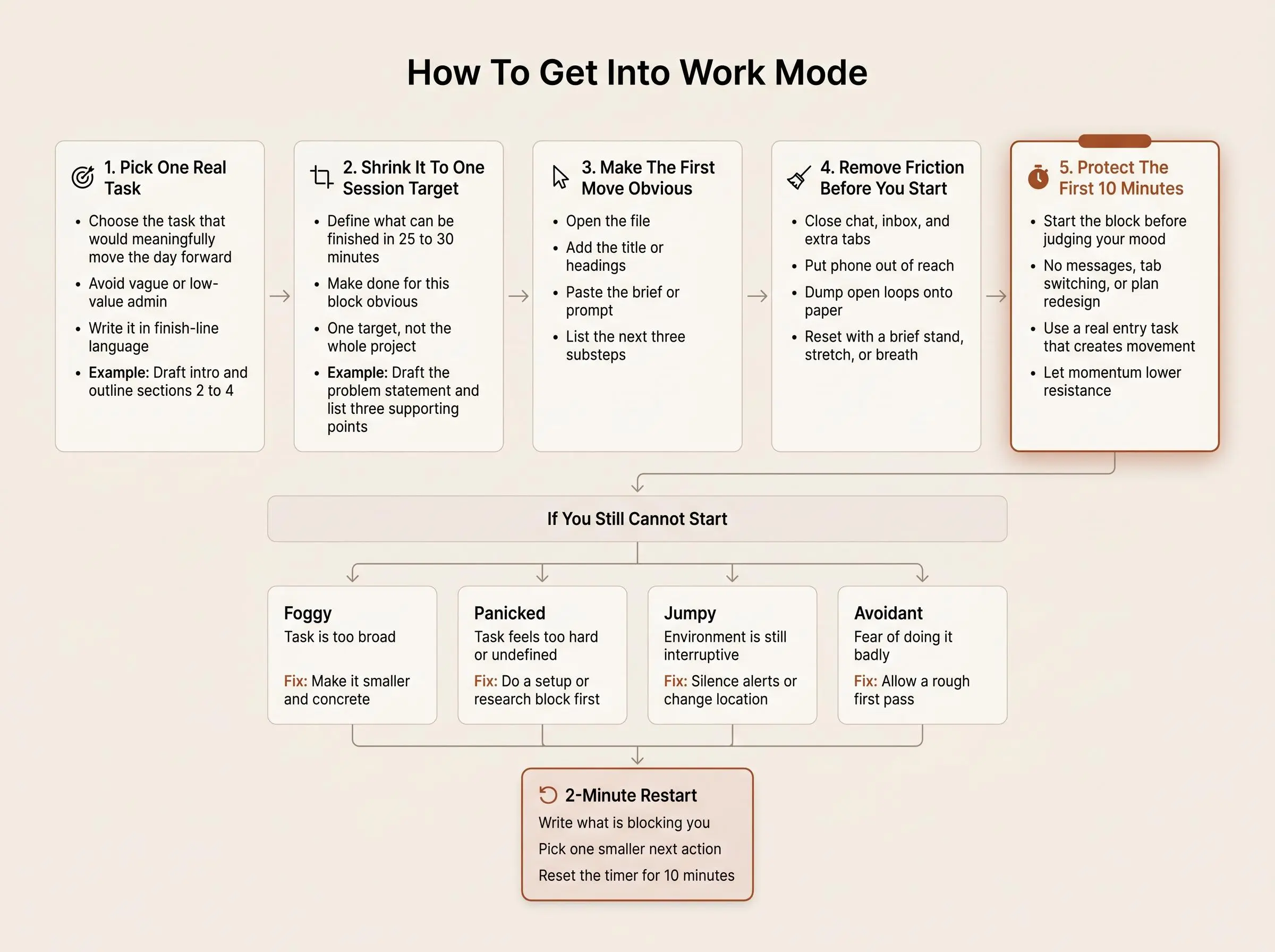
1. Reduce the assignment
Turn the project into a 20 to 30 minute target. Define what “done for this block” means before you start.
Not “make progress on report.”
More like “draft the problem statement and list three supporting points.”
2. Create a visible first action
Set up the first move so you can begin without thinking much.
- open the document
- title the page
- paste the prompt or brief
- list the next three substeps
A visible first action matters because beginning a focus session is fragile. If the first move is hidden inside thought, delay sneaks in.
3. Set a short focus block
If you’re overwhelmed, start with 25 to 30 minutes. Longer blocks can work later, but they’re a poor entry point when you’re already resisting.
4. Remove escape hatches
- phone out of reach
- notifications off
- unnecessary tabs closed
- chat and meeting windows hidden if possible
5. Begin before you evaluate your mood
This is the hinge. Don’t ask whether you feel like it. Start, then let the feeling catch up.
Useful phrases help here:
- I only need to begin this block.
- I do not need to finish the whole project today.
- I am building momentum, not proving discipline.
If you’re wondering how to get into work mode, this is the practical answer. Shrink the work, expose the first action, protect a short block, and start before your brain opens debate club. That’s how to start deep work when you feel resistance. That’s also the cleanest answer to starting work when procrastinating.
Pick a Session Length Your Brain Can Trust
A work block should feel finite, especially when you’re overloaded. If the session feels endless, your brain treats it like a threat.
A simple rule:
- 25 to 30 minutes when resistance is high, clarity is low, or you’re mentally tired
- around 52 minutes when the task is clear and your energy is decent
- up to 90 minutes for advanced deep work in a protected environment
Alertness tends to rise and taper over roughly 90-minute cycles. That’s one reason endless work sessions quietly degrade before people notice. You’re still sitting there, so it looks like work. The output says otherwise.
There’s another limit people rarely mention because it ruins the fantasy. Sustained deep cognitive work has a ceiling. For most people, truly high-quality deep work does not stretch across the whole day. Chasing eight flawless focused hours is a good way to feel broken by 3 p.m.
Short blocks build trust. A finite block lowers dread. Repeating them gives you evidence that you can start again tomorrow.
In Flocus, focus sessions sit inside a daily plan instead of floating around as isolated timers. We also log estimated versus actual time, which is a polite way of confronting how long work really takes.
Protect the First 10 Minutes Because That Is Where Most Sessions Are Won or Lost
The first 10 minutes decide whether the session settles or fractures.
At the start, your brain is still testing commitment. If you open the door to switching, it will walk through it.
For those first minutes, keep strict rules:
- do not check messages
- do not switch tabs unless the task requires it
- do not redesign the whole plan
- do not chase related tasks that suddenly feel urgent
Use an entry task that is small enough to avoid panic but real enough to count:
- outline the section headings
- solve the first problem
- annotate the first page
- clean the first dataset column
This works for plain reasons. Movement reduces dread. Specificity cuts negotiation. Early progress proves the task is workable.
Most procrastination spirals happen before meaningful work begins. Once the task starts moving, resistance often drops on its own. Not because you became disciplined in the last seven minutes. Because the fog cleared.
What to Do When You Still Cannot Start
Sometimes the first attempt fails. That’s normal. The useful question is why.
Diagnose by the feeling
- Foggy usually means the task is too broad.
- Panicked usually means it’s too difficult or too undefined.
- Jumpy usually means your environment is still interruptive.
- Avoidant often means you’re afraid of doing it badly.
Each one has a different fix.
- broad task: make it smaller and concrete
- difficult task: do a research or setup block first
- interruptive environment: move devices, silence alerts, or change location
- fear of quality: allow a rough first pass and separate drafting from judging
If you stall, use a 2-minute restart ritual:
- Write what is blocking you.
- Pick one smaller next action.
- Reset the timer for 10 minutes.
That’s enough to recover a surprising number of sessions.
Lapses are data about your setup. They are not evidence that you’re bad at focus.
Build a Work Mode Environment That Lowers Interruptions by Default
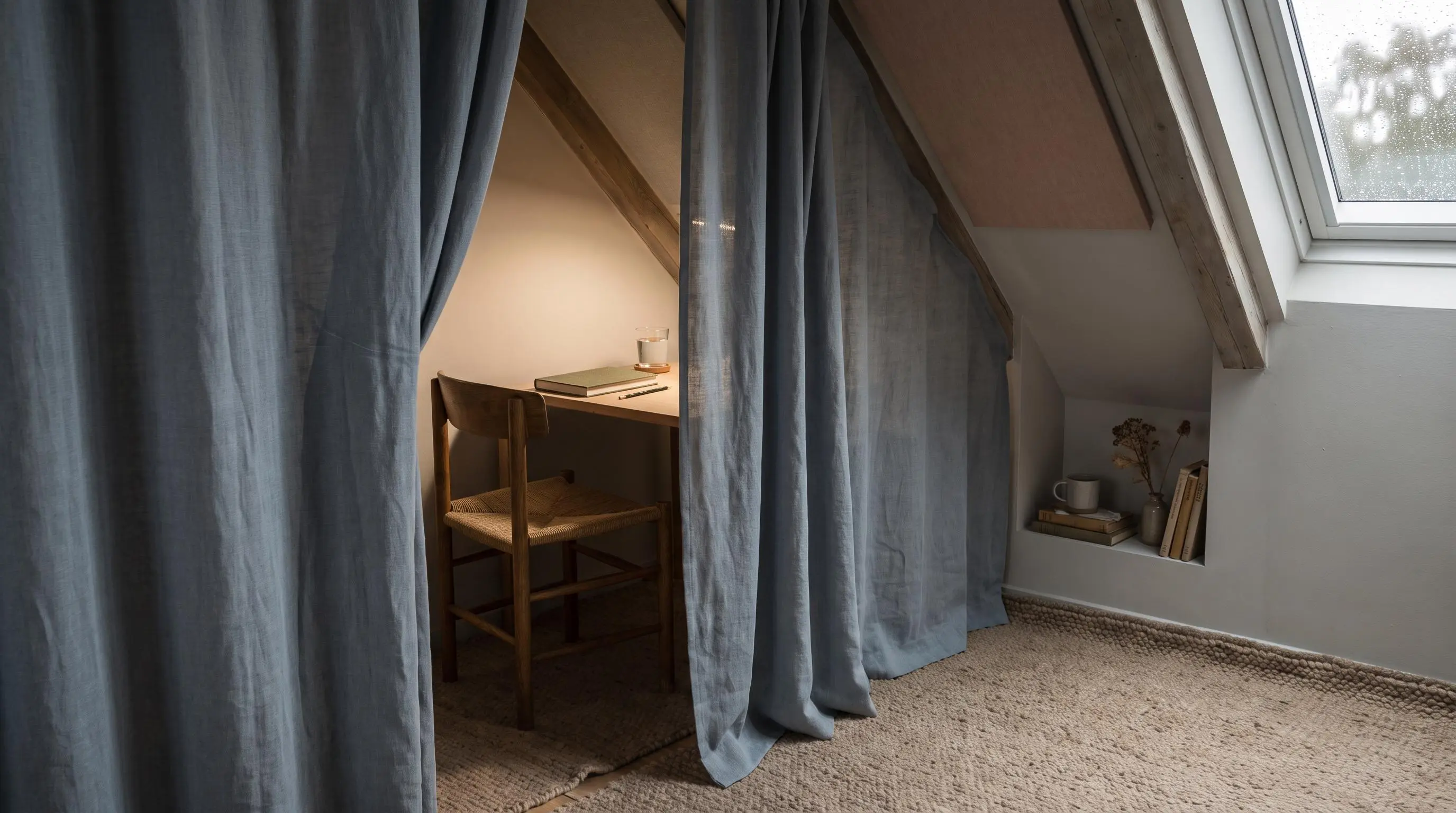
Your brain usually doesn’t have a pure focus problem. It has a focus-environment problem.
Quick distractions are expensive. The interruption itself may last 20 seconds. The mental reload can last much longer. That’s how people spend a full day “on” and still struggle to point to what actually moved.
A few changes do most of the work:
- put meetings outside your best focus windows when you can
- close communication tools during protected blocks
- keep the workspace visually simple
- use light and sound that feel steady, not stimulating
Real life is messy, so the answer doesn’t need to be monastic. You don’t need a cabin and a fountain pen. You need an environment where focus is the default and interruptions are the exception.
After meetings or reactive work, use a brief transition before returning to deeper work. If you don’t, attention residue will run the next session whether you want it to or not.
Track What Helps You Start So You Can Repeat It
Generic advice is fine until your actual patterns disagree with it.
Tracking helps because people differ. Some start better early. Some need a harder environmental reset. Some keep choosing tasks that are too vague, then blaming themselves for the predictable result.
After each session, note a few things:
- what task you chose
- planned length versus actual length
- whether you started on time
- what interrupted you
- how hard the start felt
- whether the task was clear enough
You’re not trying to turn your life into a spreadsheet. You’re trying to make the next start easier.
This is also why we care about measurable momentum at Flocus. The daily ring makes progress visible. Streaks and reflections help you see consistency instead of isolated failures. Weekly insights can show whether resistance is coming from poor planning, bad timing, or simple overload.
The point of tracking is not judgment. It’s pattern recognition.
An Optional Advanced Layer: Measuring Flow Instead of Guessing at It
Focus and flow are related, but they are not identical.
Focus is sustained attention on a task. Flow is a deeper state of absorbed engagement that usually shows up after a good start, not before. You don’t begin in flow. You earn your way into it.
Some readers want more than a timer and a hunch. They want to know when they’re actually settling into deeper concentration. That’s where neurofeedback can be useful, if you’re the sort of person who benefits from measured feedback.
With Flocus, Muse headband users can optionally track flow-state cues in real time while they work. The point isn’t gadget theater. It’s comparing felt focus with measured patterns over time.
Still, this is a refinement layer. Not a requirement.
No device is needed to build a solid work mode routine. Measured feedback only becomes useful once the basics are in place: clear task, low friction, sensible session length, protected start.
Conclusion
Work mode is not something you force through stress. You enter it by choosing one meaningful task, lowering friction, and trusting a short focus rhythm your brain can believe in.
So keep it simple:
- pick one task
- shrink it into a clear session target
- use a deep work warm up
- protect the first 10 minutes
- track what helps you begin
Try one short, protected block today. Not a heroic overhaul. Not a vow to become a different person by Monday.
Just make starting easier than avoiding. That’s usually where the whole day turns.
Article Record
ReferencesPrimary sources used for this article
- The average attention span has shrunk to roughly 40 seconds. Here’s how to get it back.
- Flow State Triggers: The Research on What Actually Works - Canopy Press
- Focus Rituals for Work Transitions: A Design System
- How to Enter a Deep Work State: 7 Proven Strategies
- How to build a deep work routine that actually holds focus | Charlotte Observer