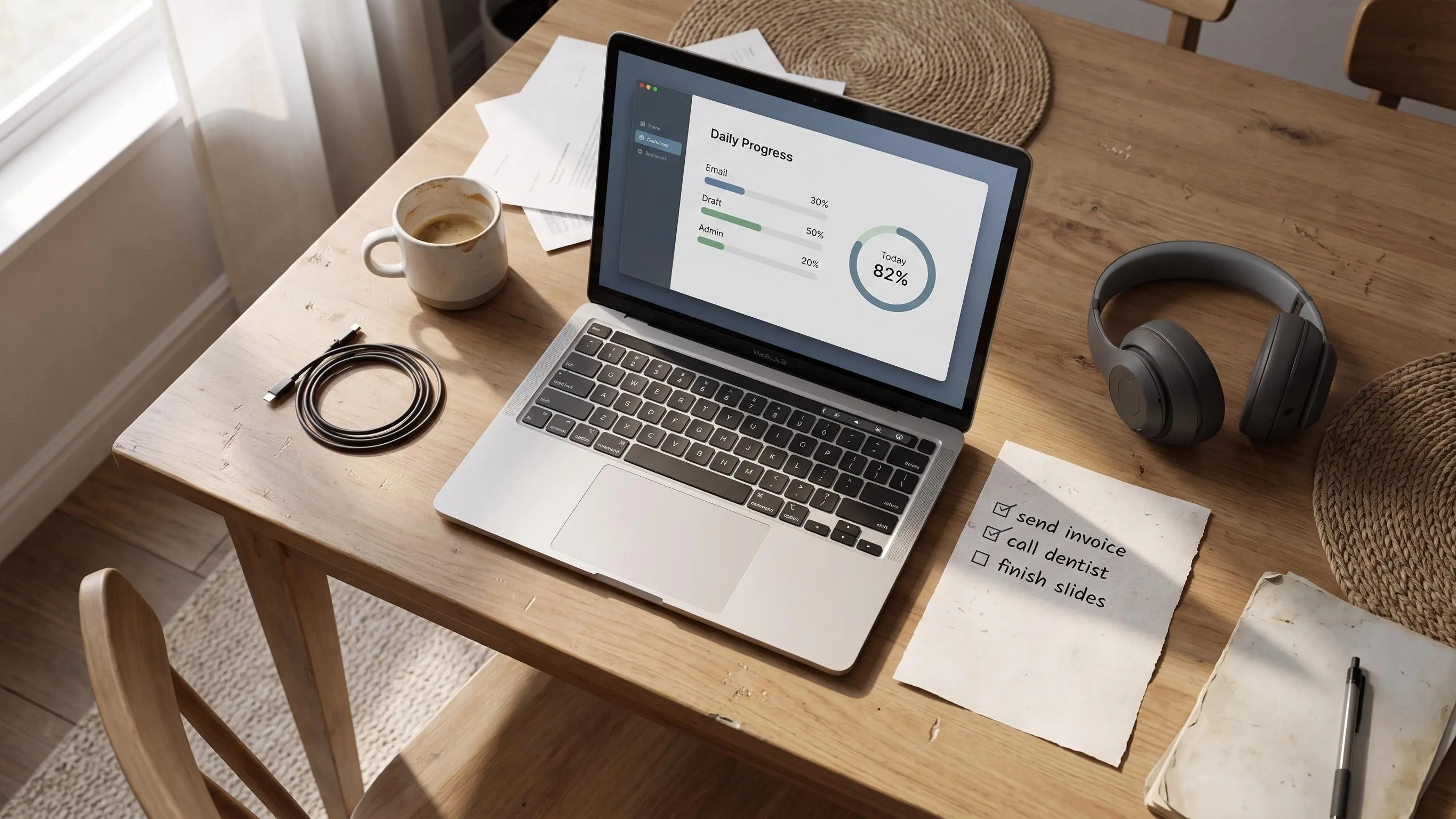

Most focus apps give you a timer and call it a system. A focus habit app needs to fix the part that usually breaks first: deciding what to do before the clock starts.
What matters is plain. One real priority, one focus block you can repeat, and one visible sign the day actually moved (glamorous stuff).
A few things to watch:
- vague task names that sound productive but go nowhere
- session lengths you only manage on a strangely perfect Tuesday
- streaks that help you return, not punish you
You'll leave with a setup you can keep using.
What a Focus Habit App Actually Is
A focus habit app isn't just a timer with better wallpaper. It should help you come back to focused work often enough that concentration starts to feel normal, not occasional.
That distinction matters more than it sounds. Most people don't fail because they can't run a 25 minute countdown. They fail a few minutes earlier, when they haven't clearly decided what deserves that time, or a few minutes later, when they don't return the next day.
A real focus habit app usually has four parts:
- a clear task or daily priority
- a defined period for focused work
- a visible record that you followed through
- some kind of feedback, reflection, or accountability
That last part is where the app stops being a clock and starts being useful.
If you're skeptical, fair enough. Productivity tools have a habit of promising spiritual renewal through slightly rounder buttons. But when a focus habit app actually sticks, it does so because it supports a repeatable behavior, not because it looks calming on a screen.
Why So Many Focus Apps Feel Helpful but Do Not Change Much
You've probably seen the pattern. The app is pleasant. The timer runs. Maybe there's rain sounds and a pine tree. Then the day ends and you still can't explain where your attention went.
That usually isn't laziness. It's self-regulation under friction. Work feels ambiguous, boring, or mildly uncomfortable, and your phone offers fast relief. Not better relief. Just faster.
Two failures show up again and again:
- you start without a clear priority
- you break focus the moment discomfort arrives
Modern tech habits don't help. Constant interruptions, app switching, and low-level multitasking are linked with greater distractibility for some people. That doesn't mean your attention span is ruined beyond repair. It means the environment is asking more of your attention than older routines ever did.
Plain timers often miss the real problem:
- they assume you already know the right task
- they count minutes without asking if those minutes were spent on the right thing
- they can turn into a tidy ritual that feels productive without producing much
Minutes are easy to count. Meaningful work is harder. That's the part worth tracking.
The Calm Alternative: Plan First, Then Focus
Focus sticks better when it starts with one decision. Not ten. One.
We like a simple loop:
- choose the most important task
- work on it for a defined block
- close the loop with visible progress and a brief review
This is gentle structure, not a personality transplant. You're not trying to become the kind of person who wakes up at 5 a.m. to optimize their electrolytes. You're reducing the amount of internal negotiation required to begin.
That quiets the noise in a few practical ways:
- fewer open loops pulling at your attention
- less task switching dressed up as responsiveness
- less time spent re-deciding what matters
The one-priority approach also reflects a basic feature of focus: as James Clear explains, concentrating on one thing requires saying yes to it and no to competing options for the moment. Repeating that choice, then reviewing what happened, gives the routine a chance to improve rather than leaving each session to chance.
For people who've bounced off timer-only tools, a planner-first setup tends to work better because each session belongs to a plan. In Flocus, the session ties back to one priority, a daily progress ring, streaks, reflections, and weekly insights. Not isolated countdowns floating in space.
You don't need a heavyweight system. Most people need less system than they think, but more structure than a timer gives them.
What Makes a Focus Habit App Work in Real Life
The test is simple: will you still use it on a hard Tuesday afternoon?
A useful app in this category needs a few things, and each one pulls its weight.
Low friction
Starting should take seconds. If there are too many choices, screens, or setup steps, avoidance creeps in early. Friction doesn't always feel dramatic. Sometimes it's just enough to make checking messages look easier.
A planning layer
Before the timer starts, the app should help you decide today's focus. One clear priority usually beats a long task list. Long lists create the feeling of organization while preserving the original confusion.
Visible progress
People focus better when progress is concrete work because they do three useful things:
- they turn intention into visible continuity
- they add a small cost to quitting today
- they give you evidence that focus is repeatable, not random
Daily focus streaks build confidence in a quiet way. Yesterday may have been messy. If you still showed up today, the pattern survives. That starts to change how you interpret your own attention.
There is a risk, though. If you treat a streak as something sacred, it can slide into all-or-nothing thinking. Then one chaotic day breaks the chain and suddenly the whole practice feels spoiled.
A healthier frame is simpler: protect the pattern, not perfection. A short session still counts when life is crowded.
How to Build Consistency With Streaks Without Becoming Obsessed With Them
If you want to build consistency with streaks, make the target easy enough to survive normal life. Not your best life. Your actual one.
That usually means one meaningful focus block, not a heroic schedule. Minimum viable consistency is underrated because it doesn't look impressive, but it's the only kind you can keep when work gets strange or your week goes sideways.
Be specific about what the streak tracks. "Focus more" is useless. "Complete one block on my most important task" is clear enough to repeat.
A few guidelines help:
- attach the session to a stable time or transition, like right after planning your day or before opening chat
- keep the starting ritual short
- check the streak at the end of the day, not every twenty minutes
- let a reduced version count when needed
Common traps are predictable:
- making the session too long
- tracking too many goals at once
- dropping the habit after one difficult day
- turning the streak into a guilt counter
Streaks and insights do different jobs. Streaks show whether you returned. Insights show what made returning easier or harder. You want both, but not confused together.
The Simple Daily Method That Makes Focus Stick
This doesn't need to be elaborate. In fact, elaborate is usually where it breaks.
1. Choose one most important task
Write it plainly. Not "work on project." More like "draft opening section" or "solve problem set 3 questions 1 to 4." One clear priority reduces internal bargaining.
2. Estimate the time honestly
Most people underestimate. Then they call the day a failure when the real issue was planning drift. Estimated versus actual time gives you a way to calibrate without drama.
3. Start a focus block with a clear endpoint
Use a duration you can repeat. Many apps use shorter sessions because smaller commitments lower resistance. That's not a hack. It's basic human behavior.
4. Mark what happened
Done. Moved forward. Got stuck. Ran over. A short reflection while the session is still fresh preserves useful detail.
5. Close the ring for the day
Use one visible completion cue. A ring works well because it makes the day feel finished in a concrete way.
Repeated gently, this trains attention better than intensity does. Consistency is less exciting than motivation. It also works.
Why Planning Accuracy Matters More Than Most Productivity Advice Admits
A lot of people think they're unfocused when they're actually overplanning.
When you compare estimated versus actual time, a few truths show up fast:
- tasks take longer than expected
- context switching steals more time than it seems
- some work needs deeper energy than a calendar slot suggests
That data reduces guilt because missed goals stop feeling mysterious. If your proposal draft always takes 90 minutes and you keep giving it 30, the problem is not your character.
Review these patterns weekly. Look for spillover tasks, better times of day, and session lengths you actually complete. In Flocus, each focus block includes estimated and actual time so you're not just logging minutes. You're learning how your work unfolds in real conditions, which is much rarer than it should be.
The Role of Pomodoro, App Blocking, and Gamification in a Focus Habit App
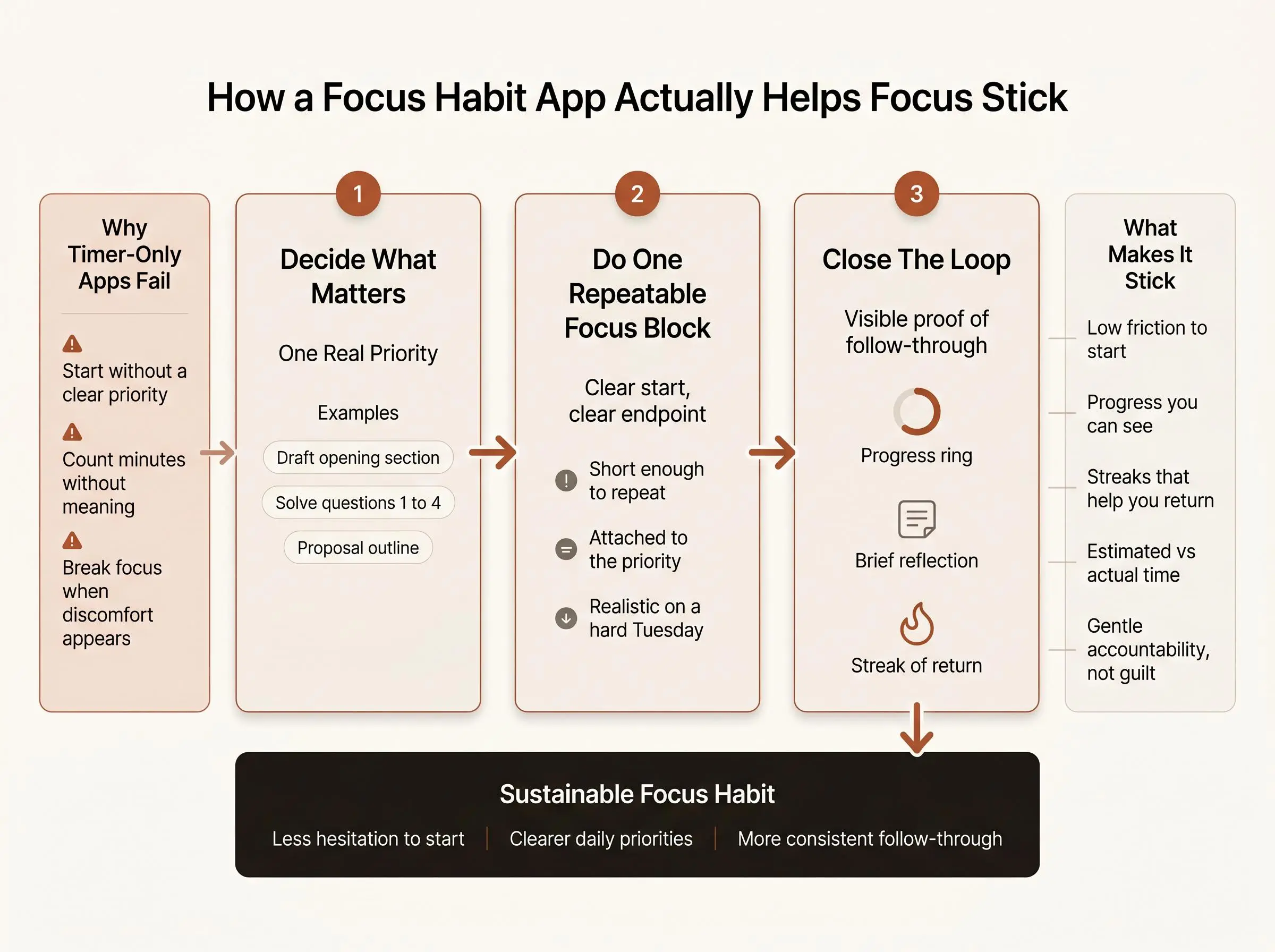
These mechanics are useful. They just solve different problems.
Pomodoro-style timers are good at lowering the barrier to starting. If the work feels heavy, a short session can make it feel less loaded. But if the task itself is fuzzy, the timer won't rescue it.
App blockers help when the main issue is compulsive checking. They work better when paired with a clear plan for what you'll do instead. Removing temptation is helpful. Replacing it with ambiguity is not.
Gamification can make repetition more appealing. Points, progression, visual rewards, cozy feedback. Some people genuinely do better with that. Others stop caring by the second week.
Reflective prompts are underrated. A short pause that asks why you're leaving the session can interrupt automatic phone-checking long enough for choice to come back online.
The common mistake is treating these features as the method. They're not. They're support beams. The method is still choose, focus, review.
What the Research Suggests About Focus Apps and Behavior Change
The practical takeaway is straightforward: focus apps can help, but they don't install focus directly. They support behavior change.
The mechanisms that seem most useful are familiar:
- immediate rewards
- visible progress
- low-friction actions
- reminders and gentle nudges
- reflective prompts that interrupt autopilot
Research also suggests reflective prompts can help people stay focused longer and resist distractions better. Chatbot-style support has appeared useful for some users trying to reduce phone use over time. The pattern is clear enough to be helpful: attention improves when the tool changes the moment of choice.
Feature-rich isn't automatically better. More options often mean more friction. The app you keep opening on a rough Tuesday is usually the one that asks the least of you while still keeping you honest.
How a Calm Focus Habit App Should Feel Day to Day
For people tired of hustle culture, the emotional tone matters. More than most app makers seem to realize.
A good focus habit app should feel:
- calm enough to return to
- structured enough to trust
- honest enough to teach you something
No guilt loops. No harsh language. No fake urgency.
Self-compassion isn't soft in the useless sense. It's practical. People sustain attention better when they aren't spending half their energy on self-criticism. Gentle accountability keeps the door open for tomorrow.
Visible proof of follow-through changes identity slowly. You stop thinking of yourself as someone who hopes to focus and start seeing someone who has a practice of focusing. That's a quieter shift, but it's the one that lasts.
A plan sticks when it feels sustainable, not theatrical.
A Simple Setup for Students and Knowledge Workers
Different contexts, same basic method.
For students, pick one assignment milestone, not an entire study day. Start a short block on a reading, problem set, or draft section. Track streaks by the days you returned, not the number of hours you suffered at your desk.
For knowledge workers, define one meaningful output for the session: proposal draft, analysis pass, decision memo. Protect the first block of the day for the most cognitively demanding work if you can. At the end, capture blockers before switching contexts. That note saves more future friction than people expect.
Keep the system light:
- one priority
- one block
- one visible completion cue
Complexity looks serious. Consistency is better.
How to Choose the Right Focus Habit App for Your Style

You can decide faster than you think. Ask three questions:
- what matters today
- when will I work on it
- did I actually follow through
If an app doesn't help you answer those quickly, it's probably not helping enough.
Different categories fit different problems:
- timer-only apps suit people who already plan well
- blockers help when impulse checking is the main issue
- gamified tools fit users who respond to visible rewards
- planner-first apps fit people who need clarity before the clock starts
- neurofeedback-enabled tools fit people who want measured attentional feedback
If you keep abandoning plain timers, you probably don't need a prettier timer. You likely need a stronger planning layer and a simple progress review.
Red flags are easy to spot once you know them:
- too many taps to begin
- weak or hidden streak feedback
- no link between sessions and actual work
- dashboards that create more friction than clarity
The Optional Depth Layer: Measuring Flow With Neurofeedback
This is optional. It is not where we'd tell most people to start.
Still, for some users, measured feedback is genuinely interesting. Instead of only logging time, the system can also show signals related to how focused you were while working. Not mind reading. Not magic. Just another layer of feedback.
That appeals to deep workers and neurotech-curious users because it makes attentional patterns more tangible. For people who already own a Muse headband, Flocus can connect to track flow state in real time during sessions.
Useful, yes. Necessary, no.
The foundation doesn't change. You still need a clear task and a repeatable routine. Neurofeedback can sharpen awareness, but it won't choose today's priority for you.
Common Mistakes That Break a Focus Habit Before It Forms
Most failed focus systems don't fail for mysterious reasons. They fail in very ordinary ways.
- sessions start too long
- too many tasks compete for attention
- the timer starts before success is defined
- one missed day gets treated as proof the system failed
- novelty replaces repetition
- rewards crowd out reflection
- weekly patterns get ignored in favor of daily mood
If you're using streaks, remember the corrective principle: protect the return, not the record.
We've seen this often enough to be blunt about it. The habit usually doesn't break because you lack discipline. It breaks because the setup asks too much too soon.
What Success Looks Like After a Few Weeks
Success here is not perfect concentration. It is not twelve flawless days and a transcendent notebook.
More realistic signs of progress look like this:
- less hesitation before starting
- clearer daily priorities
- more completed focus blocks
- a ring or streak that reflects real follow-through
- better estimates of how long work takes
- fewer mystery days where time disappears
The deeper shift is identity. Focus stops feeling like something you either have or don't. It starts feeling like something you practice.
That is where self-trust comes from. Not intensity. Not guilt. Consistency you can see.
Focus Habit App FAQ
What is a focus habit app?
A focus habit app helps you choose a clear task, work for a defined period, record your progress, and review or reflect on what happened. Unlike a timer-only tool, it supports returning to focused work consistently.
How do I choose the right focus habit app?
Choose an app that makes it easy to identify one priority, start a focus block, see visible progress, and review your follow-through. If you keep abandoning timer-only tools, a planner-first app may provide the structure you are missing.
How should I use a focus habit app each day?
Start with one meaningful focus block on your most important task. Use a duration you can repeat, mark what happened afterward, and use one visible completion cue to close the loop.
Do focus streaks help build consistency?
Streaks can show whether you returned, while insights can help reveal what made returning easier or harder. Treat a streak as proof of return rather than a perfection requirement, and let a shorter session count when life is crowded.
Conclusion
The best focus habit app is rarely the flashiest one. It's the one that helps you choose what matters, return to it consistently, and see honest proof that you followed through.
Streaks for productivity can help, but only when they support consistency rather than demand perfection. Keep them useful. Keep them humane.
If you want to start today, make it small: one most important task, one focus block, one visible completion cue.
If a planner-first, browser-based setup sounds more realistic than another pretty timer, try Flocus and see whether a simple plan is the part that finally makes focus stick.
Article Record
ReferencesPrimary sources used for this article
- Focus: The Ultimate Guide on How to Improve Focus and Concentration
- StayFocused: Examining the Effects of Reflective Prompts and Chatbot Support on Compulsive Smartphone Use
- Focus apps claim to improve your productivity. Do they actually work?
- An Economic Model of the Planning Fallacy
- The Psychology of Consistency in Fitness and Nutrition
Update HistoryMeaningful revisions to this article
- Added a sourced section based on James Clear’s guidance to help readers create a calmer, more consistent approach to focus.
- Added four frequently asked questions and answers to help readers understand the Focus Habit App more easily.