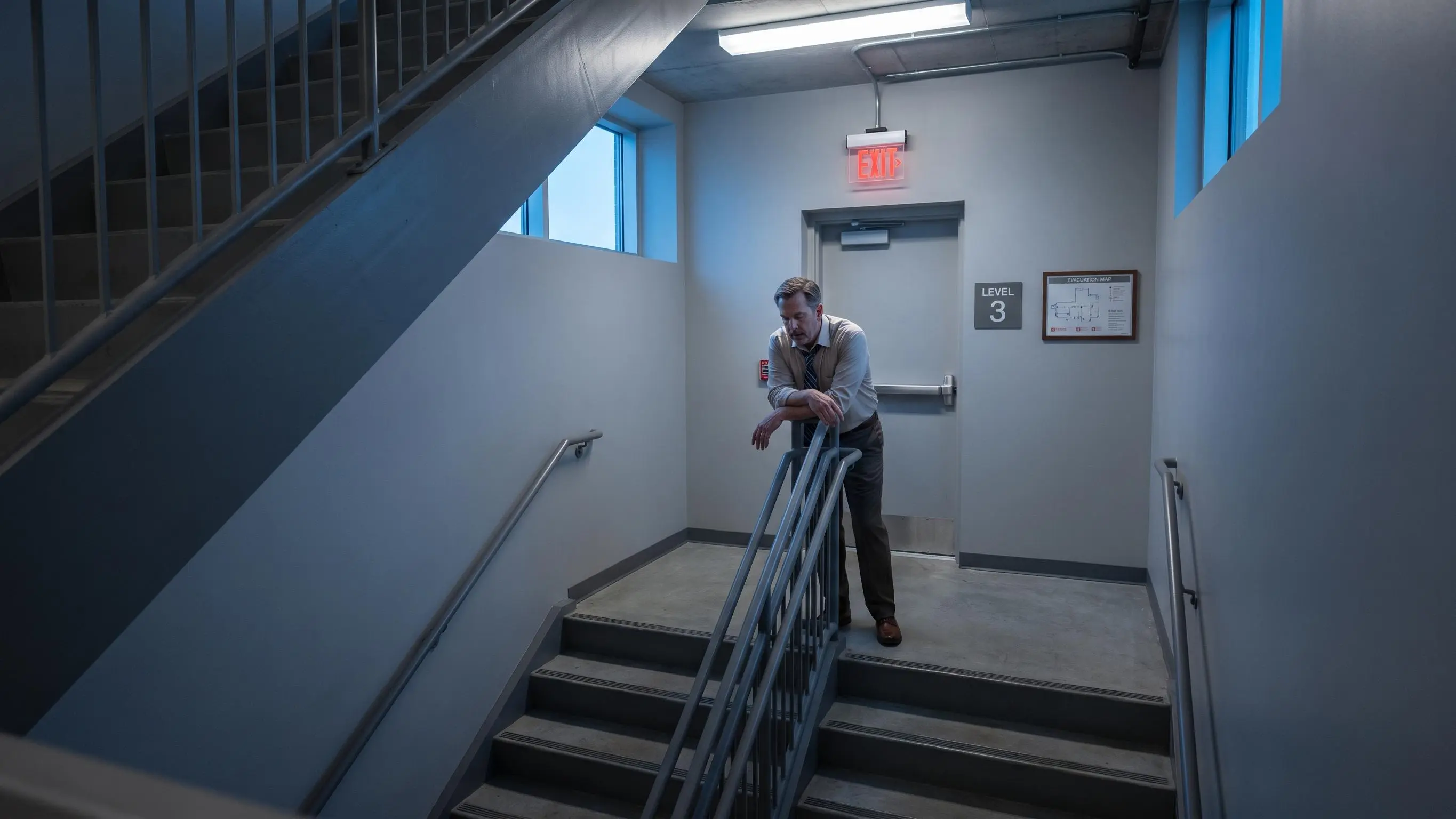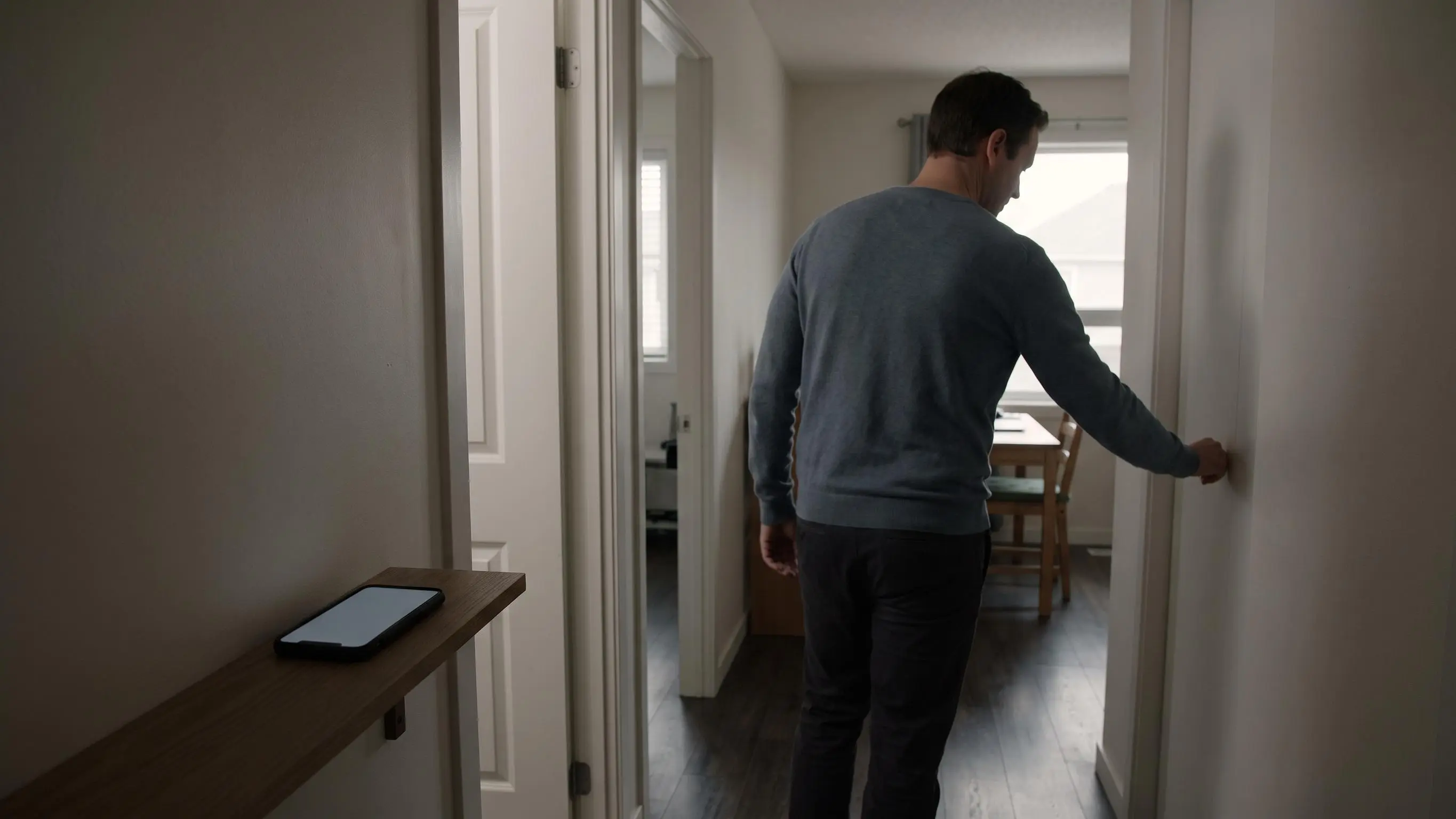

Single-tasking vs. multitasking stops being a theory once your day fills with tabs, pings, and half-finished work. You look busy, but the thing that matters keeps slipping.
What actually matters is how much clean attention the task needs. We've seen writing, studying, and planning get wrecked by tiny switches that seem harmless.
Start here:
- The faster task is not always the better one
- A five-second interruption can leave you rereading the same line
- One protected block beats a whole day of fake progress. You will feel the difference.
Single-Tasking vs. Multitasking at a Glance
Here’s the short answer. For most focus-heavy work, single-tasking is the better default.
Not because it’s morally superior. Not because disciplined people are somehow built differently. It’s better because attention, working memory, and decision-making are limited, and most of the work people care about depends on those exact things.
In the single tasking vs multitasking comparison, the result usually looks like this:
- Single-tasking wins for writing, studying, planning, analysis, and creative work
- Multitasking can feel faster in narrow cases
- The metric changes the answer because speed, error rate, stress, and depth of thinking don’t move together
- Feeling busy all day is not the same as moving the most important task forward
That last point catches people. A day can be packed and still strangely empty. Lots of motion. Not much progress.
Busy is visible. Progress is quieter.
What People Mean by Single-Tasking and Multitasking
A lot of the confusion starts with the words.
Single-tasking means giving one meaningful task your full attention for a stretch of time, with fewer competing inputs. Not forever. Just long enough for the work to develop some shape.
Multitasking usually means one of two things:
- trying to do two tasks at once
- rapidly switching between tasks with different goals
Those are not the same thing.
Concurrent vs. serial multitasking
Concurrent multitasking is overlapping tasks at the same time. Think listening to one thing while doing another.
Serial multitasking is switching between several goals across the day. Email, report, chat, spreadsheet, meeting notes, back to email, then trying to remember what the report was about. This is what most modern workdays actually look like.
People call both of these multitasking, which is why the topic gets messy fast. Most knowledge workers are not doing true parallel work. They’re doing fragmented work. Their day is shaped by notifications, chat pings, open tabs, and constant resets.
That distinction matters because if the real problem is repeated switching, the solution isn’t just a better countdown timer. It’s a better way to decide what deserves attention now.
Why Multitasking Feels Productive Even When It Often Is Not
Multitasking has good marketing. It feels productive in the moment.
Part of the appeal is emotional, not just practical:
- it creates a sense of momentum
- it helps you avoid sitting with one hard task
- it offers quick wins from easy things like messages, inbox cleanup, and small approvals
There’s also a social angle. In school and work, visible responsiveness often gets mistaken for actual output. If you answer quickly, you look engaged. If you stay inside a difficult paragraph for 40 minutes, from the outside it can look like nothing happened.
That’s the trap.
Switching away from hard work can reduce anxiety for a minute. Relief is real. But relief and progress aren’t the same thing. We’ve seen plenty of days where everything got touched and nothing important got finished.
Being in motion across many tasks is activity. Finishing meaningful cognitive work is advancement.
Focus isn’t about forcing yourself to be intense all day. It’s about protecting attention long enough for important work to compound. That’s a different standard, and it’s a lot calmer.
Does Multitasking Hurt Focus? What the Research Actually Shows
Yes, multitasking often hurts focus when tasks compete for the same mental resources.
The general pattern in research is pretty consistent. Dual-tasking and task-switching often reduce performance on one or both tasks. Errors go up. Response times slow down. Mental strain rises.
The bottleneck, in plain language
Your brain can do some background or peripheral processes in parallel. But many central operations can’t run cleanly at the same time. Things like:
- deciding what something means
- retrieving information
- choosing a response
- interpreting language
- making judgments
That’s the central attentional bottleneck. There’s only so much clean processing available at once.
Multitasking also pulls in executive functions. You’re not just waiting for one task to finish while doing another. You’re actively scheduling, tracking rules, and holding multiple goals in working memory. That helps explain why multitasking can feel exhausting even when each task seems manageable on its own.
Some people are better at handling that load than others. Fair enough. But stronger performers still face the same basic tradeoffs. They don’t get a different brain architecture.
The more your work depends on reasoning, language, memory, judgment, or creativity, the more likely multitasking is to erode focus.
The Important Nuance: Different Metrics Can Lead to Different Conclusions
This part is worth slowing down for, because it’s where people talk past each other.
Some studies suggest overlapping tasks can reduce total time on task compared with doing the same tasks one after another. So yes, in some cases multitasking may help you get through a set of tasks faster.
That still doesn’t mean it’s better for focus.
A shorter total completion time is just one metric. Depending on the task, you may also care about:
- Speed
- Accuracy
- Quality of thinking
- Ease of re-entry after interruptions
- Stress and mental effort
A person can touch two things faster and still think worse, feel worse, and need more time later to repair the damage.
This is the key tradeoff. Multitasking can sometimes gain time through overlapping peripheral processes while still imposing costs at the central processing level. So if your goal is deep focus and high-quality knowledge work, “did two things move at once?” is not a very useful question.
The better question is whether the important task received enough clean attention to be done well.
Attention Residue Explained in Plain Language
Attention residue is the leftover mental pull from the previous task after you switch away from it.
Most people know the feeling immediately. You’re reading the current paragraph, but part of your mind is still sitting inside the message you just answered. You join a meeting, but your brain is still halfway inside the unfinished report. You come back to the hard task and spend five or ten minutes reconstructing where you were.
That’s residue.
The cost isn’t only the interruption itself. Part of your attention stays anchored elsewhere, which reduces full engagement with the task in front of you.
Why it hits so hard
Residue is especially damaging when the previous task is:
- unfinished
- emotionally charged
- cognitively demanding
That’s why short switches can feel strangely expensive. You didn’t just lose two minutes. You lost clarity.
In the single tasking vs multitasking debate, attention residue is one of the strongest explanations for why multitasking feels noisy and unsatisfying. By late afternoon, many people aren’t tired from volume alone. They’re tired from carrying six open loops in their head and pretending that counts as flexibility.
Why Single-Tasking Usually Wins for Knowledge Work
Multitasking for knowledge work is usually a poor fit.
Knowledge work depends on comprehension, memory, pattern recognition, and decision quality. Those functions degrade when attention gets split or repeatedly reset.
Single-tasking has the clearest advantage in work like:
- writing
- coding
- studying
- strategic planning
- data analysis
- design thinking
- problem solving
- difficult conversations
These tasks break under fragmentation because they require context to stay alive in working memory. They also depend on subtle judgment, which is often the first thing to go when the day gets chopped into pieces.
A task can look simple from the outside and still be cognitively dense on the inside. A page of writing doesn’t look dramatic. Neither does a quiet hour of analysis. But that’s often where the real value sits.
Deep work is annoying in one specific way. It often needs uninterrupted time before anything visible appears. Meanwhile, scattered work creates lots of visible busyness right away. So the worse method can feel more productive, at least early on.
If the work matters more than the appearance of productivity, single-tasking is usually better for focus.
The Benefits of Single-Tasking Go Beyond Productivity
The benefits of single tasking aren’t just about getting more done. They’re broader than that.
Cognitively, single-tasking tends to support:
- fewer errors
- stronger comprehension
- better recall
- more consistent quality
- faster re-entry because context stays intact
Emotionally, it often brings:
- less scattered attention
- lower overwhelm
- more satisfaction from finishing what you started
- less guilt from carrying half-done tasks around all day
There’s also a practical upside that gets overlooked. Single-tasking makes weak planning visible. Once you commit to one task, you find out quickly whether it was realistic, important, or badly scoped.
That’s useful.
You also get clearer estimates, better prioritization, and a more honest review of what actually moved forward. We care about that a lot. A focus method should not just help you feel organized. It should reveal where your planning has been lying to you.
The benefit isn’t becoming rigid or slow. It’s creating conditions where meaningful work can actually land.
When Multitasking Can Work and When It Clearly Does Not
This doesn’t need to be dogmatic. There are cases where light multitasking is fine.
It tends to work better when:
- one task is mostly automatic or physical
- the second task is low stakes
- the two tasks use different resources with minimal conflict
- there are natural waiting periods
Routine household tasks plus audio can be fine. Waiting for a process to finish while handling one quick admin item can be fine too.
But some combinations are just bad bets:
- two language-heavy tasks
- two tasks that both require decisions
- anything involving learning, analysis, memory, or emotional nuance
- safety-critical settings like driving
Driving research is a useful reminder here. Adding more complexity to already divided attention does not reliably improve outcomes. Dual-tasking alone can be enough to degrade performance.
A simple rule helps:
If both tasks would suffer if done poorly, don’t combine them.
And another one. If you’d struggle to summarize one task afterward, it probably deserved full attention.
A Better Decision Rule Than “Can I Multitask?”
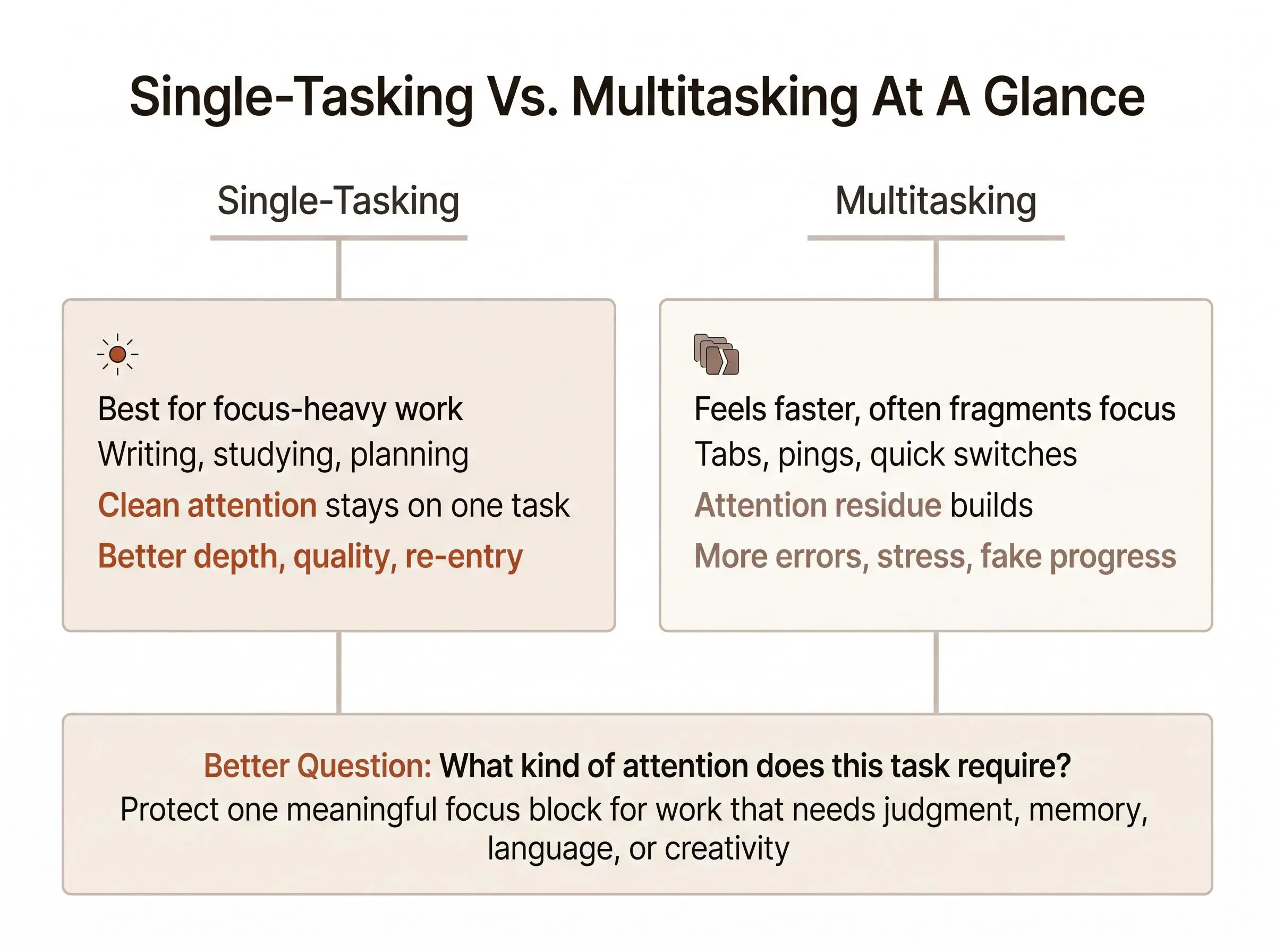
“Can I multitask?” is usually the wrong question.
Ask this instead: What kind of attention does this task require?
That reframes the whole decision. Use a quick filter:
- Does it require judgment?
- Does it require memory?
- Does it involve writing or language?
- Would errors be costly?
- Will switching create re-entry friction?
- Is this the most important task, or just the easiest task to touch?
From there, sort tasks into three buckets:
1. Deep focus tasks that need protection
These deserve uninterrupted blocks and fewer inputs.
2. Light admin tasks that can be grouped
These don’t need constant access to your attention. Batch them.
3. Passive or automatic tasks that can sometimes pair with simple inputs
This is where limited overlap may be acceptable.
This is a calmer system than trying to become “good at multitasking.” Not every task deserves simultaneous access to your mind. Frankly, most of them don’t.
How to Build One-Task-at-a-Time Productivity Into a Real Day
One task at a time productivity works best when it’s built into the day before the day gets noisy.
A practical routine looks like this:
- Choose one most-important task early
- Keep the rest of the list short
- Estimate the work in focus blocks, not vague intention
- Protect a defined work window
- Remove obvious switching triggers
- Review what actually got finished
The planning part matters. Single-tasking is weak when it relies on willpower alone. A plan reduces in-the-moment choice fatigue. It keeps the inbox from becoming your default agenda. It turns “what should I do now?” into a solved question.
This is exactly why we built Flocus the way we did. Our Daily Planner centers the day around one most-important task instead of a sprawling list. The Focus Timer then ties each work block to a planned task, so the session is anchored to something specific.
A timer can count minutes. A planner-plus-timer workflow makes those minutes point somewhere.
How to Reduce Attention Residue and Context Switching in Practice
You don’t need a dramatic life reset. Small changes do a lot here.
Try these first:
- finish a small sub-step before switching
- write a one-line next step before leaving a task
- batch messages instead of grazing them
- keep fewer tabs and tools open during focus work
- create boundaries around meeting-heavy periods
- silence notifications during protected blocks
Closure matters because residue is stronger when tasks feel unresolved. Even a short note preserves context and reduces restart cost later. “Next: revise section two and check numbers” is often enough.
Your environment matters too. One visible task helps. A cleaner browser helps. Separate windows for deep work and communication help more than people expect by the second afternoon.
A visible session length also helps the brain settle. If the block is defined, you stop renegotiating with yourself every few minutes.
For some people, it’s easier to resist scattered switching when progress is visible. Planned focus blocks and a visible progress ring, like the one in Flocus, can make completion accumulate in a way your brain actually trusts.
Common Objections to Single-Tasking and How to Answer Them
Most objections are reasonable. They just need cleaner framing.
“My job requires constant responsiveness”
Single-tasking doesn’t mean ignoring reality. It means creating protected windows inside a responsive job, even if they’re only 20 to 30 minutes.
“I get bored working on one thing”
Sometimes boredom is just withdrawal from stimulation. That doesn’t prove multitasking works better. It often means the task needs clearer scope or a shorter block.
“I actually finish more when I juggle things”
Maybe in total time touched, yes. But touch count is a bad metric. Look at quality, errors, stress, and what actually got completed.
“I’m just bad at focus”
We don’t buy that as a fixed identity. Focus is trainable. Environment, planning, repetition, and task design matter more than people think.
“I need proof that I’m focused”
Fair. For Muse users or the neurotech-curious, our optional Flow Tracking adds another layer of feedback by showing focus quality in real time during work sessions. Useful if you want measured signals, not just vibes.
What a More Focused Workday Actually Looks Like
The fragmented day is familiar. Messages all morning. Tabs half-open. Three tasks started. None clearly moved. By 4 p.m. you feel busy, behind, and slightly annoyed at yourself for reasons that are hard to name.
A more focused day looks different in quieter ways.
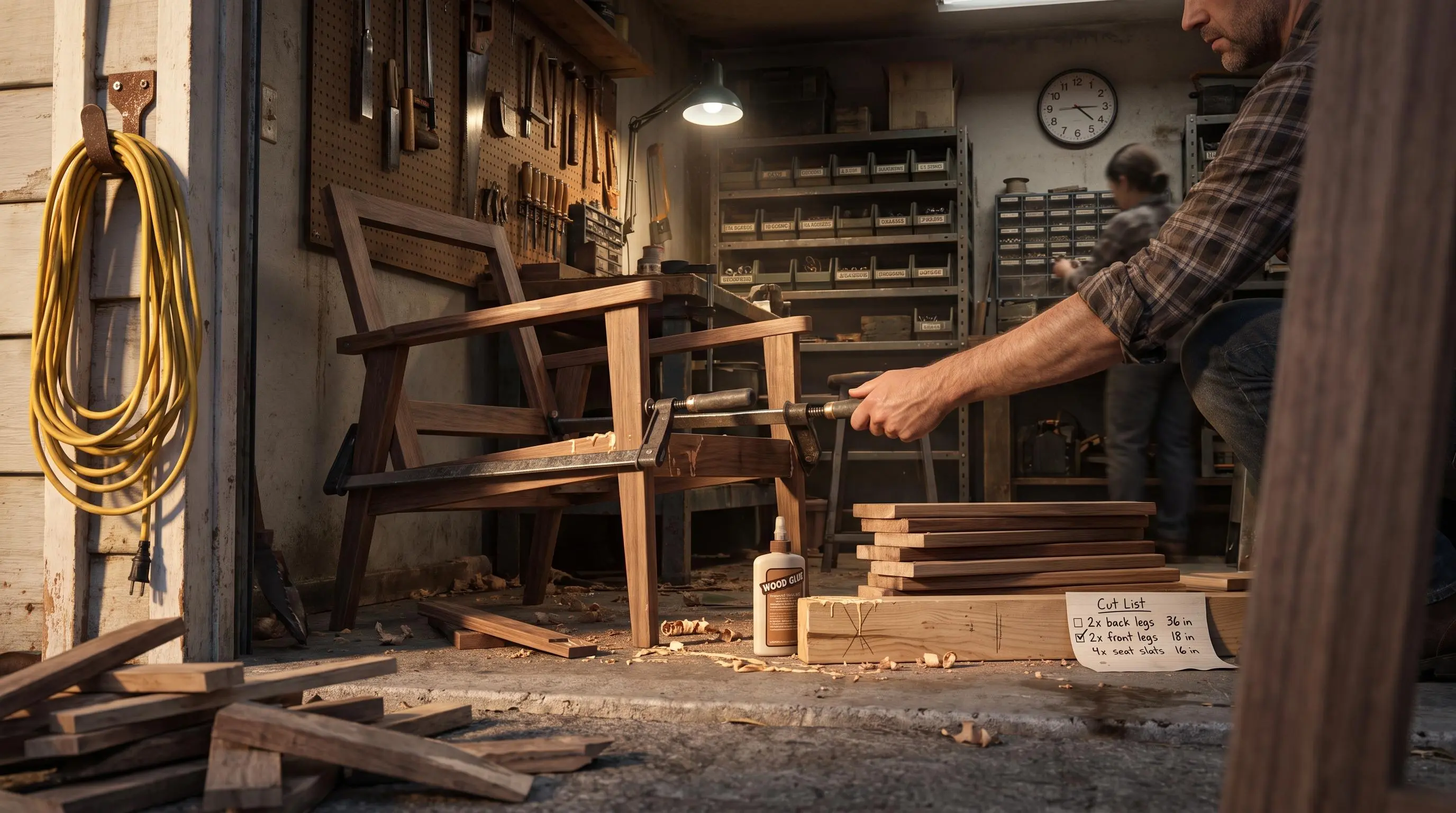
You know the main task. You have a bounded block for it. The list is short enough to be real. Progress is visible. Stopping points are clearer. Planning gets more honest because the day can’t hide behind motion.
Not perfect. Just reliable.
That’s the real win. Not monk-like concentration. Not some fantasy of becoming unreachable. Reliability. Knowing what matters, giving it attention, and seeing evidence that the day moved forward.
Conclusion
In the single tasking vs multitasking comparison, single-tasking is usually better for focus, especially for knowledge work that depends on judgment, memory, writing, learning, and creativity.
The nuance still matters. Multitasking can sometimes reduce total completion time in narrow cases. But faster overlap does not always mean better thinking, better quality, or better outcomes.
The practical move is simple:
- choose one meaningful task
- protect a defined block for it
- reduce switching triggers
- review what actually got done
Try it tomorrow. Pick one most-important task, give it one protected focus block, and compare how that feels against a day of divided attention. The difference is usually less dramatic than people expect at first. Then, after a few days, it’s hard to miss.
Article Record
ReferencesPrimary sources used for this article
- Multicosts of Multitasking - PMC - NIH
- SERIAL VERSUS CONCURRENT MULTITASKING: FROM LAB TO LIFE
- Frontiers | Inter-Individual Differences in Executive Functions Predict Multitasking Performance – Implications for the Central Attentional Bottleneck
- Is multitasking efficient? Different metrics, different conclusions | Psychological Research | Springer Nature Link
- Multitasking: does task-switching add to the effect of dual-tasking on everyday-like driving behavior? | Cognitive Research: Principles and Implications | Springer Nature Link
- Single-Tasking - Center for BrainHealth