
Boring work usually fails before it starts. Learning how to focus on boring tasks is less about discipline than removing the vague, endless feeling that makes your brain look for literally anything else.
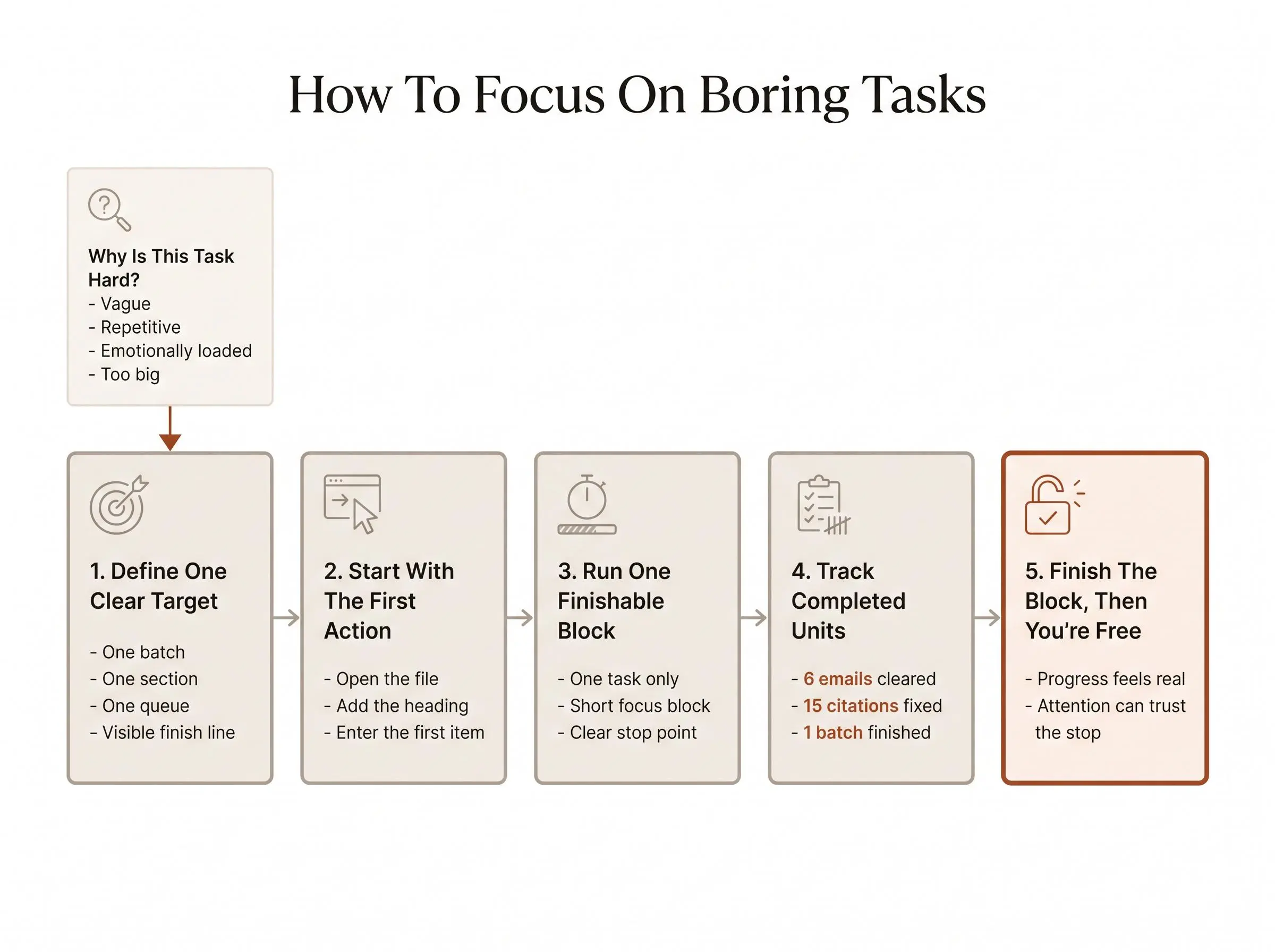
You do not need to make admin, citations, or data cleanup fun. You need one clear target, a small enough first move, and a stop point your attention can trust.
Here’s what to lock down:
- Turn “do the spreadsheet” into one batch with a visible finish line.
- Start with the first action, not the whole miserable task.
- Track completed units, not just minutes stared at a timer.
Finish the block. Then you’re free.
Why Boring Tasks Feel Harder Than They Should
Boring tasks usually don't fail because they're too hard. They fail because they ask your brain for effort before offering anything back. No spark, no novelty, no clear reward, just resistance right at the start.
That matters because a lot of people take this personally. They assume "I can't start" means "I'm lazy" or "I'm bad at focus." Usually it means neither.
Plenty of low-interest work breaks down at task initiation. You know it matters. You may even care about it a lot. But the mental start signal just doesn't arrive. This is especially common with ADHD, and a large share of adults with ADHD report real difficulty starting tasks. Still, this isn't only an ADHD problem. It's a human problem that shows up whenever the work is dull, fuzzy, or emotionally sticky.
Laziness is not the same thing as boredom resistance.
- Laziness is not caring enough to act.
- Boring-task resistance often shows up when you care so much that the task starts to feel heavy.
- If you've ever avoided an important expense report for three days, that wasn't a character reveal.
A lot of standard productivity advice falls apart here.
- Long task lists create guilt. They don't create direction.
- A plain timer counts down, but it doesn't tell you what to do.
- "Just get motivated" asks your brain to generate energy before any movement exists.
We've seen this over and over: focus gets more reliable when it's built as a system, not treated like a mood. If you're trying to learn how to focus on boring tasks, that's the shift. Stop waiting to feel ready. Build something your brain can actually enter.
Focus is easier when the path is shorter than the argument in your head.
Diagnose What Is Actually Making the Task Boring
Not all boring tasks are boring for the same reason. That's where people get stuck. They try one fix for five different problems, then decide none of it works.
Before you force concentration, figure out what kind of resistance you're dealing with.
Five common kinds of "boring"
Some tasks are monotonous. The work is clear, but it's repetitive and mentally flat. Think citations, data entry, invoice cleanup.
Some are vague. You keep "working on the report" without knowing what the next move is. Vague tasks drain attention fast because the brain has to define the work while doing it.
Some are emotionally loaded. The task itself may be simple, but it carries dread. Maybe it's admin tied to money, feedback, or a class you're already behind in.
Some are too large to see the edge. If the task feels endless, your brain treats it like open exposure.
And some are just low-meaning, low-urgency work. Important enough that it can't be ignored forever, not interesting enough to pull you in today.
Each one needs a different fix.
- Repetitive work needs rhythm and less friction.
- Vague work needs sharper definition.
- Emotionally loaded work needs a smaller first move.
- Oversized work needs visible boundaries.
- Under-stimulating work needs a shorter runway and some sign of progress.
A quick self-check helps more than people expect:
- Do I know the exact next move?
- Can I finish a meaningful piece in one sitting?
- Am I resisting the work itself, or the uncertainty around it?
- Am I tired, overloaded, or simply under-stimulated?
Learning how to focus on boring tasks starts here. The real issue may be boredom. It may also be ambiguity, dread, or fatigue wearing a boredom mask. Those aren't the same problem, so don't use the same solution.
Stop Chasing Motivation and Shrink the Starting Point Instead
Most low-interest tasks don't produce enough emotional energy to begin on their own. That's normal. Waiting for motivation first is a slow way to lose an afternoon.
Action tends to create motivation more reliably than motivation creates action.
The trick is to make the first move so small that your brain stops treating the whole task like a threat. Not fake-small. Specific-small.
- "Write the report" becomes "open the document and add the heading."
- "Send the email" becomes "type the subject line."
- "Reconcile expenses" becomes "open the spreadsheet and enter the first receipt."
This isn't about pretending the task is tiny. It's about removing the false drama around beginning it. Once the first visible action is clear, the brain no longer has to solve the entire job at once.
A good rule: if the first step still feels emotionally heavy, it's too big.
That sounds almost silly until you try it on work you've been dodging for a week. Then it starts to feel less silly and more annoyingly effective. Real motivation for uninteresting work often appears after a few minutes of movement, not before. Momentum is a better fuel source than self-talk.
A better question to ask
Don't ask, "How do I make myself want to do this?"
Ask, "What is the smallest honest version of starting?"
That question usually gets you somewhere.
What the Evidence Says About Getting Unstuck
The strategies in this guide are not a guarantee that every dull task will suddenly feel easy. But there is evidence that procrastination can be changed rather than merely endured. A systematic review and meta-analysis pooled 12 randomized studies, representing 21 treatment-versus-control comparisons and 718 participants. Psychological treatments for procrastination produced an average post-treatment advantage of Hedges’ g = 0.34 over inactive controls.
That is a modest average effect, not a promise of instant transformation. The studies also varied significantly, so the benefit was not equally large for every approach or participant. Still, the result supports treating avoidance as a behavior that can respond to a workable system: make the next action concrete, reduce competing choices, and return to a bounded piece of work when you drift.
For a task you keep avoiding, do not judge the method by whether it makes the task interesting. Judge it by a smaller test: did it help you begin one clearly defined unit and finish it?
Use the One-Task Method So Your Brain Has Fewer Places to Escape
If you're trying to focus on dull work with ten other tasks in view, your brain will shop around. Every other option looks cleaner, easier, or at least less annoying. That's not lack of discipline. That's having too many exits.
The one task method for boring tasks works because it removes alternatives on purpose.
A lot of tools are good at organizing many tasks. Far fewer are good at helping you ignore nineteen of them and do one. That's the real job.
How to run it
For one work block, choose one most-important boring task.
Then do three things:
- Hide everything else for now.
- Define what "done for this session" means.
- Start the block with only that task in front of you.
This reduces decision fatigue in a very plain way. You stop renegotiating what to work on every six minutes.
Examples help:
- admin catch-up becomes "process the six oldest items"
- documentation becomes "draft the setup steps section"
- editing references becomes "clean citations 1 through 15"
- invoice cleanup becomes "match this week's receipts"
- reviewing notes becomes "rewrite pages 3 to 5 into summary bullets"
- data entry becomes "finish one batch"
A planner like Flocus fits this well because it starts with one most-important task instead of dropping you into a disconnected timer or a giant list. That's not a fancy idea. It's just easier to commit when the system stops asking what else you might do.
Commitment gets lighter when "what next?" is already settled.
Turn Dull Work Into a Finishable Session, Not an Endless Chore
Boring tasks get worse when they have no edge. If the session has no finish line, your attention keeps looking for one somewhere else.
So don't plan "do admin." Plan a session you can actually complete.
Here's the structure we use:
- define the task
- define the next visible unit
- define the stop point
That last part matters more than people think. A stop point tells your brain the work has shape.
Better session framing
Bad: do admin
Better: clear the 12 oldest emails that require decisions
Bad: study chapter 4
Better: summarize the first 5 concepts and make 8 flashcards
Bad: clean the spreadsheet
Better: fix formatting errors in columns A through D
Notice what's happening. The task isn't smaller in some vague way. It's more finishable.
Chunk the work by completion logic, not just time:
- one batch
- one section
- one queue
- one pass
This is a quiet but useful shift for attention on low interest tasks. Attention holds better when the brain can detect an endpoint. If the task feels endless, your mind starts acting like a hostage negotiator. If it feels bounded, resistance drops.
Finishability is underrated. People talk about productivity like it's all drive and stamina. Often it's just having a stop line you can see.
Use Deep Work for Dull Work, but Make It Smaller and More Concrete
Boring work still benefits from protected attention. It just needs more structure than exciting work does. Deep work for dull work is less romantic than people make it sound. You're not chasing brilliance. You're protecting a plain block of concentration so the work can get done.
That means no vague ambitions like "finally tackle admin." Pick a finite block with a clear objective.
Compare these two setups:
- Sit down with an endless task and hope discipline carries you.
- Run one defined focus block aimed at one visible piece of the task.
The second one is much easier to enter. Also easier to repeat tomorrow.
Simple timers help some people, but they fail others for a boring reason: the countdown doesn't answer what deserves focus. If the task is fuzzy, the timer just puts a deadline on confusion. Once the task is planned first, the timer becomes useful.
The Flocus Focus Timer is built around that sequence. You start from a planned task, not from an empty clock. The timer is backing up a decision that's already been made.
Block length matters
Use shorter blocks when resistance is high.
- 10 to 15 minutes if you're really dragging
- 25 minutes for moderate resistance
- longer only after momentum shows up
People often do the opposite. They set an ambitious block to prove seriousness, then bounce off it by minute seven.
Breaks matter too. Pre-decide what a break includes. Stand up, refill water, stretch, stare out a window if you have one. If you leave it open-ended, repetitive tasks turn into scrolling detours with surprising speed.
Make Repetitive Tasks Easier to Stay With
Some tasks aren't scary or vague. They're just deadening. You know what to do. You just don't want to keep doing it for long.
In that case, the main job is to lower the cognitive cost of continuing.
Start with your environment. Repetitive work gets harder when your workspace keeps offering novelty.
- close tabs you don't need
- keep only the current materials visible
- use a simple layout with fewer choices on screen
Then batch similar items so your brain stays in one mode.
Process all invoices. Review all citations. Answer all low-stakes emails in one pass. Repetition gets easier when you're not paying switching costs every few minutes.
A little stimulation can help, but only if it doesn't split attention.
- quiet audio, if it stays in the background
- a visible count of units completed
- short batches with brief resets between them
For repetitive reading, track pages or sections. For admin, track items cleared. For grading or review work, track the batch, not the whole backlog. Looking at the entire pile is a good way to make 20 minutes feel like 2 hours.
Let's be honest about the tradeoff. The goal isn't to make repetitive work fun. Usually it won't be. The goal is to make it less mentally expensive to stay with.
Give Your Brain Proof of Progress While You Work
Boring tasks get more tolerable when progress is visible before the final result exists. Without that, effort feels disposable. You worked, but there's nothing to point to except time passing.
That is one reason plain timers can feel unsatisfying. Minutes disappear. Nothing accumulates.
Visible progress changes the feel of the work:
- completed blocks
- streaks
- progress rings
- counts of items finished
- session history you can look back on
These things help because they make attention feel cumulative. You didn't just "try to focus." You moved something.
We're not interested in fake pressure for its own sake. The point isn't hustle with prettier graphics. The point is honest feedback that gives your brain closure today and a cleaner restart tomorrow.
The Flocus Daily Planner handles this in a calm way. You choose one most-important task, estimate the work in focus blocks, then close a daily progress ring as you finish sessions. It also compares estimated versus actual time, which is unusually useful for boring work. Dread gets worse when tasks always take longer than expected. Better calibration cuts that down.
A small planning habit helps here:
- Estimate how many blocks the task should take.
- Do the work.
- Check the estimate later without turning it into a moral event.
That last part is important. Planning errors are information, not evidence against your worth as a person.
What to Do When Your Attention Slips Mid-Task
Your attention will drift. On boring work, it definitely will. That doesn't mean the method failed. It means you're a person doing low-interest work in a world full of exits.
The recovery needs to be calm and fast.
Try this sequence:
Attention reset
- Notice it
Notice the drift without scolding yourself.
- Shrink it
Shrink the task again.
- Restart
Restart with one visible action.
- Finish the block
Commit only to the rest of the current block.
That's enough. No dramatic reset required.
Common escape patterns are usually pretty predictable:
- opening a "quick" tab
- reorganizing the task instead of doing it
- switching to easier but less important work
- checking messages to break monotony
The fix is rarely complicated. Close the tab. Stop reorganizing. Put the easier task back on the list. Write down the intrusive thought once and return to the current batch.
A simple capture note helps: one line on paper or in a plain note, then back to work. The thought is stored. It doesn't need another meeting.
Some people believe they simply can't do boring work for long. For long, undefined stretches, that may be true enough. For bounded one-task sessions with a clear finish line, it's often much less true. Calm redirection works better than internal scolding when you're trying to keep attention on low interest tasks. Shame burns energy you could use for the next five minutes.
Build a Repeatable Boring-Task Routine You Can Trust
The point isn't to win one heroic afternoon. You need a routine that still works on a Tuesday when you're tired and mildly annoyed by your own inbox.
A simple version looks like this:
Simple routine
- Pick the task
Choose the one most-important dull task.
- Name the first step
Define the first visible step.
- Estimate blocks
Estimate the number of work blocks.
- Work one block
Run one finite block.
- Break
Take a real break.
- Review
Review what moved and what didn't.
Repeatability matters more than intensity. Boring work usually doesn't require heroics. It requires fewer negotiations with yourself.
This is especially useful if you've bounced off heavyweight productivity systems and also bounced off plain study timers. One is too much machinery. The other is just a clock. Most people need something in between.
The task may never become interesting. That's fine. It can still become manageable, familiar, and easier to finish.
For readers who want more objective feedback on focus quality, Flocus can optionally pair with Muse for live flow tracking. That's useful if you're curious about measured focus, not just minutes logged. But it's optional, and the planning method still does the heavy lifting without hardware.

Common Mistakes That Make Boring Tasks Harder
Most struggles here are not mysterious. They're the same few mistakes repeated in slightly different outfits.
Waiting to feel ready before starting
Start with the smallest visible action instead. Readiness usually follows movement.Setting a session goal that's too vague to finish
Replace "work on it" with a unit you can complete this sitting.Using a timer with no task attached
Decide the task first. Then run the block.Keeping the entire task list visible
Hide the rest. Your list should not double as an escape menu.Making the first step too big
If the opening move feels heavy, shrink it again.Taking breaks that become digital exits
Pre-decide the break. Stand up. Don't open the internet unless the task needs it.Measuring only time spent
Track units completed too. Minutes matter less when nothing seems to move.Treating every lapse as failure
Reset inside the current block. No speeches.Planning unrealistically, then using the mismatch as proof you're inadequate
Use the mismatch to improve estimates. That's what it's for.
This is boring advice, which is probably why it works. Most people don't need a new personality. They need a cleaner setup.
Conclusion
Learning how to focus on boring tasks is usually not about finding perfect motivation. It's about building a system that lowers resistance, narrows attention, and gives your brain proof that progress is happening.
The practical version is simple: one clear task, one small start, one finite block, one visible sign of completion.
Pick the dull task you've been avoiding. Define the smallest concrete first move. Give it one protected block today. Not the whole day. Just one block. That's often where boring work stops feeling impossible and starts feeling finishable.
Article Record
ReferencesPrimary sources used for this article
- Targeting Procrastination Using Psychological Treatments: A Systematic Review and Meta-Analysis
- Multitasking: Switching costs
- Effects of task interruptions caused by notifications from communication applications on strain and performance
- Investigating the Effectiveness of Self-Regulated, Pomodoro, and Flowtime Break-Taking Techniques Among Students
- Work interruptions of office workers: The influence of the complexity of primary work tasks on the perception of interruptions