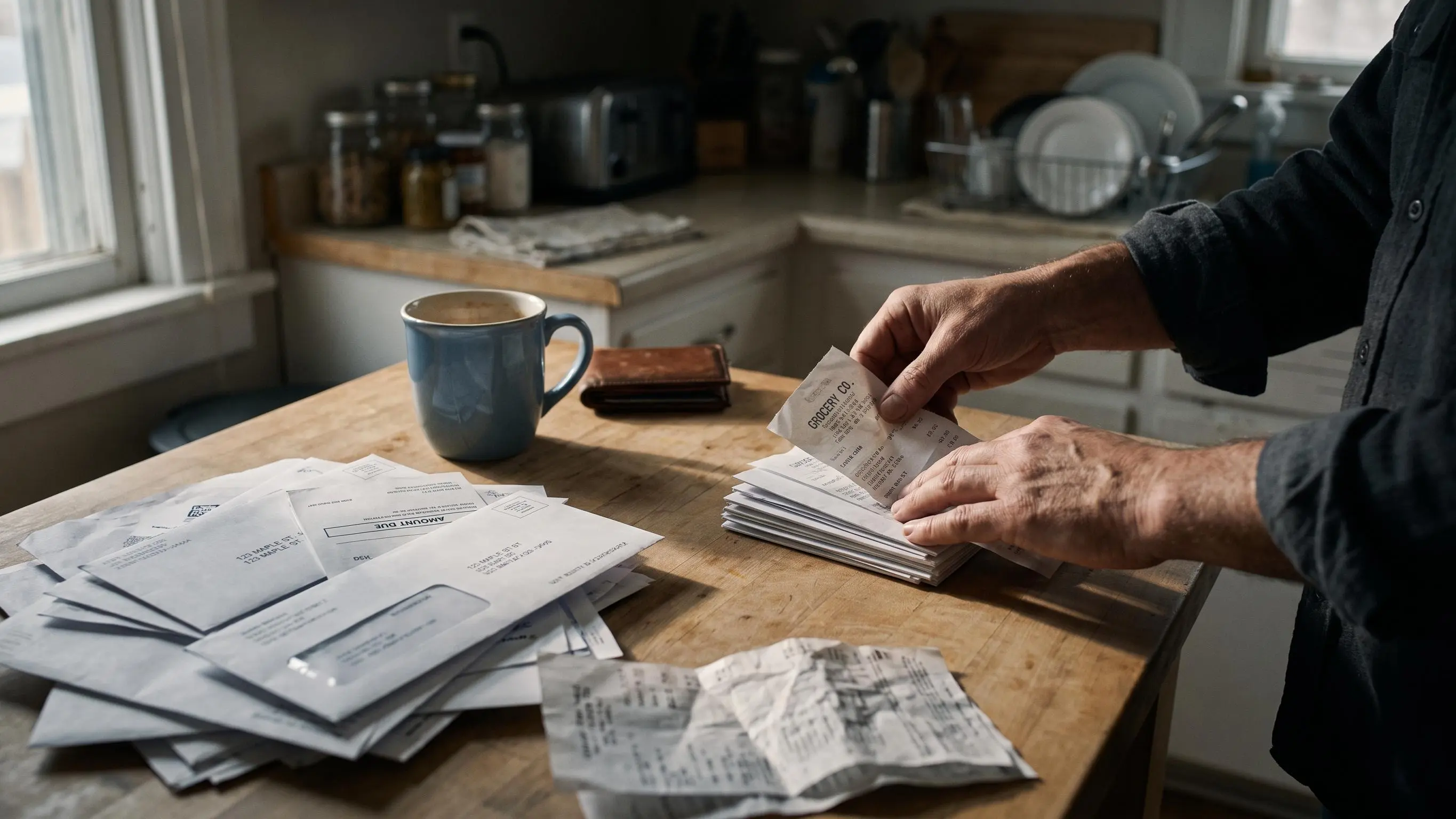
When you can’t focus, the usual move is to open another timer, another tab, another “system.” That’s often how a small attention wobble becomes a lost afternoon.
What matters is finding the real snag: too many open loops, low energy, worry, or a task so vague your brain keeps backing away. Start smaller than feels impressive.
Try this before you ask more of yourself:
- Put your phone out of reach for 10 minutes.
- Name one visible next action, not the whole project.
- Stop when the block ends and decide what’s next.
Get one clear thing moving.
Why It Feels So Hard to Focus Right Now
If focusing feels harder than it used to, that does not mean you've suddenly become lazy or weak. It usually means your environment has been training your attention to keep turning its head.
In screen-heavy work, that training is constant. Measurements of on-screen attention have dropped hard over time: from around two and a half minutes in the mid-2000s, to roughly 75 seconds by 2012, then below a minute in later work, with a recent median near 40 seconds. Forty seconds is not a character flaw. It's a habitat problem.
Modern work asks you to reorient all day. Tabs, messages, alerts, feeds, side quests, half-read docs, half-finished thoughts. Your brain gets very good at switching and noticeably worse at staying.
The cost shows up in ordinary ways:
- more mental fatigue by the middle of the day
- more stress, even when nothing dramatic is happening
- more avoidable mistakes
- more hours spent "on" without finishing the thing that actually mattered
That's why our view is simple: focus usually isn't something you squeeze out through force. You support it. Give it a clear target, reduce the number of switches, and work in a rhythm your brain can actually tolerate.
Attention doesn't break all at once. It frays through repetition.
What "I Can't Focus" Actually Means
When people say they can't focus, they're often describing different problems with the same sentence. And what to do when you cant focus depends on which problem you're actually in.
A few common versions show up again and again:
- You're overstimulated and keep checking things. Every ping feels magnetic.
- You're mentally cluttered and can't decide where to begin. Too many open loops, no entry point.
- You're tired and your brain feels slow. You reread the same paragraph three times.
- You're anxious and your mind keeps circling a worry.
- You're resisting a task that feels vague, difficult, or emotionally annoying.
These don't need the same fix. A timer won't help much if the task is still foggy. Working longer won't solve being under-slept. And if anxiety or depression is eating cognitive bandwidth, more self-scolding is about as useful as yelling at a laptop battery.
It helps to separate three buckets:
A focus skill issue
This is when you do have enough energy, but your setup is messy. Too many tabs. No clear next step. Constant switching. This is often fixable with structure.
An energy issue
This is when your brain simply doesn't have much to give. Sleep debt, unstable routines, long stretches without breaks, too much stimulation. You can still work, sometimes, but badly and expensively.
A mental health issue
If your attention is getting hijacked by panic, dread, hopelessness, or persistent fog, the problem may not be "focus" at all. Focus with mental clutter is one thing. Focus with untreated anxiety or depression is another.
Getting the category right matters. The wrong fix often feels like proof that you're failing, when really you were solving the wrong problem.
Start Here: The Calm Triage for the Next 5 Minutes
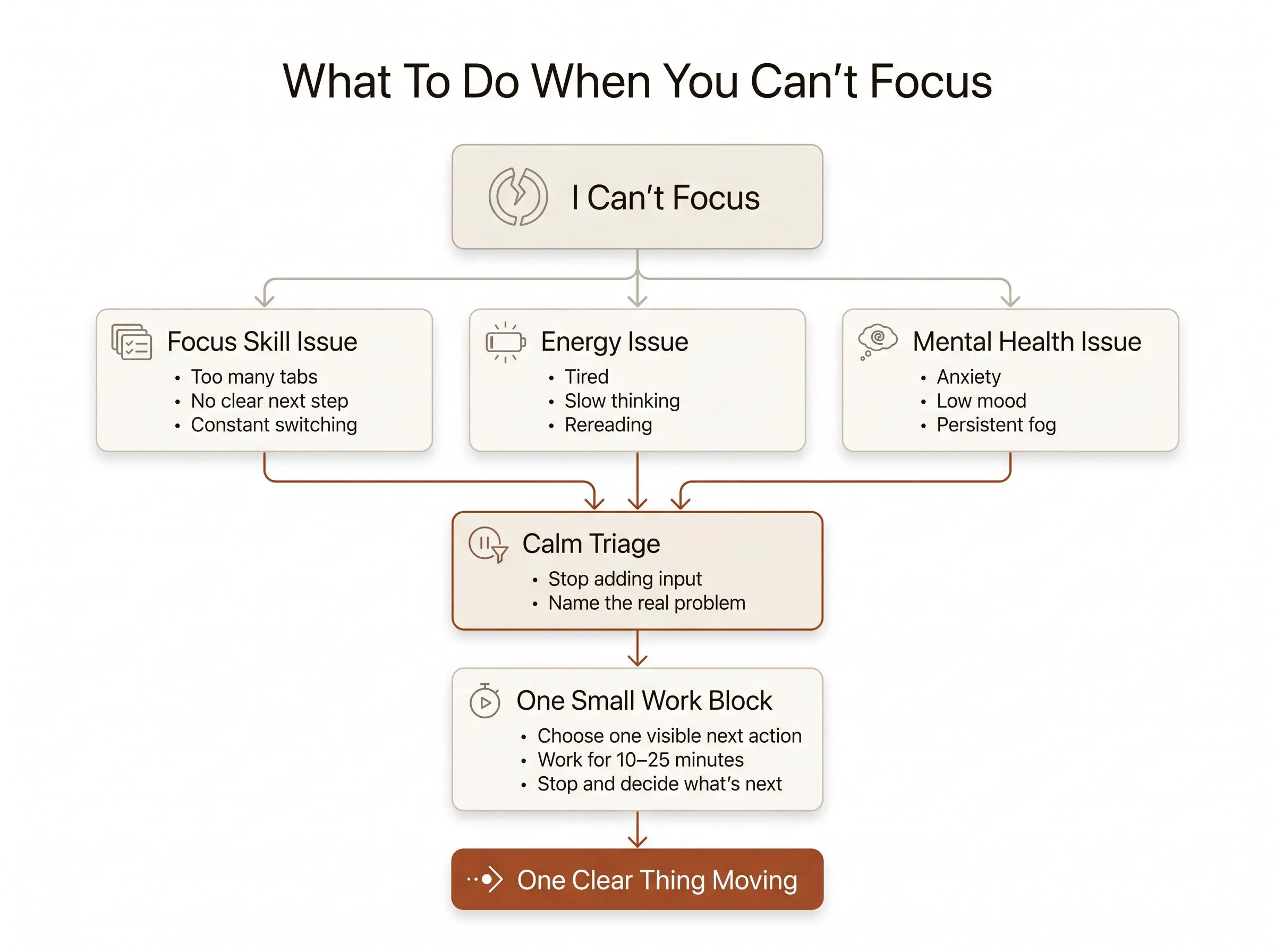
If you're stuck right now, don't build a whole new life system this minute. Just reset the next five minutes.
Use this in order:
Quick reset
- Reduce distractions
Stop adding input.
Close the extra tabs. Silence notifications. Put your phone out of reach, ideally in another room. Also stop searching for a better method while avoiding the task. That one is sneaky. - Identify the issue
Name the actual problem.
Ask: am I tired, worried, confused, overstimulated, or avoiding this? - Pick one next step
Choose one visible next action.
Not "finish project." More like "draft the opening paragraph," "answer the first email," or "read pages 1 to 3." - Time-box the effort
Set a short work block.
Pick 10 to 25 minutes when attention feels fragile. The win is finishing the block, not entering some perfect state. - Pause and reassess
Stop when the block ends.
Reassess on purpose. Don't drift into checking six unrelated things because the timer went off.
This is small on purpose. Short successful reps rebuild trust faster than heroic sessions that end with you fried, guilty, and scrolling.
A lot of people secretly make the block too big. Then they call themselves unfocused when really they just picked a fight with their current capacity.
The Real Causes to Check Before You Try Another Productivity Hack
Not every attention problem is a willpower problem. In fact, many aren't.
Here are the usual suspects and how they tend to feel in real life.
Sleep deprivation
This often feels like slow thinking, weak working memory, and a lot of rereading. You know the material. It just won't stick. People often mistake this for lack of discipline. It isn't.
Anxiety
Anxiety hijacks attention toward a specific worry or body signal. Your mind keeps checking the same internal alarm. Even simple tasks can feel hard to enter because part of your brain is busy scanning for threat.
Depression
Depression can look like fog, low motivation, flatness, and trouble holding information in mind. Work that normally feels routine can start to feel strangely heavy.
Phone-trained fragmentation
This one is common and annoyingly effective. You feel the urge to switch after a few seconds. You reach for novelty before the current task has had any chance to become interesting.
Too many open loops
An overstuffed task list creates drag. When everything is still "pending," your brain stays in monitoring mode. That is not concentration. It's low-grade internal admin.
Unstable energy
Inconsistent sleep, random meals, no daylight, no movement, constant stimulation. None of this is glamorous, but your attention notices.
If focus problems are persistent, getting worse, or paired with mood changes, panic, major sleep issues, or fog that doesn't lift, the next step may be care and support, not another timer app. That isn't dramatic. It's practical.
Why Task Switching Makes You Feel Worse, Not Better
Most multitasking is just task switching in nicer clothes. And switching is expensive.
Every time you bounce from the report to chat to inbox to the report again, a piece of your attention stays behind. That's attention residue. Part of your brain is still holding the last task while you're trying to enter the next one. No wonder the next thing feels blurry.
Heavy multitaskers also tend to be worse at filtering irrelevant information and slower at switching cleanly than people who single-task more often. That's the part people don't love hearing. Practicing constant switching doesn't make you sharper at it. It often makes you more distractible.
Research summaries have put the productivity cost of switching as high as 40 percent. You can feel that cost at work in very ordinary places:
- checking the inbox every few minutes
- reacting to every chat ping
- tab hopping when a task gets uncomfortable
- bouncing between planning and doing without ever settling into either
Quick checks feel harmless because they're short. But they train scanning, not concentration.
The goal isn't perfect silence. Most people don't have that luxury. The goal is fewer switches and stronger boundaries around one task at a time.
A Simple Single Task Reset That Works Even on a Messy Day
When attention is scattered, we don't recommend starting with ambition. Start with containment.
Here's the single task reset. It's a calm focus method, not a motivation trick:
Single-task reset
- Brain dump
Capture everything pulling at your attention.
Dump it into a note. Don't organize it yet. - Choose one priority
Choose one most important task, or one meaningful next action.
If the day is already off the rails, choose the next useful move. - Shrink the task
Narrow it until it fits one work block.
"Finish report" is too broad. "Outline section one in the doc at 9:00" is usable. - Set time and place
Decide when and where you'll do it.
Vague intentions create more drift than people realize. - Work the block
Work only on that task until the block ends.
Then stop and decide the next move on purpose.
Capture before organize works because it lowers cognitive load. Your brain relaxes a little once it knows the loose ends are parked somewhere. That's often enough to get you moving.
If you're fried, start with 10 minutes. If that goes fine, use 25 next time. Longer blocks can come later. Capacity returns faster when you don't keep proving to yourself that focus is exhausting.
A small operator note here: end a block while it still feels manageable once in a while. Let your brain learn that focused work does not always end in depletion.
How to Focus When You Feel Scattered at Work
Work and school both create a particular kind of chaos: digital interruption that looks legitimate. That's why how to focus when you feel scattered needs to be a little more realistic than "just unplug."
A practical version looks like this:
- batch inbox checks instead of monitoring them continuously
- mute nonessential notifications during focus time
- use one-hour single-task windows for moderate work
- use 90-minute blocks for deeper work if your energy is stable
- take real breaks instead of replacing work with scrolling
There is a useful caveat on notifications: turning them off is not an automatic cure. In a preregistered randomized trial of 205 people, disabling notifications for one week did not change objectively logged checking frequency or screen time, and did not improve reported productivity or smartphone distraction. It did reduce how habitual people felt their checking was, while increasing fear of missing out. A separate one-day field experiment with 247 people found fewer notification-caused interruptions benefited performance and reduced strain. The practical takeaway is to pair muted alerts with a defined task and a planned check-in time; otherwise, it is easy to replace alerts with self-interruptions. The studies point to a mixed, context-dependent effect.
Phone breaks usually don't restore attention very well. They keep the brain in stimulation mode. You come back "rested" in the same way a slot machine break is restful. Which is to say, not really.
Better breaks are boring in a good way:
- a short walk
- water
- looking away from screens for a few minutes
- a walk without podcasts, music, or feeds
If your job is interruption-heavy, adapt the block instead of abandoning the idea. Use 20 or 30 minutes. Tell people when you'll be heads down. Use headphones, a quieter corner, or even a screen position that reduces visual pull. Protect one meaningful block per day if that's all the day will allow.
You do not need a perfect environment. You need one defended patch of time.
Build a Focus System, Not Just a Timer
A plain timer helps you count time. It does not tell you what deserves the time, and that's usually where the day goes sideways.
This is why so many people bounce off standalone timers. They finish a few rounds, feel vaguely productive, and still end the day unsure what moved. The timer worked. The day didn't.
We prefer a planning-first setup:
- choose one most important task
- keep the daily list short
- estimate the work in focus blocks
- run a timed block against that task
- review estimated versus actual time afterward
That last part matters more than it gets credit for. Estimate versus actual is how you stop lying to yourself, gently, about what fits in a day.
That's the logic behind Flocus. It's browser-based, and the timer is attached to a planned task instead of floating around on its own. You choose one main priority, work in Pomodoro-style blocks, and fill a daily Focus Ring as blocks get completed. The estimate-versus-actual tracking keeps planning honest.
We built it for people who don't need more urgency. They need a plan before the countdown starts.
The 72-Hour Reset for Attention That Feels Fried
If your attention feels cooked, try a short reset instead of waiting for motivation to reappear. The point is to remove distraction cues, restore a little friction, steady your energy, and get a simple rhythm back.
Day 1
Silence nonessential notifications. Keep your phone out of the room during work. Notice what keeps pulling your attention without trying to fix every habit today.
Day 2
Do a full mind sweep. Get the open loops out of your head. Then choose one single-task hour. Batch inbox and social media into defined windows instead of letting them leak everywhere.
Day 3
Plan one protected deep-work block. Clean the visual workspace. Take a walk without content. At the end of the day, note what helped and what didn't.
This isn't about becoming monastic for 72 hours. It's just a fast way to get back under your own control. Attention improves when the environment stops training constant orienting.
How to Measure Progress Without Turning Focus Into Self-Punishment
Tracking can help, or it can become another small courtroom. We prefer the first option.
Instead of grading yourself on whether you felt amazing, look at observable signals:
- Did you choose one clear priority?
- Did you protect one work block?
- Did you return after distraction without turning it into a moral drama?
- Did you finish what you planned, or learn why you didn't?
A few useful things to track:
- number of completed focus blocks
- estimated versus actual time
- times of day when focus comes more easily
- common distraction triggers
Visible progress restores confidence better than vague self-judgment. In Flocus, that can be as simple as seeing completed blocks fill the Focus Ring and reviewing weekly patterns in the Daily Planner. Some people also like seeing where estimates keep slipping. It's not always pleasant, but it is clarifying.
For readers who are curious about measuring focus quality, not just time, there's also optional Flow Tracking with a Muse headband. It gives real-time feedback during work. Useful for some, unnecessary for most. The planning method still does the heavy lifting.
What to Avoid When You Cannot Concentrate
A lot of "productive" behavior is just anxious stalling with better branding.
Watch for these:
- making an oversized to-do list to feel in control
- reorganizing tools instead of starting
- extending sessions far past your actual attention capacity
- using your phone as a break
- waiting for perfect silence or perfect motivation
- switching tasks the moment discomfort appears
Each one has an emotional trap underneath it. Control-seeking. Avoidance. Self-criticism. Unrealistic expectations. None of them improve the work.
The correction is plain: attention is trainable and situational. It is not proof of your character. Calm consistency beats intensity here. Every time.
When It Is Time to Get Help Beyond Self-Help
Sometimes the kindest move is to stop treating the problem as a productivity issue.
If your inability to focus is persistent, seriously interfering with work or school, or showing up alongside anxiety, panic, low mood, hopelessness, sleep disruption, or ongoing cognitive fog, it's worth getting professional support. Some focus problems are symptoms of something else.
Needing help does not mean you failed at focusing. It means you're trying to understand the cause instead of forcing harder and getting nowhere.
That is a better use of your energy.
Conclusion
What to do when you cant focus is usually simpler and gentler than people expect. Reduce input. Name the real problem. Choose one concrete next action. Work in a contained block.
Stop chasing perfect conditions. Build a repeatable calm focus method instead. One clear target, fewer switches, and a rhythm you can keep tomorrow.
Try one single task reset today. Then make the process visible with a planning-first system, whether that's on paper or in Flocus, so you can see what mattered, what got done, and what needs adjusting next time. Focus gets steadier when the day stops feeling like a blur.
Article Record
ReferencesPrimary sources used for this article
- "Give me a break!" A systematic review and meta-analysis on the efficacy of micro-breaks for increasing well-being and performance
- Effects of task interruptions caused by notifications from communication applications on strain and performance
- “Phone in the Room, Mind on the Roam”: Investigating the Impact of Mobile Phone Presence on Distraction
- The effects of cues on task interruption recovery in a concurrent multitasking environment
- A Therapist’s 30-Day Plan to Improve Your Attention Span