A deep work routine usually fails before the timer starts: the task is vague, messages stay open, and “just one check” eats the morning. You do not need a heroic four-hour trance.
What works is smaller and less glamorous: one clear priority, a protected block, and a quick record of what actually happened. That is how focus becomes repeatable instead of a lucky day.
Watch for these pressure points:
- A finish line you can name before starting
- A phone that is not within arm’s reach
- Estimated time versus reality
Finish work knowing where the day went.
What a Deep Work Routine Actually Is
A deep work routine isn't "that one excellent Tuesday" when everything clicked and you finished in three hours what usually takes all week. It's a repeatable way of getting your mind into demanding work on purpose.
Deep work means distraction-free concentration on tasks that actually ask something of your brain. Writing a hard section. Solving a problem set. Untangling a bug that doesn't give up politely. Work like that creates value, improves skill, and usually can't be faked with a few quick replies and a busy-looking calendar.
Shallow work is different. Email, scheduling, status updates, file cleanup, admin. Necessary, often. Deep, no.
A real deep work routine has a few parts that show up again and again:
- a set time
- one clear target
- a protected work block
- a start ritual
- a short review at the end
That's the routine. Not mood. Not inspiration. Not deadline panic wearing a fake mustache.
It's also worth saying this plainly: the goal is not to turn your whole day into deep work. For most knowledge work, about four hours a day is already near the realistic top end for truly demanding cognitive effort. After that, quality usually gets weird. You may still be typing, but the thinking gets thinner.
So if you're trying to build a deep work habit, don't aim for heroic. Aim for sustainable. That's where this gets useful.
Why Most Deep Work Routines Fall Apart
Most people know the pattern. You mean to focus. You open a timer. You have six tasks competing for attention. Forty minutes later you've checked two messages, renamed a file, skimmed notes, and somehow feel both busy and behind.
That isn't a discipline failure. It's a design failure.
A lot of routines collapse because they rely on motivation to do the heavy lifting. Motivation is nice when it shows up. It is also unreliable, dramatic, and usually late. Good systems assume you won't feel especially heroic at 9:10 a.m.
There's another problem most people feel but don't name: attention residue. When you switch tasks, part of your mind stays attached to the previous one. So the next block begins with less mental grip than you think. You're at the document, technically. Mentally, you're still in Slack arguing about scheduling.
The cost of interruption isn't abstract. Workers often switch or get interrupted every 3 minutes and 5 seconds. It can take about 23 minutes and 15 seconds to fully return to the original task. That's absurd on its face, but it also explains a lot. If your day is built around interruption, your concentration never gets enough runway to leave the ground.
Reactive work makes people feel productive because there's constant motion. Motion is not the same thing as progress.
And this is where plain timers often disappoint. A timer can count 25 minutes with perfect honesty while telling you absolutely nothing about whether those 25 minutes moved the right thing forward. Minutes are not the problem. Direction is.
A lot of readers assume they don't have a habit of concentration. Usually the truth is less personal and more annoying: your environment, your defaults, and your routine keep dragging you back into shallow work.
The Principles That Make Focused Work Consistent
If you want to make focused work consistent, stop asking your future self to be stronger. Make the routine easier to enter.
Routines stick when they remove decisions and lower friction. That's the whole game. We keep coming back to five building blocks.
The five pieces that matter
- One meaningful priority instead of a long list of equally "important" tasks. When everything gets top billing, your brain stalls.
- A bounded work block with a clear start and stop. Open-ended focus sounds noble and usually leaks.
- A distraction-light environment set up before the work starts.
- Visible proof of progress so the effort feels real, not imagined.
- A recovery rhythm so deep work doesn't turn into self-inflicted exhaustion.
There are a few common ways people schedule deep work, and they are not equally practical.
- Monastic: cut distractions aggressively and disappear into work. Useful for a small minority with unusual control over their time.
- Bimodal: reserve full half-days or whole days for deep work. Effective, but fragile if your role involves collaboration.
- Rhythmic: same block, same time, most days. This is the method most people can actually keep.
- Journalistic: drop into deep work whenever a gap appears. Experienced people sometimes manage this. Beginners usually end up with scraps.
If you're trying to build a daily deep work practice, rhythmic wins more often than people expect.
Consistency beats intensity when you're training attention.
A routine you can repeat five times a week will do more for you than a dramatic four-hour session you resent by Thursday.
Choose the Right Block Length Before You Chase Longer Sessions
A strange productivity myth says serious people start with two-hour blocks. They don't. Most people who try that just spend longer feeling guilty.
Start with the block length you can protect and complete cleanly.
Many people do well with 60 to 90 minutes for demanding work, especially if the break afterward is real. But "90 minutes" should mean one defined output inside a protected window. Not 90 minutes of drifting around the same paragraph while checking your phone like a lab rat.
If your focus feels shaky right now, use a progression:
Follow this progression to lengthen focus blocks.
- Start small
Start with one 25-minute block.
- Extend the session
Move to 50 to 60 minutes once starting feels less dramatic.
- Work up to full depth
Stretch to 60 to 90 minutes when you can stay with one task without constant reaching for distraction.
That last part matters more than ambition. If you're still checking messages three times in 25 minutes, the problem is not that the block is too short.
A practical way to build this:
- protect one daily block first
- keep it stable for a week or two
- only then extend toward two hours, if the work actually needs it
Quality matters more than duration. A clean 50-minute block on the right task will beat a foggy 2-hour performance every time.
Try to place the block at your best cognitive time. For many people that's early morning, before the inbox starts making claims on the day. Not everyone. But enough people that it's the first place to look.
And frequency matters. Four or five sessions a week usually builds the habit faster than one or two marathon days. Attention likes rhythm.
How to Build a Deep Work Habit Around One Most-Important Task
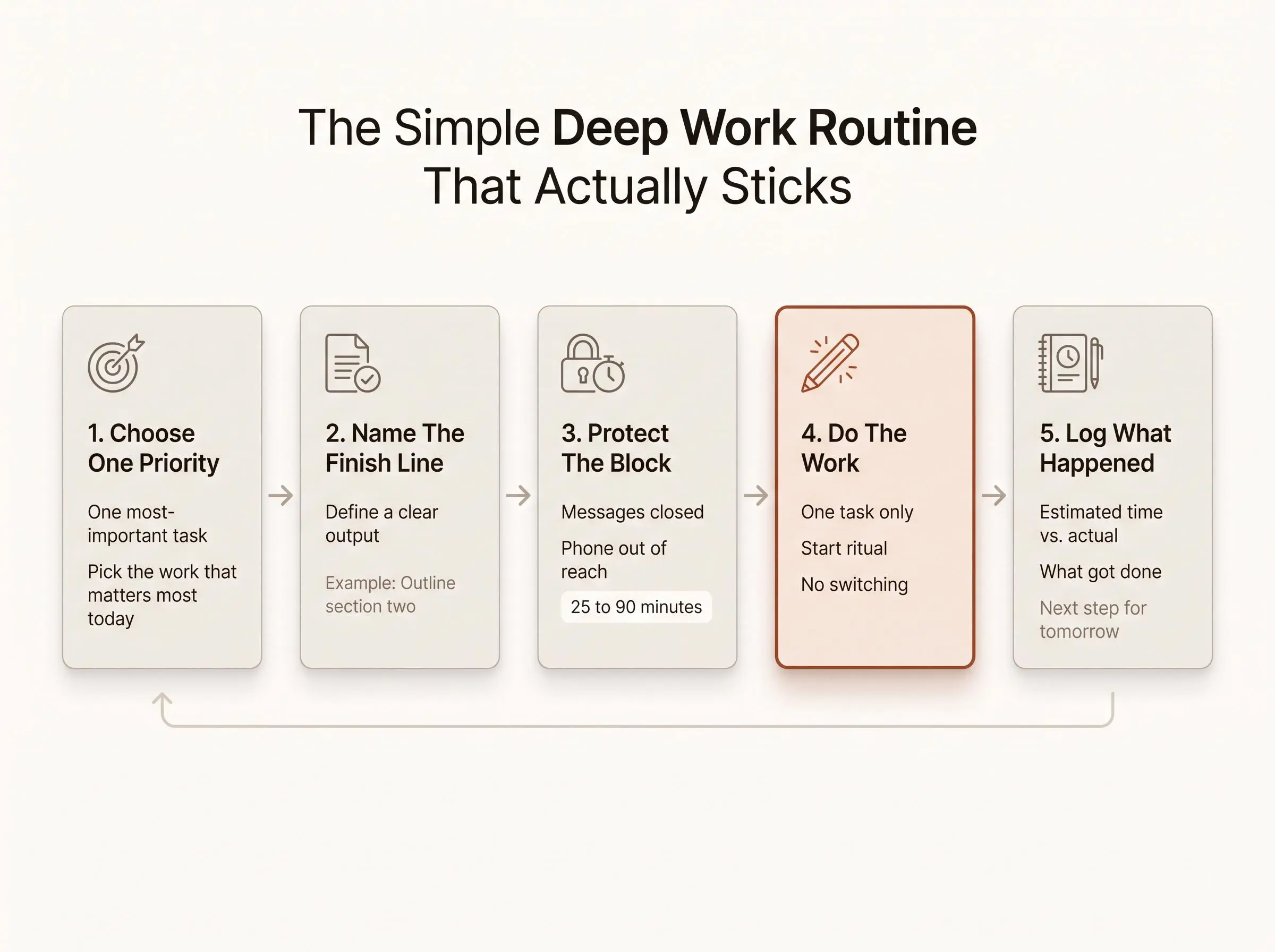
This is the part that changes things. If you want to know how to build a deep work habit that survives normal workdays, start by reducing the number of moving parts.
Use this process.
A simple operating sequence
Use this sequence to start each deep work session.
- Pick the task
Choose one most-important task. Pick the thing that would make the day feel meaningfully used if it moved forward.
- Make it specific
Shrink the target. "Work on paper" is too vague. "Outline section two" is better. So is "debug login error" or "solve problems 4 through 6."
- Size the work
Estimate the work in blocks. One block? Two? This turns the task into something bounded.
- Set the finish line
Define done for this block before you start. Otherwise the finish line moves on you.
- Set up your workspace
Prepare the work surface. Open the document, notes, dataset, or code you need. Close the rest.
- Repeat the cue
Use the same cue each time. Water. Headphones. One document open. Notifications off. The exact ritual matters less than repeating it.
- Log the next step
End with a short log. Note what happened and write the next step while the context is still warm.
This works better than an ambitious task list because it removes internal negotiation. Your brain settles faster when there is one obvious thing to do.
This is also why we built Flocus as a planner first, not just a timer. In the Daily Planner, you choose one most-important task, keep the list short, estimate the work in pomodoros, and tie today's effort to weekly goals. That planning layer does more than people think. It keeps the block honest.
A good deep work routine stops feeling mysterious once the task is clear enough to enter. Foggy tasks create fake resistance. Specific tasks are calmer.
Design an Environment That Supports Concentration Instead of Testing It
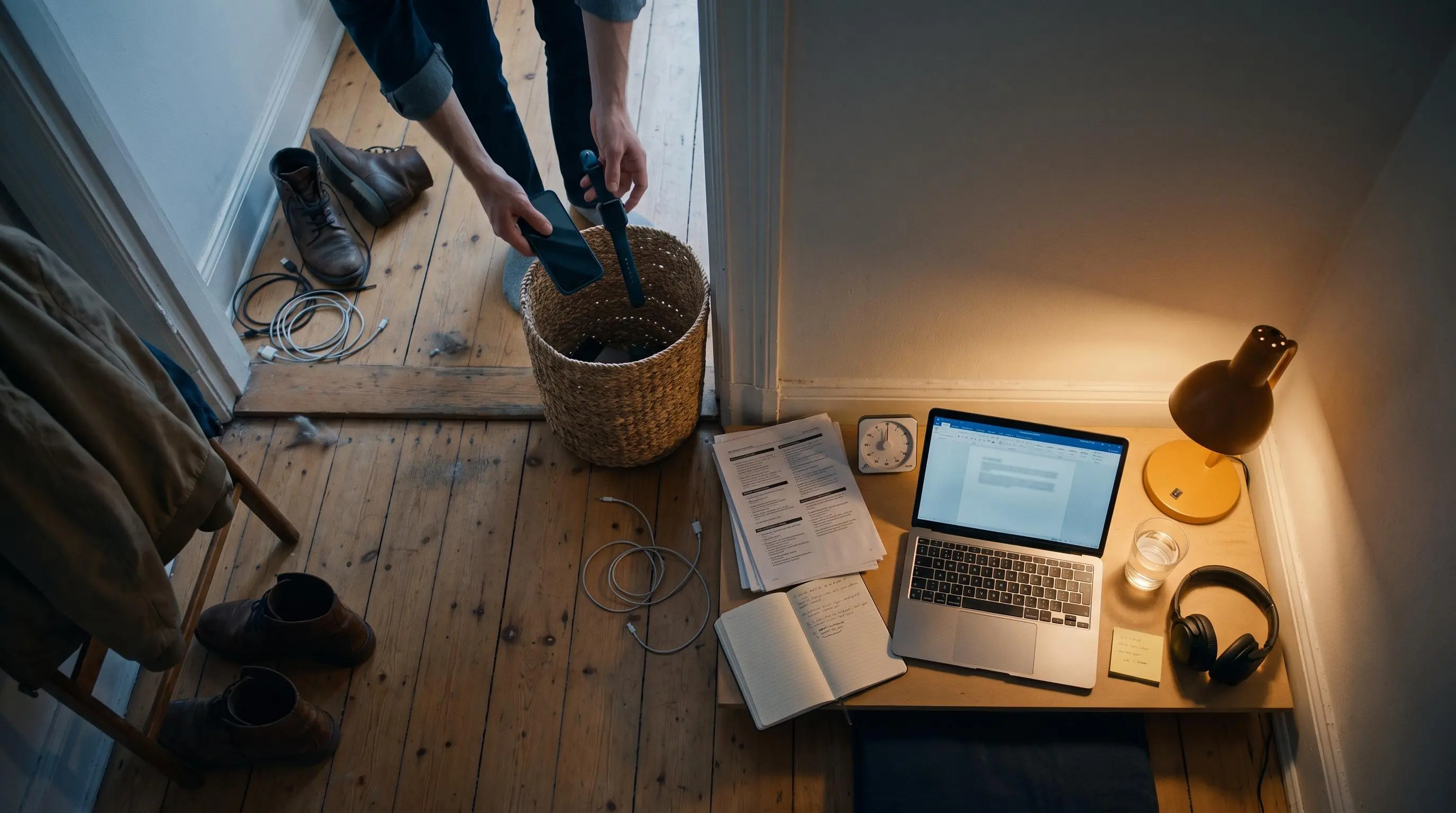
A lot of focus problems are really environment problems with better marketing.
If chat is open, email is visible, your phone is within reach, the calendar is chopped into confetti, and you have 18 tabs open "just in case," you're not creating conditions for concentration. You're running an obstacle course and acting surprised when your pace drops.
Before a session, do the boring setup:
- close or mute communication apps
- turn off nonessential notifications
- keep only the tools for the current task open
- put the phone out of sight
- get reference material ready in advance
Small details matter here. If you spend the first six minutes hunting for notes, the block starts with friction. Friction turns into avoidance faster than people admit.
Protect the calendar too. Don't wait for open space to appear on its own. It won't. Shallow work expands aggressively unless you give it a fence.
It also helps to batch admin into set windows so it stops leaking into every hour. Email at 11:30 and 4:30 is boring. Boring is often useful.
If you work in an open office or a shared home, don't pretend you'll get monastery conditions. Use realistic fixes:
- headphones
- a visible status signal
- a different location for the block
- a recurring protected slot people learn not to interrupt
And take real breaks. Checking your inbox "for a second" during a break is one of the quickest ways to drag your mind back into reactive mode.
A short shutdown note at the end helps too. Write the next step. Otherwise unfinished work keeps tugging at the rest of your day like a child pulling your sleeve.
Protect the Routine From Interruptions, Meetings, and Other Real-World Friction
Deep work can sound slightly fictional if your job involves other humans. Fair enough. But collaborative work doesn't make focused work impossible. It just means your boundaries need structure.
The scale of the problem is bigger than a few badly timed pings. In Microsoft's 2025 analysis of aggregated Microsoft 365 activity, employees were interrupted by a meeting, email, or notification every 2 minutes on average. Half of meetings landed in the 9–11 a.m. and 1–3 p.m. windows, while Tuesday carried 23% of weekly meetings versus 16% on Friday. For a routine that needs uninterrupted runway, the practical implication is to protect time before the meeting-heavy windows where possible—and treat a calendar opening as insufficient if messages are still arriving.
Start with response windows. If you answer every message instantly, people learn that instant access is normal. Then your whole day gets chopped into tiny surrender ceremonies.
Try language like this:
- "I'll be offline from 9:00 to 10:00 working on a priority item. If it's urgent, call."
- "I check messages at 11 and 3. Send anything time-sensitive through the urgent channel."
- "Can we move this meeting after 11? I protect mornings for heads-down work."
That isn't grandstanding. It's scheduling.
If your role is reactive, shorten the block and get precise about what it's for. Protect 25 or 45 minutes for your highest-leverage work, not routine cleanup. Also make urgent channels clear so you don't half-monitor everything.
When interruptions do happen, recovery matters more than perfection. Before switching away:
- write the next exact action
- capture the interruption somewhere if it can wait
- restart with a smaller target if the block gets fractured
Don't use deadlines as your only way into concentration. Plenty of smart people do this for years and call it pressure tolerance. Usually it's just stress with a good publicist.
A repeatable focus system produces steadier work with less strain. Which is less exciting, maybe. Also much better.
Measure the Routine So Progress Becomes Visible
A deep work routine sticks better when you can see it. Otherwise you're left with vibes, and vibes are unreliable record-keepers.
Track a few lead measures first. These tell you whether the routine is happening.
- planned deep work blocks
- started blocks
- completed blocks
- estimated time versus actual time
- days per week with at least one protected session
Then track lag measures. These show what the work produced.
- chapters drafted
- problems solved
- features shipped
- study milestones completed
- your weekly sense of progress and whether the end-of-day fog is easing
Estimate versus actual is especially useful. It exposes planning optimism fast. Most people are not bad at work. They're bad at guessing how long work will take.
This is where a timer attached to the plan matters more than a disconnected countdown. Our Focus Timer starts from a planned task, so each block connects to the day instead of floating off on its own. You can see completed blocks, time spent, and whether the effort matched the plan.
Visible signals help too. Completion rings, streaks, weekly insights. Not because you need cheap motivation, but because visible proof tells your brain the routine is becoming real.
Set aside ten minutes each week to review patterns. When was focus strongest? Which tasks reliably went deep? What kept breaking the block? That's the sort of information people usually try to replace with self-criticism. Bad trade.
What to Do When the Routine Stops Working
Even a good deep work routine needs adjustment. Workloads change. Semesters get ugly. Teams discover the calendar invite button and start using it like a weapon.
When the routine slips, diagnose it instead of moralizing about it.
Common failure modes
- You keep avoiding the block. The task is probably too vague or too big.
- You start strong but fade fast. The session is too long for your current capacity.
- You complete blocks but not important work. You're protecting the wrong tasks.
- Meetings keep swallowing the routine. The block isn't protected early or clearly enough.
- It works for three days and vanishes. The setup is too ambitious or too dependent on mood.
If things are wobbling, cut back to a minimum viable routine:
- one priority
- one block
- one review
That's enough to rebuild from.
Treat concentration like a trainable skill, not a personality trait. People get oddly fatalistic about focus. As if some were born able to work deeply and the rest were assigned to a lifetime of tab-switching. Not true.
Making focused work consistent usually looks less like becoming superhuman and more like making fewer decisions, protecting fewer things, and repeating them long enough that they start to hold.
If You Want to Measure Focus Quality, Not Just Time
Time spent working and quality of attention are related. They are not identical. Anyone who's stared at the same paragraph for 20 minutes already knows this.
For readers who own a Muse headband, or are curious about measuring focus more directly, neurofeedback can add another layer. Plainly put, it lets you observe patterns in your attention during a session instead of guessing afterward.
With Flocus Flow Tracking, you can connect a Muse device in the browser, run a short personal calibration, and see a live 0 to 100 flow score while you work. The system can classify patterns like Flow, Overload, and Low Engagement. That can tell you whether a block was smooth, strained, or mentally flat.
Useful ways to use it:
- test whether 25, 50, or 90 minutes fits you better
- see which time of day gives you stronger focus
- catch fatigue before you extend a session
- notice whether interruptions hurt only time, or attention quality too
This isn't required for a daily deep work practice. Most people should build the routine first and keep it simple.
But for the niche reader who wants measured focus rather than self-report, it can be clarifying. Sometimes the session felt decent but the data shows overload. Sometimes a shorter block performs better than the noble longer one. Brains can be rude like that.
Conclusion
A deep work routine lasts when it's planned, bounded, protected, and reviewed. It falls apart when it depends on rare motivation or deadline panic.
The practical formula is simple: choose one most-important task, put it inside a realistic protected block, track what actually happened, and adjust each week. That's how you build a repeatable focus system. Not flashy. Effective.
For tomorrow, do this tonight:
- decide your block time
- pick one task with a clear finish line
- run one session before shallow work takes over
If you want more structure than a basic timer, try Flocus in the browser. You can plan the task, run the block, and review your progress in one place. That's usually the missing piece. Not more intensity. Just a better routine.
Article Record
ReferencesPrimary sources used for this article
- The Book Facebook Doesn’t Want You to Read
- Work Task Transitions / page 1
- Effects of task interruptions caused by notifications from communication applications on strain and performance
- How Do Interruptions Affect Productivity?
- Talk to Your Boss About Deep Work
- Breaking down the infinite workday
- Deep Work in Practice: A Complete Focus System | Deep Work Strategy — Framezone Learn
- The Complete Guide to Deep Work