
Most people chasing productivity without burnout still pack the day too full, bounce between pings, and wonder why the important work barely moved.
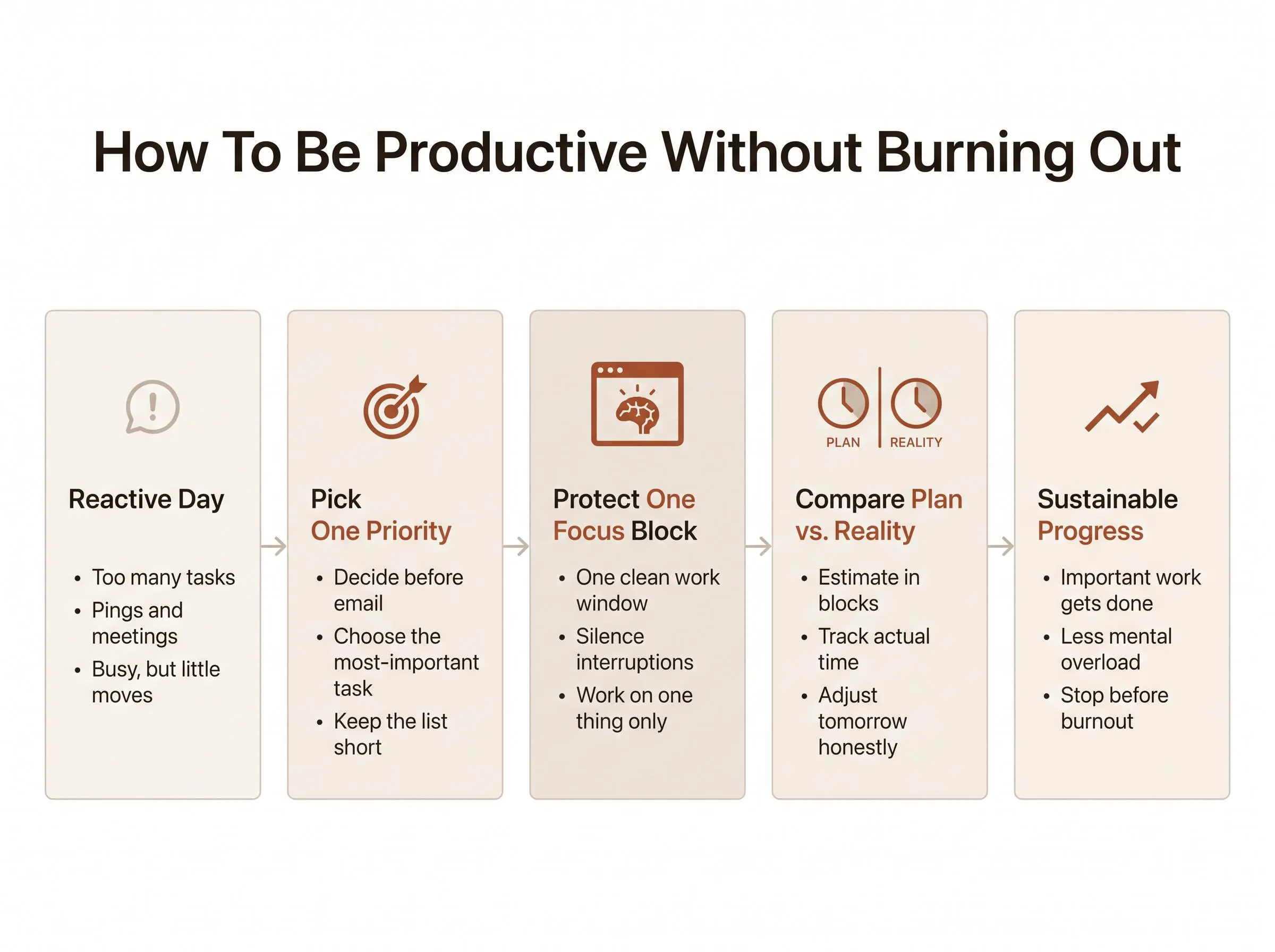
What matters is simpler. You don't need a bigger system, just one real priority, one protected block, and a quick reality check on time. Start with this.
- Pick one task before email decides the day.
- Estimate it in blocks, then compare the guess to the actual time.
- Protect one clean work window and stop before your brain turns to mush, so you know what got done.
Why Burnout Often Looks Like Productivity at First
A lot of people end up chasing the feeling of effort instead of actual output. It happens quietly. Your calendar is full, messages keep moving, tabs multiply, and by 5 p.m. you feel like you worked hard. You probably did. That doesn't mean the right work moved.
The pattern is familiar because it's common, not because you're uniquely bad at focusing. A day fills with meetings, inbox checks, quick replies, and constant task switching. You stay active the whole time, yet the important thing still sits there half-started. Then the guilt arrives on schedule.
Modern work often rewards availability theater. If you're visibly responsive, you look engaged. If you're hard to reach for 90 minutes because you're actually thinking, that can look suspicious in the wrong environment. It's backwards, but it's real.
A few signals make the problem hard to ignore:
- Many workers report they don't get enough uninterrupted time to focus during the workday.
- More than half say they're too busy to think.
- Leaders now spend far more time in meetings than previous generations, which leaves less room for strategic work.
Then there's the interruption cost. Constantly checking chat or email doesn't just steal a minute here and there. Attention residue builds. After a disruption, it can take roughly 23 minutes to fully refocus. Not every interruption costs the full 23, but enough of them do. By the second afternoon check-in, your brain is mostly doing scene changes.
After-hours phone use makes it worse. Work apps on personal devices blur recovery, and that blur is associated with more work-life conflict and lower job satisfaction. You never fully leave, so you never fully reset.
Burnout often starts as impressive responsiveness.
The useful shift is this: treat the problem as a design issue, not a character flaw. Your environment is shaping your behavior. Your habits are reinforcing it. Both can be redesigned.
What Productivity Without Burnout Actually Means
Productivity without burnout means getting important work done at a pace your mind and body can repeat tomorrow. Not once. Repeatedly. That's the whole game.
Hustle culture usually runs on urgency, overcommitment, and borrowed energy. It can produce short bursts of output, especially when fear is doing the management. It also creates sloppy planning, reactive work, and the kind of fatigue that makes Thursday feel like wet cardboard.
A calm productivity method isn't code for low standards. It isn't laziness dressed up as self-care. It's a stricter idea, really. You do fewer things at once so you can finish meaningful things well.
That usually includes:
- fewer live priorities
- longer stretches of focused attention
- clear stopping points
- actual recovery between efforts
- evidence of progress you can trust
The engine underneath this is sustainable deep work. Not marathon sessions fueled by guilt. Repeatable bursts of concentrated work that respect cognitive limits.
Exhaustion can happen during productive work, sure. But exhaustion is not proof. Feeling wrung out is not the same as having moved something important forward. Steady completion is a better signal.
If you're looking for productivity without burnout, you probably don't need a life overhaul or a color-coded operating system. You need a gentle focus system that makes good work easier to start and easier to finish.
Deep Work for People Who Hate Hustle Culture
Let's clean up the term first. Deep work has been dragged into enough grind-heavy advice that some people hear it and immediately want to close the tab. Fair enough.
We think of deep work as a protective practice. It's how you create a small stretch of working life where your attention isn't rented out by the minute. That's very different from macho productivity posturing.
For people who hate hustle culture, deep work usually looks like this:
- choose one meaningful target
- reduce collisions with meetings and messages
- work for a bounded period
- stop before quality falls apart
The point is not to cram more labor into the day. It's to reduce drag, rework, and mental scattering. Two uninterrupted hours of real thinking can beat a full day of reactive micro-tasks. Most knowledge workers have felt this firsthand. The rare quiet block changes everything.
There's also a structural side that gets ignored when advice becomes too personal. One engineering group more than doubled completed work by reorganizing into small autonomous squads and isolating unplanned work instead of asking people to grind harder. That's the lesson. Better structure often beats better motivation.
Calm productivity is mostly about friction
Anti hustle work habits don't need to feel dramatic. Good ones lower friction:
- clearer work modes
- fewer inputs
- stronger boundaries
- predictable recovery
An experienced operator would say it plainly: if your system requires daily heroics, it isn't a system. It's a recurring emergency.
Start With One Most-Important Task, Not a Heroic To-Do List
Most days go sideways before work even starts. Not because of laziness, but because the plan is too vague or too bloated to survive contact with reality.
Choosing one most-important task before the day starts changes the shape of the day. It gives your attention somewhere to land. Without that, a to-do list becomes a menu of avoidance. Knowledge work is especially vulnerable here because "work" can always be redefined as easier work.
One clear priority makes several things simpler:
- starting gets easier
- saying no gets easier
- success becomes easier to judge
You don't need a perfect list. You need a short one. Our preferred planning method is deliberately plain:
Plan the day calmly
- Pick the priority
Choose one most-important task.
- Trim the list
Keep the rest of the list short.
- Tie to weekly goals
Link tasks to weekly goals so the day isn't random.
- Estimate focus blocks
Estimate the work in focus blocks, not vague optimism.
That last part matters more than people expect. Estimate-versus-actual time is one of the best burnout prevention tools we know because it exposes unrealistic planning without turning it into self-blame. If something takes three blocks instead of one, that's useful information. It doesn't mean you failed. It means your future plans just got more honest.
The Flocus Daily Planner is built around that planning-first approach. You pick one priority, keep the list tight, and compare planned time with actual time over real days. That's very different from a basic timer or an aesthetic study dashboard. Counting minutes is easy. Deciding what deserves them is the hard part.
And no, your most-important task doesn't need to be grand on a heavy day. Sometimes the right priority is modest. Honest plans beat heroic fiction.
Use Timed Focus Blocks to Make Progress Feel Finite
A lot of overwhelm comes from work feeling endless. Timed focus blocks fix part of that by turning abstract effort into a contained commitment. You're not promising to finish the universe. You're doing one clean block.
That bounded feeling matters. Focus blocks are humane, not punitive. They help your brain stop negotiating and start working.
A standard Pomodoro rhythm helps many people get moving, especially when motivation is low. Twenty-five minutes is short enough to feel approachable and long enough to get traction. But it isn't sacred. Some work needs a different cadence, and some people settle better with custom durations.
A practical way to start:
- If you're tired or resistant, commit to one block. Just one.
- For moderate cognitive work, 25 to 35 minutes is often enough.
- Use longer custom blocks only after you have evidence they stay clean.
Breaks are part of the method, not a prize you earn for suffering. A real break reduces strain and makes the next block usable. A fake break that turns into frantic phone scrolling often does the opposite.
The Flocus Focus Timer works from a planned task instead of acting like time and tasks live in separate universes. That's a small design choice, but it removes a lot of friction. You don't just start a countdown. You start work on the thing you already decided matters.
At the end of each block, write a quick note:
- what moved
- what's stuck
- whether the estimate still looks realistic
That 20-second pause prevents the next block from starting cold.
Protect Your Attention From Meetings, Notifications, and Constant Triage
Focus is much easier to protect upstream than to rescue after you've been interrupted six times. By then you're not working. You're rebuilding.
The biggest sources of fragmentation tend to be predictable:
- meetings
- chat and email
- phone notifications
- unplanned work
- fake urgency
Organizations that significantly cut meetings often see productivity improve, along with people's feeling that they were productive. That second part matters. When fewer hours are chopped into status calls, you can actually see what moved.
Async-first behavior helps more than most teams expect. In plain language, it means:
- write updates instead of scheduling a call
- use comments for decisions that don't need live debate
- batch status sharing instead of scattering it across the day
Use explicit work modes
We've found it helps to name the day in blocks rather than pretending every hour can do every kind of work.
- Maker blocks for writing, analysis, design, coding
- Connector blocks for meetings, reviews, collaboration
- Triage windows for inbox and chat
Triage should be a box, not a lifestyle.
A realistic urgency rule also helps. Define what counts as a true interruption. Most pings are merely new, not urgent. Those are not the same thing.
After-hours boundaries deserve more respect than they get. If work lives on your phone with no friction, you'll keep checking. Not because you're weak. Because the path is frictionless and your brain likes unfinished loops. Protecting off-duty time protects tomorrow's focus quality. That's the bargain.
Build Sustainable Deep Work Around Energy, Not Guilt

Sustainable deep work depends on rhythm and recovery, not daily acts of self-coercion. The calmer truth is that your energy is part of the plan whether you acknowledge it or not.
Guilt distorts planning in predictable ways. You stack too much onto low-energy days. You keep pushing after quality drops. You treat stopping as failure. Then the next day starts already depleted.
A better rhythm is less glamorous and more effective:
- put demanding work where your energy is naturally strongest
- move admin and coordination to lower-energy windows
- don't force back-to-back focus blocks when your brain clearly needs a reset
For many people, two protected focus windows are far more achievable than trying to hold deep concentration all day. Whole-day focus sounds disciplined. In practice, it's often fantasy.
There's useful workplace evidence here too. Teams that reduced hours or protected recovery have often reported equal or better productivity. Large four-day workweek trials have shown gains in productivity alongside lower absenteeism and better wellbeing signals. Rest is not the enemy of output. Chaotic overwork is.
Signs your system is actually sustainable:
- you can repeat it most weekdays
- you don't dread starting
- you recover between blocks
- work quality stays reasonably steady
The right question isn't how much an ideal person could do. It's how much your real life can support consistently.
Measure Progress Without Turning Productivity Into Self-Surveillance
A fair concern: tracking can become its own pressure spiral. We've seen that happen. The answer isn't to avoid measurement entirely. It's to use gentler metrics that clarify reality without making your worth feel audited.
A short list is enough:
- completed focus blocks
- whether the most-important task got done
- estimate versus actual time
- how often interruptions broke the day
- whether you finished with mental energy left
Visible completion matters more than it sounds. It reduces the strange feeling that the day vanished. It helps your brain register progress. It builds trust in the system.
Daily completion signals can help here. A ring, a streak, a short reflection. Not because gamification is magic, but because concrete endings are psychologically useful. They tell your brain the workday closed somewhere real.
Weekly review beats constant self-analysis. Look for patterns:
- where did work take longer than expected?
- when did focus come easiest?
- which obligations repeatedly broke concentration?
Skip vanity metrics. Total hours logged, number of apps used, and how busy the day felt are often poor guides. Measurement should improve planning, not become proof of virtue.
Choose Tools That Add Structure, Not Pressure
Most focus tools are better at counting than guiding. That's fine if all you need is a countdown. It isn't enough if your real problem is deciding what to work on and staying with it.
There are three broad tool types:
- Timer-only apps help with countdowns, but they don't help you choose.
- Planner-plus-timer tools connect tasks to sessions and make review possible.
- Advanced measurement tools add focus-quality data for people who want deeper feedback.
Our bias is straightforward: planning is the layer that makes focus more likely, because it decides what the timer is for. Without that layer, the timer can become a very polite way to procrastinate.
Flocus is built around that planner-plus-timer model. You choose one most-important task, run focus blocks against that plan, log estimate versus actual time, and close the day with a visible completion signal. It's browser-based, calm by design, and works without hardware.
For the smaller group who want measured feedback on focus quality, Flocus Flow Tracking can connect with a Muse headband and show real-time flow-state feedback during sessions. Plainly put, it measures focus quality instead of asking you to guess how focused you felt. It does require hardware, and it isn't necessary for the planner to work. It's most relevant for neurotech-curious users who want to see patterns in flow, not just minutes on a timer.
When choosing a tool, ask four boring questions:
- does it reduce start-up friction?
- does it connect planning and execution?
- does it support realistic review?
- is it calm enough that you'll keep using it?
Boring questions tend to produce better systems.
Common Anti Hustle Work Habits That Still Sabotage Focus
Not every calm-looking habit is actually helpful. Some are just softer packaging for the same old drift.
A few common traps:
- keeping a peaceful aesthetic but never making a real plan
- using breaks for phone scrolling, which adds stimulation instead of recovery
- calling every task urgent
- changing systems every week instead of letting one method compound
- filling every open hour and leaving no buffer
Vague flexibility is a sneaky one. It can feel kind and spacious, but without a protected focus window it often becomes hidden procrastination. The day stays open right up until it disappears.
Over-customizing tools can do the same thing. If you spend more time tuning the setup than doing the work, the setup has become the work. That sounds obvious when said out loud. People still do it constantly.
Gentleness is not the absence of boundaries. A calm productivity method still needs standards:
- one meaningful priority
- a limited list
- a clear block of attention
- a defined stop point
And when the day breaks anyway, which it sometimes will, don't try to recover the whole thing. Shrink the plan. Return to the most-important task. Salvage one clean block.
Repair beats perfection. Always.
Conclusion
Productivity without burnout comes from narrower focus, more honest planning, lower interruption load, and recovery that's treated as part of the work instead of an obstacle to it. That's the calm version. It tends to hold up better.
Deep work doesn't need to feel punishing, performative, or all-consuming to be effective. In many cases, that style is exactly what ruins it.
If you want to test this without turning your life upside down, start small: one most-important task, one protected focus block, and one simple end-of-day review. That's enough to learn a lot in a week.
And if a calm system feels easier to trust than yet another timer, try a planning-first approach that helps you choose what matters, focus on it, and watch the day close with visible progress. Sometimes the missing piece isn't more intensity. It's a plan.
Article Record
ReferencesPrimary sources used for this article
- "Give me a break!" A systematic review and meta-analysis on the efficacy of micro-breaks for increasing well-being and performance
- Information and communication technologies-assisted after-hours work: A systematic literature review and meta-analysis of the relationships with work–family/life management variables
- PLOS Digital Health
- Breaking down the infinite workday
- The impact of hedonic social media use during microbreaks on employee resources recovery
- Workplace interventions to improve well-being and reduce burnout for nurses, physicians and allied healthcare professionals: a systematic review