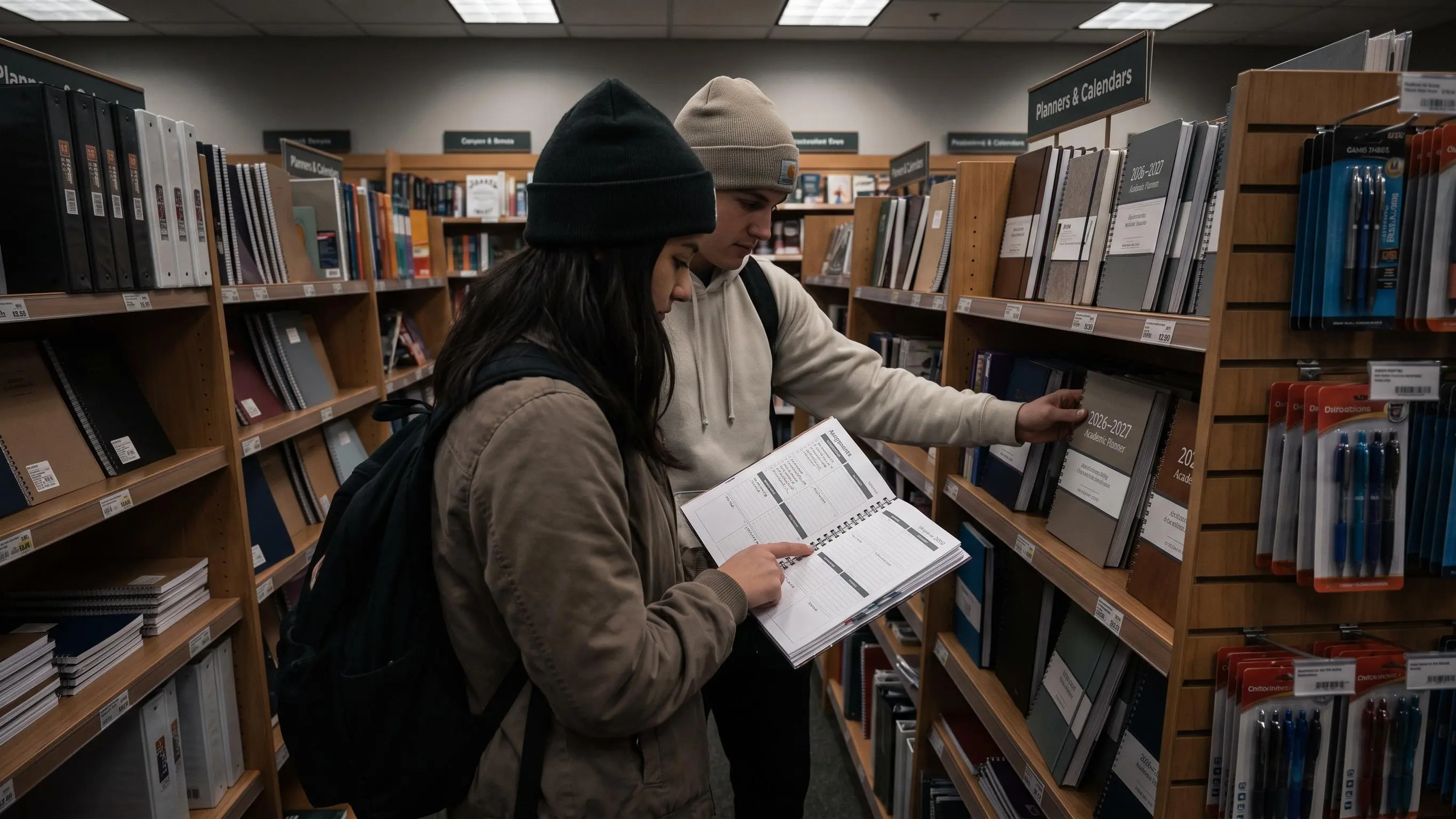

The pomodoro study method sounds simple until you try it on actual coursework. Most people don't fail the timer; they start with a fuzzy task, break at the wrong moment, and lose the afternoon.
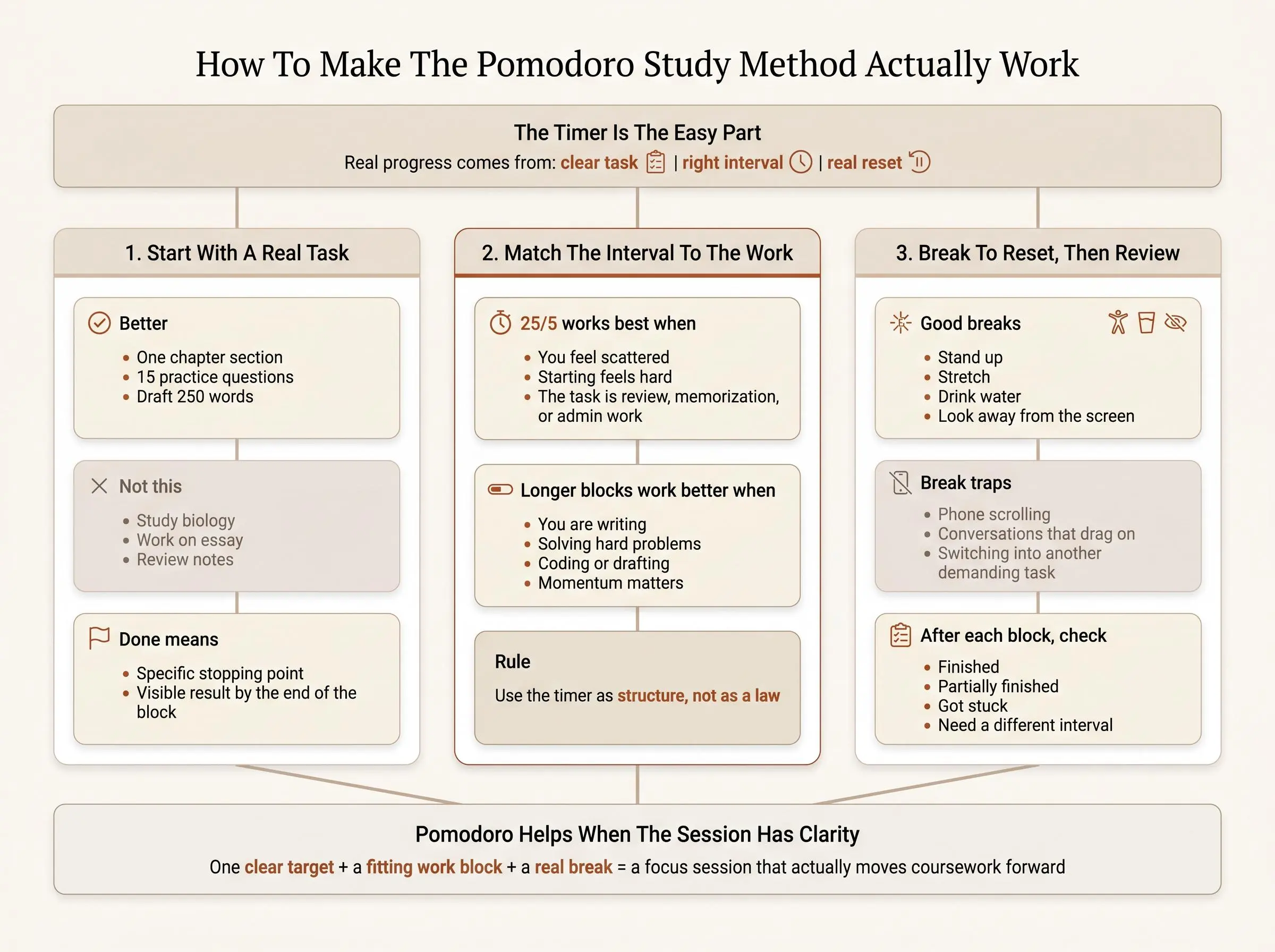
What matters is simpler: pick one real target and know what done means before you start. The timer is the easy part.
A few things to watch:
- One chapter section beats "study biology."
- 25/5 works when you're scattered; essays usually need longer.
- A break should reset you, not send you to your phone. Then you finish with something real.
What the Pomodoro Study Method Actually Is
The pomodoro study method is simple on paper. You work in a focused interval, usually 25 minutes, then take a short break, usually 5. After a few rounds, you take a longer break.
That basic structure is why so many students try to study with pomodoro technique in the first place. It feels manageable. Twenty-five minutes is less threatening than “study all afternoon,” which is usually how people end up reorganizing their notes and calling it work.
Used well, though, it’s more than a countdown.
A good pomodoro study method has three parts:
- a clear task
- a defined stopping point
- a short review after the block
Without those, you don’t really have a method. You have a timer making accusations.
The deeper principle is protected attention plus planned recovery. The 25/5 split is just the classic version. It’s a useful default because it gives your brain a finish line, but it isn’t a law of concentration. Some tasks need shorter blocks. Some need longer. The method works because it turns vague study time into a concrete study timer routine, not because 25 minutes has magical properties.
Why Students Keep Losing Focus Even When They Sit Down to Study
Most students who struggle with focus are not lazy. They’re overloaded, tired, and trying to begin with five tabs open, three subjects in mind, and no clear first move. One study looked at break-taking during a real two-hour study session. One group chose breaks freely. One used 25-minute work blocks with 5-minute breaks. One used Flowtime, where students decided when to stop and break length depended on how long they had worked.
The three-method comparison involved 94 university students: 25 used self-regulated breaks, 36 used Pomodoro, and 33 used Flowtime. That is useful real-session evidence, but it is one relatively small study—not a final answer for every task or learner.
A separate scoping review found a much larger but more varied evidence base. The counts show research scope, not a head-to-head performance score: the review combines different study designs and does not calculate one pooled effect.
| Evidence source | Participants | Studies included |
|---|---|---|
| Direct three-method comparison | 94 | 1 |
| Pomodoro scoping review | 5,270 | 32 |
The findings were more nuanced than most productivity advice.
- In the Pomodoro group, fatigue rose faster over time.
- In both the Pomodoro and Flowtime groups, motivation dropped faster than in the self-regulated group.
- But there were no overall differences in productivity, task completion, or flow across groups.
That matters. Structured breaks are not magic. They do not automatically create deeper learning, better focus, or more output.
The larger review should not be read as a verdict that overrides this comparison: it mapped heterogeneous studies rather than pooling them into one effect estimate. Its search also ended before the newer three-method study. The practical takeaway is still to test the interval against your task and your own results, rather than assume one timer pattern wins for everyone.
Another mixed-method comparison among college students showed why the method still sticks around. Many students preferred Pomodoro for structure, predictable breaks, and easier tracking. Flowtime was valued for flexibility, deeper immersion, and creative engagement. Pomodoro tended to be seen as better for memory retention, academic performance, and time management. Flowtime tended to feel better for flexibility, focus, and motivation.
There was also a memory retention experiment among psychology students that found no statistically significant effect. Again, useful reality check. A timer does not upgrade your brain on contact.
The gain usually comes from structure, consistency, and self-awareness, not from the timer alone.
That’s less exciting than a miracle method. It’s also more useful.
When the Method Works Best and When It Does Not
The pomodoro study method shines when the main problem is resistance. If you’re avoiding the first page, the first question, the first paragraph, a short block helps. It lowers the cost of beginning.
It’s especially helpful for:
- reading and review
- flashcards and memorization
- practice sets
- admin-heavy coursework
- breaking a big assignment into pieces you can actually finish
It also helps in distraction-prone sessions. If your attention wanders every time your brain hits discomfort, a defined block gives you a boundary to work inside.
But a rigid 25/5 rhythm can backfire.
Deep writing, hard problem solving, coding, and drafting often need a warm-up period. You may spend the first 15 minutes just getting properly into the work. If the timer cuts you off right as you reach traction, the break feels less like recovery and more like sabotage.
That mismatch is why some students think they “failed” with Pomodoro. Usually they didn’t fail. They used the wrong interval for the task.
Treat it like a training wheel for attention, not a permanent rule for every kind of study. Short blocks are great for getting moving. They are not sacred.
Pomodoro vs Flowtime vs Self-Regulated Breaks
If you’re comparing methods, don’t look for a winner in the abstract. Choose based on what problem you actually have.
Here’s the plain version:
- Pomodoro uses preset work and break intervals.
- Flowtime lets you work until focus drops, then take a break based on how long you worked.
- Self-regulated study leaves timing and breaks entirely up to you.
Pomodoro is strongest when you need clarity and external structure. It’s easy to track, easy to repeat, and useful when drifting is your default.
Flowtime supports immersion better. If your best work depends on momentum, it often feels more natural. The tradeoff is that it asks more from your judgment. In a noisy or distraction-heavy environment, that flexibility can quietly turn into drift.
Self-regulated breaks can work very well for students who already notice their energy honestly. That’s the catch. “I’ll just take breaks when needed” sounds mature right up until the fourth accidental detour.
A practical way to choose:
- Use Pomodoro if starting is hard or you keep losing the thread.
- Use Flowtime if your work improves once you get fully absorbed.
- Use self-regulated study only if your attention habits are already reliable.
Not every method is for every day. That’s normal.
How to Use Pomodoro for Studying Without Making It Feel Mechanical
The best way to use Pomodoro is to reduce friction before the timer starts. Most sessions go wrong earlier than people think.
Here’s a workable process.
Pick one most important task.
One chapter section. One chunk of a problem set. One essay subsection. One review deck.Define what done means for this block.
Finish 15 practice questions. Annotate 8 pages. Draft 250 words.Choose your interval.
Start with 25 minutes if you’re scattered or resisting. Adjust later based on the task and your actual attention pattern.Remove obvious distractions first.
Put the phone out of reach. Close extra tabs. Get your notes ready before the clock starts.Work only on the chosen task until the timer ends.
Take the break seriously.
Stand up. Stretch. Drink water. Look away from the screen. Don’t turn a five-minute break into a scroll session with better branding.Mark what happened after the block.
Finished. Partially finished. Got stuck. Underestimated the effort.Decide what comes next based on reality.
Repeat, switch tasks, or stop.
The planning step matters as much as the timer step. A bad plan with a clean timer is still a bad session.
How Many Pomodoros to Study for Different Kinds of Work
There isn’t one correct answer to how many pomodoros to study. The right number depends on the task, your energy, and how much mental warm-up the work needs.
A few decision rules are more useful than fake precision:
- 1 to 2 pomodoros for a small review task or for starting a subject you’ve been avoiding
- 2 to 4 pomodoros for a medium session focused on one class
- More than that only if you still have clarity, not just guilt
Counting pomodoros can help with planning. It can show patterns. It can make workload visible. But it is not the same as learning.
Different work behaves differently:
- memorization and review often fit short cycles well
- practice problems usually need multiple blocks, plus a pause to review errors
- essay writing often starts with one short block, then works better in longer or blended sessions
Track estimated versus actual time whenever you can. Students are usually wrong in the same direction. They underestimate setup, overestimate stamina, and call the gap a motivation problem.
More pomodoros does not automatically mean better studying. If error rate rises and recall gets worse by the third afternoon block, you’re not being disciplined. You’re just staying seated.
Build a Study Timer Routine That You Can Actually Stick To

One good session helps. A repeatable routine helps more.
A calm study timer routine can be very plain:
- choose the day’s most important task
- decide the first block before opening distractions
- run one focus session
- log what got completed
- adjust the next block based on what actually happened
Visible completion matters more than vague intention. “I studied for a while” is hard to trust. “I finished the review deck and half the problem set” gives your brain something solid to work with tomorrow.
This is where many timer-only systems fall short. They measure time, but they don’t give you much of a planning layer. We’ve found that the missing piece for a lot of students isn’t another prettier timer. It’s a simple way to decide what matters, run a focus block, and see progress accumulate.
That’s the logic behind Flocus. It’s browser-based, free to start, and built around one clear priority, timed focus blocks, and visible daily progress
- using pomodoros to feel productive instead of finishing meaningful work
- picking intervals that are too short for the task
- ignoring signs that the method needs adjusting
- treating interruptions as personal failure instead of environmental feedback
- taking breaks that become social media detours
- packing too many subjects into one sitting
- measuring success only by time spent
If a session goes off track, recover quickly. Don’t abandon the day because one block got messy.
Try this instead:
- stop the timer
- choose one task again
- shrink the next block if needed
- remove the thing that interrupted you
- run one clean round
You do not need a heroic comeback. You need a usable next step.
How to Tell if Your Focus Sessions Are Working
Timer totals are not the best signal. They’re just the easiest one to count.
Better markers are:
- task completion
- recall quality
- error rate
- how easily you resume after a break
- motivation before and after the session
- how accurate your time estimates were
After each session, ask a few plain questions:
- What task did I choose?
- Did I finish the block goal?
- Where did attention break?
- Was the block too short, too long, or about right?
Then look for patterns across a week, not verdicts after one bad afternoon. A rough Tuesday tells you very little by itself.
The most useful sign is often emotional, but not in a soft way. Are you becoming calmer and more realistic about your workload? Good systems reduce drama. They make the day easier to read.
For students who want a visible record, tools like Flocus can pair focus blocks with reflections and weekly insights so those patterns don’t stay fuzzy.
For Neurotech-Curious Students: What Measured Flow Adds
Most students do not need gadgets to use the pomodoro study method well. A task, a timer, and some honesty will carry a lot of weight.
Still, some people want more than self-report. That’s reasonable.
Some tools can track signals associated with attention and let you observe how focused states rise and fall during work. The practical value isn’t novelty. It’s feedback. You can see whether a certain interval helps immersion, whether breaks actually restore attention, and whether your planning assumptions match what happened during the session.
With Flocus, there’s an optional depth layer for this. You can connect a Muse headband and get real-time flow-state feedback during focus sessions. We think of it as measured focus, not a replacement for judgment.
It won’t study for you. It won’t turn bad planning into good work. But for skeptical, data-curious students, it can make concentration feel less mysterious and more observable.
A Simple 7-Day Reset for Students Who Feel Scattered
If you feel behind, overloaded, or mildly irritated by productivity advice, keep this simple. One week is enough to learn something useful.
Day 1 to 2
Use one pomodoro per study sitting. Focus only on choosing one clear task and finishing the block.
Day 3 to 4
Test two back-to-back student focus sessions for one subject. Notice whether the break helped you reset or broke your momentum.
Day 5
Compare one rigid Pomodoro block with one more flexible Flowtime-style session. Use different task types if needed. See which fit feels better.
Day 6
Estimate how many pomodoros a real assignment will take. Then compare estimate to actual time. This is where optimism usually gets exposed.
Day 7
Review patterns, not perfection. Choose your default study timer routine for the next week based on what actually worked.
That’s enough. You do not need a life overhaul to get your attention back.
Conclusion
The pomodoro study method works best as a simple structure for intention, effort, and recovery. It is not a magic 25-minute formula, and the research does not support treating it like one.
Timed blocks can help with organization, consistency, and getting started. They do not automatically improve learning or flow for every student. Sometimes Pomodoro is the right tool. Sometimes Flowtime fits better. Sometimes the problem is not your concentration at all, but the fact that you sat down without a real plan.
Start smaller than your guilt wants. Choose one important study task today. Run one honest focus block. Then use what that session teaches you to build a calmer, smarter routine tomorrow.
Article Record
ReferencesPrimary sources used for this article
- Investigating the Effectiveness of Self-Regulated, Pomodoro, and Flowtime Break-Taking Techniques Among Students
- Assessing the efficacy of the Pomodoro technique in enhancing anatomy lesson retention during study sessions: a scoping review
- Investigating the Effectiveness of Self-Regulated, Pomodoro, and Flowtime Break-Taking Techniques Among Students
- Assessing the efficacy of the Pomodoro technique in enhancing anatomy lesson retention during study sessions: a scoping review | BMC Medical Education | Springer Nature Link
- ABSTRACT
- Fact Check: Is the Pomodoro technique actually effective for studying? - The Brown Daily Herald
- A Comparative Study Between Pomodoro and Flowtime Techniques Among College Students | International Journal of Multidisciplinary: Applied Business and Education Research
Update HistoryMeaningful revisions to this article
- Added a comparison table to clarify what research says about Pomodoro intervals and break strategies.
- Explained the differences between a focused student study and broader research to help readers interpret the findings more confidently.