

Most people searching for how to stop overplanning are not lazy. You're usually trying to feel ready, and the planning starts eating the work.
What matters is a plan you can trust: one real priority, a short list, and enough room for the day to go sideways. You can't organize your way out of a task you still haven't defined.
Start here.
- Pick the one task that would make the day feel worth it
- Turn vague work into a first step you can actually start
- Stop rebuilding the whole day after one interruption
That alone makes focus much easier to hold.
What Overplanning Actually Is
Overplanning isn't just "planning a lot." It's when rebuilding the plan becomes the work. You keep refining, reshuffling, rewriting, or overstuffing the day until execution is somehow always a few steps away.
A healthy plan adjusts to reality. A compulsive plan keeps restarting in search of a version that feels safer.
That distinction matters. If a meeting moves, a dependency slips, or your energy drops after lunch, adjusting is normal. Starting from scratch every morning, or after every interruption, is a different pattern. That's not responsiveness. That's the planning loop.
It usually looks productive from the outside:
- rewriting the task list instead of starting the hard task
- color-coding the calendar again after one delay
- packing in twenty tasks, finishing five meaningful ones, and still calling the day a failure
We've seen this a lot with students and knowledge workers who care about doing things well. The irony is blunt: the more detailed the plan gets, the less believable it becomes.
This pattern is also described by Ashley Janssen, who notes that overplanning can feel like progress while helping you avoid the uncertainty and risk of actually starting. Her practical response is to limit planning time, choose a start point, and begin before the plan feels perfect.
If you're trying to learn how to stop overplanning, the goal isn't to become looser or sloppy. It's to build enough structure that work can actually begin.
A plan should lead into work, not compete with it.
Why Overplanning Feels Safe but Makes Focus Worse
Overplanning is usually a trust problem, not a calendar problem. When yesterday slipped, making a fresh, tighter plan can feel like wiping the slate clean. For a few minutes, it works. The discomfort eases. Then the real work shows up again.
That relief is expensive.
Every time you re-decide what matters, you burn attention before you've used it on anything important. Decision fatigue doesn't only come from big life choices. It also comes from re-ranking the same seven tasks three times before noon.
Minute-by-minute plans are especially fragile. One meeting runs long. One message needs an answer. One low-energy hour appears, as it tends to do. Suddenly the whole plan feels contaminated, and many people respond by abandoning it completely. That's a steep price for a small delay.
Long task lists make the problem worse. You can have an objectively solid day and still feel behind because the list was built to be impossible. The list becomes a guilt machine.
Focus suffers in predictable ways:
- more context switching
- less time in sustained attention
- more avoidance of fuzzy or emotionally difficult work
- less willingness to begin before everything feels perfectly mapped
This is why a calmer, more credible plan usually outperforms a strict one. Focus deepens when the day feels workable. Not when it feels overcontrolled.
The Four Patterns That Usually Cause Daily Overplanning
Most overplanning comes from a few repeatable patterns. Once you see them, they're hard to unsee.
1. Fuzzy tasks that aren't truly startable
"Work on presentation."
"Make progress on course."
"Fix landing page."
These sound responsible. They are not actionable. They're containers, not tasks. A container creates friction because your brain still has to decide what "working on it" means when it's time to begin.
A startable version is different:
- draft slide 1 to 3 outline
- complete chapter 3 practice questions
- rewrite landing page headline and first section
If the task still needs interpretation, planning will keep replacing doing.
2. Unrealistic capacity assumptions
Many plans quietly assume a version of you that doesn't exist on most weekdays. Fully rested. Uninterrupted. Mysteriously efficient at 8:30 p.m.
When a plan keeps pretending you have more time, energy, or evening bandwidth than you actually do, trust breaks. And once trust breaks, you compensate with more planning. That's the trap.
3. One missed block triggers a full reset
This is the all-or-nothing pattern. One session slips, so the whole day now feels invalid. Instead of protecting the next useful block, you reset the entire system.
Experienced operators don't do that. They trim, salvage, and keep moving.
4. Planning for certainty that doesn't exist
Some people overplan because detail feels calming. If every hour is mapped, the day seems manageable. Until the day behaves like a day.
High-achieving students and knowledge workers are especially vulnerable here because they care, and because they're used to solving problems with effort. But uncertainty doesn't disappear because the planner got prettier.
Signs Your Planner Is Increasing Overwhelm Instead of Reducing It
A planner should lower friction. If it keeps raising it, something is off.
You might be using the wrong system, or asking the system to do the wrong job. Either way, the signs are usually pretty obvious once you stop defending the setup.
- You spend more time maintaining the system than doing the work.
- You feel stressed the moment you look at today's page.
- You keep switching apps, templates, or methods, hoping the next one will finally make execution happen.
- Your list is so long that choosing the next task feels like another task.
- You rewrite priorities multiple times a day.
- After the first disruption, you stop looking at the plan because it now feels fictional.
- You can't answer two basic questions: what matters most today, and what does starting look like right now?
This is where many people need a daily planner for overwhelmed people, not a power-user productivity stack. More fields, more views, and more options don't calm an overloaded mind. A simple planner for overwhelm often works better because it reduces decisions instead of multiplying them.
The Shift That Changes Everything: Plan for Focus, Not for Total Control
A good plan doesn't account for every minute. It reduces decisions and creates a believable path into work.
That's the shift.
Most people don't need a more complete plan. They need a plan that's credible enough to survive contact with a real day. The aim is not scheduling everything. It's protecting a few meaningful outcomes.
A good day is not the day where everything got arranged. It's the day where the important work happened.
Choosing one most-important task helps because broad priority lists often blur into each other. Ten priorities is another way of saying none has real protection. One clear commitment forces clarity.
A calm daily planning system usually has a few traits:
- a short list
- realistic capacity
- flexible order
- visible completion
That's the thinking behind the Flocus Daily Planner. It connects a lightweight plan to actual focus sessions, so planning and doing aren't treated as separate worlds. Useful, because that's where a lot of systems quietly fail.
Start With One Visible Day, Not an Entire Perfect Week
Overplanning often starts too wide. Week views and month views invite fantasy capacity. They make every future day look available, which is convenient, because future-you is apparently made of discipline and spare time.
When you're overwhelmed, start with today.
First, capture what is fixed:
- classes
- meetings
- appointments
- deadlines that will happen whether you plan or not
That gives you the real shape of the day before you pile ambition on top of it. We like this step because it exposes the truth early. Some days have one genuine focus window. Some have three fragmented ones. Some have almost none. Better to know.
Weekly goals still matter. But the daily plan should translate those goals into one realistic execution path for today, not a vague promise to "catch up later."
Choose One Most-Important Task and Make It Startable
One clear priority works better than trying to defend ten equally. It gives the day a center.
Your most-important task is the task that would make the day feel worthwhile even if little else got done. Not the noisiest task. Not the one with the most notifications attached to it. Usually it's the one that is meaningful, time-sensitive, cognitively important, and tied to a real goal.
Then make it startable.
Instead of:
- work on report
Use:
- draft opening section of report
Instead of:
- study biology
Use:
- complete chapter 3 practice questions
A task is ready when it passes a few simple tests:
- You can begin without more planning.
- You know the first visible step.
- You could describe the next 25 minutes in one sentence.
Clarity lowers resistance. That's not magic or motivation. It's just easier for the brain to enter sustained attention when the starting edge is obvious.
Keep a Deliberately Short List to Reduce Task List Stress
Most people don't need a bigger planner. They need a shorter commitment list.
A useful daily page usually includes:
- one most-important task
- one or two supporting tasks
- optional admin if time remains
That's it.
A planner for too many tasks often becomes a stress amplifier because it confuses capture with commitment. You can store a long list somewhere. Fine. But the daily page should contain only the few things you're actually willing to protect.
One sorting method works well here:
- Must move today
- Nice to move today
- Can wait without real consequences
That simple distinction helps reduce task list stress because it stops low-value maintenance from crowding out meaningful work. There will always be enough admin to fill every available gap. The trick is not letting it colonize the whole day.
Shorter lists also make completion visible. And visible completion matters more than people admit. It builds trust.
Estimate in Focus Blocks, Not in Wishful Hours
Broad time estimates are often fantasy with numbers attached. Tasks always look smaller before you start them.
A better approach is to estimate in focus blocks. Short, concrete work sessions force honesty. If something "should only take an hour," ask whether that really means two 25-minute blocks, or four, or six with setup and revision included.
This matters because many people pack eight hours of effort into a day that only contains four hours of real focus capacity.
The useful mindset here is simple:
- the estimate is a hypothesis
- actual work is feedback
- better planning comes from comparing the two
We built this into the Flocus Focus Timer for that reason. Starting a session directly from a planned task makes the estimate-versus-actual comparison visible, which is often the fastest way to learn which tasks consistently expand on contact.
The point isn't perfect prediction. It is honest planning that gets less fictional over time.
Make the Day Flexible Without Letting It Become Vague
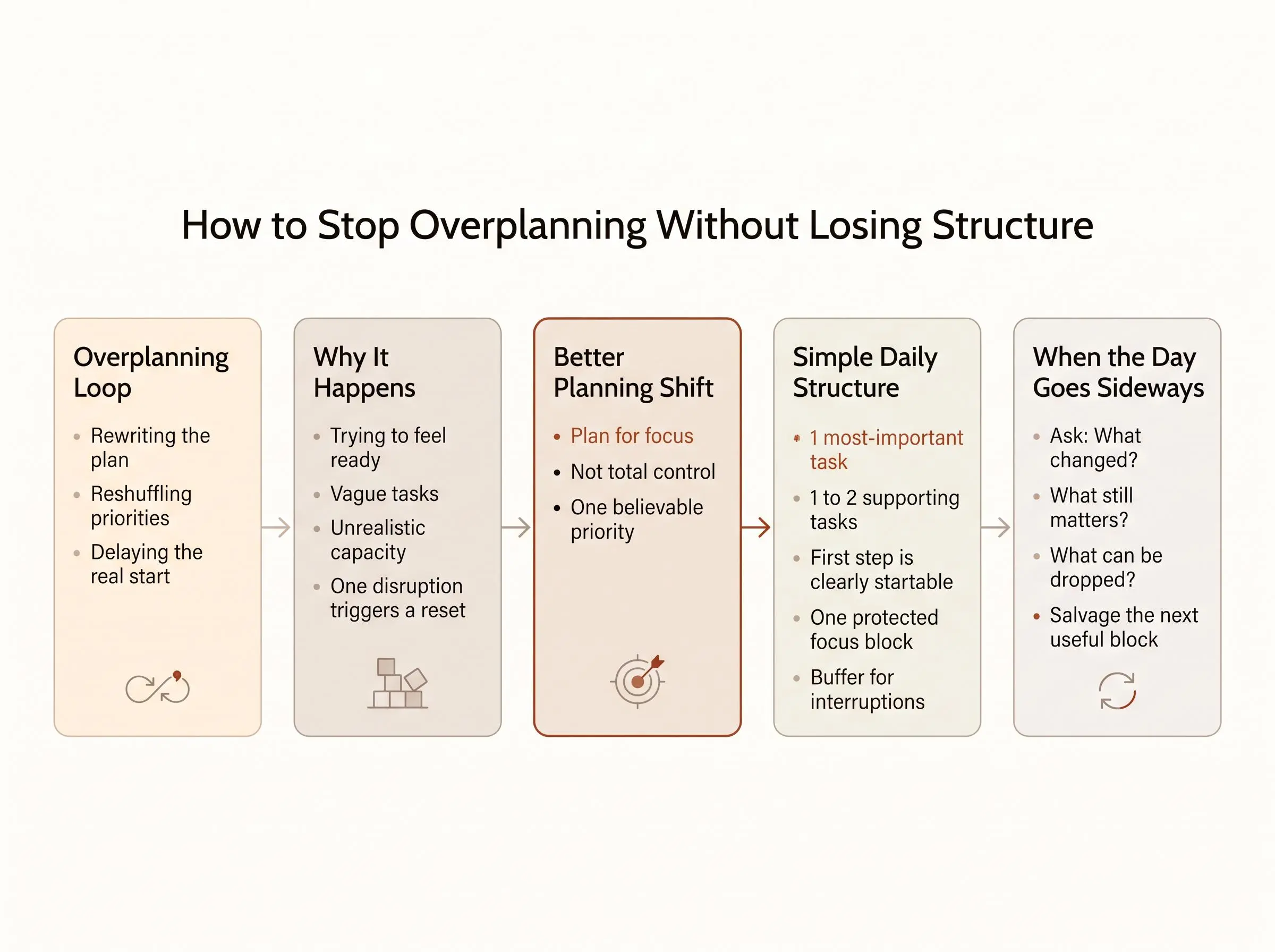
You don't need a rigid script, but you do need shape.
Flexible time blocking is the middle ground. It gives the day boundaries without pretending every minute can be predicted. In practice, that usually means:
- define a real start and stop time
- reserve one protected block for the most-important task
- leave buffer space for interruptions or spillover
- keep the order of smaller tasks flexible
A calm daily planning system might look like this:
fixed commitments first, one deep work block, one to two smaller tasks, a buffer, then stop
That structure absorbs disruption much better than rigid hourly planning. If a smaller task moves, the day still works. If the deep work block is protected, the day still has a spine.
Flexibility is not low standards. It's realism.
What to Do When the Day Goes Sideways
Some days break early. That's normal. The mistake is treating disruption as a reason to restart everything.
Use a quick mid-day check instead:
- What changed?
- What still matters?
- What can be dropped?
Then protect the next useful block.
Don't rebuild the whole day when your energy is already lower. That's how overplanning steals the last workable hour. Salvage beats reset.
A practical fallback hierarchy helps:
- keep the most-important task if possible
- reduce its scope if needed
- drop low-value tasks first
A shortened session still counts. A smaller version done today is often better than the perfect version rescheduled again.
At the end of the day, take a brief look back. Not to judge. Just to see what actually happened, so tomorrow's plan comes from reality instead of guilt.

Common Mistakes That Pull You Back Into Overplanning
These mistakes are boringly common, which is good news because they can be spotted early.
- treating the capture list like today's commitment list
- planning every open hour and leaving no white space
- assuming one missed block means the whole plan failed
- choosing priorities based on urgency theater
- building a system that takes too long to maintain
- using planning to avoid emotional friction on hard tasks
- piling on too many tools that compete for attention
- writing tasks that are still too abstract to start
- scheduling deep work at times when you're predictably mentally flat
The quietest mistake is also the most stubborn: using planning to avoid starting. Many people don't notice they're doing it because the planner still feels like work. It is work. Just not the work that matters.
How to Choose a Daily Planner When You Are Easily Overwhelmed
Choose based on friction, not feature count.
If you're easily overwhelmed, the planner needs to help you see today clearly and start without much ceremony. That's usually more useful than having six views, twelve fields, and a weekly ritual that eats half an hour before you've opened the actual task.
A simple planner for overwhelm should make a few things easy:
- one clear priority
- a short list
- visible time boundaries
- easy review
- low setup cost
And it should avoid a few traps:
- too many views
- too many required inputs
- constant manual maintenance
- pressure to fill every slot
A good daily planner for overwhelmed people should let you answer four questions quickly:
- Can I see today clearly?
- Can I connect planning to actual work?
- Does it help me stay realistic about capacity?
- Does it make progress visible?
That's where Flocus fits for many readers. It's more structured than a standalone timer, but lighter than a heavyweight productivity system. You choose one most-important task, run focus blocks against it, and close the day with visible progress and a short reflection. Enough structure to guide attention. Not enough to become a hobby.
If You Want to Go Deeper, Measure Focus Quality and Not Just Time
Time-on-task is useful, but incomplete. Two 25-minute sessions can look identical on paper and feel completely different in practice.
Some readers want to know not just how long they worked, but how engaged they actually were. That's where measured focus can be helpful, as long as it stays attached to a simple method and doesn't become another distraction.
Flocus Flow Tracking is an optional layer for that. If you already own a Muse headband, it can show a live focus score during sessions and classify states like Flow, Overload, and Low Engagement. In plain language, it gives you another signal about how your attention is behaving while you work.
Used well, that can help you notice:
- peak focus windows
- fatigue patterns
- when you're present versus just sitting there
Still, the core habit matters more than the sensor. Measured focus is only useful when it's sitting on top of a repeatable planning system. Otherwise it's just more data attached to the same old chaos.
Conclusion
The goal isn't to become less organized. It's to stop using planning as a substitute for starting.
If you want to know how to stop overplanning, the method is fairly plain: see the real shape of the day, choose one most-important task, keep the list short, estimate in focus blocks, and stay flexible when the day shifts.
A believable plan builds more trust than a perfect one. That's the whole game.
For the next three days, try this: plan only one meaningful task, two supporting tasks, and one protected focus block. Then review what actually happened before changing the system again.
Not prettier. Truer.
Article Record
ReferencesPrimary sources used for this article
- Why Overplanning Is a Trap And How to Stop
- How to Stop Re-Planning Every Day and Actually Start | Kognivu
- Planning Just Enough (How to Stop Overplanning) - Aretha Boex
- Flexible time blocking: A gentler way to plan your day - Monthly Method
- To Plan or Not to Plan? - Humanizing Work
- Swing Easy: The Power of Doing Less to Achieve More | Psychology Today
Update HistoryMeaningful revisions to this article
- Added expert-backed guidance to explain what overplanning is and help readers recognize it more easily.