

How to prioritize when everything feels important is less about discipline than admitting your list is lying to you. A deadline, a Slack ping, and the work that actually matters all show up with the same little checkbox.
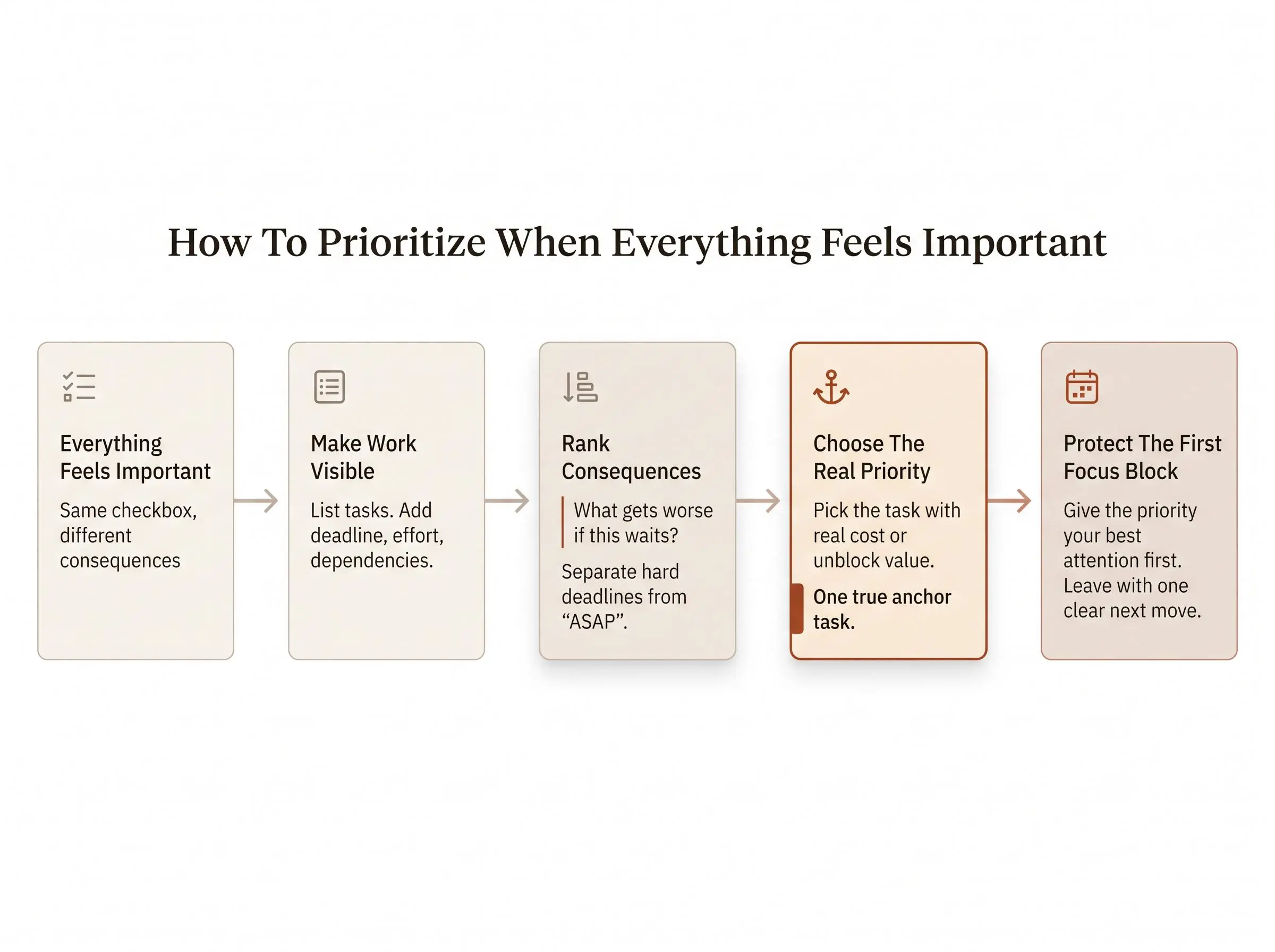
The useful move is to rank consequences, not panic. Get the work visible, find what blocks other people or creates real damage, then protect one task before the day gets noisy.
Start here:
- Write the consequence of delay beside each task
- Separate hard deadlines from “ASAP”
- Give the real priority the first focus block
Leave with one clear next move.
Why Everything Feels Important in the First Place
When your whole list feels urgent, the first problem usually isn't discipline. It's overload. A crowded list creates a strange kind of panic where replying to a message, fixing a spreadsheet, booking an appointment, and finishing a proposal all start to feel morally equal.
That pressure has a measurable workplace backdrop. Microsoft’s analysis of aggregated Microsoft 365 activity found that the average worker receives 117 emails and 153 Teams messages per weekday—270 incoming messages in total—and is interrupted by a meeting, email, or notification every two minutes on average. In its accompanying survey, 48% of employees said work feels chaotic and fragmented. The analysis does not prove that every message is unimportant; it does show why the newest or loudest request can so easily take over a day.
That's why this feels so personal. You aren't just sorting tasks. You're dealing with guilt, pressure, and the low-grade fear that if you choose one thing, something else will quietly catch fire.
A few forces make this worse:
- mixed lists flatten everything into one visual pile
- inboxes and chat reward the loudest request, not the best use of your attention
- context switching creates the feeling of motion, which can fool you into thinking you're handling it
- other people's urgency lands in your day fully formed, while your important work usually arrives as something quieter
That last one matters. A message from someone else feels immediate because it came with a tone, a timestamp, maybe even a little panic. Your own meaningful work often shows up as a document you haven't opened yet.
Pressure and consequence are not the same thing.
A task can feel intense and still have no real cost if it waits until tomorrow. Another can feel oddly calm while carrying a real deadline, a dependency, or a promise you made three weeks ago. If you don't separate those two things, your day gets run by adrenaline.
So the goal here isn't a perfect system. It's much simpler than that. If you're trying to figure out how to prioritize when everything feels important, you need a reliable way to make one honest decision about what deserves your best attention now.
What Priority Actually Means When Everything Cannot Be First
Priority is not a gold star you stick on twelve tasks. It's sequence. What goes first, and what are you willing to let wait because of that choice?
That sounds obvious until you look at how most people plan. They label half the list "high priority," then spend the day deciding and re-deciding what that means. That's not prioritizing. That's carrying the argument around with you.
Here's the practical split:
- Urgent means there is a real clock attached. A deadline, a cost, a dependency, a person blocked on your output.
- Important means it matters to your goals, your commitments, or work that will still matter next week.
The classic urgent-important grid can help, but it often falls apart when you're in the thick of it. In real life, several things may be both urgent and important. Or nothing looks urgent until 4:30 p.m., when suddenly it all does.
A better test is less philosophical and more operational. Compare each item by:
- Consequence if it waits
- Dependency on it from other people or other work
- Timing in the plain sense of when it actually needs to happen
That gives you something firmer than "this feels big." It also helps you choose what matters most without turning every decision into a long inner debate.
One sentence we come back to a lot: if everything is first, nothing is first.
Get It Out of Your Head Before You Try to Rank It
Trying to prioritize from memory is a bad bargain. Once your brain is overloaded, it becomes a very dramatic storage device. It will keep resurfacing the most uncomfortable thing, not the most important one.
Start with a short brain dump. One place. No sorting yet.
Capture this for each item:
- the task or commitment
- who it's for
- the promised date or deadline
- rough effort
- who or what is waiting on it
That's enough. You don't need a polished project board to begin. In fact, too much organizing too early is often just avoidance wearing business casual.
Hidden work can't be prioritized honestly. If a task lives only as background stress, it keeps borrowing weight from everything else. Once it's visible, it usually gets smaller. Or at least more specific, which is close enough for a Tuesday morning.
We built our Daily Planner around this kind of calm structure for a reason. People who are already overloaded don't need a heavier system. They need a place to see the day clearly enough to make one clean decision.
Stop Thinking Only in Tasks and Start Thinking in Projects
A flat task list lies to you. It puts "send invoice" beside "finish chapter draft" beside "reply to team thread" as if they belong in the same category of thought. They don't.
Group work by project or area of responsibility first. Something like:
- client work
- writing or studying
- team communication
- admin
- personal obligations
That one move changes the texture of the day. Instead of twenty-seven loose items staring back at you, you can see the actual shape of your responsibilities.
Then go one level deeper. Within each project, ask what has to happen first.
Maybe you can't write the promo copy yet because the outline isn't done. Maybe you can't send the summary until the meeting notes are cleaned up. Maybe the "big project" isn't one task at all. It's three steps, and only one of them is real today.
Sequencing removes fake options
This is the part people skip.
Inside a project, you often don't have five next actions. You have one. The rest are future tasks pretending to be current ones. Once you sequence the work, the fog thins out fast.
A good operator question is: "What is the next thing that makes the rest easier?"
Not prettier. Easier.
The Five Simple Prioritization Questions That Cut Through Noise
When you need to decide between urgent tasks, don't ask which one feels more important. That's too vague, and your nervous system will answer before your judgment does.
Use these simple prioritization questions instead:
- What gets worse if this waits until tomorrow?
- Is there a true deadline, or just pressure?
- Does this unblock someone else or several other tasks?
- Is this reversible, or expensive to undo?
- Does this directly move an important goal or commitment forward?
These questions work because they force concrete answers. Not mood. Not guilt. Not "I should probably."
Write the consequence beside each item if you need to. Examples help:
- late fee
- missed deadline
- colleague loses a day
- customer can't move forward
- no meaningful consequence
That last one is useful. A surprising amount of priority overload at work comes from treating discomfort as damage. They are not the same thing. A slightly delayed reply may feel bad and still cause nothing.
If you can't name the cost of delay, the urgency may be borrowed.
How to Decide Between Urgent Tasks When They All Feel Real
Sometimes several tasks do matter. This isn't always a perception problem. Some days are genuinely crowded, and pretending otherwise just makes you feel foolish.
When that happens, use a tie-breaker order:
- Real external deadlines or material consequences
- Work that unblocks multiple people or important downstream work
- Hard-to-reverse decisions that affect trust, safety, or costly commitments
- Important work with no loud deadline yet that prevents future emergencies
This helps in ways a generic ranking system doesn't.
A small unblocker can beat a larger project. If spending fifteen minutes answering one decision lets three people keep moving, that's often the right call. But don't overrate dependencies either. If nobody needs the output yet, "someone might use this later" does not make it urgent.
Reversible work and irreversible work deserve different treatment. A draft, test, or exploratory note can usually be done quickly and improved later. A contract, a sensitive message, or a decision that affects money or trust needs more care. Speed is useful. Rework is not always cheap.
One more thing, especially for knowledge workers: fast responses are often mistaken for good prioritization. They aren't. Being quick in chat can make you look available while your real work quietly slips another day.
If two requests truly collide, make the tradeoff visible. Say what moves if this moves up. Silent accommodation is how impossible expectations become normal.
Pick One Important Task for Today
After you've ranked projects and identified the real next steps, choose one most important task for today. Just one anchor.
This works better than it sounds.
When the day has a center, you stop renegotiating with yourself every half hour. You spend less energy scanning for danger. You know what "a good day" would actually look like.
That doesn't mean ignoring everything else forever. It means one task gets first claim on your best attention.
A solid choice usually fits at least one of these:
- highest consequence if delayed
- best progress toward a weekly goal
- bottleneck that makes other work easier
- the task that would make the day feel genuinely meaningful if done
If you like a Top Three, that's fine. We do too, in moderation. But only one item should be the true anchor. Otherwise you've just renamed the whole list.
Calm commitment beats heroic ambition. Most people don't need a more intense plan. They need a plan they can actually keep.
Turn Priority Into Protected Time, Not Just a Good Intention

A chosen priority still loses if you leave it floating on a list until the day gets "less busy." It won't. The day rarely becomes generous on its own.
Put the one important task into a specific focus block.
Short, deliberate work intervals help because they lower the starting cost. You don't need to feel inspired. You need to begin. Once you're in motion, resistance tends to get less theatrical.
This is where plain timers often fall short. A countdown by itself can make you active without making you directed. Our approach in Flocus is planning first:
- choose one most important task
- estimate the work in focus blocks
- start a planned session tied to that task
The Focus Timer matters here because it isn't floating on its own. The session belongs to something you already decided was worth doing. That sounds small, but it changes the whole feel of the day.
Estimate-versus-actual tracking also keeps planning honest over time. If your "quick task" keeps taking three blocks, that's useful information, not a personal failing. And a visible progress signal like the Focus Ring tends to work better than a long list of unchecked intentions. Completion needs somewhere to land.
What to Do When New Work Tries to Hijack Your Day
Prioritization is not a morning ritual that stays politely intact. New work shows up. Someone pings. A teacher changes the assignment. A client needs an answer. By 11:20, your lovely plan is already under negotiation.
Use the same consequence-based filter on interruptions that you used on the original list.
A simple response pattern helps:
- name your current commitment
- state what will move if the new request becomes first
- ask the other person to choose the tradeoff when that's appropriate
That can sound as plain as: "I'm in the middle of X, which I need to finish by 2. If this needs to happen now, Y moves to tomorrow. Which do you want me to prioritize?"
This matters because many workplaces reward responsiveness more visibly than effectiveness. If you aren't careful, you become very efficient at abandoning your own plan.
Keep a parking lot for nonessential tasks. Not everything deserves immediate screen space. Some things just need a safe place to wait so they stop trying to win the day through repetition.
And yes, guilt will show up here. Let it. Delaying something is not failure when the tradeoff is conscious and justified. That's just decision-making.
Common Mistakes That Keep Priority Overload Going
Most overload sticks around because of a few repeat mistakes, not because the person is uniquely disorganized.
Watch for these:
- treating every request from a manager, client, teacher, or teammate as equal
- confusing anxiety with urgency
- ranking tasks before naming the consequence of delay
- keeping too many "non-negotiables"
- missing the difference between a hard deadline and a preference for sooner
- letting easy busywork crowd out deeper work because it gives faster relief
- picking a priority but never reserving time to do it
- using a timer with no planning layer, which can increase activity without improving direction
- waiting for perfect certainty before acting
That last one catches smart people more than they'd like to admit. Good prioritization often starts with incomplete information. You make the best call you can, then adjust if reality changes. Certainty is nice. It is not required.
When You Want a More Objective Mirror of Your Focus
Some readers want more than time tracking. Fair enough. Minutes worked and quality of attention are not the same thing, and most of us have felt that difference by the second afternoon of the week.
For people with a compatible Muse headband, Flocus has an optional deeper layer called Flow Tracking. During a work session, it can show a live focus score and states like Flow, Overload, and Low Engagement.
The useful part isn't gadget theater. It's feedback.
If you planned the right task, blocked the time, and still spent the session bouncing, that tells you something. Maybe the task was too fuzzy. Maybe your environment was noisy. Maybe you picked cognitively demanding work for the wrong time of day. Seeing focus quality next to planned work and time spent gives you a more honest read.
Most readers do not need hardware for this method to work. The core approach stands on its own. Get clear, choose one, protect the block. The extra measurement is there if you want a stricter mirror.
Conclusion
When everything feels important, the answer is not to do more. It's to decide more clearly.
The method is simple on purpose:
- get everything visible
- group work by project
- sequence the real next steps
- compare consequence, deadlines, and dependencies
- pick one important task
- protect it with focused time
That's how to prioritize when everything feels important without turning your day into a constant stress test.
If you want a practical place to start today, do three things. Write one complete list. Choose one most important task. Give it the first protected block of your day. If a simple planner helps you hold that line, use one. The point is not the tool. The point is finally trusting your own sequence.
Article Record
ReferencesPrimary sources used for this article
- How to Prioritize Work When Everything Feels Urgent | Cadence
- Opposite effects of interruption frequency on performance in interrupted and uninterrupted multistep task
- Implementation intentions speed up young adults’ responses to prospective memory targets in everyday life
- The effect of time management education on critical care nurses’ prioritization: a randomized clinical trial
- Breaking down the infinite workday
- Time Blocking
- How to Prioritize When Everything Feels Important — Gillian Perkins