

Starting busy is easy; ending unsure where the day went is the usual cost. When you ask, “What should I work on first?” the loudest task often wins—and it’s rarely the one that changes anything.
The useful answer is one concrete outcome that deserves your best hour before messages start nibbling at it. Not a whole project. Not three “top” tasks (cute). Pick the work you’d regret leaving untouched.
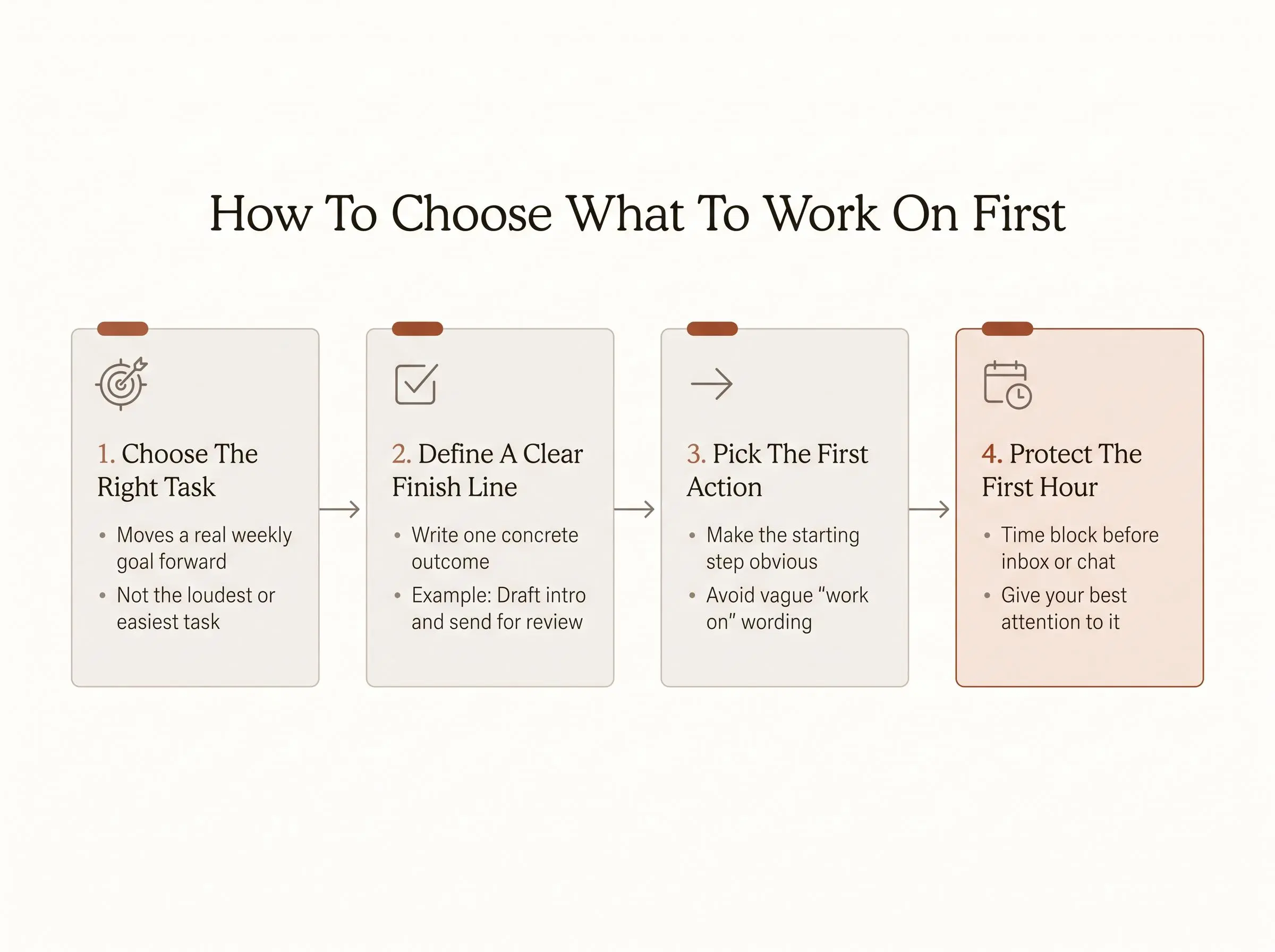
Here’s the filter to use:
- Choose the task that moves a real weekly goal forward.
- Name a finish line you can actually see.
- Protect one timed block before inbox or chat.
Make the first hour count.
Why Deciding What to Do First Feels Harder Than It Should
If you keep asking what should i work on first and still end up checking messages, tidying a doc, and somehow losing the morning, the problem usually isn't laziness. It's too many inputs arriving at once.
Urgent work creates emotional pressure. Important work often doesn't. That's the trap. A message from someone else gives immediate relief when you answer it. The proposal, chapter draft, analysis, or planning work that actually moves your week forward just sits there quietly, waiting to be postponed.
A lot of people confuse a full day with a productive day. By 5 p.m. the calendar looked busy, the inbox moved, small things got handled, and yet the one piece of work that mattered most didn't move an inch. That's not a motivation problem. That's a selection problem.
Starting reactively is expensive in a way that doesn't show up on a to do list:
- email and chat spend your best attention before your own work gets a turn
- small requests multiply because they're easy to keep saying yes to
- the day starts feeling decided by whoever reaches you first
- by the second afternoon, you can't even remember what your real priority was
A good day rarely starts by accident. It starts with a decision.
If you don't choose your first task, your inbox will do it for you.
The Real Goal Is Not to Pick the Easiest Task, but the Most Important One
The first task of the day should not be the easiest thing you can get done quickly. It should be the thing that matters enough to deserve your best hour.
Urgent means it wants attention now. Important means it moves a real goal forward. Sometimes those overlap. Often they don't.
When people ask how to choose one priority for the day, we usually suggest a Most Important Task, or MIT. Some people keep one to three MITs for the day. That's fine. But there still needs to be one clear first priority. Otherwise you've just renamed your confusion.
A few plain examples make this easier:
- Important: draft the proposal that unlocks next week's client decision
- Urgent but lower value: answer a run of noncritical messages
- Easy but distracting: reorganize files, tweak formatting, clear a few low impact tasks
Choose your MIT is not about making a perfect philosophical judgment before 9 a.m. It's a filter. You're asking: what piece of work would make today count if it actually got real attention?
That sounds obvious until you notice how often guilt, novelty, or convenience sneak in. The task that feels easiest to start is often the one you'd least care about by tonight.
Picking one important task is not rigid. It's protective. It keeps your day from being eaten by defaults.
What Counts as the Right First Task
The right first task is usually not the biggest thing on your list. It's the next meaningful move inside that bigger thing.
That matters because "finish the research paper" is a project. It isn't something you can start cleanly at 8:30 without first deciding what "start" means. A better first task might be "write the introduction draft" or "analyze the final data set." Specific work calms the brain. Vague work creates drift.
A strong first task usually has four traits:
- it connects to a weekly goal or a longer thread that actually matters
- it creates real progress, not just visible busyness
- it benefits from fresh energy because it takes thinking, not just attendance
- it removes friction later by clearing a blocker or unlocking the next step
There's also a useful gut check here. The right first task is often the one you'll regret not touching by the end of the day.
Not the one that looks respectable in a planner. The one that will still bother you at dinner if it stayed untouched.
Project versus task
Keep this distinction brutally clear:
- Project: finish the research paper
- Task: write 700 words of the introduction draft
- Project: prepare the client presentation
- Task: outline the deck and draft slides 1 through 5
If a task is too broad to begin immediately, it isn't a task yet. It's still a fog bank.
A Simple Filter for Choosing One Priority for the Day
You don't need a dramatic morning ritual to decide what matters today. You need a short filter you trust.
Run these three questions:
- Which task most directly moves an important goal forward today?
- Which task becomes less likely to happen if I leave it until later?
- Which task would make the day feel meaningfully successful even if other things stayed unfinished?
If you're still stuck, use a tie breaker:
If I could finish only one thing before noon, which completion would matter most?
That question cuts through a lot of nonsense.
Notice what's missing here: quantity. Daily priority setting works better when you're scanning for leverage, not volume. Five "top priorities" is usually just a polite way to avoid deciding.
It also helps to write the answer as a commitment, not a label. "Budget" is vague. "Finish the first pass of next month's budget and send questions to finance" is a real decision.
Stable criteria matter more than clever criteria. If you use the same filter every day, your brain stops renegotiating the rules.
Choose Tomorrow's Priority Before Tomorrow Starts
The best time to decide tomorrow's first task is usually the end of today.
Evening planning works for dull, practical reasons. Context is still fresh. Fewer people are trying to get something from you. You're less likely to confuse incoming noise with actual importance.
This shouldn't turn into a second work session. Ten minutes is enough.
A simple shutdown routine looks like this:
- review what actually moved today
- capture open loops so they stop rattling around in your head
- pick one important task for tomorrow
- define the first concrete action
That's it.
Make the last step slightly more specific when you can: name the likely obstacle and write an if-then response. For example: “If I sit down at 9:00, then I will open the proposal outline and draft the first three headings before checking messages.” A meta-analysis of 21 studies covering 24 independent effect sizes and 15,907 participants found that mental contrasting paired with implementation intentions improved goal attainment by a small-to-moderate amount (Hedges’ g = 0.336). The evidence tests the combined strategy—not a nightly task list alone—but it supports turning tomorrow’s priority into a concrete cue-and-action plan rather than leaving it as a good intention.
Morning sorting has a way of becoming morning avoidance. You open your laptop, check one message "just to orient yourself," and suddenly the decision has been made for you. If you can't plan at night, make the choice before opening inboxes or chat. Not after.
A small decision made early saves a surprising amount of energy later.
Write the Priority as an Outcome, Not a Vague Intention
A lot of daily plans fail because the task is written in a way that hides the finish line.
"Work on report" sounds reasonable until you try to start. What counts as enough? Ten minutes? Two hours? A couple edits? There's no clean edge to it, which makes it harder to begin and easier to abandon.
Stronger wording fixes that.
Weak: work on report
Strong: complete the first draft of the report summary and send it for reviewWeak: study chemistry
Strong: finish chapters 3 and 4 notes and complete 20 practice questions
We like a simple formula: by the end of this block or this day, you will have finished a specific deliverable at a clear quality bar.
That makes time estimates less fictional. It also makes protection easier. It's much simpler to defend "finish the draft and send it" than "do some work on the draft."
This is one reason what should i work on first becomes easier to answer once "work on" becomes "finish this result." The brain handles concrete edges better than noble intentions.
Make Sure the Task Fits Real Human Focus
Even the right priority can fail if it's too large, too fuzzy, or too emotionally loaded to start.
Meaningful work often needs one to three hours of real attention. That's normal. It also means your first task needs a shape that fits actual human focus, not some heroic fantasy version of it.
If the task is big, cut it to a first-session target:
- instead of finish presentation, outline the deck and draft slides 1 through 5
- instead of write thesis chapter, revise the argument section and annotate three sources
The question we come back to is simple: what is the smallest version of this priority that still counts as meaningful progress?
That's different from making it tiny just so it feels easy. The point is not to baby yourself. The point is to give important work an entry point.
Task switching also steals more time than people admit. Three half-starts can eat a whole morning. One clear task usually wins, even on crowded days.
When Two or Three Tasks All Feel Important
Sometimes there really are several legitimate priorities. This isn't always procrastination in disguise. Some days are just loaded.
Still, trying to start all of them at once recreates the original problem. You end up with diluted attention and a false sense of movement.
Use this tie break process:
- pick the task that advances the most important goal
- if equal, pick the one that removes the biggest blocker
- if still equal, pick the one that's hardest to do later when energy drops
- if still equal, pick the one with the clearest next action
That last one gets overlooked. Clarity has value. A task you can enter cleanly at 9:00 often beats a slightly more abstract task that turns into twenty minutes of circling.
A Daily Top 3 can still be useful. An MIT list can too. Just don't confuse "these all matter" with "these should all compete for the same first hour." One goes first. The others wait their turn.
Protect the Task Before the Day Tries to Renegotiate It

Choosing the right task is only half the job. The other half is keeping it from being pushed aside by whatever feels urgent at 9:12.
A simple protection plan helps:
- start before email and chat if you can
- block a work window on your calendar
- prepare materials in advance
- define the first two actions so starting feels obvious
Timed blocks are especially useful if open ended work sessions tend to dissolve on you. A block creates a boundary. You don't have to feel inspired. You just have to begin.
That's part of why we built Flocus the way we did. In the Daily Planner, you choose one most important task, estimate the work in pomodoro style blocks, and start the Focus Timer directly from that planned task. The timer isn't floating off by itself like a kitchen timer with ambition. It stays attached to what you decided mattered. Later, you can compare estimated versus actual time and see where your planning was honest and where it wasn't.
A timer alone doesn't fix much if you never chose what deserved the timer first.
Learn From Reality Instead of Repeating the Same Bad Guess
Choosing well gets easier when you review what actually happened, not what you meant to do.
Most people keep making the same bad estimate because they never look back. They just feel vaguely disappointed and try again tomorrow with the same wishful math.
A few signals are worth tracking:
- which tasks you keep avoiding
- which kinds of work always take longer than expected
- when your best focus tends to happen
- whether your chosen first task gets completed or repeatedly postponed
Estimate versus actual review is blunt, which is useful. If your "one hour task" keeps taking two and a half, the problem may not be discipline. The task may be larger than you admit.
A weekly prompt helps: which first tasks created real progress, and which ones were just urgent noise wearing a serious face?
In Flocus, that review is built into the rhythm. Completed blocks fill a daily Focus Ring, and streaks plus weekly or monthly recaps give you a visible record of real days, not idealized ones. For readers who already own a Muse headband or are curious about measured focus, Flow Tracking adds another layer. It can show focus quality during sessions, not just time spent, which makes it easier to spot your best focus windows or notice which task types pull you into deeper engagement. Useful, if you're into that. Not required.
Common Mistakes That Make Daily Priority Setting Fall Apart
Most breakdowns aren't dramatic. They're small planning errors repeated daily.
Watch for these:
- choosing a task that's really a whole project
- letting other people's deadlines outrank your own goals by default
- picking several "number one" tasks and calling that clarity
- choosing based on guilt, novelty, or ease instead of importance
- deciding too late, after messages and requests have already claimed the day
- skipping the next action, which makes the task feel heavier than it is
- underestimating time, then blaming the method instead of the scope
- treating the daily priority like a moral test instead of a planning practice
That last one matters. Some days you will choose badly. Some days the day will change underneath you. The fix is not shame. It's adjustment.
What a Good Day Actually Looks Like
A good day doesn't mean everything got cleared. For most thoughtful people doing real work, that standard is absurd.
A good day means the thing that mattered most got real progress, maybe even completion, before the noise took over. That's enough to change how the rest of the day feels.
You can usually expect a few shifts:
- less background stress
- less second guessing
- more visible momentum
- a clearer sense of where the day went
One completed priority often improves the rest of the afternoon too. Guilt drops. Confidence rises a notch. You stop carrying that quiet dread of avoiding the one task you know you should be doing.
Calm structure beats constant sorting. Every time.
Choosing the first task is not a one time insight. It's a daily practice. Done often enough, it becomes a way of working that feels steadier, lighter, and a lot less performative.
Conclusion
If you want a better answer to what should i work on first, stop asking which task is loudest. Ask which one would make today count.
The method is simple on purpose: decide early, choose one meaningful priority, write it as a concrete outcome, protect it with focused work blocks, and review what reality teaches you. That's how daily priority setting turns from guesswork into something you can trust.
Tonight, before you close your laptop, pick tomorrow's one important task. Then write the first action so clearly that starting feels almost automatic.
Article Record
ReferencesPrimary sources used for this article
- A field experiment on the effects of weekly planning behaviour on work engagement, unfinished tasks, rumination, and cognitive flexibility
- Effects of task interruptions caused by notifications from communication applications on strain and performance
- A Meta-Analysis of the Effects of Mental Contrasting With Implementation Intentions on Goal Attainment
- Most Important Tasks Method: The MIT Daily Planning Guide