

If you want to learn how to plan your day in 10 minutes, the usual advice makes a mess. You write a heroic list, check your calendar, open your inbox, and suddenly planning has eaten the first 25 minutes.
What works is simpler: choose one task that matters, give it a real block, and cut the rest until the day fits. This is for getting oriented before work starts, not for building a bureaucracy.
A few things to watch:
- Plan before messages.
- Pick a task you can finish.
- Leave space for overruns, and you end up calmer by lunch.
Why Most Daily Planning Creates More Stress Than Clarity
A lot of people don't need a better planner. They need less friction before starting work.
The usual frustration is familiar enough: a long list, five things that feel equally urgent, and a quiet suspicion that planning is becoming a cleaner-looking form of avoidance. You sit down to get organized, and twenty minutes later you've built a system instead of starting the day.
That happens for a few predictable reasons:
- elaborate systems take too long to maintain
- they demand too many decisions before any real work begins
- they create schedules that collapse the second a meeting runs long or someone drops a "quick thing" on you
There's also the planning fallacy, which sounds academic but isn't. We tend to assume work will take less time than it does. So a packed plan can feel disciplined at 8:00 AM and absurd by 10:00 AM. Not because you're failing. Because the plan was fiction.
Choice overload makes it worse. If your system has categories, tags, priorities, labels, energy levels, due dates, and color codes, you've built yourself a small admin job before breakfast. The more options you give yourself, the harder it gets to decide what to do next.
A quick daily planning routine works better because it removes decisions, not because it adds motivation. That's the real point. A good plan should survive real life, including interruptions, uneven energy, and the fact that your brain is not a project management tool.
A daily plan should lower the cost of starting, not raise it.
What a Good 10-Minute Plan Actually Needs
If you're wondering how to plan your day in 10 minutes, the answer is simpler than most systems make it sound. You do not need a complete life dashboard. You need a small plan you can trust when the day gets noisy.
A useful 10 minute planner routine only needs four parts:
- one most-important task
- a short list of other concrete tasks
- rough time estimates
- flexible focus blocks
That's it. No weekly life audit required at 8:12 on a Tuesday.
This is different from three common setups that look productive but usually aren't:
- The giant brain dump with no priorities. Useful for clearing your head, not enough for deciding what matters.
- The rigid minute-by-minute schedule. Looks precise. Breaks fast.
- The timer-only setup. It tells you when to work, but not what deserves your best attention.
We prefer a method that feels light enough to repeat every day, even when you overslept, even when you have class in forty minutes, even when your morning is already a little crooked. That is the point of simple day planning steps. They work because they're small enough to survive.
Think of it as a fast workday setup, not a full productivity identity.
Set Up Your Morning Planning Ritual Before the Day Gets Loud
Timing matters more than tools here. If you plan after email, chat, or social feeds, you've already handed the steering wheel to other people.
The best windows are usually one of these:
- The night before. Good if morning indecision tends to waste your first hour.
- First thing in the morning. Better if your day changes overnight or your energy varies a lot.
Night-before planning reduces hesitation. Morning planning gives you a truer read on today's constraints, energy, and deadlines. Neither is morally superior. Pick the one you'll actually do.
The habit sticks better when it's attached to something that already happens:
- coffee starts brewing
- laptop opens
- you sit at your desk
- class notes come out
Keep the setup plain. A notebook works. A notes app works. A calendar works. If you want a digital system without turning planning into software management, a browser-based tool like the Flocus Daily Planner can keep the morning planning ritual lightweight. That's useful for people who want structure but bounce off heavier systems.
The perfect tool is usually the one you stop fiddling with after the second day.

Step 1: Spend Two Minutes Reviewing Yesterday So Today Starts From Reality
Don't start with a blank page. Start with evidence.
A two-minute review is enough. Look at yesterday and ask:
- What got finished?
- What rolled over?
- What surprised you?
That last question is the one people skip, and it often tells you the most. Maybe the "quick" task took an hour. Maybe meetings drained the afternoon. Maybe you keep scheduling deep work for a time when your brain is clearly off duty.
This is not self-criticism. It's data gathering. There's a difference.
Carry forward only what still matters:
- unfinished tasks with real value
- fixed commitments already on the calendar
- constraints that will shape the day, like meetings, classes, errands, or deadlines
What you should not do is blindly copy yesterday's unfinished list into today. That's how rollover becomes wallpaper. An experienced operator learns to ask, "Is this still important, or have we just been dragging it around?"
Step 2: Do a Fast Brain Dump to Clear Mental Clutter
Now get everything out of your head before you try to prioritize it.
Write down:
- work tasks
- personal obligations that affect today
- admin chores
- reminders
- random ideas that keep tapping your shoulder even if they're not for today
The point is not organization yet. The point is relief. Once a task is externalized, your brain can stop rehearsing it every seven minutes like it's trying not to forget groceries, a PDF, and an email reply at the same time.
Keep this quick. Don't break items into subprojects. Don't sort by category. Don't start ranking them mid-stream. That's where people quietly turn a two-minute release valve into a twenty-minute planning spiral.
This is one reason a quick daily planning routine works so well. It clears the mental backlog first, which makes prioritization less emotional. A crowded mind tends to mistake loud tasks for important ones.
Step 3: Choose One Most-Important Task and Keep the Rest of the List Short
This is the central decision of the day. Everything else supports it.
Your most-important task is the one piece of work that deserves your best attention. Not the easiest task. Not the newest request. Not the task that looks most impressive in a status update. And not always the most urgent item if that urgent item is just admin wearing a fake mustache.
Good selection criteria are pretty plain:
- the task with the biggest impact
- the one that would make the day feel worthwhile if completed
- the task you've been avoiding even though it matters
Make it concrete. Vague tasks create fake progress.
- not "work on presentation"
- instead "draft slides 1 through 5"
- not "study chemistry"
- instead "complete practice set for chapter 4"
After the main task, choose only 3 to 5 additional tasks. Concrete ones. Small enough to finish. Large enough to matter. If you want, keep a separate might-do list for nice-to-haves so your brain can stop lobbying for them without promoting them into commitments.
A shorter list is not lower ambition. It is more honest planning.
If your plan says twelve things matter most today, it doesn't mean you're ambitious. It means you haven't decided.
Step 4: Estimate Time Honestly and Cut the List Until It Fits
This is the part that makes the whole routine real.
Give each planned task a rough estimate. Keep it simple:
- 15 minutes
- 30 minutes
- 1 hour
- 2 focus blocks
These estimates do not need to be precise. They only need to be good enough to expose overload.
Do the basic math. Subtract the non-negotiables first:
- meetings
- classes
- commute
- lunch
- breaks
- other fixed commitments
Then compare your remaining time to the work you've listed. If the plan doesn't fit, cut something. Usually the lowest-priority item. Not after lunch. Now.
This is where overwhelm starts to drop. You stop pretending all of it can happen today. The day gets smaller, and oddly enough, more useful.
Leave margin. Real days have friction. People ask things. Files break. Attention dips. A full plan leaves no room for reality.
One quiet advantage of using Flocus for this is estimate-versus-actual tracking. Over time, you start seeing where your plans drift. Some people consistently under-estimate writing. Others pretend admin takes no time at all. The data keeps the optimism in check without turning the process into homework.
Step 5: Turn the Plan Into Flexible Focus Blocks
Now give the work a shape.
You do not need to schedule every minute. You need to assign a few approximate blocks so the day has direction. That's a big difference.
Place the work intelligently:
- put the most-important task where your energy is strongest
- batch shallow admin together
- protect breaks and lunch before the day eats them
For deep work, Pomodoro-style blocks are a solid default. They lower the activation energy because starting one 25-minute session feels smaller than "finish the whole thing." Breaks also help attention last longer across the day, which is not glamorous advice, just useful.
A plan might look like this:
- 9:00 to 10:00: two focus blocks on draft slides 1 through 5
- 10:15 to 10:45: email and form submission
- 11:00 to 11:30: prep notes for class
- afternoon: one block for revisions if needed
If you use a timer, it helps when the timer is attached to the task itself. That's why a built-in Focus Timer is more useful than a separate countdown living off to the side. The timer should reinforce the plan, not compete with it.
Exact block length can vary. Some tasks need 25 minutes. Some need 45. The important part is tying time to a task so attention has somewhere to land.
Step 6: Follow the Plan Without Becoming Rigid
A plan is a guide. Not a contract, and definitely not a test of character.
When the day changes, use simple rules:
- if you're interrupted, return to the next planned block instead of rebuilding the entire day
- if a task expands, split it into a smaller next action
- if new work appears, decide what it displaces instead of stacking it on top
That last rule is where most planning systems quietly fail. People keep adding without subtracting, then wonder why the plan feels useless by midafternoon.
Protect the most-important task first when the schedule slips. If something has to move, move the lower-value admin before the work that actually gives the day shape.
Also, stop checking a giant task list every half hour for reassurance. It usually doesn't reassure. It just creates more cognitive noise and tempts you toward easy tasks that feel busy.
Experienced operators don't keep renegotiating the whole day. They make the next sensible move.
A Sample 10-Minute Planner Routine for a Real Workday
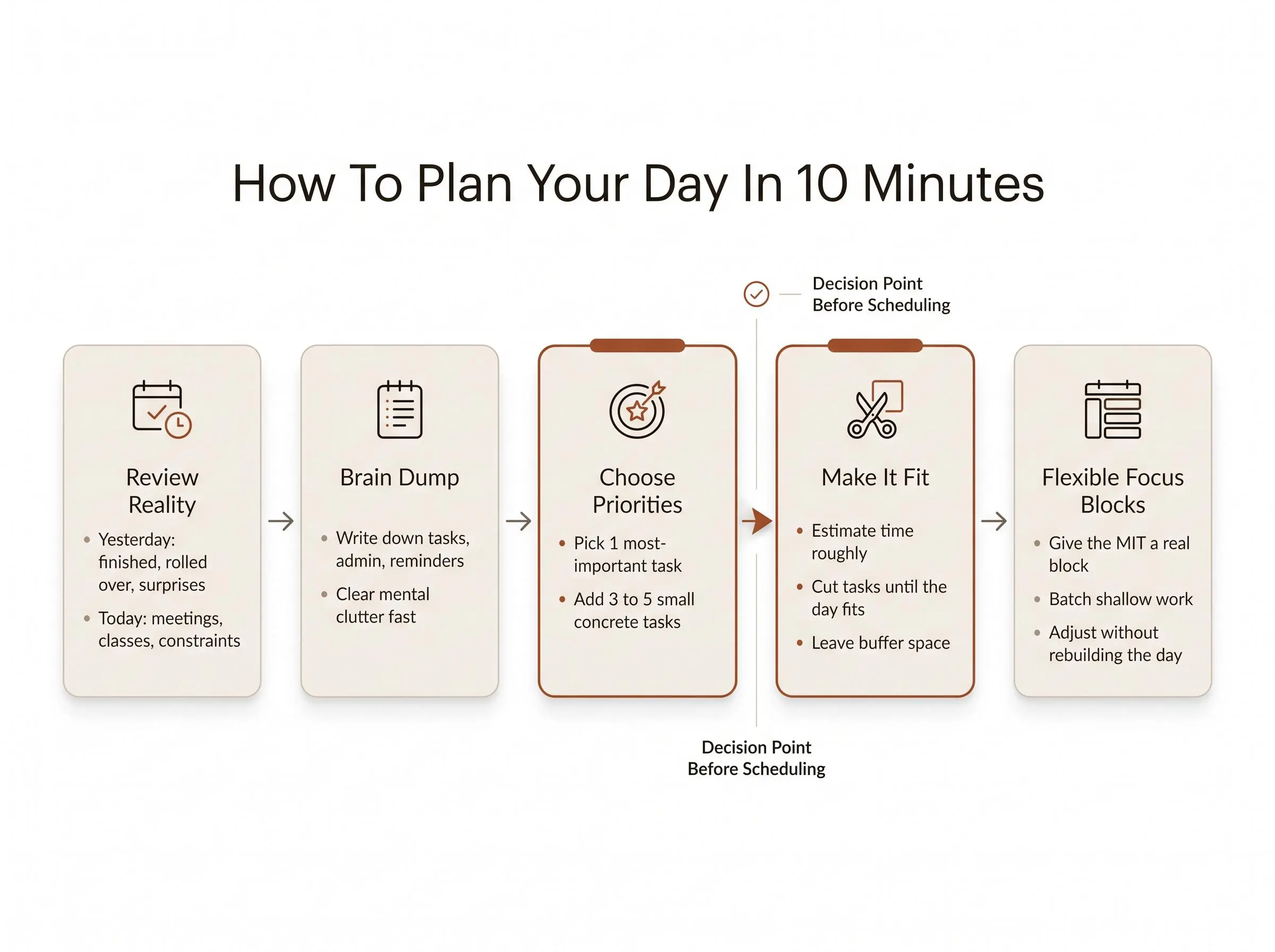
Here's what planning your day in 10 minutes can look like in practice. Not theoretically. On an actual workday with meetings and leftovers.
Say you're a knowledge worker with one deep-work deliverable, two meetings, and a pile of admin trying to look urgent.
Minutes 1 to 2: Review yesterday and fixed commitments
You notice yesterday's report outline is unfinished. One meeting moved to 2:00 PM. You also remember the morning tends to be your best thinking time.
Minutes 3 to 4: Brain dump everything competing for attention
You write down:
- finish report outline
- reply to three emails
- submit expense form
- prep meeting notes
- book dentist
- follow up on vendor question
- idea for next week's project
Minutes 5 to 6: Choose the most-important task and 3 to 5 others
- MIT: finish report outline
- prep meeting notes
- reply to three emails
- submit expense form
- vendor follow-up
Book dentist goes to the might-do list. Project idea gets parked for later.
Minutes 7 to 8: Estimate time and cut what doesn't fit
Report outline: 2 blocks
Prep notes: 30 minutes
Emails: 20 minutes
Expense form: 15 minutes
Vendor follow-up: 20 minutes
After meetings, lunch, and breaks, you have about three focused hours. It fits, barely. So you keep the dentist task off today's list instead of pretending.
Minutes 9 to 10: Assign flexible focus blocks
- 9:00 to 10:00: report outline
- 10:15 to 10:45: meeting prep
- 11:00 to 11:30: email and vendor follow-up
- 3:30 to 3:45: expense form
That's a fast workday setup. Simple day planning steps. Not fancy, just usable.
Common Mistakes That Make a Quick Plan Feel Overwhelming Again
The routine is short, but there are a few ways people accidentally break it.
One is planning too many tasks and calling it ambition. Another is choosing projects instead of next actions. "Work on thesis" is not a plan. It's a fog bank.
The usual mistakes look like this:
- letting urgent but low-value admin crowd out the one task that matters
- planning after opening inboxes or messages
- forgetting transition time, breaks, and meetings
- treating rollover as failure instead of feedback
- using a focus timer without a plan
That last one is more common than it should be. Timers can create the appearance of productivity while attention drifts across low-priority work. You can do four focused sessions and still avoid the thing that mattered.
A quick plan starts feeling heavy again when it stops helping you decide. That's the test.
How to Know Your 10-Minute Planning Habit Is Working
You don't need a perfect streak to know the method is helping. The signs are usually quieter than that.
Look for these shifts:
- less hesitation about what to do next
- faster starts on important work
- fewer unrealistic daily plans
- a clearer sense of where your time actually goes
A few review questions help at the end of the day or week:
- Did the most-important task get protected?
- Did your estimates get closer to reality?
- Did the day feel less reactive?
Visible progress helps habits stick. That's part of why some people do well with the Flocus Daily Planner. The daily Focus Ring, streaks, reflections, and weekly insights give you proof that the plan turned into actual work. Not just good intentions at 8:00 AM.
If you happen to own a Muse headband, Flow Tracking adds another layer by showing focus quality in real time. Useful for the curious niche, not required for the method. The core routine works perfectly well without hardware.
Success here is not flawless execution. It's a calmer, more repeatable relationship with attention.
Frequently Asked Questions About Planning Your Day in 10 Minutes
A realistic 10-minute plan reduces the day to one clear priority, a short list, rough time estimates, and flexible focus blocks.
What should a 10-minute daily plan include?
A useful plan includes:
- one most-important task
- a short list of other concrete tasks
- rough time estimates
- flexible focus blocks
It should also account for fixed commitments such as meetings, classes, commuting, lunch, and breaks.
How many tasks should I put on my daily plan?
Choose one most-important task, then add only 3 to 5 additional concrete tasks. Keep nice-to-have items on a separate might-do list rather than treating them as commitments.
Should I plan my day the night before or in the morning?
Either can work. Planning the night before can reduce morning hesitation, while morning planning gives you a truer read on the day's constraints, energy, and deadlines. Choose the time you are most likely to repeat.
What should I do when my day does not go according to plan?
Treat the plan as a guide rather than a contract. Return to the next planned block after an interruption, split expanding tasks into smaller next actions, and decide what new work displaces instead of adding it on top. Protect the most-important task first when the schedule slips.
Conclusion
The best answer to how to plan your day in 10 minutes is not to manage everything. It's to reduce the day to one clear priority, a short realistic list, and a few protected blocks.
That shift matters. You stop trying to hold your whole life in working memory. You stop mistaking a crowded list for a meaningful plan. You work with real attention instead of hustle fantasy.
Try this morning planning ritual for one week. Keep it simple. Watch where your estimates were wrong, where your day got hijacked, and where the plan held. Your actual days will teach you more than any perfect system will.
Article Record
ReferencesPrimary sources used for this article
- The Complete Guide to Planning Your Day
- Decision Fatigue and How Too Many Choices Cause Overload Anxiety and Mental Exhaustion
- How I Got More Done, Reduced Stress, Increased Focus, And Mastered Time Management In 10 Minutes A Day - For The Interested
- How to Plan Your Day in 10 Minutes
- 10 Minutes to Take Control of Your Day - Asian Efficiency
Update HistoryMeaningful revisions to this article
- Added four frequently asked questions about planning your day in 10 minutes to help readers find quick, practical answers.