Most people look for deep work examples and still miss the point. Deep work is not a heroic four-hour trance; it is one hard task, one clear output, and fewer exits than usual.
We see the same mistake a lot. You protect time for focus, then spend half of it circling the task. What matters is picking work that actually needs your full brain. Start here.
- If a task survives 12 tab switches, it is not deep work.
- A solid 45 minutes on one output beats two messy hours of busy work.
- Estimate the block first, then finish something real.
What Deep Work Really Means in Practice
Deep work sounds grander than it usually looks. In practice, it's one important thing, one clear result, and a stretch of attention long enough to think properly.
We'd define it simply: distraction-free, cognitively demanding work that creates new value, improves your skill, or solves a hard problem. That could be writing the core argument of an essay, designing a system change, building a model, or making a difficult recommendation.
It is not:
- sitting at your desk for three hours
- feeling tired by noon
- bouncing between tabs while calling it research
- doing ten small tasks quickly and hoping quantity counts as depth
A useful test is whether the task needs uninterrupted thinking to produce something that isn't easy to copy with half your attention. Deep work usually has friction. You have to hold ideas in your head long enough for them to connect.
Meaningful deep work often looks quieter than people expect. No dramatic montage. Just a protected block, one demanding task, and actual progress by the end of it.
Deep work is usually less intense than hustle culture suggests, and more deliberate.
You also don't need four perfect hours a day for it to matter. Most people would get a lot from one honest block. Sustainable deep work is less about wringing out maximum effort and more about choosing the right work, then protecting it from the usual nonsense.
What Is Shallow Work and Why It Takes Over So Easily
Let's answer the plain question directly: what is shallow work? It's the logistical, reactive, low-cognitive work that can often be done while partially distracted.
It includes the stuff that keeps a day moving but rarely moves the real work forward:
- clearing inboxes
- replying to routine messages
- moving tasks between tools
- sitting in status meetings
- formatting slides
- checking dashboards without making decisions
- low-stakes admin
None of that is evil. Some of it is necessary. The problem is that shallow work is easier to start, easier to finish, and easier to prove to yourself.
You reply, click, tidy, update, confirm. The work disappears quickly, which feels productive. Meanwhile, the harder task sits there waiting for a version of you with more courage and fewer notifications.
Always-on communication makes this worse. A message pings, a dashboard refreshes, someone needs "just a quick thought." Shallow work puts on an urgent costume. Most days, that's enough to win.
The trick isn't to eliminate shallow work. Good luck with that. The trick is to make it support meaningful work instead of replacing it.
Deep Work vs Shallow Work Examples That Make the Difference Obvious
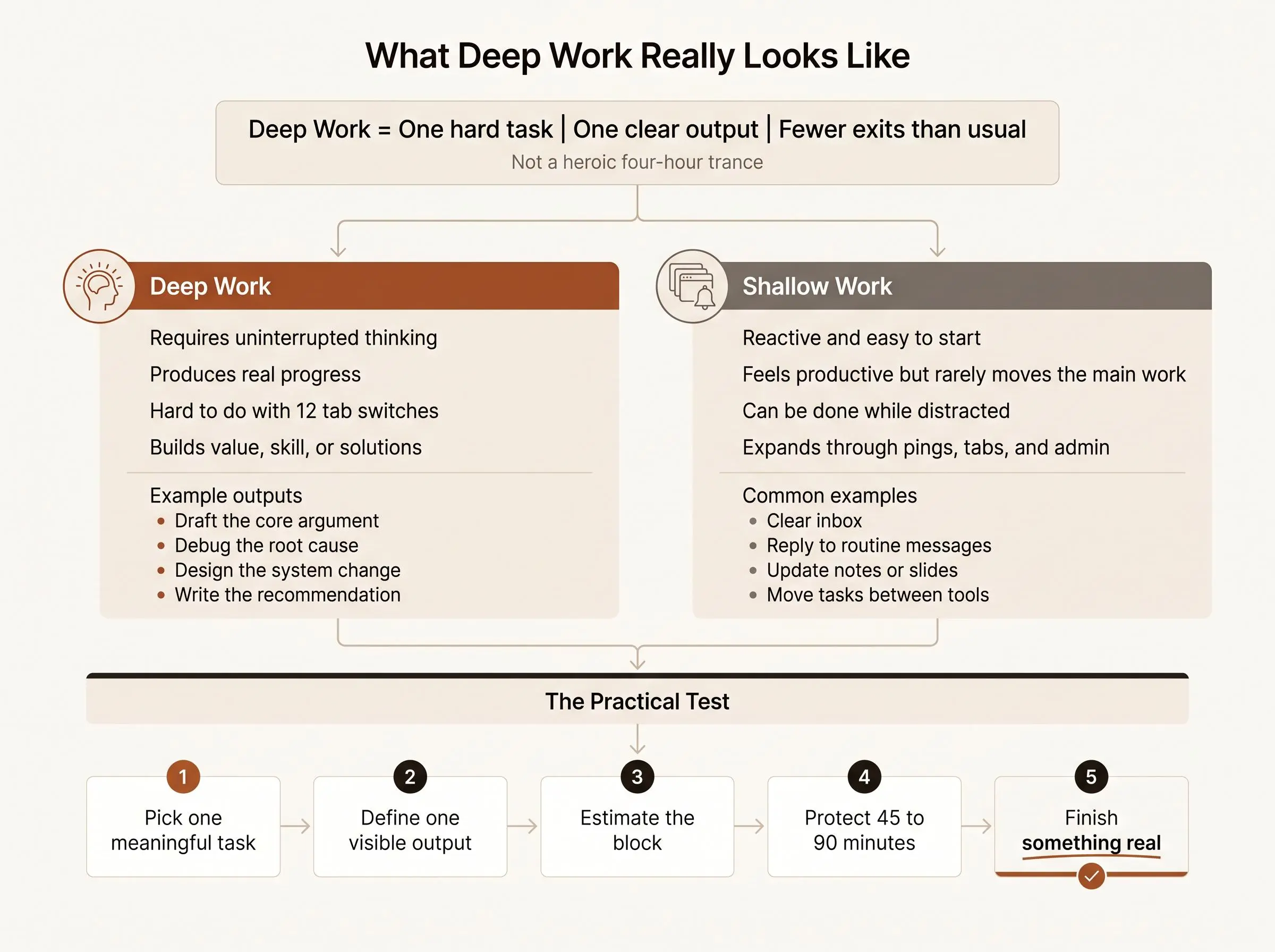
The fastest way to understand deep work vs shallow work examples is to compare tasks that sit near each other but do very different jobs.
| Deep work | Shallow work |
|---|---|
| Writing the core argument of a paper | Adjusting citations and formatting |
| Debugging a root-cause production issue | Answering scattered chat pings about it |
| Planning a product strategy memo | Updating the meeting notes template |
| Learning a hard concept for an exam | Color-coding the study plan |
| Drafting a proposal with a recommendation | Researching tools forever without deciding |
This is also the clearest version of focus work vs busy work. Two tasks can both feel productive. Only one changes the state of the project.
If a task demands uninterrupted thinking and produces a hard-to-replicate result, it's probably deep work. If it can be done while glancing at messages, switching tabs, and staying socially available, it's probably shallow.
The edge cases matter
Some tasks shift categories depending on how you do them.
- Code review can be deep when you're tracing architectural implications. It becomes shallow when you're skimming line comments between meetings.
- Reading can be deep when you're trying to understand and synthesize a hard concept. It becomes shallow when you're collecting sources to avoid writing.
- Research can be deep when it leads to a decision. It becomes shallow when it turns into organized hesitation.
- Planning can be deep when you're setting direction and tradeoffs. It becomes shallow when you're decorating a system instead of using it.
Experienced operators learn to ask a blunt question: is this helping me think, or helping me avoid thinking?
Why Better Focus Feels So Hard Right Now
If focusing feels harder than it should, that isn't just a character flaw in nicer packaging. Modern work is built to interrupt you.
Research on knowledge work shows people switch tasks every few minutes. The average worker stays on one screen for less than a minute before switching. After a meaningful interruption, getting fully back into a complex task can take more than 23 minutes.
That last part matters more than most people realize. Attention doesn't reset cleanly. When you switch away from important work, some of your mind stays attached to the thing you just left. That's attention residue instead of a long flat list where everything pretends to matter equally. A day needs a center of gravity. Without one, shallow work fills the vacuum and then kindly offers you guilt as payment.
False positives show up all the time:
- organizing your workspace to avoid starting
- checking messages for reassurance
- overplanning instead of producing
- researching without moving toward a decision
There's also a practical reason planning systems help when they include estimates. If you have to guess what one block can actually accomplish, fantasy planning starts to lose its charm. Suddenly "write report" becomes "draft recommendation section in 45 minutes," which is a real thing a real person might do.
How to Do Deep Work Without Burning Yourself Out
Deep work is not a contest to see how long you can suffer in silence.
Even elite performers don't sustain unlimited intense cognitive effort. Around four hours a day appears to be a practical upper limit for truly demanding mental work, and most people never get close because fragmentation gets them first. So if you're imagining deep work as a daily four-hour monastic trial, you can relax.
Two protected blocks can already put you ahead of the norm.
For most readers, better patterns look like this:
- one 30-minute block if you're rebuilding attention
- one 52-minute block if you want a solid working session
- two 60 to 90 minute blocks if your role and calendar allow it
The key is repeatability. A smaller block you actually protect beats a heroic schedule that collapses by Wednesday afternoon.
A few operating rules help:
- breaks should be real breaks, not email with worse posture
- stop while you still know the next step
- treat fatigue as planning feedback, not moral failure
That second one is underrated. Ending with a restart note makes re-entry much easier. You don't return to a blank wall. You return to a next move.
Respecting your limits is not lowering the bar. It's how you stay in the game.
What Short Breaks Can Actually Do
A real break is not laziness dressed up as a productivity technique. A 2022 systematic review and meta-analysis pooling 22 independent samples and 2,335 participants found that micro-breaks had small average benefits for vigor (d = 0.36), fatigue (d = 0.35), and performance (d = 0.16).
“Small” is the useful word here. The evidence supports breaks as a way to manage accumulated strain, not as a magic way to make every hour more productive. It also does not identify one perfect break length or schedule for every kind of demanding work. The review rated only four of its 22 samples as low risk of bias, so treat the finding as a practical reason to protect recovery—not a promise of dramatic gains.
For deep work, that makes the rule fairly simple: step away long enough to stop feeding the task more inputs, then return with your next move already defined.
Real-World Deep Work Schedules That Survive a Messy Calendar
A good schedule for deep work shouldn't depend on a fantasy life. It needs to survive an ordinary Tuesday.
Here are realistic patterns we've seen work better than vague good intentions.
Protected morning block
Reserve the first serious block of the day for meaningful work before meetings and coordination expand to fill the room.
Best for:
- students
- remote workers
- anyone with some calendar control
Tradeoff: great for cognition, less great for customer-facing or highly reactive roles.
Two daily focus blocks with a coordination window
Use one block in the morning, one later in the day, and put meetings, chat, and admin in the middle.
This creates more output, but it only works if your team has decent norms. Otherwise the middle window leaks everywhere.
No-meeting mornings until 11
This is often enough to give teams real maker time without redesigning the entire week. Simple rules beat aspirational culture decks.
Tradeoff: collaboration pressure may get pushed into afternoons.
One meeting-light day each week
Useful for project work that needs longer setup and fewer context switches.
Tradeoff: if the rest of the week stays chaotic, that one day can become a pressure cooker.
Journalistic approach
For unpredictable roles, you use open windows intentionally when they appear instead of losing them by default. This works well for managers and reactive operators. It requires quick task definition. If a 40-minute opening appears, you need to know exactly what meaningful work fits there.
The best schedule depends on your context:
- student: anchor one block around your highest-energy study window
- open-office worker: protect headphones-on blocks and batch shallow work aggressively
- manager with limited control: use smaller windows and a stronger restart habit
- remote worker with flexible hours: claim your best cognitive hours before social availability takes over
The best deep work schedule is not the longest one. It's the one that can survive an ordinary week.
A Simple Deep Work Workflow You Can Repeat Daily
You don't need a complicated productivity system. You need a method you can run half-asleep on a busy day.
Here's a simple workflow:
- Choose one most-important task.
- Define one visible output for the next block.
- Estimate how long it should take.
- Protect one focus block.
- Set one main distraction rule for that block.
- Stop with a restart note.
- Review estimated versus actual time.
That estimate-versus-actual step matters more than it seems. It teaches realistic planning instead of mood-based planning. Over time, you learn whether you're underestimating meaningful work, overcommitting your day, or picking tasks that are too vague to finish cleanly.
It also solves a common failure mode: doing a very sincere focus session on the wrong task.
At Flocus, this is the part we care about most. The timer isn't the whole system. We combine daily planning with timed focus blocks so the session starts with a real priority, not just a number on a countdown. Each block records estimated versus actual time, which makes your planning more honest over time. That's the useful feedback loop.
How to Tell if Deep Work Is Actually Working
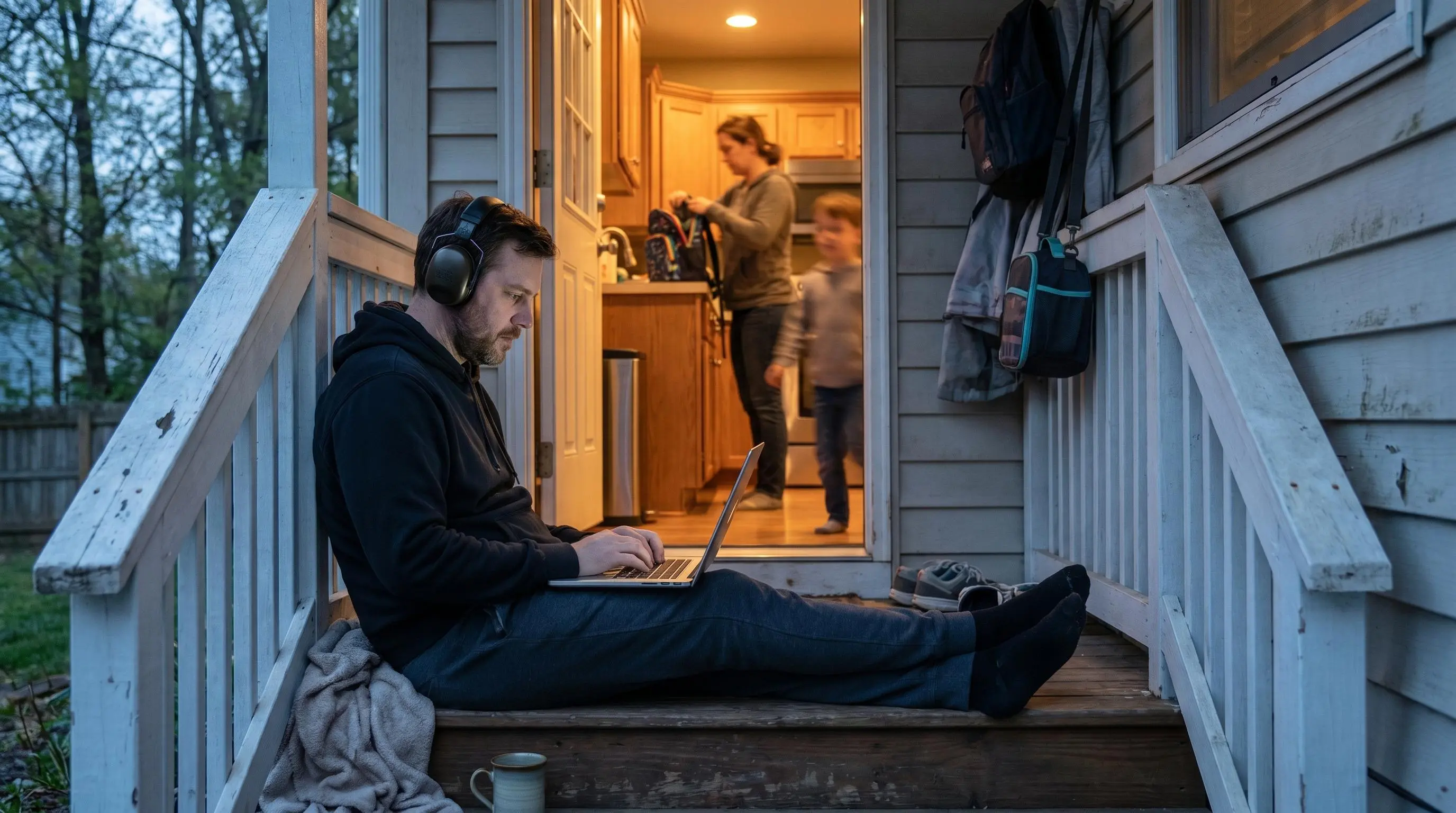
Don't judge deep work by vibes alone. Some sessions feel smooth and produce little. Some feel awkward and still move the important thing forward.
Better signals are calmer and more concrete:
- total uninterrupted minutes on meaningful work
- number of completed deep work blocks per week
- whether your most-important task moves early in the day
- quality of output, not just time spent
- how quickly you can re-enter after a break
Visual progress can help if it reflects real work instead of gamified guilt. A ring, a streak, or a weekly reflection is useful when it shows patterns you can act on. Maybe mornings are genuinely better. Maybe certain tasks always take twice as long as expected. Maybe interruptions cluster around 2 p.m. and you keep acting surprised.
For readers who want more direct feedback, there is an optional deeper layer. Some people are curious whether they're actually settling into focused states rather than just sitting still. For Muse headband users, Flocus can track flow state in real time while you work. Measured focus, not self-reported. It's not magic, and it isn't a status symbol. It's just another form of feedback for people who like data.
Common Mistakes That Turn Deep Work Into Another Form of Stress
Deep work works best as a practice, not an identity. Once people turn it into a personality test, things get weird.
The usual mistakes are predictable:
- choosing too many priorities
- using a timer without a clear task
- protecting time but not attention
- filling breaks with inbox checks
- expecting every block to feel like flow
- judging the session only by mood
- scheduling impossible four-hour blocks from day one
Open-plan and reactive workplaces make purity unrealistic. That's fine. You don't need purity. You need adaptation.
For a lot of readers, the right answer is hybrid. Deep work happens in the best available windows. Shallow work gets batched elsewhere. You protect what you can, and you stop pretending every hour of the day has equal cognitive value.
Consistency beats intensity, especially if you're recovering from distraction fatigue. A calm daily block will do more for your attention than occasional heroic efforts followed by collapse.
Conclusion
The real shift is simple. Deep work is not about doing more things harder. It's about choosing one meaningful task and giving it real attention.
Once you can see the difference between deep and shallow work, a lot of the guilt starts to loosen. You stop confusing visible activity with progress. You protect blocks for the work that actually changes something. You measure honestly instead of guessing whether the day counted.
Start small. Pick one meaningful task. Protect one block. See what happens.
If you want more structure, use a planner-first system like Flocus to choose the task, run the block, and learn from the result. That's the point. Not perfect focus. A calmer way to know where your day went, and why.
Article Record
ReferencesPrimary sources used for this article
- "Give me a break!" A systematic review and meta-analysis on the efficacy of micro-breaks for increasing well-being and performance
- Examining the cognitive processes underlying resumption costs in task-interruption contexts: Decay or inhibition of suspended task goals?
- The effects of cues on task interruption recovery in a concurrent multitasking environment
- Email Duration, Batching and Self-interruption: Patterns of Email Use on Productivity and Stress Gloria Mark1, Shamsi T. Iqbal2, Mary Czerwinski2, Paul Johns2, Akane Sano3 1Department of Informatics 2Microsoft Research 3Media Lab University of California, Irvine One Microsoft Way Massachusetts Institute of Technology Irvine, CA 92697 USA Redmond, WA 98052 USA Cambridge, MA 02139 USA gmark@uci.edu {shamsi,marycz,Paul.Johns}@microsoft.com akanes@media.mit.e
- For whom and under what circumstances does email message batching work?
- 2023 Work in America™ Survey
- The Role of Mental Health on Workplace Productivity: A Critical Review of the Literature
Update HistoryMeaningful revisions to this article
- Added a new section explaining what short breaks can realistically do to support recovery and focus.
- Clarified that short breaks offer modest benefits without presenting them as a cure-all for productivity.