

Most people use the 50 10 study method like a stretched Pomodoro, then hit block two and drift. The problem usually starts earlier: the task is fuzzy, the tabs are still open, the break gets wasted.
What matters is matching the block to work that needs time to load. Get that right, and 50 minutes feels calm, not long. Watch these bits:
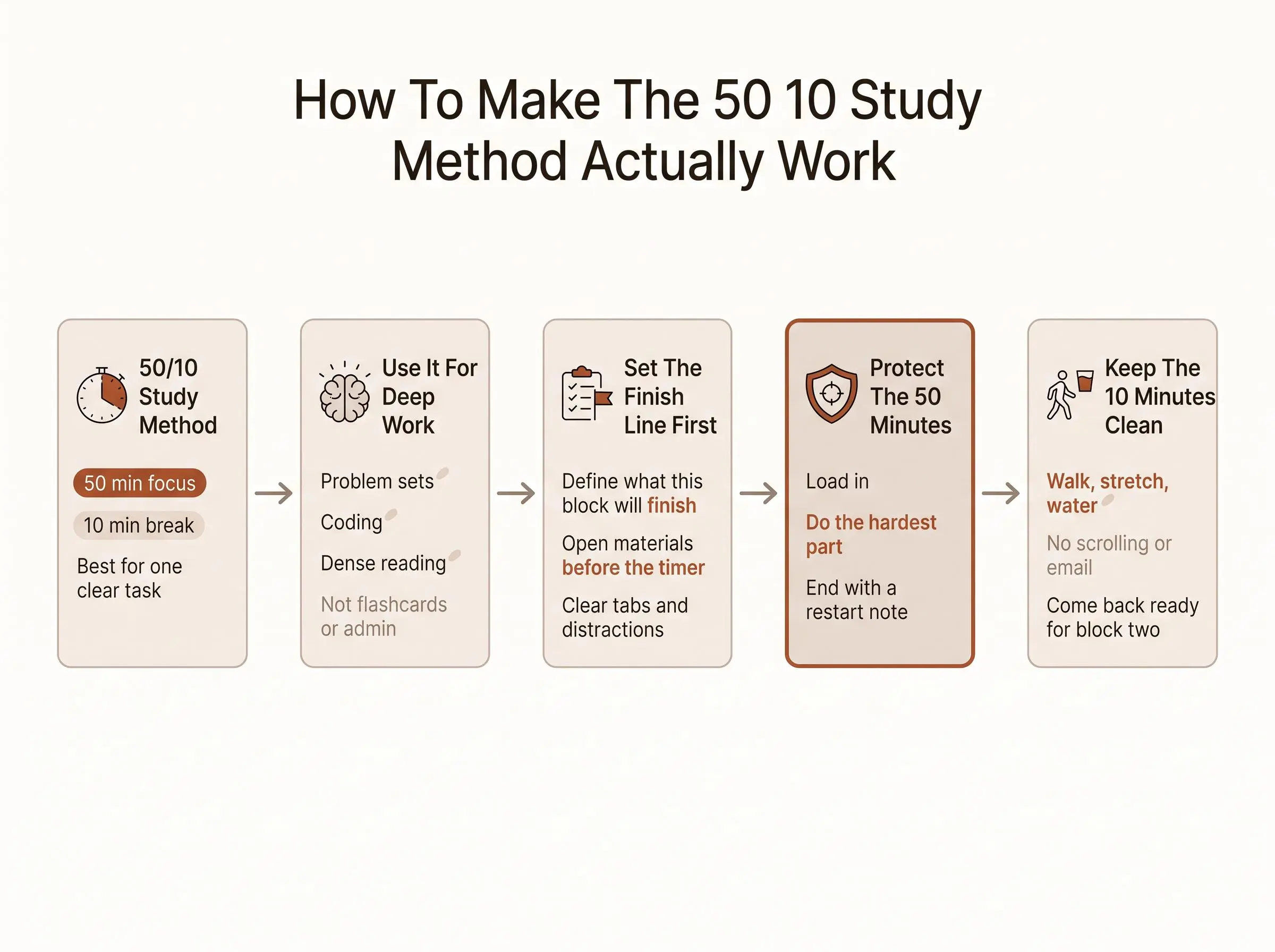
- Use it for problem sets, coding, or dense reading, not flashcards.
- Set the finish line before the timer starts.
- Keep the 10 minutes clean, so you'll come back and actually finish something.
What the 50 10 Study Method Is
The 50 10 study method is simple: work with full attention for 50 minutes, then take a 10 minute break. That’s one cycle. Then you decide whether to run another.
It keeps the same 5:1 work-to-break ratio as a classic 25/5 Pomodoro, just scaled up. You’re not changing the logic. You’re changing the length of the runway.
That matters more than people think.
This method isn’t about studying longer for the sake of virtue. Nobody needs a timer that cosplays discipline. The point is to create enough uninterrupted time for real concentration to happen, especially on work that has a mental loading period before anything useful starts.
That makes it a strong fit for students and knowledge workers doing high-context tasks like:
- problem sets
- dense reading
- drafting
- coding
- case analysis
- research synthesis
You can use 50/10 as a standalone rhythm, or place it inside a larger plan. We think it works best when the block is attached to one clearly chosen task, ideally the most important one for the day. A timer alone counts minutes. A plan tells those minutes where to go.
Why 50 Minutes Often Feels Better Than 25
A lot of people don’t hate short timers because they dislike structure. They hate them because the bell goes off right when their brain finally shows up.
That’s the quiet problem with 25 minutes. For easy tasks, it’s enough. For harder work, the first chunk often disappears into orientation. You’re reopening notes, recalling what matters, finding the thread again. By minute 20, things are finally moving. Then the timer chirps like it accomplished something.
Not ideal.
Research on interruptions points in the same direction. Context switching has a real reset cost, and getting back to the original task after a distraction can take roughly 23 minutes. If your work intervals are short and your task is complex, you can end up repeatedly paying the entry fee without staying long enough to benefit.
The long focus session benefits are practical, not mystical:
- You get time to build momentum.
- You avoid forced restarts.
- You’re more likely to finish a meaningful chunk.
- You spend less energy re-entering the same problem.
A 50 minute work block is long enough for deep reading, drafting, or serious problem solving. But it’s still short enough to recover from. That’s the sweet spot. Not a sprint so brief it breaks momentum, not a marathon that leaves your brain smoking by block two.
Focus needs room. Recovery needs to be real.
Attention tends to work in cycles anyway. A 50 minute focus session sits nicely between very short intervals and bigger deep work blocks like 90 minutes, which can be powerful but harder to repeat without strain.
When the 50 10 Study Method Works Best
The method works best when the task has setup cost. In plain English, you need time just to get the work loaded into your head before you can do anything useful with it.
That’s why deep work 50 minutes makes sense for:
- math and physics problem sets
- coding practice
- essay drafting
- dense textbook reading
- case analysis
- research synthesis
These tasks aren’t just “hard.” They’re layered. The first part of the session goes to understanding instructions, recalling concepts, and seeing structure. If you interrupt too early, you’re not resting from real work. You’re resting from warm-up.
That’s also why 50/10 is good when the goal is to complete a substantial section, not merely make a ceremonial start. “Finish problems 1 to 8” has a different shape than “look at chemistry.”
Some tasks are easier to fragment. Those don’t usually need 50 minutes:
- flashcards
- light review
- admin
- quick reading checks
The key idea is simple: focus sprint length should match the shape of the work. Not the other way around. If you force every task into the same interval, the timer becomes the boss and the task becomes an inconvenience.
When 25/5 Still Makes More Sense
We’re not evangelical about 50/10. Sometimes 25/5 is the better tool.
Its biggest advantage is humble and useful: it lowers the barrier to starting. On procrastination-heavy days, that matters more than theoretical depth. A short interval can get you in motion before your brain has time to negotiate a hostage release.
25/5 is often better for:
- repetitive tasks
- surface review
- topic rotation
- low-energy afternoons
- days when starting is the main problem
A practical rule helps here:
- If starting is the main problem, go shorter.
- If staying with a complex task is the main problem, go longer.
Some people also do well with a mixed ramp. Start with 25 minutes to get moving, then shift into a 50 minute focus session once momentum is there. That’s not cheating. That’s knowing your own startup cost.
And yes, longer formats like 90/20 exist. They can be excellent for deep work. They’re also harder to sustain consistently, especially if your days include classes, meetings, or ordinary human limits. A method only helps if you’ll actually use it next Tuesday.
How to Set Up a 50 Minute Focus Session So It Actually Works
A 50 minute block needs a real target. “Study biology” is not a target. It’s a category.
Before the timer starts, define what this block is for. Better session goals look like this:
- finish problems 1 to 8
- draft the introduction and outline the first section
- read pages 40 to 65 and write five recall notes
That small shift changes everything. You stop renting time and start aiming it.
Do the setup first. Open the document. Pull up the chapter. Find the assignment instructions. Put the notes where you can see them. Don’t spend the first 12 minutes of a 50 minute work block acting surprised by your own task.
A useful pre-session checklist:
- choose the one task that matters most
- clear unnecessary tabs
- put the phone out of reach
- keep water and notes nearby
- decide what counts as done for this block
This is where planning beats timing. The timer helps only when it’s attached to something specific. In Flocus, our Daily Planner is built around that idea: pick one most-important task, keep the list short, and estimate how many focus blocks the work will actually take. It’s a calmer way to stay honest than staring at a countdown and hoping structure appears on its own.
What to Do During the 50 Minute Work Block
The goal is not perfect concentration for all 50 minutes. That standard is silly. The goal is to stay with one task and return to it when attention drifts.
A block usually has a natural internal rhythm:
A simple shape for the session
- First 5 to 10 minutes: load the material, orient, find the thread
- Middle stretch: do the hardest work while the task is fully in view
- Final minutes: finish a thought, mark progress, note the next step
That last part is underrated. Ending with a restart note saves a surprising amount of friction later. “Resume at question 7” is better than reopening the work tomorrow and trying to remember who you were.
When distractions show up, capture them on paper. Don’t act on them. A random errand, an email to send, a thing to Google later, write it down and keep moving. Most distractions become less urgent when they’re parked somewhere visible.
The block should be indivisible in spirit, even if life occasionally interrupts. If the doorbell rings, fine. The method is not ruined. We’re after repeatable attention, not monastic theater.
A browser-based timer tied to the task itself helps more than a disconnected countdown. Our Flocus Focus Timer lets you run custom durations, including a 50 minute work block, directly from a planned task and compare estimated versus actual time afterward. That matters because minutes completed and work completed are not the same thing. They rarely even live in the same neighborhood.
How to Use the 10 Minute Break for Real Recovery
The break is not filler between serious parts. It’s half the method.
Ten minutes is enough time to recover on purpose. Five often turns into a panicked half-break where you check notifications, stand up briefly, then sit back down more scattered than before. Ten gives your attention room to reset instead of fray.
Good break activities are boring in the best way:
- stand up
- walk
- stretch
- drink water
- look away from screens
- step outside if you can
Bad break activities are the ones that keep your brain half at work:
- messaging
- scrolling
- opening a new study task
The trap is thinking you need to earn recovery. You don’t. Recovery is part of focus. Skip it, and the next block starts with hidden fatigue.
A break isn’t a prize. It’s maintenance.
How Many 50/10 Cycles You Should Do in a Day
This method works best in sets, not as an all-day test of character.
For most people, 2 to 3 consecutive 50/10 cycles is a practical ceiling before a longer reset helps. Beyond that, quality usually drops before pride does, which is an annoying pattern if you’ve ever mistaken endurance for progress.
A real day might look like this:
- Two morning 50/10 blocks on the hardest subject
- A longer meal break or walk
- Later blocks for lighter review, admin, or cleanup work
You don’t need to force every task into 50/10. In fact, you probably shouldn’t. Mixing formats is often smarter. Use longer blocks for dense study and shorter ones for review or fragmented work.
Success here isn’t “I completed six timers.” It’s “the right work got protected and moved forward.”
A Study-Specific Twist: Use 50/10 for Interleaving, Not Just Endurance
There’s a useful twist here for studying: use the method for interleaving.
Interleaving just means mixing related topics or problem types instead of drilling one narrow pattern for hours. Not every five minutes. That’s just chaos. But across blocks, it can be very effective.
For example:
- algebra in the first block, geometry in the second
- constitutional law cases first, essay application second
- reading theory first, applying it in problems next
This works because the shift happens between focused sessions, not inside one. You still get depth. But the next block asks your brain to retrieve, compare, and distinguish. That tends to deepen understanding better than staying in one groove until your thinking goes flat.
The 50 10 study method is good at this because it creates both depth and variety without constant task hopping. One block digs in. The break resets. The next block changes angle, not direction.
A Simple Daily Routine for the Fifty-Ten Study Method
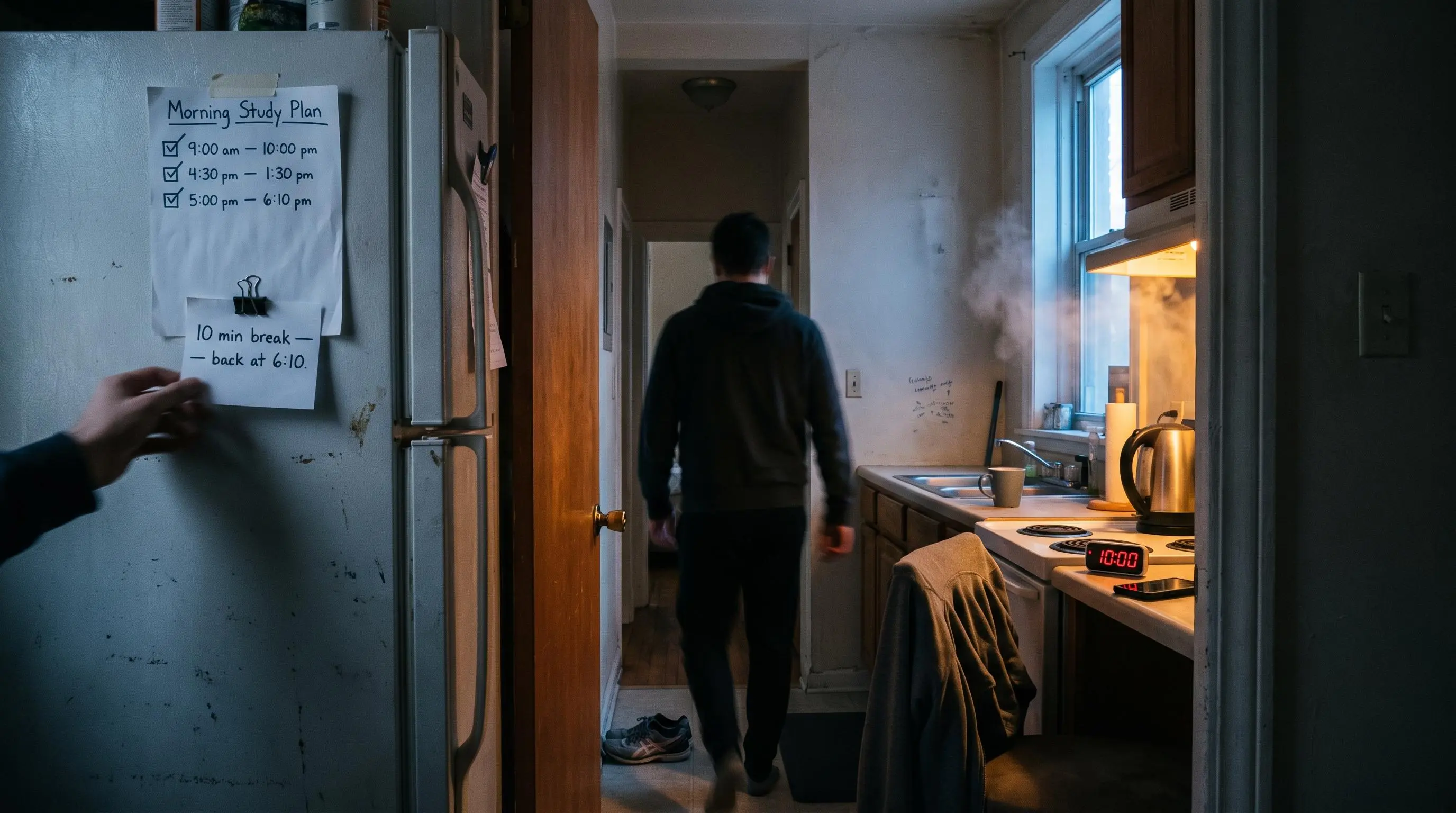
You don’t need a complicated routine. You need one you’ll repeat.
A calm version looks like this:
- pick the one most-important study task
- estimate how many blocks it needs
- run the first session early, before trivia takes over
- take a real 10 minute break
- repeat once or twice
- review what got finished and what remains
At the end of each block, leave a short restart note. That one habit reduces the dread of beginning again later.
This routine also cuts guilt. Progress becomes visible and finite. You can point to what moved. The day stops feeling like a fog of effort with no edges.
In Flocus, that loop is built into the planner: attach focus blocks to planned tasks, then close the day with a visible Focus Ring. It’s a small thing, but completion signals matter. Vague effort rarely feels satisfying, even when you worked hard.
Common Mistakes That Make the Method Feel Harder Than It Should
Most problems with 50/10 aren’t caused by the interval itself. They come from using it sloppily, then blaming the method.
Watch for these:
- choosing a session goal that’s too broad
- using the break for more screen time
- starting before materials or instructions are ready
- forcing 50/10 onto shallow tasks
- treating one distracted block as proof it doesn’t work
- pushing past 2 to 3 long cycles without a bigger reset
- doing the hardest work when your energy is already spent
- counting minutes instead of asking whether the block moved the task forward
One rough block doesn’t mean you’re bad at focusing. It usually means something in the setup was off. That’s a fixable problem. Much better than a character flaw.
How to Tell Whether 50/10 Is the Right Focus Sprint Length for You
You don’t need a personality test for this. You need a week of honest observation.
Fifty minutes is often a good fit if:
- you need time to get into the zone
- your work is complex
- short timers interrupt momentum
- one substantial chunk feels better than four tiny ones
It may be too long right now if:
- you keep breaking the block
- the task is light and fragmented
- starting is the hardest part
- your energy collapses before halfway
Try a simple test week. Use 50/10 for deep tasks. Keep 25/5 for review and admin. Compare focus quality, output, and mental fatigue. Not vibes alone. Patterns.
For readers who want a more measured view, Flocus also offers optional Flow Tracking with a Muse headband. It shows live focus quality during sessions, so you can test whether your best rhythm really is 50 minutes or whether you’re forcing a block length that sounds impressive but doesn’t fit.
How to Measure Progress Without Turning Studying Into a Numbers Game
Track a few things that actually help:
- what task the block was for
- what got finished
- whether your estimate matched reality
- how attention felt near the beginning, middle, and end
Estimate-versus-actual tracking is especially useful. It tells you whether the issue is focus, planning, or task sizing. Those are different problems, and they need different fixes.
After a few days, look for patterns:
- which subjects suit longer blocks
- what time of day gives you the strongest concentration
- whether breaks are restoring attention or getting diluted by distractions
Visible progress reduces that awful feeling that the day disappeared into effort without results. But don’t turn this into a private accounting system. The point is better feedback, not a prettier spreadsheet.
50/10 Study Method FAQ
What is the 50/10 study method?
The 50/10 study method uses 50 minutes of focused work followed by a 10-minute break. One work period and one break make a cycle.
What tasks work best with the 50/10 study method?
It works well for tasks with a setup cost, such as math and physics problem sets, coding practice, essay drafting, dense textbook reading, case analysis, and research synthesis.
What should you do during the 10-minute break?
Use the break for real recovery: stand up, walk, stretch, drink water, look away from screens, or step outside. Avoid email, messaging, scrolling, or starting another study task.
Is 50/10 better than 25/5 for studying?
It depends on the task. Use 50/10 when staying with a complex task is the main challenge and short timers interrupt momentum. Use 25/5 when starting is difficult or the work is repetitive, light, fragmented, or suited to surface review.
How many 50/10 cycles should you do in a day?
A practical ceiling is 2 to 3 consecutive 50/10 cycles before taking a longer reset. You can use later blocks for lighter review, administration, or cleanup work instead of forcing every task into 50/10.
Conclusion
The 50 10 study method works because it gives your mind enough time to engage deeply, then enough space to recover before attention starts to unravel.
The practical takeaways are plain:
- match your focus sprint length to the task
- use 50/10 for dense, high-context study
- protect the 10 minute break
- plan the block before you start the timer
- adjust based on real patterns, not guilt
If you want a decent place to start, choose one important study task today and protect one 50 minute focus session for it. Then notice the difference. Studying feels a lot better when the rhythm supports the work instead of interrupting it.
Article Record
ReferencesPrimary sources used for this article
Update HistoryMeaningful revisions to this article
- Added five frequently asked questions to help readers understand and use the 50/10 study method more easily.