
What is a focus session, really? It is not a fancy timer and it is definitely not productivity cosplay. Most people start the clock, keep chat open, switch tasks twice, and call the whole mess focus.
What matters is simpler: one real task, a clear stopping point, and enough quiet time for your brain to stop skidding. If you've tried Pomodoro apps and still ended the day foggy, this is usually the missing piece.
A few things worth getting straight:
- A 25 minute block can be too short for hard work; setup eats it alive.
- If the task is vague, the session turns into tidy looking procrastination.
- The short review at the end is what helps you leave with a result.
What a Focus Session Actually Is
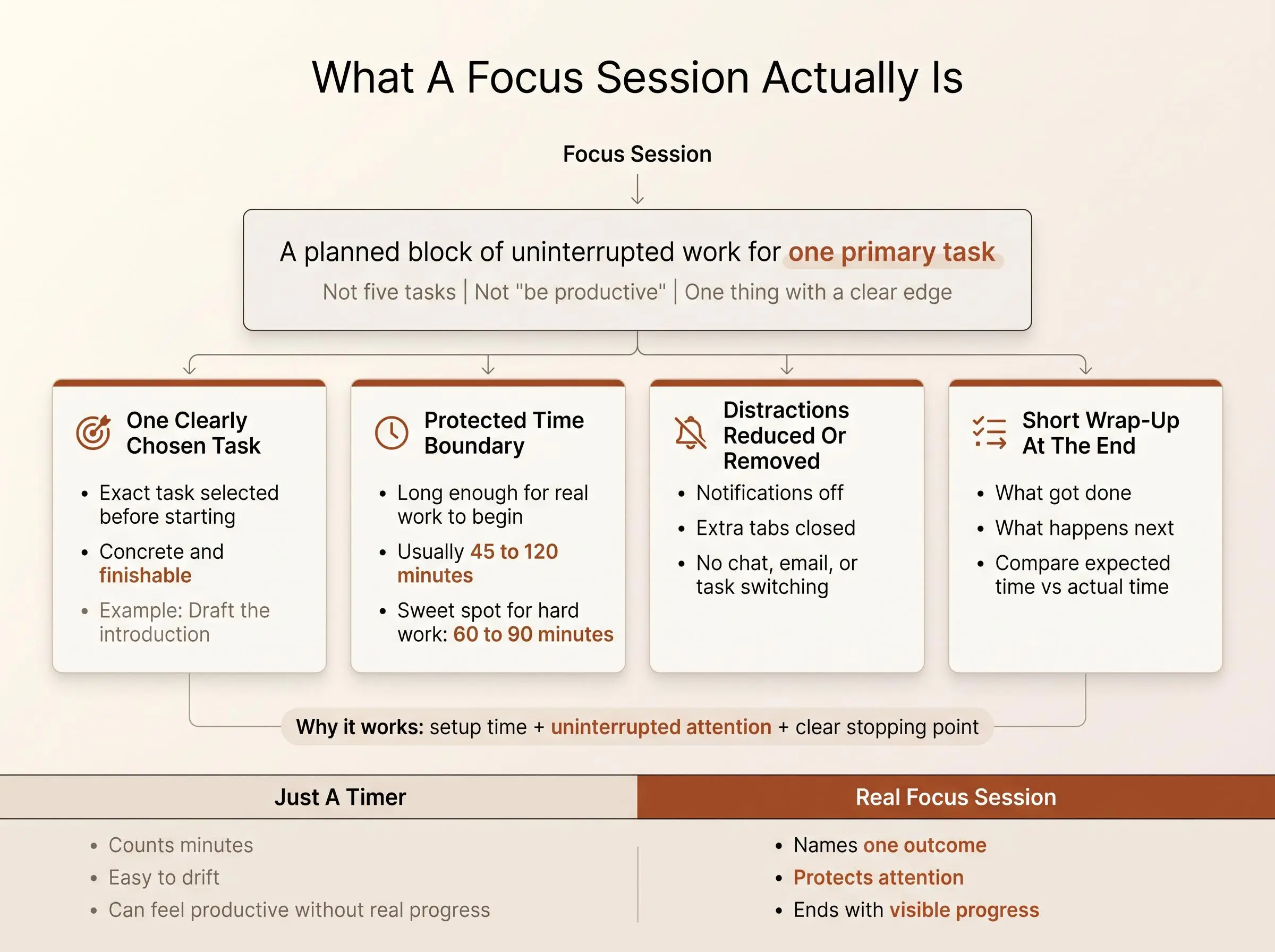
A focus session is a planned block of uninterrupted work for one primary task. Not five tasks. Not "be productive." One thing, with a clear edge around it.
The point isn't to stare at a timer and hope discipline appears. It's to give your attention somewhere definite to land so your brain can stop renegotiating what it should be doing every three minutes. That little renegotiation is exhausting, and people often mistake it for a motivation problem.
A real focus session has four parts:
- one clearly chosen task
- a protected time boundary
- distractions reduced or removed
- a short wrap-up at the end
Most good sessions land somewhere between 45 and 120 minutes. For demanding work, 60 to 90 minutes is often the practical sweet spot. Long enough to get past the setup fog. Short enough that your brain doesn't file a complaint.
Shorter sessions still count. If you're new to this, tired, or trying to get moving on a resistant task, 25 to 30 minutes can work well. The only rule is that the block has to be long enough for real work to begin, not just for opening tabs and adjusting your chair with unusual seriousness.
A focus session is a practice, not a personality trait.
Some days it clicks. Some days it feels clunky. That's normal. The goal is not to become the sort of person who is "naturally focused." The goal is to build a structure that makes focus more likely.
Why Focus Sessions Help When Plain Timers Do Not
If you've tried Pomodoro apps, pretty study dashboards, or a generic countdown timer and still ended the day thinking, what exactly did I do, you're not the problem. The setup usually is.
A timer counts minutes. A focus session connects those minutes to a specific intention.
That difference sounds small until you see it in practice. Without a defined task, the timer becomes a container for whatever feels easiest in the moment. You answer one email, tidy a note, check something "quickly," and by the end you have the vague glow of productivity with very little to show for it. Structured procrastination is still procrastination. It just has better branding.
This is where people start blaming themselves. They assume they lack grit. Usually the issue is simpler:
weak focus is often unclear priority plus unprotected attention
Visible completion signals matter here. When you know what the block was for, and you can mark what moved, progress stops feeling fuzzy. That's why we built Flocus around a planning-first method rather than a timer alone. You choose one most-important task, work in a timed block, then close it out with visible progress. Minutes matter, but only if they were pointed somewhere useful.
What Happens Inside a Good Focus Session
A good session has a shape. That shape keeps it calm.
We'd break it into three parts: preparation, deep work, and buffer.
Preparation
This part should be brief, but not lazy. Before the session starts:
- choose the exact task
- gather what you need
- close extra tabs
- silence notifications
- decide what "done for now" looks like
That last step matters more than people expect. If you don't define the finish line, your brain keeps scanning for one while you're supposed to be working. That's part of why vague sessions feel restless.
Deep work
Now you do the one thing.
No inbox checks. No chat dips. No swapping over to low-value admin work because it's easier to finish. The aim is to let attention build instead of restarting it over and over. Most people don't have a focus problem so much as a restarting problem.
Buffer or shutdown
This is the part people skip, then wonder why tomorrow feels messy.
Take a couple of minutes to note:
- what got done
- what's next
- whether your time estimate was close or wildly optimistic
That final check is useful because it keeps planning honest. If you repeatedly think a task will take 30 minutes and it takes 70, that isn't a moral failing. It's information. Good systems learn. Bad ones just keep making promises.
Why Focus Sessions Work for the Brain
Complex work has a loading phase. That's the plain version.
When you sit down to write, study, code, analyze, or solve a hard problem, the early minutes are usually spent reopening files, recalling what you were doing, and figuring out where the real problem begins. Productive momentum often starts later than people think. Not instantly.
That's why fragmented work feels so unsatisfying. You keep paying the entry cost without staying long enough to get the benefit.
Interruptions are expensive too. It can take more than 20 minutes to fully refocus after being interrupted. Not because you're fragile. Because your brain has to rebuild context. If your day gets cut into little pieces, your best thinking never gets enough uninterrupted time to settle.
This is why longer blocks tend to outperform scattered work for:
- writing
- analysis
- coding
- studying
- strategic thinking
- problem-solving
There is a limit, though. Longer isn't automatically better. Many people can sustain strong focus for around 60 to 90 minutes before quality dips and recovery starts to matter. Past that point, another half hour can be excellent or useless. Depends whether your attention is still alive or just being polite.
If focusing feels hard, don't jump straight to self-diagnosis. Often your work is simply being chopped up too often to let real concentration form.
How Long Should a Focus Session Be?
You don't need the perfect duration. You need one you can actually keep.
Here's the practical guide we use:
- 25 to 30 minutes for beginners, high resistance, or getting started
- 45 to 60 minutes for standard focused work
- 60 to 90 minutes for deeper cognitive tasks
- 90 to 120 minutes for experienced deep work blocks with solid energy and a protected environment
Match the session to the task. Shallow admin work usually doesn't need a long block. Writing, studying, planning, design, and problem-solving usually do.
The session should be long enough to get through setup and into real work, but short enough that you don't quietly stop trusting your own plan. That's the part people miss. If you keep setting heroic blocks you never complete, your system starts to feel fake.
After longer sessions, take about 10 to 15 minutes off. After multiple deep blocks, take a more meaningful recovery break. Your brain isn't a machine, which is inconvenient but still true.
Consistency beats drama.
Focus Sessions vs Time Blocking
This is where a lot of confusion comes from. When people compare focus sessions vs time blocking, they're often comparing two different layers of the same process.
Time blocking means putting work on your calendar in advance. It answers when the work will happen. That's useful, especially if you need to protect time from meetings and interruptions.
A focus session answers how you'll use that protected time.
A calendar block can exist without deep concentration. You can schedule "Project work" from 2:00 to 3:30 and still spend it bouncing between chat, tabs, and half-decisions. The time was protected. Your attention wasn't.
A focus session is the execution layer inside time blocking:
- the calendar protects the time
- the focus session gives the time structure
This pairing also appears in the approach described by Ali Abdaal, who brings goals, calendars, and focus sessions together so the day is planned around what matters.
Here's the difference in plain terms:
- Calendar block: "Project work, 2:00 to 3:15"
- Focus session: "Draft section one of the report for 75 minutes, notifications off, stop after outline plus first pass"
Deep work blocks vs calendar blocks isn't an either-or question. They work best together. One reserves the space. The other makes the space useful.
Deep Work Blocks vs Calendar Blocks
Some people are busy all day and still don't get much meaningful work done. That's usually a deep work problem disguised as a scheduling problem.
A deep work block is distraction-light, cognitively demanding work on one high-value task. A calendar block is simply a scheduling commitment. It may turn into deep work. It may also turn into 47 minutes of tab-switching and one thoughtful sip of coffee.
The common failure mode is predictable. People schedule time, but they don't choose a real target, reduce interruptions, or set a stopping point. The block looks respectable on the calendar and collapses in use.
If you want to turn a calendar block into a deep work block, ask:
- Is there one primary outcome?
- Are chat and notifications muted?
- Is the block long enough for context loading?
- Is there a stopping point and a break after?
That distinction matters in any daily planning methods comparison. The best system isn't the one with the prettiest calendar. It's the one that reliably turns intention into completed work.
Focus Sessions vs Pomodoro
Pomodoro helps a lot of people get started. It also makes some people oddly twitchy.
The difference is simple. Pomodoro uses rigid 25-minute intervals. Focus sessions are flexible blocks shaped around the task itself.
Twenty-five minutes can work well for admin work, breaking resistance, or starting something you've been avoiding. No argument there. But for complex work, it can be too short. By the time you load context, find the thread, and define the real problem, the timer is already clearing its throat.
The break structure differs too:
- Pomodoro: short breaks every 25 minutes
- Focus sessions: longer uninterrupted work, then a more meaningful recovery break
Our take is practical, not ideological. Keep Pomodoro as a starter tool if it helps you begin. Shift to focus sessions when the work needs uninterrupted reading, thinking, writing, or analysis. Use the method that fits the task, not the one that sounds more disciplined.
Time Blocking With Timers: The Combination That Usually Works Best
This is usually the most useful setup in real life: time blocking with timers.
The sequence is straightforward:
- reserve the time on your calendar
- define the one task
- start a visible timer
- review what happened at the end
The timer isn't the hero. It's the guardrail. Without it, a protected block can drift. With it, you get enough pressure to stay inside the task without turning the session into a performance.
A few ordinary examples:
- 60 minutes to revise lecture notes
- 75 minutes to draft the proposal opening
- 45 minutes to analyze a dataset before lunch
Estimated versus actual time matters more than people think. It improves planning accuracy. It exposes your recurring underestimation. It turns "I had no time" into a more honest record of what the work actually took.
That's part of the reason Flocus logs estimated and actual time for each block. It keeps the planning layer tied to reality, which is less glamorous than productivity theater and far more useful.
Planning Sessions vs Scheduling
Planning sessions vs scheduling gets blurred all the time, and the difference is worth keeping clean.
Scheduling is deciding when something goes on the calendar.
A planning session is stepping back to decide what matters, what fits, and what actually deserves focused time.
Scheduling without planning often creates overloaded days full of low-priority blocks that looked organized at 8:30 and ridiculous by 2:00. Planning without scheduling has the opposite problem. Great intentions. No protection.
The relationship is simple:
- planning chooses the priority
- scheduling protects the time
- the focus session delivers the work
If you're doing a daily planning methods comparison, it helps to think of each tool by job:
- to-do lists capture tasks
- calendar blocks reserve time
- focus sessions execute one task with full attention
Clarity comes before concentration. Otherwise you end up concentrating very hard on the wrong thing.
How to Run Your First Focus Session

You can try this today. Keep it plain.
A simple first session
- Choose one most-important task. Make it concrete and finishable. Not "work on project." More like "draft the introduction" or "review chapters 3 and 4 notes."
- Decide the session length. Start with 30 to 60 minutes if you're new to this or easily distracted.
- Prepare the environment. Silence notifications, close unnecessary tabs, put your phone away, gather materials before the timer starts.
- Define the success condition. What counts as useful progress by the end of the block?
- Start the session and single-task. If a new thought shows up, write it down and return. Don't switch tasks just because your brain offered a side quest.
- End with a short review. What got done? What's next? Did it take more or less time than expected?
- Take a real break. Stand up. Move. Drink water. Look at something that isn't glowing.
That's enough. Your first session does not need to be elegant.
What to Do if You Get Distracted Mid-Session
You will get distracted sometimes. The goal isn't to become distraction-proof. It's to recover faster and learn what keeps breaking the block.
There are three common disruption types:
- Internal distraction: boredom, restlessness, urge-checking
- Digital distraction: pings, banners, flashing tabs
- External interruption: coworker, class, household demand
Try the recovery move that matches the problem. If a thought pops up, write it down instead of acting on it. If the task feels too abstract, restart with a smaller sub-goal. If you're genuinely in the zone and still working on the same task, extending the session can help. Deliberately. Not endlessly.
A broken session isn't failure. It's feedback.
Sometimes the task was too vague. Sometimes the environment was noisy. Sometimes you picked the lowest-energy hour of the day and asked your brain to perform a small miracle.
The Best Tasks for Focus Sessions and the Worst Ones
Some work benefits from sustained attention. Some work just wants a clean checklist.
Focus sessions are best for tasks like:
- writing
- studying
- coding
- analysis
- reading for comprehension
- strategic planning
- learning something new
- creative problem-solving
These all benefit from context buildup. You need time to understand the problem before you can do anything smart with it.
Tasks that usually don't need a full focus session include routine email, admin cleanup, simple approvals, and quick logistics. Those aren't bad tasks. They just don't require deep work conditions, and giving them prime focus time is often a waste of good mental energy.
Sort the day accordingly. Use focus sessions for important, cognitively heavy work. Batch reactive tasks separately so they don't leak into every hour and claim the whole day by erosion.
Common Mistakes That Make Focus Sessions Feel Useless
Most failed sessions fail for boring reasons.
- starting the timer before choosing a real task
- picking a task that's too large, vague, or emotionally loaded for one block
- turning the session into a guilt ritual instead of a realistic commitment
- leaving chat, email, or phone notifications on
- scheduling deep work in your lowest-energy window
- skipping the end-of-session review
- confusing duration with quality
- turning the whole thing into productivity theater
One operator rule is worth keeping: if the session can't tell you what it was for, it wasn't a real session.
How to Make Focus Sessions a Sustainable Daily Habit
Don't overhaul your life. Start with one dependable session a day.
For most people, one real block changes the feel of the whole day. It gives the day a center. That's more useful than six half-kept plans.
A few supports help:
- use the same start ritual
- use the same workspace when possible
- end with the same review question
Visible progress loops matter too. Completion signals, streaks, short reflections, and weekly pattern review all make the habit easier to trust. That's part of the calmer loop we use in Flocus with the daily ring, streaks, and insights. The point isn't pressure. It's evidence. You start seeing focus as a pattern you can learn, not a daily referendum on character.
An Optional Advanced Layer: Measuring Flow Instead of Just Counting Minutes
This part is optional, and it should stay optional.
Most productivity tools measure time spent. Some people, especially Muse headband owners or the neurotech-curious, also want feedback about the quality of attention. Flocus offers an optional Muse connection for real-time flow-state tracking during work.
The useful part isn't mind-reading. It isn't gadget drama. It's another feedback layer that can help you notice when your environment, task choice, or timing supports steadier focus.
Still, the core method does not depend on this. The main win is simpler than that: plan one important task, protect a realistic block of time, and review what happened after. If you do that consistently, you've already solved most of the problem.
Conclusion
So, what is a focus session?
It's a protected block for one important task, with a clear boundary, reduced distractions, and a short review at the end. More than a timer. Less than a complicated life system.
It works well with time blocking because the calendar protects the time and the session gives that time structure. It differs from rigid Pomodoro cycles because some work needs longer context than 25 minutes allows.
Most of all, a focus session reframes focus itself. It's not a mood you wait for. It's something you build on purpose.
Try one today. Choose a meaningful task, protect 30 to 60 minutes for it, and give that time both a boundary and a purpose. The change is usually noticeable by the end of the first block. Not magical. Just clearer.
Article Record
ReferencesPrimary sources used for this article
Update HistoryMeaningful revisions to this article
- Added insights from Ali Abdaal to the “Focus Sessions vs Time Blocking” section.
- Made the comparison easier to understand with practical, expert-backed guidance.