
If you are asking what is flow state, focus has probably felt slippery even when you sit down with good intentions. People blame discipline. Usually it is the setup.
In practice, flow is less about motivation and more about task shape, challenge, and a block of quiet time (a plain timer is not enough). Watch for this:
- "Study" is too vague. "Review pages 12 to 18" gives your attention somewhere to land.
- Too easy and you drift. Too hard and you stall. Flow shows up in the middle.
- Visible progress matters. It helps you stop guessing and finish the work.
What Flow State Means, Explained Simply
If you've ever looked up after working and realized 40 minutes disappeared without much drama, you've probably brushed against flow. Not magic. Not a personality type. Just a mental state where your attention locks onto one meaningful task and stays there.
So, what is flow state in plain language? It's deep absorption. You're fully engaged, less self-conscious, and the task becomes easier to stay with. You're not constantly pulling yourself back every 90 seconds. The work has a grip on you.
Psychologist Mihály Csíkszentmihályi developed the idea after studying people like artists, athletes, musicians, dancers, climbers, and chess players who described full immersion in difficult but rewarding activity. Over time, people started calling it "being in the zone," which is close, but a bit loose. Flow state explained simply is more than concentrating hard. It usually includes momentum, clarity, and a sense that you can keep going without forcing every step.
That matters because plenty of people concentrate while also suffering. Flow is different.
It also isn't limited to big dramatic pursuits. We see the same pattern in ordinary work:
- writing a draft that suddenly starts moving
- coding through a clear problem without checking three other tabs
- studying one chapter straight through
- editing a deck slide by slide without mental resistance
- even getting through a household task with surprising steadiness
A useful expectation: flow tends to show up in pockets. Not whole afternoons. If you wait for an eight-hour masterpiece session, you'll mostly end up disappointed and slightly annoyed with yourself.
The Psychology of Flow State and What Happens in Your Brain
The psychology of flow state is fairly practical once you strip away the mystique. Flow tends to appear where attention, challenge, motivation, and feedback meet. Miss one of those, and the whole thing gets shakier.
The core idea is challenge-skill balance. If a task is too easy, your brain gets bored and wanders. Too hard, and you start tightening up or avoiding it. Flow usually lives in the narrow middle where the task asks a lot from you but doesn't feel impossible.
Researchers and practitioners keep circling back to the same ingredients:
- clear goals
- immediate feedback
- concentrated attention
- a sense of control
- low distraction
- some kind of intrinsic interest or meaningful pull
During flow, parts of the brain involved in self-monitoring and time awareness appear to quiet down. That's one reason time can feel strange. It's also why the work can feel less effortful even when it's objectively demanding.
You may hear the phrase transient hypofrontality. In plain English, it means some of the mental chatter softens for a while. Not your intelligence. Not your awareness. Just the running commentary that keeps asking, "Is this good? Am I behind? Should I check something else?"
When your mind stops toggling between doing the work and judging the work, attention gets steadier.
There's probably brain chemistry helping too, especially around motivation and reward. We don't need to turn this into gadget theater. The useful point is simpler: when the task feels meaningful and progress is visible, your brain is more willing to stay put.
How Flow Feels When You Are in It
People searching for how flow feels usually expect something intense or cinematic. Most of the time, it isn't. It often feels quiet.
The common signs are familiar once you know them:
- time speeds up or slows down
- the inner critic gets quieter
- the next step feels obvious
- action and awareness start to merge
- the task feels demanding but manageable
- you feel present instead of mentally scattered
That's the usual pattern. Not fireworks. More like steady traction.
One thing people miss: flow doesn't always feel good at the start. The first five or ten minutes can still be sticky. You might fidget, resist, reread the same sentence, or want to check messages for no reason worth respecting. Then attention settles.
Often you recognize flow most clearly after it ends. You look up, notice the room again, and realize more time passed than expected. That's usually the tell.
Different kinds of work give it different texture. A climber may feel acute intensity. A writer may feel a smooth sequence of decisions. A student working through a problem set may just notice they stopped drifting. The shared feature is total immersion with less self-consciousness.
Flow is not the absence of effort. It's the absence of unnecessary friction.
Signs of Flow at Work and While Studying
In normal work and study settings, flow can look almost boring from the outside. That's part of why people miss it. They think it has to look impressive.
Here are the signs of flow at work that tend to matter most:
- you stop checking messages or switching tabs
- you're not renegotiating with yourself every few minutes
- output becomes more continuous and less stop-start
- you know what to do next without having to reorient
- interruptions feel unusually jarring
- progress feels rewarding on its own
For students, it might mean staying inside one chapter, one essay section, or one set of problems without drifting into three side quests and a snack. For knowledge workers, it often shows up during drafting, coding, analysis, editing, or building a presentation where each step naturally leads to the next.
One subtle sign is lower self-consciousness. You're less busy wondering whether the work is perfect. You're just moving it forward. That's not a small difference. A lot of fake productivity is really just nervous self-monitoring in nicer clothes.
Also, a session doesn't need to be flawless to count. Brief distraction doesn't cancel the larger pattern. If you lose the thread for a minute and return quickly, that's still sustained engagement. Real workdays have edges.
Deep Focus vs. Flow: What Is the Difference?
This is where a lot of people get tangled. Deep focus vs flow is not an either-or choice. They're related, but they aren't the same thing.
Deep focus is sustained concentration on demanding work. You usually create it on purpose by protecting time, reducing distractions, and committing to one task.
Flow is the psychological state that can emerge inside that block when the task, challenge level, and feedback line up.
The distinction is worth keeping:
- deep focus is something you can plan for
- flow is something you can invite, not command
You can absolutely have a solid, uninterrupted work block without entering flow. You stayed focused. You made progress. Time still felt normal. That's fine. Useful work does not require transcendence.
Flow usually adds a few things ordinary concentration doesn't:
- stronger intrinsic reward
- less self-consciousness
- more time distortion
- more felt momentum
This matters if you've bounced off plain timers. A countdown can protect attention, but it doesn't tell you what deserves that attention. It doesn't right-size the challenge. It doesn't provide feedback beyond "25 minutes happened."
That's why we tend to say structure first, state second. Build the conditions. Let flow follow when it can.
Why Flow Matters for More Than Productivity
People usually come to flow because they want to get more done. Fair enough. But its value is broader than output.
Regular flow is often linked with:
- stronger concentration
- higher quality work
- smoother learning
- less mental friction
- more satisfaction in the work itself
It can also feel restorative in a way fragmented work doesn't. Not because you're doing less, but because you're not burning energy on constant switching, self-correction, and low-grade guilt. There is a real difference between tired from effort and tired from fragmentation. Most people know the second one too well.
You'll sometimes see big productivity claims around flow, including numbers like 500 percent. We wouldn't hang too much on the exact figure. The better takeaway is that flow produces a different quality of attention. And quality changes outcomes fast.
For most readers, the real win is simpler. You end the day knowing where your time went. Something meaningful moved. You don't need to manufacture pride about color-coded busyness.
Flow is a decent antidote to guilt-driven productivity. It replaces self-blame with a cleaner loop: focus, progress, recovery, repeat.
The Conditions That Make Flow More Likely
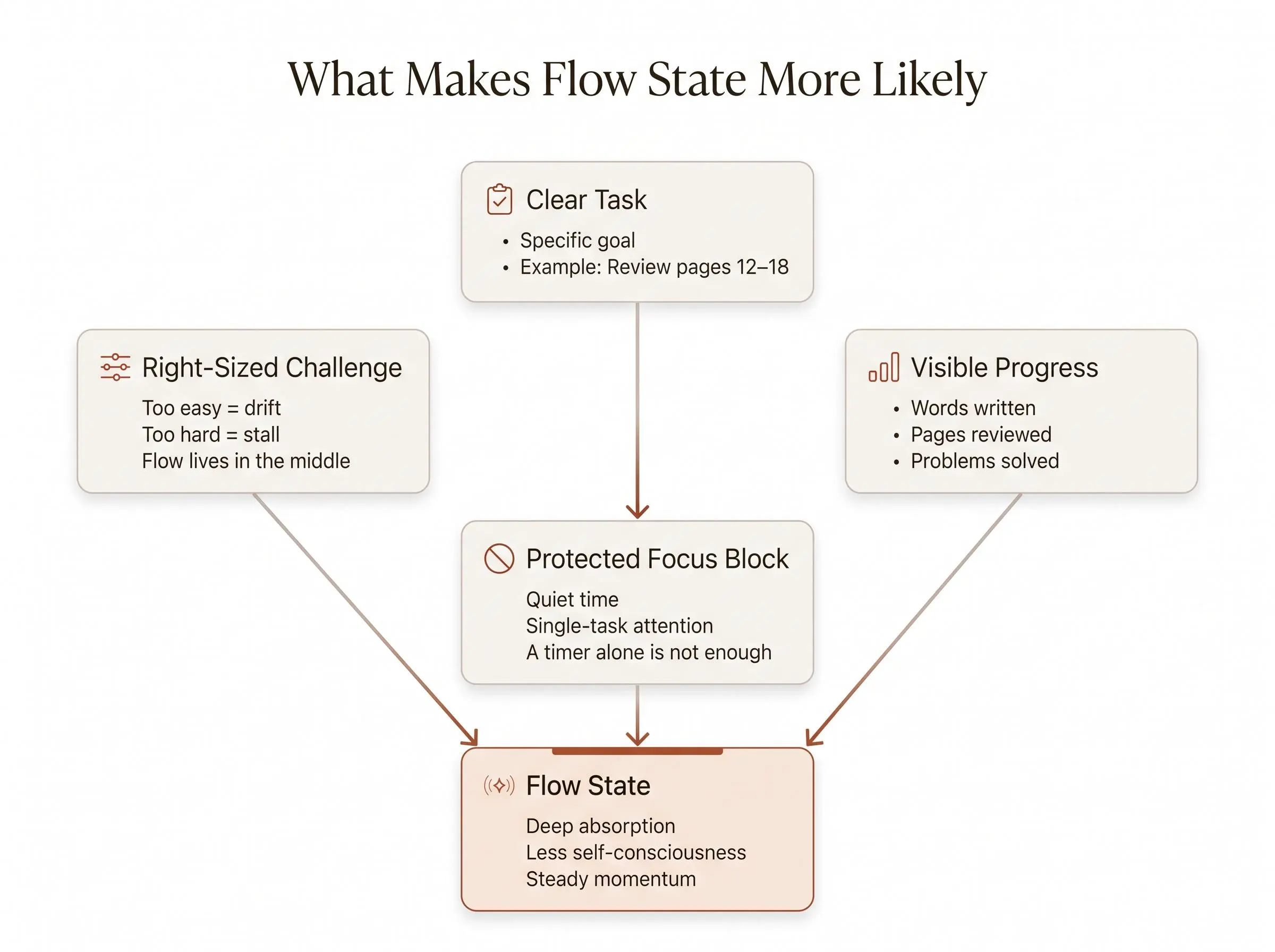
You can't force flow, but you can make it much more likely. The setup is usually less glamorous than people want. That's why it works.
A practical checklist
Clear goal
Pick a specific outcome for the next block. Not "work on project." Try "draft the intro," "solve problems 1 to 3," "review one client deck," or "clean one dataset."Right-sized challenge
The task should ask something real of you without creating dread. If it's too large, shrink it until it still matters but has edges.Immediate feedback
Choose work where progress is visible. Words written. pages reviewed. bugs fixed. slides revised. completed blocks. The brain likes evidence.Single-task attention
Tab switching, notifications, and competing priorities work directly against immersion. Multitasking is usually just fast context loss with good branding.Sense of control
Protect time where you can decide the next move without constant interruption.Meaning or intrinsic pull
Flow is easier when the task matters, supports a real goal, or feels satisfying on its own.Recovery and energy
Low sleep, hunger, and accumulated fatigue can flatten even a well-designed session.Repetition
A repeatable pre-work ritual beats waiting to feel ready. Readiness is overrated.
What this looks like in practice
Say you need to write a project introduction. Instead of opening your laptop with the vague instruction to "work on the project," make the setup concrete:
- Put your phone out of reach and close unrelated tabs.
- Write the target on a note: draft the introduction and leave three unresolved questions marked for later.
- Keep the source material and the document open side by side so the next step is visible.
- Set one short focus block and begin with the easiest paragraph rather than waiting for the perfect opening.
- Mark visible progress as you go: paragraph drafted, source checked, question flagged.
- When the block ends, write the next physical action before taking a break: compare the second source with the claim in paragraph three.
This setup does not guarantee flow. It simply removes avoidable decisions, gives the task clear edges, and makes progress easy to notice. If the work feels too easy, add a slightly harder target. If you keep stalling, shrink the target or clarify the next action.
By the second or third day of using the same setup, most people notice something small but important: less internal negotiation. That's often the real beginning.
What Disrupts Flow in Modern Work
Most people don't have a focus problem in the abstract. They have a work design problem.
A few blockers show up constantly:
The usual suspects
Too many priorities at once
If everything is important, your brain keeps re-deciding what matters. That's expensive.Tasks that are too vague
"Study," "admin," and "project work" are not workable instructions. Vagueness creates drift.Constant stimulation
Pings, open inboxes, chat, phones, background stress. Your attention stays half-alert even when you're sitting still.Context switching
Meetings, requests, and bouncing between task types break the build-up flow depends on.Perfectionism
If you're evaluating quality too early, action and awareness never quite merge.Mismatch between skill and challenge
Boredom and overwhelm are both anti-flow. They just fail differently.Overreliance on tools without a method
A nice timer or aesthetic dashboard can feel productive while hiding the obvious question: what exactly got moved forward?Chasing the feeling itself
Flow usually arrives as a byproduct. Hunt the feeling directly and you tend to scare it off.
A Simple Routine to Invite More Flow Into Your Day
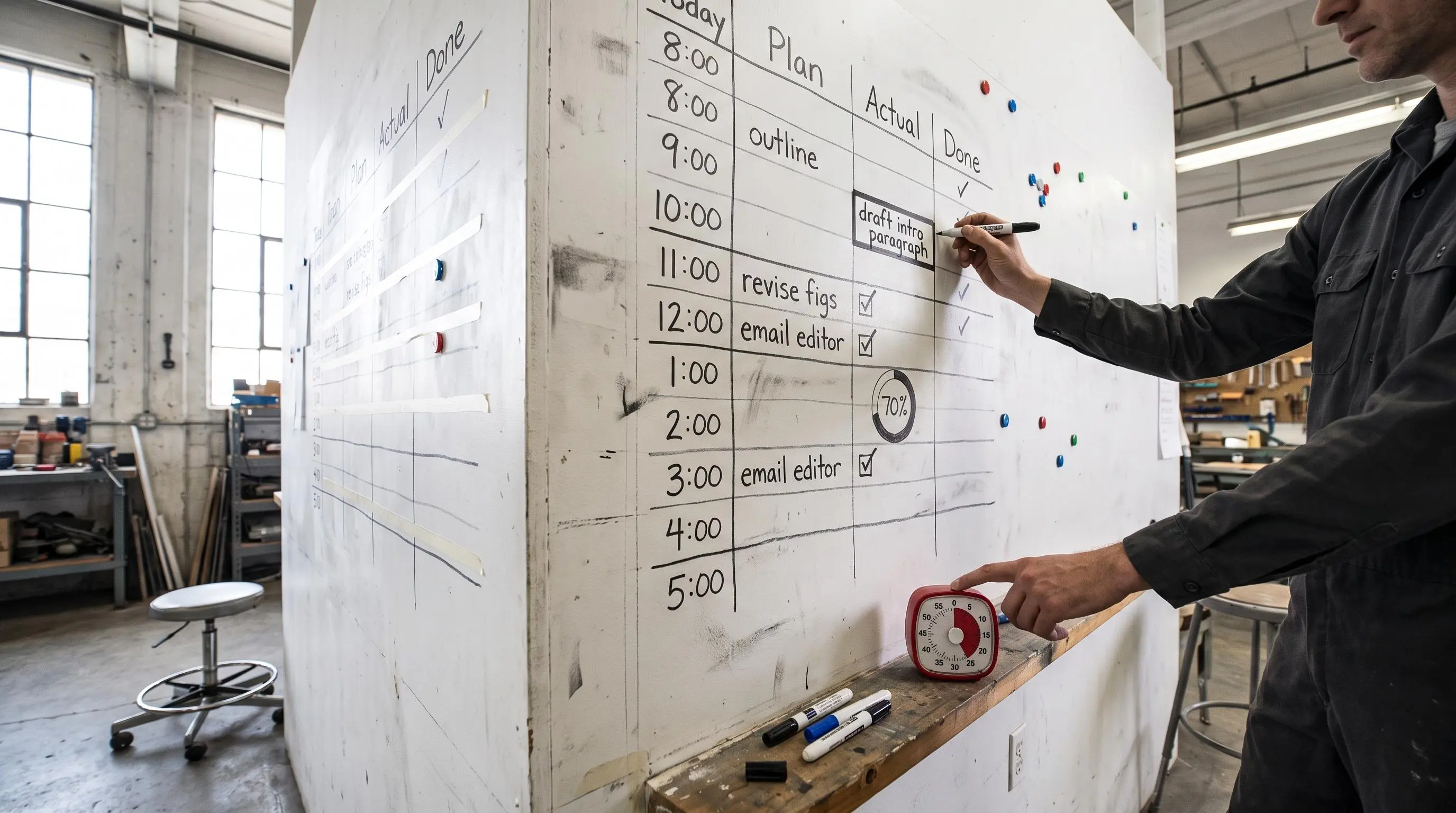
You don't need a heavyweight system for this. You need a repeatable one. Ours is boring in the best way.
Choose one most-important task
A single clear priority cuts down internal debate. The brain enters faster when the door is obvious.Shrink it into one visible target
Turn "work on essay" into "draft the first 300 words" or "outline the argument." Make the next win easy to recognize.Estimate the number of focus blocks
This keeps planning honest. It also reveals when your day is pretending to be larger than it is.Work in short, deliberate intervals
Twenty-five minutes is often enough to get past resistance without making the block feel heavy. Some people go longer once momentum builds. Fine. Start smaller than your ego wants.Take a real break, then return
Rhythm beats marathon effort for most people, especially on normal Tuesdays.Review what happened
Compare expected time with actual time. Notice what supported focus and what interrupted it.
This is one reason a planner-plus-timer setup works better than a timer alone. In Flocus, the focus block starts from a planned task, so timing is attached to intent instead of floating around by itself. Estimate-versus-actual tracking helps you learn from real days, not fantasy days. And visible completion cues like a daily progress ring, streaks, or weekly reflections give immediate feedback, which flow depends on more than people think.
Can You Measure Flow, or Only Feel It?
Most people identify flow through subjective signs first. That's normal. But attention doesn't have to stay completely invisible.
Without any hardware, useful proxies include:
- how often you complete planned focus blocks
- how often estimated time matches actual time
- how often you sustain attention without switching
- whether certain times of day reliably produce better sessions
None of that proves flow with scientific certainty. It does make your attention easier to study. That's already valuable.
For the smaller group who are neurotech-curious, there is a deeper option. Flocus offers optional Flow Tracking for Muse headband users. After a short personal calibration, it can show live session feedback like a flow score and states such as Flow, Overload, and Low Engagement.
The important part is the posture around it. This is not a status symbol. It is not required. The planner and focus method still work in any browser without hardware.
Measurement is useful when it teaches you patterns. Peak windows. Fatigue. Which tasks pull you in. Which ones quietly scatter you. That's the point.
Common Myths That Make Flow Harder Than It Needs to Be
A lot of bad advice about focus survives because it sounds serious. Let's clear a few things out.
Myth: flow is only for elite athletes, artists, or naturally disciplined people
Reality: ordinary students and knowledge workers can experience it during well-shaped work.Myth: flow means feeling amazing every time
Reality: it often feels steady and absorbed, not euphoric.Myth: more time automatically means more flow
Reality: a shorter protected block on the right task often works better than a long vague session.Myth: if you need structure, you aren't naturally focused
Reality: structure is often what makes focus possible in the first place.Myth: a timer alone creates flow
Reality: timing helps, but clarity, challenge balance, and feedback matter just as much.Myth: distraction means failure
Reality: brief breaks in attention are normal. The question is whether you can return.Myth: measuring focus ruins it
Reality: for many people, light reflection or optional feedback makes attention more learnable, not less.
The common thread here is simple. People make flow harder by treating it like a gift instead of a condition.
Conclusion
Flow is not a mysterious talent handed to a lucky few. It's a learnable state that becomes more likely when you reduce noise, choose one meaningful target, and give your attention a clear path.
The practical model is not complicated: one priority, a right-sized challenge, visible feedback, short focus intervals, and an honest review afterward. That's enough to change the texture of a day.
If you want a useful next step, test it for one day. Pick one most-important task. Protect one focused block. Then notice something quieter than perfection: did your attention feel easier to trust?
Article Record
ReferencesPrimary sources used for this article
Update HistoryMeaningful revisions to this article
- Added a practical example to show how the conditions for flow can be applied in everyday life.
- Made the guidance easier to understand and use for improving focus.