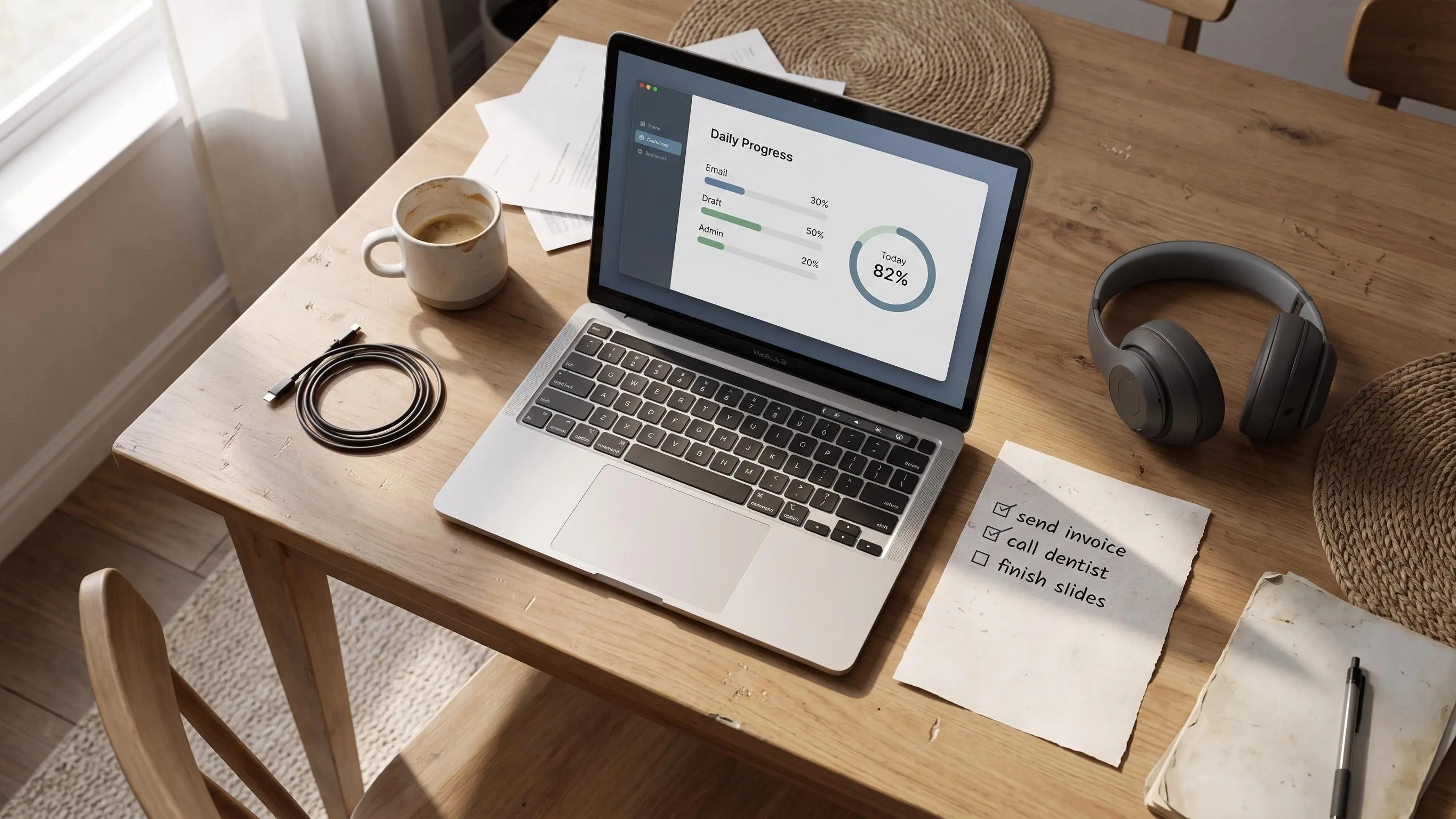

Most focus reviews go bad fast. You open a session review template, stare at half-finished blocks, and end up judging your mood instead of your work. That's usually the miss: you remember the stressful session, not the pattern.
What matters is simpler. You need a way to compare what you planned, what happened, and where your estimates fell apart. Start here:
- Which task kept spilling into another block
- What time of day gave you the cleanest start
- Which interruptions were real, and which were bad setup
You leave with a cleaner plan.
Why Most Focus Reviews Feel Vague, Guilty, or Useless
Most people don't review their work. They replay it. That's a different thing.
A replay remembers the dramatic bits. The session where you got stuck for 40 minutes. The afternoon that felt strangely smooth. The day that disappeared into messages and tabs. What it misses are the repeated patterns that actually shape your focus week after week.
Plain timers don't help much here. They count minutes, which is fine as far as it goes, but minutes detached from a task, an estimate, or an outcome tend to blur together. You can log three hours and still end the day asking where it went.
The usual trap is judging a session by how productive it felt. That's unreliable. Some sessions feel heavy because the task is hard, yet they move the real work forward. Others feel satisfying because you're busy, but they never touched the important thing. Felt productive is not the same as was well planned.
A useful session review template should lower the emotional volume, not turn it up. We want less courtroom, more field notes.
There are really two kinds of review:
- Outcome review asks: did the task get done?
- Decision review asks: was the priority clear, was the estimate sensible, was the block length right, did the timing and environment make any sense?
That second one matters more than people think. Outcomes are noisy. Decisions repeat. If your deep work keeps landing after lunch when your brain has already wandered off, that's not a character flaw. That's a scheduling problem wearing a moral costume.
We're after a calmer shift here:
Move from self-criticism to curiosity. Focus improves faster when you notice better, not when you scold harder.
What a Session Review Template Should Actually Help You See
A session review template is just a repeatable way to look back at one focus session, or one week of them, so you can spot patterns and make the next plan better. Nothing grand. It should be useful enough to keep and short enough to survive a tired Friday afternoon.
Its job is fairly plain:
- capture what you intended to do
- compare that with what happened
- identify a few patterns that matter
- turn those patterns into next-week adjustments
That's it. Not a diary. Not an annual performance evaluation in miniature.
The best templates stay narrow. Too much detail and you won't use them. Too little and you learn nothing beyond "worked some, got distracted some," which is not exactly a breakthrough. In practice, a handful of signals usually tells the truth:
- your most-important task
- estimated versus actual time
- completed focus blocks
- interruptions and friction points
- energy or attention quality
- what seemed to support deep work
A non-obvious point here: reviewing two or three representative sessions deeply is often more useful than skimming twenty. A close look at one strong session, one rough one, and one average one can tell you more than a pile of totals. That's often enough to analyze deep work history without building a private analytics department in your browser.
This is where structure helps. In Flocus, sessions are tied to planned tasks and tracked against estimates, so your review has actual evidence underneath it. Memory is a decent storyteller. It is not a great accountant.
The Simple Anatomy of a Useful Weekly Focus Session Review
A good weekly focus session review should feel like a working document. You should be able to glance at it next Monday and know what to do differently.
Here are the parts worth keeping.
TLDR
Start with a one-line summary of the week. One or two sentences. Quick, slightly blunt, and useful.
Example: planned well, but kept overestimating post-lunch energy.
That line does more work than a page of vague reflection.
Aims and context
Write down what the week was meant to move forward. Maybe you were trying to protect thesis writing, finish analysis before meetings piled up, or test whether shorter blocks help you start.
Then add the context that shaped the week:
- deadlines
- meetings
- travel
- sleep disruption
- exam load
- family noise
- any other practical constraint
Context matters because dips in focus are often explained by conditions, not by motivation. We see people invent personality stories when a calendar explanation would do.
Session or week data
This part is the evidence table, not the drama section. Keep it simple:
- number of focus blocks
- tasks worked on
- estimate versus actual time
- ring completion or another visible progress marker
- optional flow-quality notes if you track them
Results, discussion, and issues
Now note what was completed, advanced, stalled, or deferred. After that, discuss what stands out. Which sessions were easier than expected? Where did the plan break? Did the task expand? Did setup eat half the block?
Then call out recurring issues. These often include:
- unrealistic task sizing
- bad timing choices
- avoidable interruptions
- tool friction
- starting with unclear next steps
Next-step decisions
End with decisions, not sentiments:
- what to keep
- what to change
- what to test next week
That last part turns a weekly focus session review into a planning tool instead of a thoughtful little artifact you never use again.
The Session Review Template You Can Use Every Week
You don't need a complicated format. You need one you'll actually fill out. Here's the template.
Weekly session review template
- Week or session name: simple label you can revisit later
- Primary focus: what mattered most, and whether there was one clear priority
- Planned work: main tasks and estimated blocks or planned time
- Actual work: blocks completed, actual time spent, finished vs partly advanced
- Best session: what made it work, including time of day, environment, task type, energy, preparation
- Hardest session: what interrupted focus, and whether the issue was internal, external, or planning-related
- Pattern check: where estimates were accurate, where tasks expanded, and which kinds of work fit your blocks better
- Attention quality: did focus improve, drift, recover, or stay noisy through the block
- Small leaks: context switching, too many tabs, vague next steps, starting cold
- Key lessons: one to three observations that explain what actually happened
- Next-week adjustments: one planning change, one environment change, one execution change
A small note from experience: don't write this like you're evaluating your worth. Write it like you're tuning a system. Calm beats dramatic. Dramatic rarely helps on Tuesday.
How to Review Your Focus Sessions Each Week Without Overthinking It
The easiest way to make review painful is to turn it into a philosophical exercise. Don't. Use a sequence and let the data go first.
Gather the raw evidence before memory edits the story.
Pull up your logged sessions, planned tasks, completed blocks, and estimate versus actual time. Data first, interpretation second.Start with the main priority.
Was the most important work clearly named and protected? If not, log that as a planning problem. Not a discipline failure.Choose two or three sessions to review properly.
Pick one that went well, one that felt difficult, and one that seems average. Average sessions are sneaky. They often reveal the real pattern.Compare intention versus reality.
What task did you choose? How long did you think it would take? How long did it actually take? Did the session end with meaningful progress?Find the repeated decision points.
Look for things like: - starting too late - underestimating setup time - choosing tasks too large for one block - planning around ideal energy instead of real energySeparate signal from mood.
A frustrating session can still be well planned. A satisfying session can hide bad estimation and unsustainable effort. Mood is data, but it's not the boss.Write a short summary.
Keep it brief: what worked, what didn't, what changes next.
This is where having planning and execution in one place matters. In the Flocus Daily Planner, planned tasks, time estimates, and completed focus blocks live together, which makes the review less annoying. That's not glamorous. It is very practical.
How to Analyze Deep Work History and Learn From Weekly Work Data
To analyze deep work history, you don't need advanced charts. You need repeated observation.
You're looking for patterns across sessions, not one dramatic anecdote. Most useful insights come from the smaller misses that keep repeating. The late start that keeps shrinking the first block. The writing task that always needs setup before real work begins. The admin drift that quietly pushes the important task into worse hours.
A simple framework helps.
Read the patterns by category
- Timing patterns: which days support deeper work, which hours give you clean starts, what late starts do to the rest of the day
- Task patterns: writing, studying, analysis, admin, revision, and which kinds reliably resist a single block
- Estimate patterns: chronic underestimation, overpadding, or fairly accurate forecasting
- Distraction patterns: meetings, phone checks, open tabs, emotional resistance, unclear task definitions
- Completion patterns: whether one block creates momentum or whether work keeps fragmenting
A few examples make this concrete:
- if focus consistently drifts after lunch, move deep work earlier
- if tasks spill over by one extra block every time, break them into smaller planned units
- if routine work is estimated well but creative work isn't, add buffer blocks for thinking-heavy tasks
The trick is to learn from weekly work data without getting obsessive. Look for direction, not perfection. One messy week is not a personality diagnosis. It might just be a messy week.
Flocus session history and weekly recaps support this kind of reading because they connect planned work, actual work, and visible progress. That's the whole point of a review. You want the pattern, not just the pile of minutes.
Turning the Review Into a Focus Planning Feedback Loop
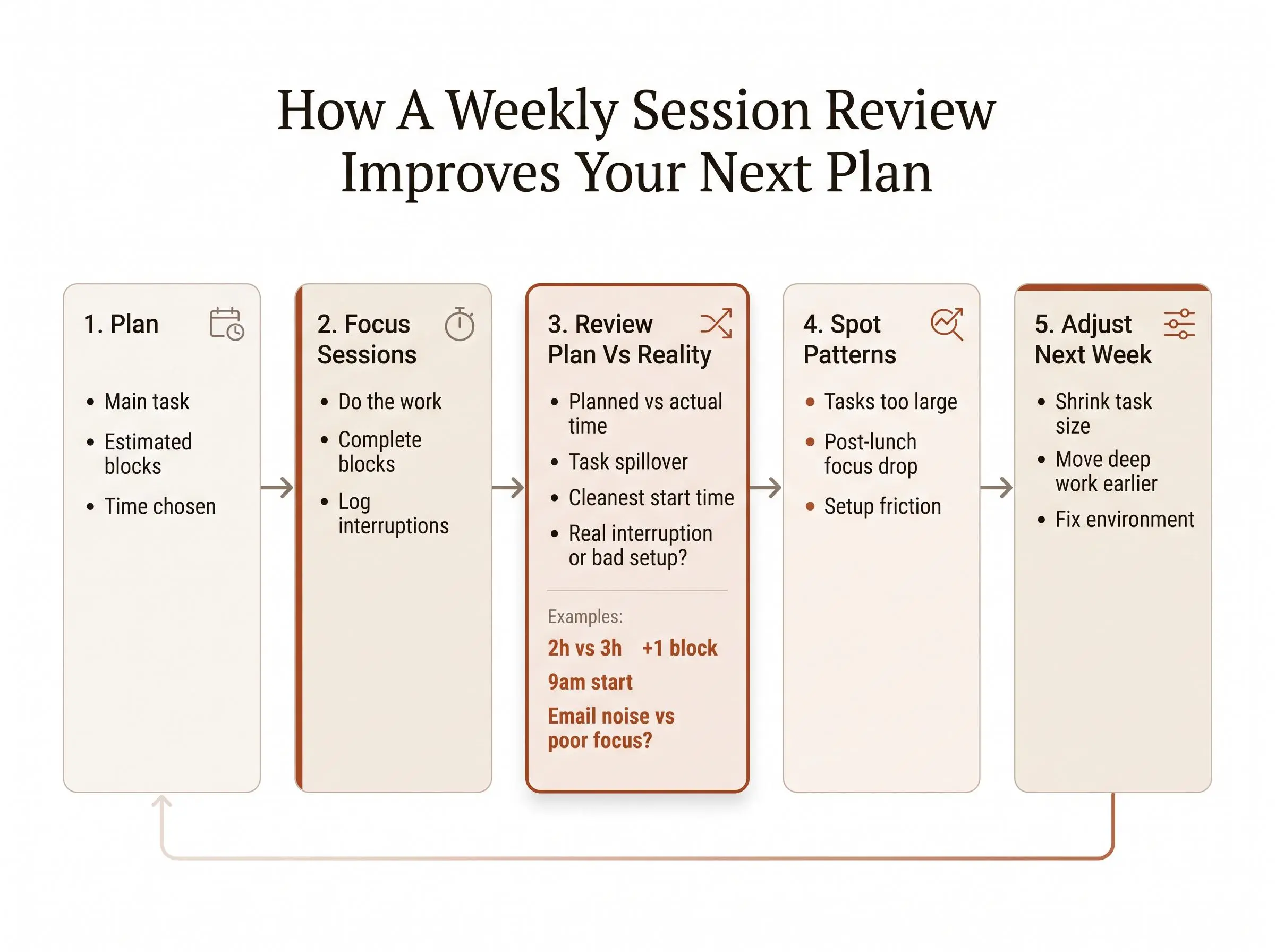
Review only matters if it changes the next plan. Otherwise it's tidy procrastination.
The focus planning feedback loop is simple: plan, focus, review, adjust, repeat. A timer can help with one part of that. It can't carry the whole loop on its own.
Each lesson from your review should map to a concrete planning change:
- unclear priorities become one explicit most-important task next week
- oversized tasks become smaller planned units
- inaccurate estimates become revised block counts
- distraction-heavy environments become protected work windows or cleaner setups
A useful translation system looks like this:
- Lesson observed
- Decision changed
- Experiment for next week
For example:
Lesson: messages break the first block almost every day
Decision: deep work happens before reactive communication
Experiment: no inbox until one completed focus blockLesson: the daily list keeps growing past what fits
Decision: reduce list length
Experiment: one most-important task, plus a deliberately short supporting listLesson: writing sessions start slowly
Decision: add setup before the timer
Experiment: five-minute ritual to define the next milestone and close stray tabs
This is how a weekly focus session review becomes a feedback loop instead of a record-keeping ritual. The missing layer in most focus tools isn't another countdown. It's planning, estimation, and structured reflection.
What to Measure and What to Ignore
A review gets worse when it starts pretending to be a spreadsheet hobby.
Keep your eye on a short list of high-value signals:
- whether the most-important task was completed or meaningfully advanced
- estimate versus actual time
- number of focused blocks
- consistency across the week
- recurring blockers
- conditions that supported your best work
These are enough to learn from weekly work data in a way that changes behavior.
Useful but secondary signals include:
- streaks
- total hours
- normal day-to-day variation
And some things are better ignored or at least downplayed:
- comparing yourself to idealized productivity routines
- overreacting to one low-focus day
- treating busyness as proof of effectiveness
- reviewing output while ignoring planning quality
Reliable self-knowledge is the goal. Not perfect productivity. Those are not the same thing, and pretending otherwise usually ends in weird guilt.
Optional Depth: Adding Focus Quality, Not Just Time
Time on task and focus quality are not always the same. You already know this if you've ever sat at your desk for an hour and achieved mostly tab management.
For some people, it helps to track not just how long a session lasted, but how engaged or overloaded they were during it. This is optional. The review process should work perfectly well without extra hardware.
If you have a compatible Muse headband, Flocus Flow Tracking can add real-time focus measurement during sessions. That can help distinguish between a long session that was calm and engaged and a long session that was mentally noisy the whole way through.
That changes the review in a few practical ways:
- you can compare productive-looking sessions with actual focus quality
- you can spot fatigue patterns earlier
- you can identify windows where deep work is easier to sustain
Still, no gadget worship. Measured focus only matters if it leads to better planning and kinder interpretation. Otherwise it's just another graph to feel strange about.
Common Mistakes That Make a Session Review Template Backfire
Most review problems are self-inflicted. Not because people are careless, but because they add too much weight to something that should stay light.
Common mistakes include:
- making the review too long to repeat each week
- reviewing every session equally instead of choosing representative ones
- focusing only on big misses while ignoring frequent small leaks
- judging yourself by outcomes alone instead of planning and execution decisions
- writing vague conclusions like "need more discipline"
- treating interruptions as moral failure rather than usable data
- looking at total hours without checking whether they were tied to meaningful priorities
- failing to turn lessons into next-week changes
- tracking so many metrics that the process stops being calm or practical
A blunt rule helps here: if your review produces shame faster than decisions, the template needs work.
A Realistic Weekly Review Rhythm for Busy Students and Knowledge Workers
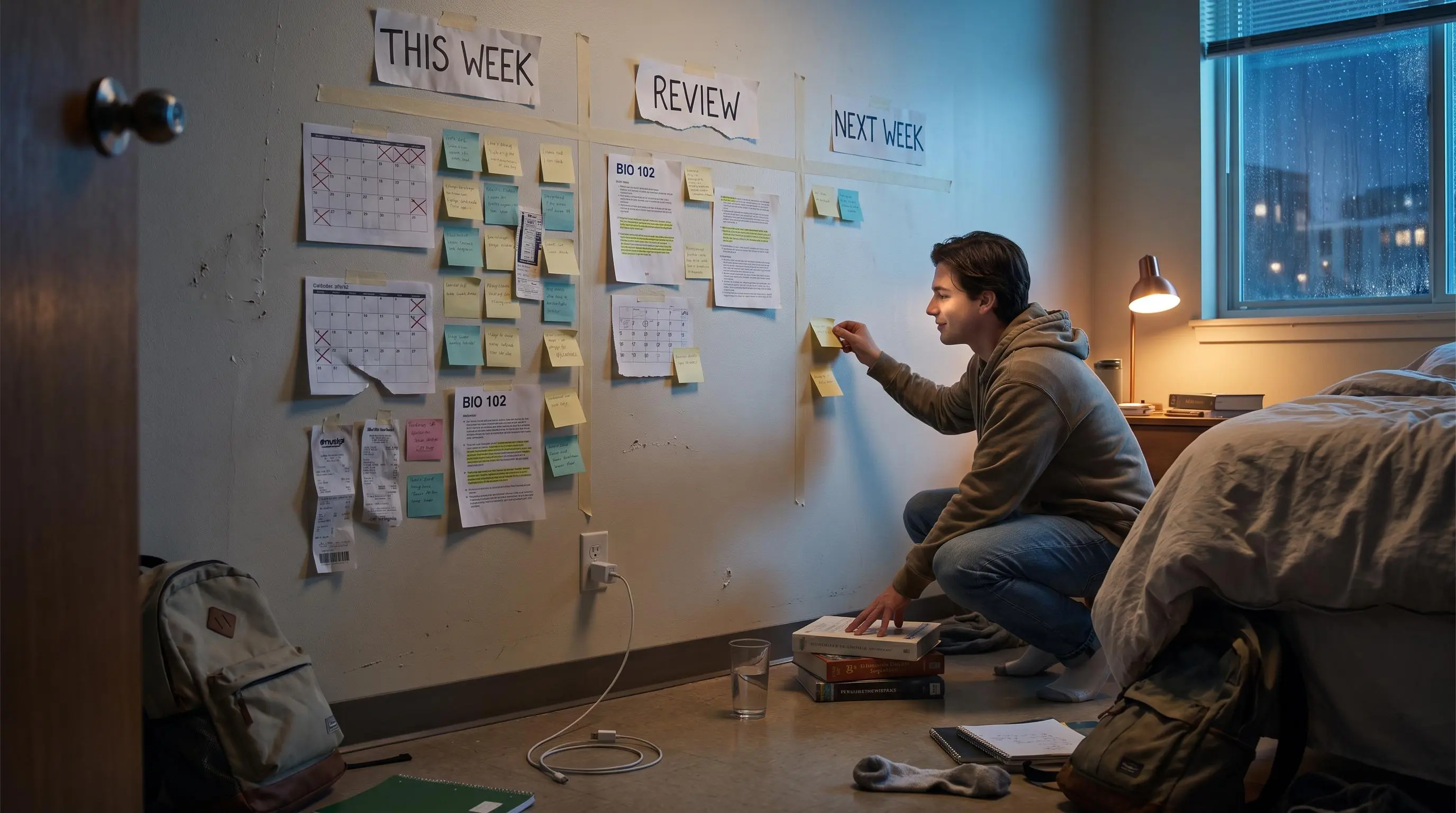
The review rhythm should fit inside a real week, not an imagined one.
For most people, a brief end-of-day note plus one deeper weekly review is enough. The daily note captures context while it's fresh. The weekly review finds the pattern.
A sustainable rhythm looks like this:
- open session history
- scan the week
- choose two or three sessions
- complete the template
- adjust next week's plan immediately
Usually this takes somewhere between ten and twenty minutes. Short enough to maintain. Long enough to notice something real.
If you're thinking, "I don't have enough data yet," start anyway. A small amount of consistent data beats a perfect system you never begin.
If your work changes week to week, that's fine too. You're not looking for robotic sameness. You're looking for repeated conditions, decisions, and timing effects.
If reviewing feels like more work, that's often because the process is too elaborate. Strip it down. This is for people who want a calmer system, not a heavier one. The aim is to build trust in a repeatable method, not to optimize every minute until the whole thing becomes unbearable.
Session Review Template FAQ
What is a session review template?
A session review template is a repeatable way to look back at one focus session or a week of sessions. It helps you compare what you intended to do with what happened, identify useful patterns, and improve the next plan.
What should a session review template include?
Keep the template focused on signals such as:
- the primary focus and planned work
- estimated versus actual time
- completed focus blocks and meaningful progress
- interruptions and friction points
- attention quality and conditions that supported deep work
- lessons and next-week adjustments
How often should you review your focus sessions?
A brief end-of-day note can capture context while it is fresh, followed by one deeper weekly review to identify patterns. A sustainable weekly rhythm is to scan your session history, choose representative sessions, complete the template, and adjust the next week's plan.
How many sessions should you review each week?
Choose two or three representative sessions to review properly: one that went well, one that felt difficult, and one that seemed average. Reviewing a few sessions deeply can reveal more than skimming every session equally.
How do you turn a session review into a better plan?
Translate each lesson into a decision and a small experiment for the following week. For example, unclear priorities can become one explicit most-important task, oversized tasks can become smaller planned units, and inaccurate estimates can become revised block counts.
Conclusion
A good session review template helps you see three things clearly: what you planned, what actually happened, and what to change next. Done well, it interrupts the usual spiral of vague guilt and replaces it with something more useful.
Consistent focus doesn't come from forcing harder. It grows from a simple loop: choose what matters, review a few meaningful signals, and carry those lessons into the next week. Not fancy. Effective.
Run one weekly focus session review with the template above. Keep the insights short. Then let your next plan reflect what your sessions actually taught you.
Article Record
ReferencesPrimary sources used for this article
Update HistoryMeaningful revisions to this article
- Added five frequently asked questions to help readers use the session review template with greater confidence.