

End of day reflection questions matter most when your day looked busy and still somehow slipped through your hands. You checked things off, answered messages, sat through meetings, and by evening you still can't say what actually moved.
What helps is not a long journal entry. You need a few blunt questions that show where your focus held, where it leaked, and what deserves a cleaner plan tomorrow.
That gives you a day you can learn from.
1. What were the three most important things that happened today?
Start here because most days feel fuller than they were and blurrier than they should. If you only ask whether you finished your tasks, you miss the actual shape of the day.
This question helps you separate signal from noise. Not everything that happened deserves equal weight. Usually three things carried the day, for better or worse.
Those three things might be:
- a task you finished that unblocked other work
- a hard conversation that changed priorities
- a stretch of deep focus that moved something important
- a distraction pattern that quietly ate the afternoon
That last one counts. Sometimes the most important thing that happened is that your attention got hijacked in a very predictable way.
We like this question first because it starts with observation before analysis. That's useful if you tend to judge yourself too quickly. You're not deciding whether you were good or bad. You're just naming what actually mattered.
Look back over a week and it gets even more useful. You start seeing repeats. The same meeting keeps derailing your morning. The same kind of work gives you momentum. The same “small” interruption keeps costing an hour.
Busy is not a category worth protecting.
2. What went well today, and why?
This is one of the best daily review prompts because it doesn't stop at “good.” It asks for cause. That's where the value is.
A lot of people can answer what went well today in a sentence. Fewer can explain why it went well. That second part is the whole game.
You might notice that a good stretch of work happened because:
- you picked one clear priority early
- you started before checking messages
- the task was defined enough to begin without negotiating with yourself
- your environment was quieter than usual
- you had enough energy for the kind of thinking the task required
That's operational. You can use it again.
This is also a quiet correction to the habit of only replaying what failed. If you only study bad days, you end up with a distorted picture of your own focus. Good work leaves clues too.
We've seen this over and over. People think their focus is random until they write down the conditions around their better sessions. Then it stops looking random.
Gratitude is fine. Causes are better.
3. What didn't go as planned, and what can I learn from it?
You need at least one question that can hold a messy day without turning into self-accusation. This is that question.
The wording matters. “What didn't go as planned” is more useful than “what did I do wrong.” One gives you feedback. The other gives you theater.
Maybe you missed a planned work block. Maybe your task list was too vague. Maybe reactive work took over by 2 p.m. Maybe you hit an energy crash and started circling easy tasks because the real work felt too expensive.
Write down what happened. Then force the second move: what can you learn from it?
A few examples:
- “I scheduled hard writing after three meetings. Next time that goes in the morning.”
- “I kept switching tasks because I hadn't decided what done looked like.”
- “I said yes too fast and paid for it later.”
- “I planned four important things. That was fantasy.”
Without the learning step, reflection slips into rumination. That's not a review. That's just sitting in the wreckage.
If you want to reflect on workday patterns honestly, this question does the heavy lifting.
4. What am I grateful for today?
This question softens the review without making it vague. That's important. If every evening becomes a performance audit, you'll eventually avoid it.
Gratitude adds perspective. Not as a productivity trick. Just as a way to end the day like a person instead of a scoreboard.
Keep it concrete. It works better that way.
- a helpful message
- a clean hour of concentration
- lunch away from the screen
- someone who made a problem smaller
- the fact that one hard thing is now done
Notice that these don't need to be impressive. On low-output days especially, this question stops the whole review from collapsing into “nothing happened.”
It's also different from what went well. Something can be worth appreciating even if it didn't improve your output. A calmer commute. A kind colleague. The meeting that ended on time for once. Miracles do occur.
If you want a simple shutdown ritual that doesn't feel like management looking over your shoulder, keep this one.
5. What is one thing I want to focus on tomorrow?
This is where reflection starts earning its keep. If today's review doesn't make tomorrow easier to start, it's incomplete.
Choose one thing. Not seven. Not “be more productive.” One actual piece of work that deserves first protection.
The answer should be narrow enough to act on. “Draft section two of the report” works. “Catch up” does not. Catch up is not a task. It's a mood.
One clear focus does two things:
- It lowers next-day decision fatigue.
- It gives your attention somewhere to land before the day starts making demands.
This is a big part of our own approach. Most people don't need a heavier system. They need one most-important task and a realistic plan for touching it before the day gets noisy.
If you use the Flocus Daily Planner, this is the moment to choose that priority and estimate it in focus blocks. Not because estimating is glamorous. It isn't. But estimate-versus-actual time is one of the fastest ways to stop lying to yourself about capacity.
6. How did I make a positive impact on those around me?
A good day is not only about what you finished. For students and knowledge workers, a lot of valuable work doesn't look dramatic on a checklist.
You clarified something for a teammate. You prevented confusion. You followed through when someone needed a decision. You answered carefully instead of quickly. That counts.
This question shifts the lens outward. It also reduces the self-absorbed feel that some productivity habits pick up after a while.
Positive impact often shows up in small forms:
- making a next step clear
- reducing friction for someone else
- noticing and fixing a problem before it spread
- giving someone your full attention instead of partial attention and a fast reply
Focus helps here too. When your attention is scattered, your communication usually gets worse before you notice. Messages get sloppier. Decisions get delayed. You create extra work for other people.
That's rarely on the to-do list, but it's part of the day.
7. Is there anything unfinished or that needs to be written down for tomorrow?

This is the most practical question in the set. If you skip it, work tends to follow you into the evening in fragments.
Ask yourself:
- what's still unresolved?
- what needs a next step?
- what needs to be parked, scheduled, or captured before I stop?
That might be a half-finished paragraph, a message you need to send, a task that needs a clearer label, or a decision you're not making today. Fine. Write it down anyway.
A lot of mental fatigue is really uncaptured work.
Simply reviewing a to-do list doesn't always solve this because lists often hide ambiguity. This question is more relieving because it asks you to transfer what still has mental charge. That's different.
If you're still thinking about work two hours after closing the laptop, this is usually the missing step.
8. What reinforcing choice did you make today?
This one is easy to overlook, which is exactly why it helps. It asks you to notice behavior that matched the kind of worker or student you want to become.
Not outcomes. Choices.
Maybe you came back to the task after drifting. Maybe you protected a planned focus block. Maybe you paused before reacting to a stressful message. Maybe you stopped adding fake urgency to everything.
Those are reinforcing choices. They build trust.
This question matters because progress gets fragile when it's tied only to results. Some days the work is messy, slow, or dependent on other people. You still need evidence that you showed up in a way you respect.
A few examples:
- returning to the document instead of opening another tab
- starting the hard task before polishing easy ones
- taking a real break before your brain turned to soup
- admitting the plan was too ambitious and trimming it
Better focus is often boring in the best possible way. It's a series of small choices repeated long enough to become normal.
9. Who did you serve today?
This question adds meaning without getting sentimental about it. Useful work usually reaches someone, even when your day feels fragmented.
The emphasis here is different from positive impact. There, the focus is your action. Here, it's the recipient.
Who benefited from your effort today?
- a client
- a classmate
- your team
- your future self
- someone who needed a clear answer
- the person who doesn't have to clean up confusion tomorrow because you were careful today
That distinction matters. When you name who your work served, your day stops feeling like a pile of disconnected tasks. You remember why the work existed.
This is especially helpful on abstract workdays. Research, planning, writing, analysis. Those can feel slippery by evening. Naming the person on the other end brings the day back into focus.
Efficiency without purpose gets thin pretty fast.
10. How did I move closer to my long-term goals?
Some days are full of maintenance work, interruptions, and admin. Necessary, often annoying, and not always a good measure of whether your life is moving in the right direction.
This question protects you from judging progress only by busyness.
The movement might be modest:
- learning something you needed for later
- finishing one piece of a larger project
- making a useful connection
- clarifying the next milestone
- protecting time for work that compounds instead of only work that shouts
Small progress still counts. Especially repeated small progress.
Students and knowledge workers often have long arcs. Degrees, portfolios, research, writing, complex projects. If you don't connect the day to the larger arc, it's easy to feel like you're just managing incoming requests forever.
We'd say this out loud because it's true: if your days never point at anything larger, productivity starts to feel like janitorial work.
11. What was my biggest time sink?
You can't improve focus on compliments alone. At some point, you need to name the leak.
Your biggest time sink is the activity that consumed real time without creating much value. Not the thing that sounds bad in theory. The one that actually happened.
Common examples are familiar:
- scrolling when you meant to “take a quick break”
- meetings with no decision and no owner
- idle chat that kept running
- task switching every time work got uncomfortable
- fiddling with your system instead of doing the work inside it
Be specific. “I was distracted” is too soft to help. “I lost 40 minutes after lunch to my phone” gives you something to design around.
This isn't for self-punishment. It's for tomorrow's setup. Better boundary, better schedule, better environment, better task definition. Usually one of those is the fix.
Tracking hours worked won't tell you this. Time sinks explain why a long day can still feel strangely hollow.
How to Turn These Questions Into a Simple Close the Day Ritual
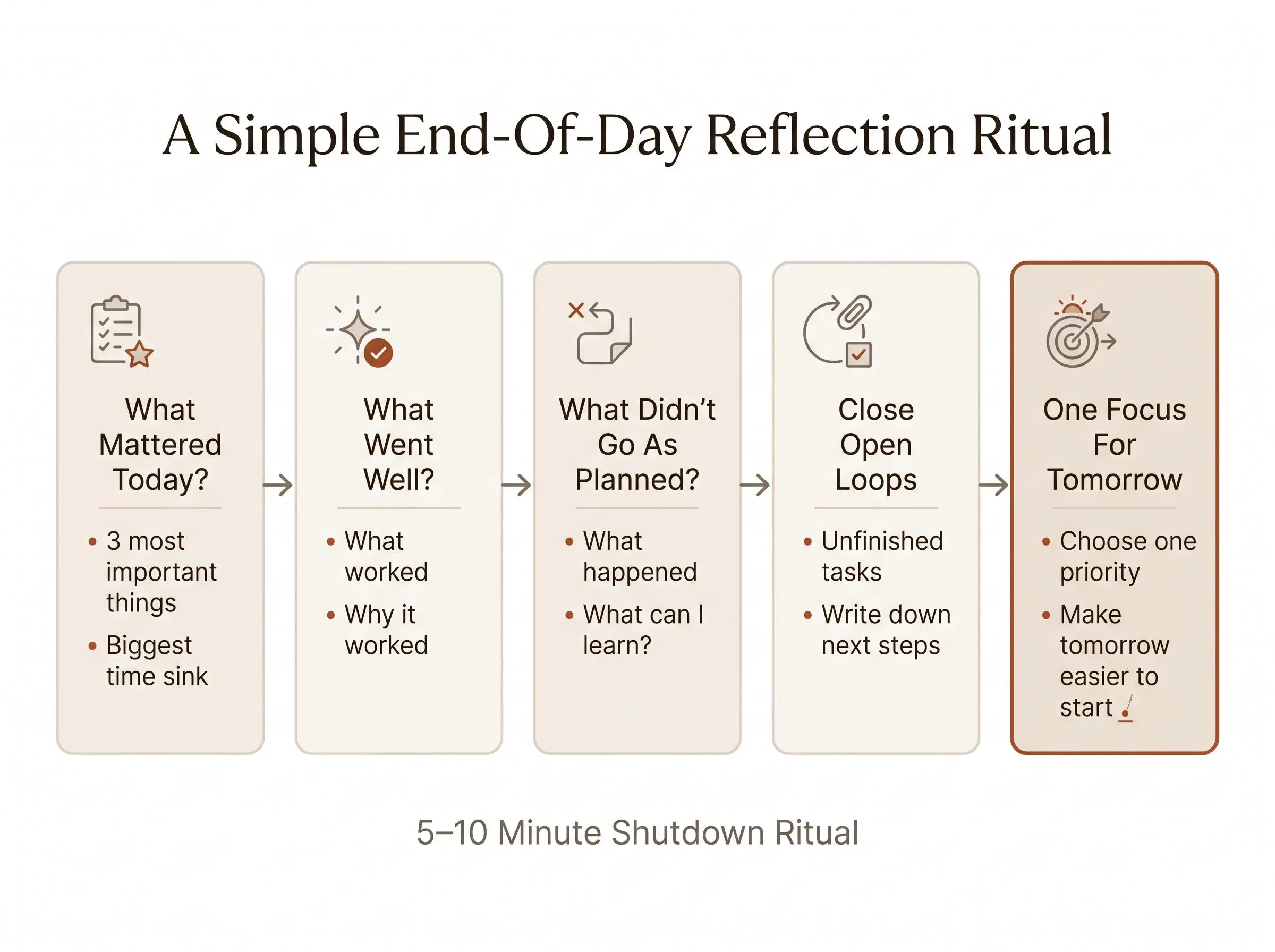
A useful ritual is brief enough to survive normal life. If it takes 30 minutes and a special mood, it won't last.
Keep it to five or ten minutes at a consistent time. Right before you close your laptop works well. Before bed also works, though it's slightly riskier if your brain likes reopening cases at 11:40 p.m.
Use a simple sequence:
- Observe what happened.
- Note what worked and what didn't.
- Add one line of gratitude or purpose.
- Set tomorrow's one focus.
Answer fast. Bullet points are fine. Better, even. This is not a memoir.
If the day felt confusing, compare what you planned with what actually happened. Mood is a poor historian. On some days you did more than it feels like. On other days the fog is justified.
If you use Flocus, this ritual gets easier because the evidence is already there: your planned task, completed focus blocks, estimate-versus-actual time, and daily Focus Ring. Reflection works better when you're looking at the day itself, not only your memory of it.
How to Make Daily Productivity Reflection Helpful Instead of Harsh
A lot of people avoid reflection because they expect it to become another way to feel behind. Fair concern. That happens when the review turns into judgment instead of feedback.
Here's the distinction:
Reflection produces one insight and one adjustment. Rumination repeats the verdict.
Keep your answers specific. “I lost 40 minutes after lunch” is useful. “I have no discipline” is lazy thinking dressed as honesty.
Treat the review as data, not identity. Focus changes with planning quality, energy, environment, and task clarity. Some days the plan was the problem. Some days the task was too fuzzy. Some days you were simply tired. That's not a moral event.
It also helps to keep the whole thing short. A few direct sentences usually do more than a long emotional debrief. The point of daily productivity reflection isn't to prove you had a perfect day. It's to make tomorrow easier to start and easier to stay with.
That's a much calmer standard. Also a more effective one.
Conclusion
The best end of day reflection questions won't turn you into a different person overnight. They do something better. They help you notice what mattered, what supported your attention, what pulled it off course, and what deserves a cleaner plan tomorrow.
Start tonight. Take five to ten minutes and answer them briefly. Then choose one clear focus for tomorrow.
If you want that review connected directly to your task plan and focus blocks, Flocus can help make it a steady practice instead of another good idea you meant to keep up with. Focus isn't a personality trait. It's a pattern you can observe, train, and close the day with a little more honesty.