

Most failed focus sessions start with a vague task and a timer ticking beside 14 open tabs. Learning how to get into flow state is less about forcing your brain to behave and more about giving it one job it can actually grab.
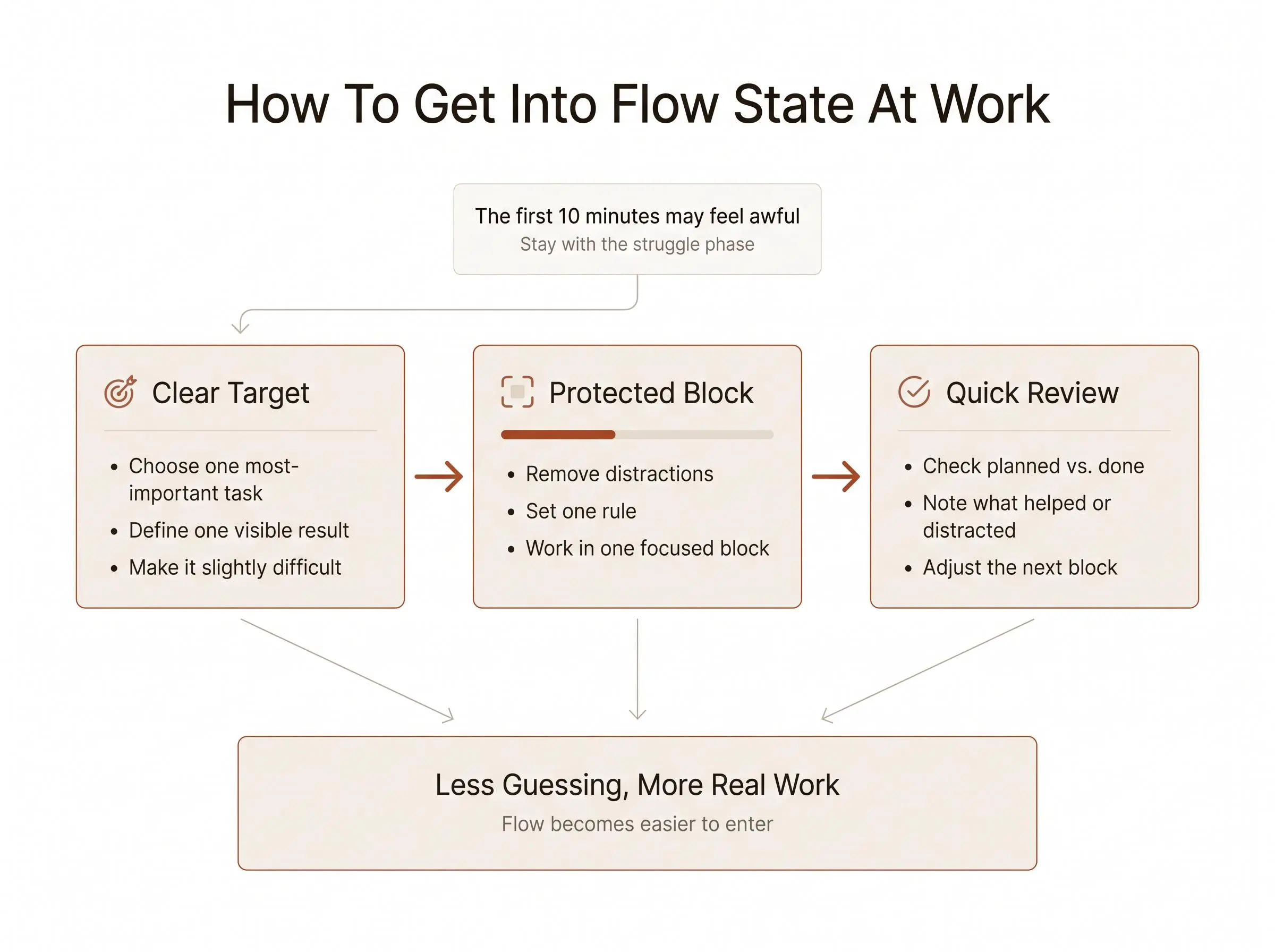
A clear target, a protected block, and a quick review beat another elaborate routine. The first 10 minutes may feel awful; that’s normal.
Start by getting these right:
- Define one visible result for the next block.
- Make the task slightly difficult, not impossible.
- Keep breaks boring enough to return quickly.
Less guessing. More real work.
Why Flow Feels So Hard to Access at Work
You sit down to do something important, and five minutes later you're checking a message, reopening yesterday's tab, and trying to remember what the task even was. That isn't a character flaw. It's what work feels like when attention has too many doors.
Most people don't struggle with focus because they're lazy or undisciplined. They struggle because they begin work with a foggy target and too many moving parts. The brain can't lock on if the job keeps changing shape.
There's also a difference between being busy and being absorbed. You can answer things all day, move items around, feel tired by 4 p.m., and still never touch deep focus. That's the nasty part. Activity gives you the feeling of effort without the payoff of real progress.
Context switching makes it worse. Every jump between tasks has a re-entry cost. You don't just lose the minute you spent checking chat. You lose the mental thread, then spend another few minutes rebuilding it, usually while feeling oddly annoyed at yourself.
So the real question isn't how to force concentration through sheer will. It's how to remove enough friction that focus starts to happen with less drama.
A simple focus plan does that better than a lonely timer or a vague to-do list. Duration helps. Direction helps more.
What Flow State Actually Is
Flow gets talked about like it's mystical. It isn't. It's a recognizable state of attention.
Flow state is complete absorption in a task. You know what you're trying to do, your mind stops commenting on every little move, and time goes strange in that familiar way where 25 minutes feels like 7 or 70. Usually, the work gets better too.
A few signs tend to show up together:
- you have a clear target for what you're doing right now
- concentration feels steady instead of sticky
- inner criticism gets quieter
- you can tell, moment to moment, whether the work is moving
- time feels compressed or blurred
- the work becomes rewarding while you're doing it, not just after
That last one matters. Flow is not the same as being motivated beforehand. Plenty of good sessions begin with reluctance.
It's also worth separating deep work from flow. Deep work is the setup. It's scheduled, protected, and intentional. Flow is the psychological state that may emerge inside that setup. You can create the conditions for deep work on your calendar. You can't order flow around like a coffee.
Still, it matters because once a session clicks, resistance drops fast. Output often improves, but the more immediate win is simpler than that. Work stops feeling like a fight.
The Conditions for Flow State You Can Create on Purpose
The conditions for flow state are useful because they're practical. You don't need a theory lesson. You need levers you can actually pull before a work block starts.
The main ones are plain:
- clear goals
- immediate feedback
- challenge that matches your current skill
- uninterrupted attention
That challenge-skill balance is where a lot of sessions go wrong. If the task is too easy, you get bored and drift. If it's too hard, your brain starts scanning for exits. Flow tends to appear in the narrow band where the work stretches you a bit without knocking you flat.
Slightly beyond comfortable is usually enough. Dramatically beyond comfortable is how you end up alphabetizing your desktop.
Researchers have named a long list of flow triggers, but most desk workers don't need twenty. They need four or five used consistently. In practice, these help most:
- fewer distractions in view
- one visible target instead of several competing tasks
- constraints that reduce switching
- a repeatable start ritual
- a work environment that asks less from your brain before you even begin
That's why how to trigger deep focus usually starts before the timer begins. By the time you're "trying to focus," a lot has already been decided, often badly.
The Part Most Focus Advice Misses: Flow Has a Cycle
Many people expect focus to turn on instantly. Then the first ten minutes feel messy, and they assume the session is dead. That's a bad read.
Flow has a cycle. In everyday terms, it tends to move through struggle, release, flow, and recovery.
Struggle is normal
The struggle phase feels like resistance, noise, second-guessing, and low-grade irritation. You reread the brief. You adjust the sentence three times. You feel tempted to check something "quickly."
None of that means you're failing. It usually means you're early.
The first 5 to 15 minutes often feel worse than the rest of the session.
Release is small, not dramatic
After some initial effort, there's often a short release point. Maybe it's one slow breath, a tiny reset, standing up for 20 seconds, or deciding to stop over-controlling the work. You're not trying to relax into a nap. You're just loosening the grip.
Then momentum takes over
Flow itself feels like the task begins carrying you. Decisions come faster. You stop monitoring yourself so much. The work has a thread, and you can follow it.
Recovery is part of the cycle
Recovery matters if you want this again tomorrow. Hard focus without real breaks tends to make the next session slower and uglier. A clean stopping point and a decent pause preserve more than people think.
The practical takeaway is simple: expect the opening minutes to be imperfect. If you stop quitting during the struggle phase, you give flow a chance to show up at all.
Why a Simple Focus Plan Works Better Than a Standalone Timer
A timer gives you duration. A plan gives you direction. Most people are missing direction.
That's why plain Pomodoro apps often disappoint. The countdown starts, but the task is fuzzy. Success isn't defined. The block doesn't connect to anything larger than "I worked for 25 minutes," which is nice, I suppose, but not enough.
A useful focus plan has three parts:
Simple flow plan
- Pick the task
choose one most-important task
- Set success criteria
define what success looks like for this block
- Review the result
review what actually happened when the block ends
That structure cuts decision fatigue before work starts. It also creates immediate feedback. You're not staring at an empty timer wondering what counts as progress.
This is the idea behind Flocus. Our Daily Planner and Focus Timer live together, so a session starts from a chosen task rather than a disconnected countdown. Estimate-versus-actual tracking also helps over time, because it exposes the little lies we all tell ourselves about how long work "should" take.
The tool isn't the magic part. The method is. But the right tool makes the method easier to repeat when your brain is not in a cooperative mood.
Step 1: Choose One Meaningful Target Before You Try to Focus
If you want to know how to get into flow state, start by shrinking the field. One chosen target beats a long "today" list almost every time.
The most-important task is not a cute prioritization trick. It's a commitment device. It tells your attention where it lives for the next block.
A good flow target should be:
- meaningful enough that it matters today
- specific enough that you can see the edge of it
- challenging enough to hold attention
- small enough that progress is possible in one or two blocks
Weak target: work on report
Strong target: draft the intro and outline three findings
Weak target: study biology
Strong target: finish flashcards for chapter 4 and test recall on key terms
If everything feels important, choose the task whose completion removes the most mental drag from the day. That's usually the one sitting in the back of your head making everything else feel slightly fake.
Flocus is built around picking one most-important task first for exactly this reason. People who get overwhelmed by long lists usually don't need more options. They need a smaller promise.
Step 2: Turn That Task Into a Flow-Friendly Work Session
Once you've picked the task, give it shape. This should take a couple of minutes, not a planning ceremony.
Decide four things before you begin:
- what exactly will be done in this block
- how long the block will last
- what "done for now" means
- what materials need to be open first
Pre-deciding scope removes a lot of mid-session hesitation. You don't want to burn ten minutes negotiating with yourself about whether reading counts, whether outlining counts, whether maybe today should be research instead.
A simple estimate helps too. Think in blocks, not fantasy:
- one focus block
- two focus blocks
- one block plus a short continuation after review
That estimate creates a feedback loop before the work even starts. Later, you can compare the plan with reality and get better at sizing tasks.
A deliberately short daily list also matters. If your chosen task is sitting next to ten backup priorities, it doesn't feel chosen. It feels temporary.
A few examples:
- Student: summarize lecture notes from one chapter and turn them into a one-page review sheet
- Analyst: draft the first section of a brief and check two supporting numbers
- Designer: iterate on one screen state, not "keep designing"
- Writer: draft one section with rough subpoints, not "write all morning"
Specific work is easier to enter. Vague work leaks attention.
Step 3: Create a Fast Entry Ritual to Enter Flow Faster

A flow state routine doesn't need incense, affirmations, or twelve perfect steps. It needs to be short enough that you'll actually do it on a Tuesday.
A good 5 to 10 minute entry ritual might look like this:
- close irrelevant tabs and apps
- put your phone on Do Not Disturb or out of reach
- dump open loops onto paper or a note
- write one sentence describing the win for this block
- choose one rule such as "drafting only" or "no switching until the timer ends"
Constraints help because they remove choices. And choices, right before hard work, are expensive.
One rule can save a whole session. "No editing while drafting" prevents the block from turning into planning, polishing, and mild self-sabotage all at once.
Some people also benefit from a repeated sensory cue:
- the same playlist
- the same desk setup
- one slow breath
- a quick stretch
Keep it simple. Consistency beats complexity here. The best ritual is the one you don't get bored of by the second afternoon.
Step 4: Match the Block Length to the Type of Work
There is no perfect session length for everybody. Anyone claiming otherwise is selling certainty.
Timed blocks help because they put a fence around your attention. That's especially useful when getting started is the hardest part.
A few practical options:
- 25 minutes when resistance is high or the task feels fuzzy
- longer custom blocks when momentum already exists
- a short extension when the session is going unusually well
The point of a Pomodoro-style block is not to interrupt useful work just because the timer beeped. It's to help you cross the threshold into focused work in the first place.
Shorter blocks tend to work well when:
- you're avoiding the task
- the scope is unclear
- energy is low
- you need a low-friction start
Longer blocks often fit better for writing, coding, analysis, and design work where stopping every 25 minutes can feel a bit like tapping the brakes on the highway.
Our Focus Timer is useful here because the block stays attached to the planned task. It doesn't become just another countdown floating around your browser, counting time but not meaning much.
Step 5: Protect the Conditions That Keep Flow Alive
Getting into flow is only half the job. The other half is not puncturing it with avoidable nonsense.
Inside the block, a few rules carry a lot of weight:
- keep one main window or tool open
- don't check inbox or chat
- don't "just research one thing" unless research is the task
- capture side thoughts without acting on them
Immediate feedback also helps keep attention steady. Make progress visible while you work. That could be a checklist, paragraph count, solved problems, test results, or pages reviewed. Your brain settles faster when it can tell whether effort is landing.
Adjust challenge in real time if needed. If you're bored, raise the standard a little. If you're overwhelmed, narrow the task until you can finish one meaningful unit.
Watch for signs that you're leaving flow:
- repeated tab switching
- a sudden urge to tidy low-value tasks
- editing too early out of perfectionism
- self-consciousness creeping back in
A good rescue move is simple: reduce the target, reset the rule, finish one small unit before the block ends. Save the session first. Diagnose it later.
Step 6: Use Breaks and Recovery Without Losing Momentum
Breaks aren't a prize for being good. They're part of the mechanism.
A useful break restores attention without scattering it. Usually that means low stimulation:
- stand up
- stretch
- get water
- look away from the screen
- take a short walk
What tends to go wrong is obvious and still easy to ignore. Social media, email triage, and random tabs create re-entry friction. Five minutes later, your brain is in a different room.
There is a useful reality check here: a meta-analysis of 22 study samples involving 2,335 people found that micro-breaks had small but statistically significant effects on vigor (standardized effect d = 0.36) and fatigue (d = 0.35). It did not find a reliable overall improvement in performance (d = 0.16). In other words, a short break is better understood as a way to restore energy than as a guaranteed productivity boost.
A good break preserves the thread of the task. Before the next block, do a quick check: am I continuing the same task, what's the next visible step, and do I need to adjust the scope or difficulty?
That tiny reset supports a full day better than people expect. A flow state routine isn't about one heroic session. It's about making the next session easier to begin.
Step 7: Review What Happened So You Can Trigger Deep Focus More Reliably Tomorrow
Reflection makes flow less mysterious. Without it, a good session feels lucky. With it, you start seeing patterns.
After each block, review:
- what you planned
- what you completed
- whether the estimate matched reality
- what distracted you
- what helped you settle in
Estimate-versus-actual time is especially useful because it keeps planning honest. If a task you thought was "one block" keeps taking three, that's not a moral issue. It's data.
A few review questions help:
- was the task specific enough
- did the block length fit the work
- was the challenge too high, too low, or about right
- what part of the setup made focus easier
Visible progress matters too, and not in a hustle-culture way. Completion signals reduce ambiguity. Streaks and daily closure give shape to work that might otherwise disappear into memory as "I was busy all day."
That's why Flocus uses a daily Focus Ring, streaks, and recap insights. For people who end the day unsure where the time went, seeing the ring close is not silly. It's evidence.
If You Want to Measure Flow Instead of Guessing, Here Is the Optional Next Layer
Most people do not need hardware to build better focus. A cleaner plan and a calmer routine will do more than enough.
Still, there is a real difference between tracking time and tracking focus quality. If you already own compatible hardware, or you're specifically curious about measured concentration, EEG can add another layer.
Our Flow Tracking works with a Muse headband and starts with a short personal calibration. During a session, you can see a live flow score and states like Flow, Overload, and Low Engagement. Over time, you can also spot patterns such as your best focus windows or where fatigue starts showing up.
Used well, that feedback is clarifying. Used badly, it becomes another thing to obsess over. So the right use case is narrow: readers who want to study their concentration more closely, not readers who simply need a better work habit.
The planner still works fully without hardware, and raw EEG isn't stored or transmitted. That's important because this should stay practical. Measured focus is interesting. It is not a shortcut.
Common Reasons You Still Do Not Get Into Flow
If your sessions still aren't clicking, the issue is usually one of a few boring things. Boring is good. Boring can be fixed.
- The task is too vague. Define one visible output for the block.
- The task is too big. Shrink it until completion feels possible.
- You quit during the struggle phase. Expect friction early and stay with it longer.
- Your environment invites switching. Remove cues and set one-session constraints.
- The work isn't challenging enough. Raise the standard or set a concrete performance target.
- The work is too heavy for your current energy. Narrow the task or move it to a better time of day.
- Your breaks ruin re-entry. Use low-stimulation breaks and keep the thread intact.
- You're using a timer without a plan. Attach the block to one task, one target, and one review.
Most failed focus sessions are not mysterious. They were just underspecified.
A Simple Daily Template You Can Repeat
If you want a practical answer to how to get into flow state, use this. Keep it light.
At the start of the day or session
- choose one most-important task
- define the next block's deliverable
- estimate the number or length of focus blocks
Before the block
- remove distractions
- clear open loops
- set one constraint
- start the timer
During the block
- keep the task visible
- capture distractions without switching
- use some form of immediate feedback
After the block
- mark progress
- compare estimate to reality
- decide whether to continue, reduce scope, or stop
At the end of the day
- review what moved
- note what made focus easier
- set up tomorrow's first task
That's it. You're not building a life operating system. You're building one repeatable way to enter flow faster.
Conclusion
How to get into flow state is usually not about finding more motivation. It's about creating the right conditions on purpose: one meaningful target, one protected work block, and one short review loop.
That shift matters because it replaces guilt with method. You stop asking, "Why can't I focus?" and start asking, "What did I set up badly?" That's a much calmer question. Also a more useful one.
Try it with one task today. Not next Monday, not after you reorganize your tools.
If a plain timer has never been enough, use a planner-led approach that keeps your task, timer, and progress in the same place. Focus gets easier when the work has a shape.
Article Record
ReferencesPrimary sources used for this article
- "Give me a break!" A systematic review and meta-analysis on the efficacy of micro-breaks for increasing well-being and performance
- Individual differences in visuo-spatial working memory capacity and prior knowledge during interrupted reading
- The impact of hedonic social media use during microbreaks on employee resources recovery
- From challenge-skills balance to wellbeing in sports: the role of team identification and flow
- Development and validation of a flow state scale for healthcare professionals