

The conditions for flow state are usually broken before you begin: a vague task, chat pings, and six tabs pretending to be research. Then the timer ends and you’ve been busy without getting anywhere.
Flow is less mysterious than it sounds. You need one visible target, work that pushes you a little, feedback from the task, and enough quiet for your attention to settle (not heroics).
Start by noticing where your work leaks:
- Name the next finished piece, not the whole project
- Protect 25 minutes from messages and tab-hopping
- Adjust tasks that feel numb or impossible
Make one block count.
What Flow State at Work Actually Means
Flow at work is simpler than people make it sound. It is complete absorption in a task. Your attention narrows, the usual self-commentary quiets down, and time gets a little strange. Twenty minutes can feel like five, or an hour can pass before you notice your coffee went cold.
That is not the same as being generally productive. It is not motivation. It is not being busy, and it definitely is not answering twelve Slack messages before lunch and calling it momentum.
For knowledge workers and students, flow matters because it changes the texture of work. You concentrate better. The output is usually better. There is less internal grinding, less starting and restarting, less of that miserable feeling of being "at work" all day without getting anywhere that feels real.
A slightly awkward truth: many people hit flow more often during work than during passive leisure. Work can give you clearer goals, faster feedback, and a better level of challenge than scrolling, watching, or drifting around online. Structure helps. The brain likes a lane.
Flow is not luck. It is a setup.
That is the frame for this whole article. You cannot order yourself to feel flow on command. You can build the conditions that make working in the zone much more likely.
The Conditions Versus the Signs of Flow
This distinction saves people a lot of frustration. The conditions for flow state are not the same thing as the signs that flow has already started.
The practical conditions are plain:
- clear goals
- immediate feedback
- challenge matched to skill
- uninterrupted concentration
The signs feel different:
- time seems distorted
- your inner critic gets quieter
- you feel in control without forcing it
- action and attention start to blend
- the work becomes satisfying in its own right
People often chase the signs. They wait to feel inspired, sharp, or unusually ready. That is backwards. If you only try to work once you "feel flow-ish," you will spend a lot of time waiting around like a Victorian novelist with a headache.
A better approach is less romantic and more reliable. Build the conditions first. Then let flow show up if it wants to. That is the practical answer to how to get into flow state while working.
The Four Core Conditions for Flow State
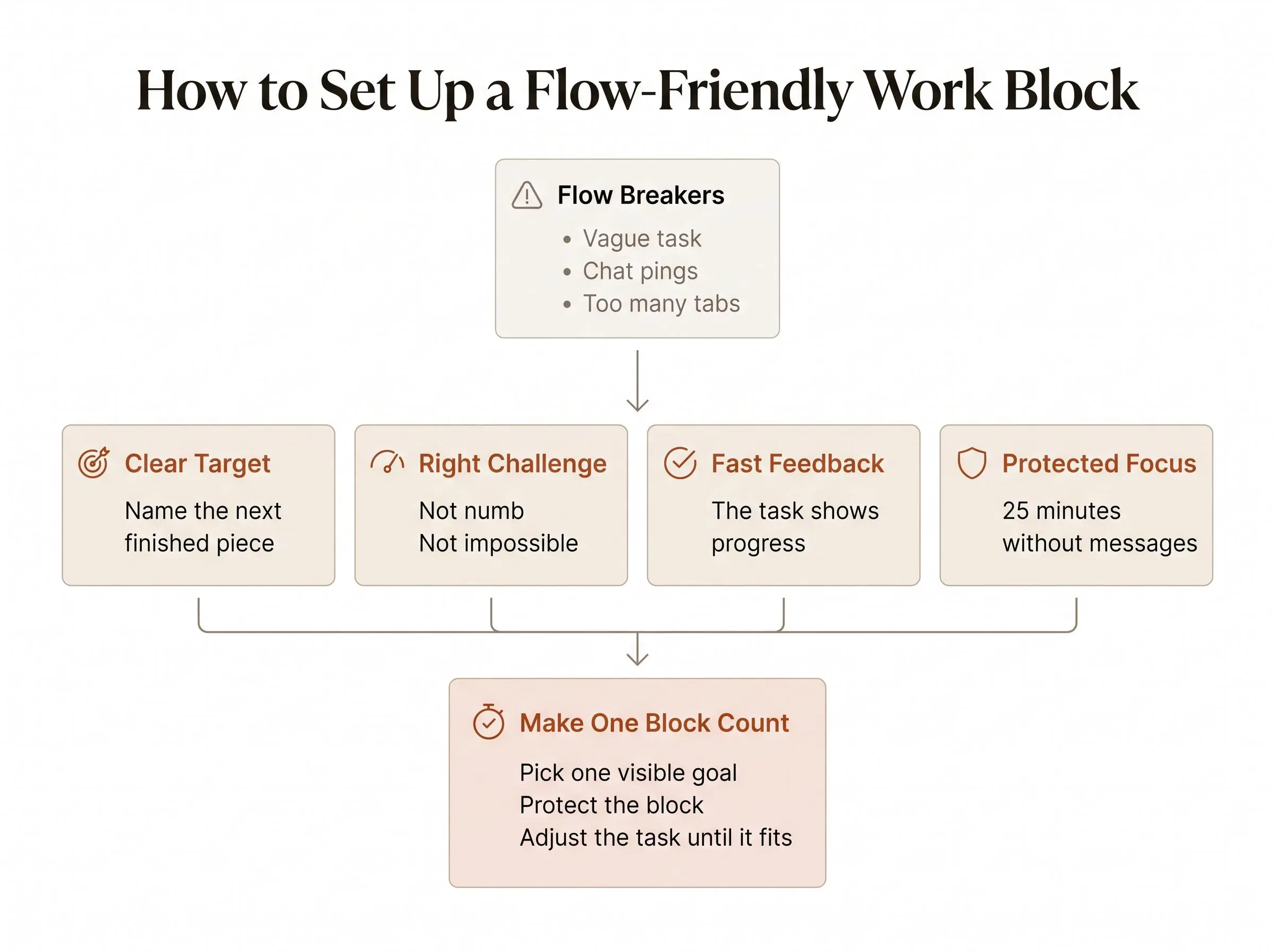
These four conditions work together. Treating them like isolated tips misses the point. You are building an environment for attention, not collecting productivity trivia.
Clear goals
A clear goal is a concrete target for the current work block. Not "work on the presentation." That is fog. Try "draft the opening slide sequence" or "answer questions 1 through 5."
The brain settles faster when "done" is obvious. Vague tasks leave too much room for negotiation, and negotiation is where avoidance sneaks in.
Immediate feedback
Feedback does not need to come from a boss, client, or teacher. Good work often tells you something quickly on its own.
A paragraph gets sharper or it doesn't. The test passes or fails. The dataset becomes cleaner or stays messy. A draft starts taking shape in front of you. Without that loop, attention drifts because your brain cannot tell whether effort is paying off.
Challenge matched to skill
This is the balance point. Too easy and you get bored. Too hard and you get anxious.
Flow often appears when the task is a little beyond comfort but still manageable. That is why some sessions feel alive while others feel dead on arrival. You do not want comfort. You want stretch with a floor under it.
You can adjust difficulty in a few ways:
- narrow the scope if the task feels too big
- break it into smaller parts if the first step is fuzzy
- add a tighter standard or constraint if it feels too easy
- pick one harder sub-problem instead of skimming ten lighter ones
Uninterrupted concentration
This is the condition modern work attacks most aggressively. Flow needs protected attention. Not heroic attention. Protected attention.
It often takes 15 to 25 minutes of sustained focus before the mind fully settles. So if you get pinged every six minutes, you may be working hard without ever crossing into deep work. You keep paying the startup cost and never get the return.
Why Modern Work So Often Breaks These Conditions
Most people already know the list. Notifications. Open tabs. Chat apps. Meeting-heavy calendars. Shoulder taps. False urgency dressed up as professionalism.
The worse problem is not just interruption. It is permanent availability. Even when nobody messages you, part of your attention stays on standby. That thin layer of vigilance is enough to keep many people from dropping into deeper concentration.
A few minutes of interruption can cost much longer in recovery. Anyone who has tried to return to a difficult paragraph, model, or bug after being pulled into chat knows this. You do not simply resume. You reconstruct.
Remote and hybrid work did not magically solve this. Home can remove office noise, sure. It can also replace it with digital noise and continuous partial attention. Different wallpaper, same fracture.
Unclear priorities make it worse. If every session begins with "what should I even do first," then decision fatigue eats the front of the block before action has a chance.
So if you struggle to focus deeply at work, do not jump straight to "I must lack discipline." Maybe. But often the setup is bad. Many people are trying to enter flow in conditions that were built for reaction, not concentration.
What the Conditions Look Like in Real Work
This gets easier once you stop thinking about flow as a special category for artists or coders in dark rooms. A lot of ordinary work is flow-capable if you shape it properly.
For a writer or marketer, the goal might be one section draft or one round of headline rewrites. Feedback is immediate. The paragraph either tightens up or keeps sagging in the middle.
For a developer or analyst, the target could be one bug, one test set, or one model section. Feedback is built into the work. The code runs, the output improves, or the logic falls apart in a very direct and slightly rude way.
For a designer or researcher, flow often comes from pursuing one question. Produce one direction. Review one dataset. Test one claim. The layout clicks, or it doesn't. The evidence supports the idea, or it refuses.
For a student, the same pattern holds:
- solve a short problem set
- outline one argument
- review one chapter section
- check where confusion still lives instead of pretending it isn't there
Team work can support flow too, though teams often make a mess of it. Group flow is more likely when people share a clear objective, get quick feedback, and have protected working time instead of constant coordination theater.
A useful test is simple: look at your work and ask which parts have a visible finish line, fast feedback, and enough challenge to demand real attention. Those are your best flow candidates.
How to Get Into Flow State While Working

You do not need a dramatic ritual. You need a decent setup and a few clean decisions before the session starts.
Here is the sequence we recommend.
Build a flow-friendly work block
- Pick the task
Choose one meaningful target.
Pick a most important task, not a sprawling list. One clear priority cuts cognitive drag. Starting gets easier when the day has a center. - Set the finish line
Define the next visible win.
Turn the task into a block-sized goal with a clear finish line. Make the first move obvious enough that you can begin without more planning. - Calibrate difficulty
Match the challenge.
If the work feels flat, raise the bar a little. Add a tighter standard. Pick the harder case. If it feels overwhelming, shrink the scope or gather the missing support first. - Remove distractions
Protect the block.
Silence notifications. Close unrelated tabs. Put the phone somewhere mildly inconvenient. Tell people you are unavailable if needed. Entering flow during deep work depends more on prevention than resistance. - Allow enough time
Give the session enough runway.
Use an interval long enough for attention to settle. Twenty five minutes often works well because it creates a little urgency while still giving the mind time to lock in. - Reset for next time
End with a quick reset.
Note where to resume, what moved forward, and whether the task was too easy, too hard, or about right. Future you should not have to solve today's setup problems again.
That is how to work in the zone more often. Not by summoning the right mood. By making the next hour less slippery.
A Simple Work Rhythm That Makes Flow More Repeatable
Flow becomes more reliable when it sits inside a rhythm. Not a huge system. Just enough structure to stop guessing.
A timer alone counts minutes. A plan gives those minutes somewhere to go. That is the difference most focus tools miss.
Our preferred rhythm is lightweight:
- choose one most important task
- keep the rest of the list short
- estimate how many focus blocks the work should take
- run the blocks against that plan
- review what actually happened
This is the logic behind the Flocus Daily Planner and built-in Focus Timer. You plan the task first, then start a block tied to that task, then compare estimated time with actual time afterward. The daily Focus Ring makes progress visible without turning your day into a scoreboard for maniacs.
Estimate versus actual tracking matters more than it sounds. It shows whether you are underestimating complexity, choosing tasks that are too vague, or breaking focus more often than you think. In other words, it turns flow state habits into something you can learn from instead of something you either "have" or don't.
For a lot of people, that is the real relief. Structure without a giant productivity religion. A calm record of whether the day matched your intention.
Habits That Quietly Increase Your Chances of Working in the Zone
Flow is easier when your habits do some of the work before motivation arrives. We are not talking about elaborate morning routines. Just useful defaults.
A few habits pull more weight than others:
- keep your daily list short so attention is not split across too many open loops
- start deep work at the same time when you can, because the brain learns those hours
- protect your best energy for demanding work and push admin to lower-energy windows
- use a brief transition ritual, like clearing the desk or writing the session goal
- review when flow happens most often by task type, time of day, and energy level
One habit is easy to miss: keep adjusting challenge as your skill grows. If yesterday's stretch task becomes today's easy task, boredom will quietly replace engagement. A lot of people think their focus got worse when the real issue is that the work got too familiar.
Recovery matters too. Endless partial attention is not noble. It is just exhausting. Working in blocks with breaks makes it easier to re-enter concentration later.
How to Tell Whether You Actually Reached Flow
People sometimes romanticize flow and miss the obvious signs. You do not need mystical certainty. You need a decent read on what happened.
Subjectively, flow often looks like this:
- time moved oddly
- you stopped monitoring yourself every two minutes
- the work felt demanding but coherent
- you wanted to continue when the block ended
Behavior matters too. You stayed with one task. You finished a defined unit of work. The session felt smoother after the first stretch, not easier exactly, but cleaner.
After a block, ask:
- Was the goal clear enough?
- Did the work give me feedback?
- Was the challenge too low, too high, or about right?
- What interrupted me, if anything?
Completed time alone is not proof of flow. You can spend forty minutes trapped in task switching and still have a timer report a lovely number.
For readers who want a more concrete signal, Flocus also has optional Flow Tracking with a Muse headband. It shows live focus quality during sessions and can separate patterns like flow, overload, and low engagement. Useful, if you are neurotech-curious. Not required. The fundamentals still come first.
Common Myths About Flow at Work
A lot of bad advice comes from bad myths.
Flow is not only for artists, athletes, or people who are wildly in love with their jobs. Structured knowledge work can be very flow-friendly when the conditions are right.
Discipline alone does not mean you can focus anywhere. Environment matters. Interruptions matter. Team norms matter. Some offices are basically anti-flow machines with branded mugs.
Flow also does not mean the work feels effortless from minute one. There is often a friction period at the start. That is normal. If you quit during that phase, you keep mistaking the doorway for the whole room.
Harder is not always better. Push challenge too far and you get anxiety, not depth.
Long hours do not equal deep work. Attention quality beats dragging a task through a fragmented day.
And no, a timer is not enough. Timing helps. Planning, clear goals, and reflection are what make the time usable.
When the Problem Is Bigger Than Your Personal Habits
Sometimes the issue is not your routine. It is the workplace.
If interruptions are built into the culture, personal time blocking will only get you so far. You can defend a focus block for a while, but if the whole team runs on immediate replies and constant status checking, the system wins.
A few team-level changes help a lot:
- shared quiet hours
- meeting-free mornings
- clear response-time norms for chat
- visible signals that someone is in a focus block
- fewer status meetings and more async updates
You do not need to sound precious to ask for better conditions. Keep it practical. Try language like: "I do better work if I can protect 9 to 11 for concentrated tasks. I will still reply after that window." Or: "Could we move status updates to async so the team gets more uninterrupted time?"
That is not rigidity. It is work design.
Conclusion
The conditions for flow state are not mysterious. They are mostly about design, not willpower.
Clear goals. Immediate feedback. Challenge matched to skill. Uninterrupted concentration. Those are the four essentials. Miss one badly enough and flow gets much less likely.
If you want to test this tomorrow, keep it simple:
- choose one important task
- define one block-sized goal
- protect one focus interval
- review what actually happened
That is enough to learn something useful in a day.
If you want more structure than a standalone timer, Flocus can help. Plan the work, run the block, review the result, repeat. Calm beats chaos more often than people think.
Article Record
ReferencesPrimary sources used for this article
- Investigating the “Flow” Experience: Key Conceptual and Operational Issues
- Frontiers | Fostering flow experiences at work: a framework and research agenda for developing flow interventions
- Frontiers | The Cognitive Control Model of Work-related Flow
- Effects of task interruptions caused by notifications from communication applications on strain and performance
- How Do Interruptions Affect Productivity?