
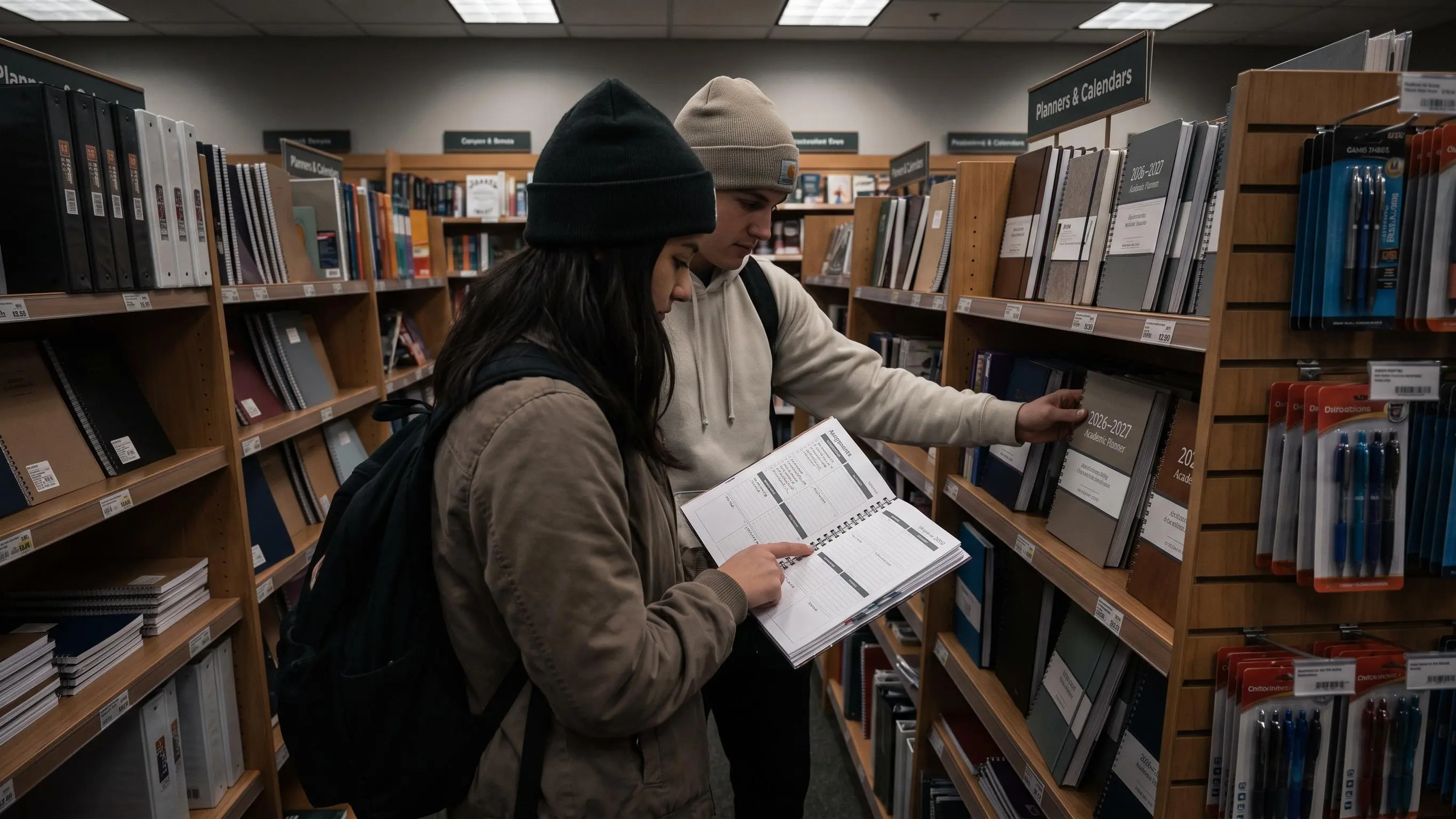
Finding the best planner for students gets weirdly hard once you realize a pretty weekly spread won’t make you start the reading due by 9 a.m. Most options either track everything or help you focus. Very few do both without becoming homework themselves.
What made the cut here: clear daily structure, realistic academic tools, and less friction when your brain is already fried.
These are the planners worth your attention.
Show 5 more productsShow fewer products
1. Daily Planner

- Turns planning into focused action
- Short lists reduce decision fatigue
- Pomodoro estimates improve time realism
- Weekly recaps show real progress
- Works on phone or laptop
- Free plan limits daily focus
- Best if you plan digitally
- Muse feature feels niche
If your real problem is not "I forgot the deadline" but "I knew what to do and still didn't start," this is the one to look at first. We built Daily Planner for students who don't need a prettier list. They need a plan that survives contact with an actual Tuesday.
The difference is small on paper and big in use. You choose one most important task, keep the list short, estimate the work in Pomodoros, and then do the focus block in the same place. No handoff. No "I'll plan now and focus later" fiction. That gap is where a lot of good intentions go to die.
A few details matter more than they seem:
- the most-important-task setup cuts decision fatigue fast
- timed focus blocks turn planning into a start button
- estimated vs actual time shows whether your study plans are honest
- weekly and monthly recaps are based on completed days, not vibes
- it works in a browser on laptop or phone
- Muse support exists if you want real-time flow-state tracking, but most students won't need that layer
Compared with paper planners here, Daily Planner is more action-oriented. Compared with iPad planners, it's lighter. Compared with a plain Pomodoro app, it gives you the missing planning layer. A timer counts minutes. It doesn't decide what deserves them.
Planning without a focus layer often becomes decorative organization.
The free version includes one 30-minute focus session daily, so heavy users may want more room than that. Still, for students searching for the best focus app for students, a student productivity app, or a study timer with planning, this is usually the cleaner answer than bolting three tools together and pretending that's a system.
2. Ivory Paper Co Academic Planner

- Dual layout shows deadlines and hours
- Strong weekly structure for students
- Semester and project planning included
- Thick paper resists ink bleed
- Coil binding stays open easily
- Doesn't directly support follow-through
- More planner than minimalists need
- Requires carrying a physical planner
Some students just think better with paper. Not nostalgically. Mechanically. Writing things down slows the brain enough to sort the day out. Ivory Paper Co fits that kind of student well.
Its best move is the dual weekly layout. You get a horizontal weekly overview for assignments and a separate hourly structure for the same week. That sounds simple, but it solves a common paper-planner problem: most layouts are either good for seeing deadlines or good for blocking time, not both.
You'll probably notice the paper quality and customization, but the more useful parts are these:
- monthly calendars and semester planning pages
- a project tracker for longer assignments
- hourly scheduling for class-heavy weeks
- coil binding that makes it easier to actually leave open on a desk
This is more detailed than a minimal weekly planner, but it doesn't become a giant life-management binder. That's a good line to hold. Students who want assignment tracking and class scheduling in one physical planner will likely find it easier to live with than bulkier systems.
Where it falls short is follow-through. Like most paper planners, it helps you map the work, not begin it. If you already start reasonably well and mostly need clean weekly structure, that's fine. If you routinely write "study chem" three days in a row and still don't sit down, paper alone may not solve the real problem.
3. The Dailee 2026-2027 College Planner

- Covers full academic-year rhythm
- Deep all-in-one student organization
- Daily and weekly planning included
- Strong support for campus logistics
- Helpful budgeting and habit pages
- Very bulky at 500+ pages
- Daily upkeep can feel demanding
- Too much for minimal planners
This one is for students who want their planner to run a large part of their life, not just schoolwork. And to be fair, some semesters really are like that. Classes, internship hours, scholarship deadlines, workouts, grocery planning, budget tracking. It adds up fast.
The Dailee 2026-2027 College Planner leans into that all-in-one role. It runs August through July, which makes more sense for many students than a January start, and it includes daily pages alongside weekly overviews and college-specific planning sections.
The scale is the point here:
- dated daily pages with hourly time blocking
- class and project planning
- four-year course and credits planning
- scholarship tracking and extracurricular planning
- monthly budget and expense pages
- meal planning, grocery lists, workouts, habits
- reflection and brain dump pages
- more than 500 pages
This is broader than Ivory Paper Co and more campus-life-specific in tone. It also asks more from you. Daily pages are useful when you're in the habit of checking them. If you're not, they can turn into evidence against yourself by week three.
That's the quiet tradeoff with big planners. They promise control, but they also expect maintenance. Students with packed semesters may love that. Students who want less guilt and less bulk probably won't.
4. The Dailee 2026-2027 Weekly College Planner
- Weekly format feels less overwhelming
- Strong college-specific planning pages
- Good balance of structure and flexibility
- Helps organize classes and projects
- Academic-year layout fits school rhythm
- Less helpful for daily time blocking
- Can feel bulky for weekly use
- Requires self-direction to start studying
The weekly Dailee version makes a smarter bet for a lot of students. It keeps much of the college-specific planning support, but drops the full daily format. That sounds like subtraction. Often it's relief.
If unused daily pages tend to make you feel behind, weekly is usually the safer format. You still get structure, but not the obligation to account for every hour of every day.
It keeps plenty of the academic backbone:
- weekly spreads for a full-week view
- fall and spring semester schedules
- class and project planning
- four-year course and credit planning
- scholarship and extracurricular pages
- monthly budget tracking
- notes, reflections, and brain dump sections
- monthly progress tracking
This sits in the middle of the list nicely. Less intense than the full Dailee college planner, but much more student-specific than a generic weekly planner. The catch is practical: weekly layouts work best when you already know how to convert assignments into actual study sessions. Some students do that naturally. Others end up with a clean week spread and no start point.
If you want structure without feeling micromanaged by your own planner, this is one of the better paper choices.
5. The Dailee 2026 Digital Planner for Students
- Deep academic planning toolkit
- 500+ hyperlinked pages navigate quickly
- Keeps planning on one device
- Great for handwritten iPad workflows
- Requires iPad and GoodNotes
- Setup feels more involved
- Less helpful for focus execution
This is the digital option for students who already live on an iPad and want a paper-style planning experience without the physical weight. If GoodNotes is already part of your school setup, the appeal is obvious.
The planner has more than 500 hyperlinked pages, which is useful because a file this large would be annoying without fast navigation. It covers daily pages, weekly overviews, monthly calendars, class planning, project tracking, budgeting, reflections, and longer-range academic planning.
A few things stand out in real use:
Where it fits
- you annotate PDFs and take notes digitally already
- you want one device for classes, planning, and review
- handwriting helps you think, but carrying a thick planner does not
Compared with Daily Planner, this is deeper as a planner and weaker as a focus system. Compared with paper Dailee versions, it's easier to carry if your iPad is always with you anyway. Compared with Rocketbook, it's much more fixed and structured.
The friction is setup. You need the device, the app, and enough willingness to maintain a fairly involved digital notebook. Browser-based tools are lighter. iPad planners are better when you really want the handwriting workflow, not just "digital."
6. Rocketbook Academic Planner

- Reusable pages reduce paper waste
- Handwriting plus cloud backup
- Flexible mix of planning templates
- Great for projects and brainstorming
- Less permanent planning history
- Requires scanning for best workflow
- Not tailored to academic terms
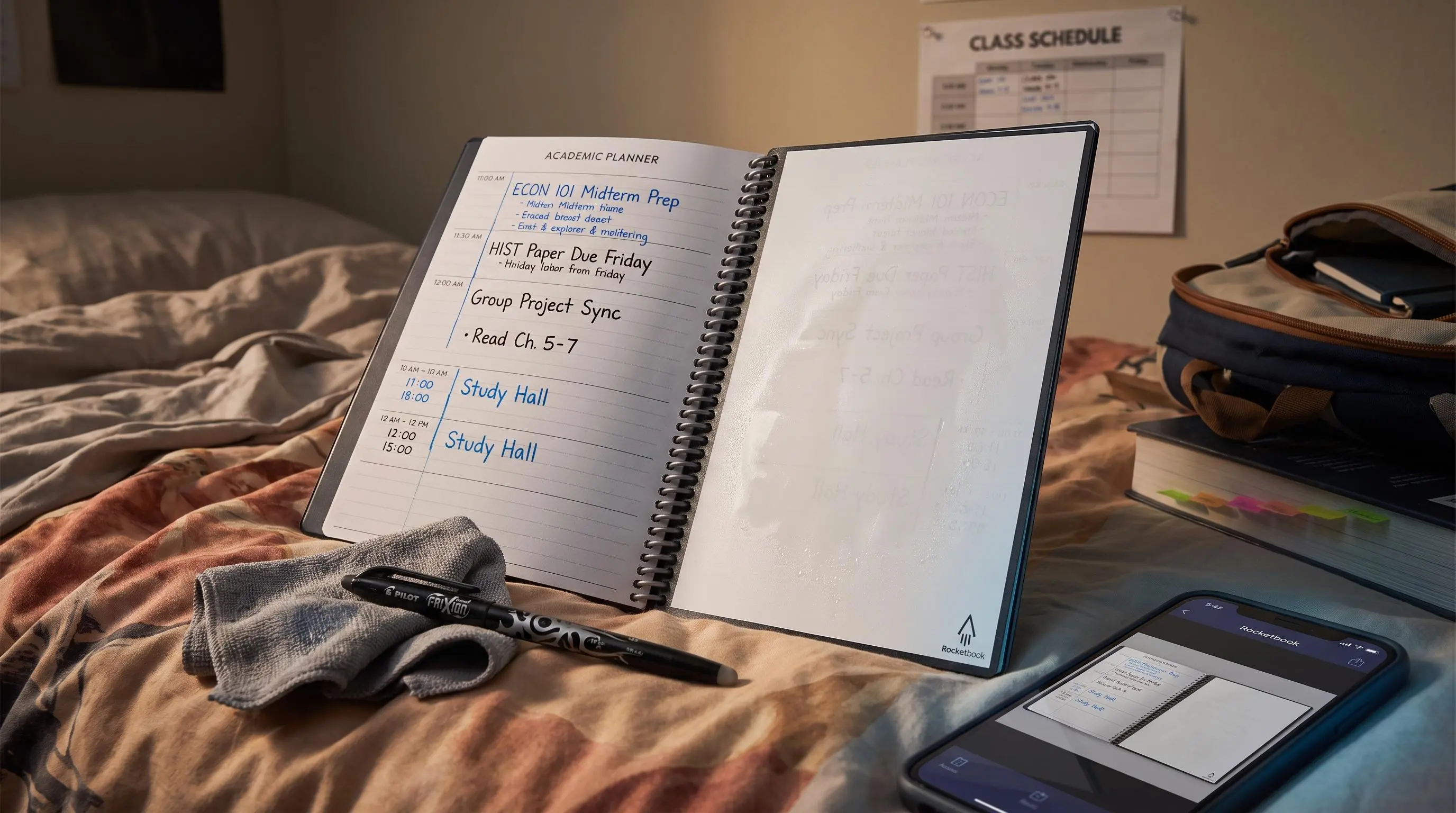
Rocketbook is for students who like writing by hand but don't want stacks of old paper, and who don't mind a little scanning in exchange for that flexibility. It's less a traditional dated planner and more a reusable planning notebook with student-friendly templates.
That changes the day-to-day experience. You aren't filling a bound academic year. You're using pages, wiping them clean, and storing what matters digitally. Some students find that freeing. Others miss the permanence.
The mix of page types is the attraction:
- daily, weekly, monthly, and annual planning pages
- class schedule and project tracker
- reflection, mind map, and priority matrix pages
- graph, lined, and dot grid pages
- cloud scanning through the app
- reusable pages with FriXion pen support
Rocketbook is more flexible than fixed paper planners here and more analog in daily use than any student study focus app. It's also less school-year-specific than planners built around semesters and dated academic pages.
A non-obvious point: reusable systems are great for experimentation because mistakes don't feel expensive. That's good for messy thinkers and project-heavy students. But if you rely on flipping back through old weeks to see your history, a wipe-clean workflow may feel oddly thin.
7. The Dailee 2026 College Planner
- Calendar-year format suits some students
- Combines academics, routines, and budgeting
- Daily pages support strong structure
- Helpful for habit and routine building
- Dense layout demands consistent use
- Can feel bulky and involved
- January start won't suit everyone
This one is close in spirit to the 2026-2027 edition, just shifted to a January through December calendar year. For some students that's a minor detail. For others it's the whole reason to choose it.
If your life rhythm follows the calendar year more than the school year, maybe because of internships, personal goals, or how you manage routines outside class, this format can feel more natural. The planner keeps the same "run your whole life from one book" approach.
Inside, the structure is familiar:
- daily pages with time blocking, to-dos, and notes
- yearly calendar and holidays
- class and project planners
- four-year course planning
- scholarship and extracurricular pages
- monthly budgeting and expense tracking
- weekly grocery, meal, and workout planning
- weekly overview and habit tracking
- reflection and brain dump pages
It's stronger for routine-building than paper planners focused mostly on assignments. It's also just as involved as the academic-year Dailee. That means the same warning applies: if you won't use a dense planner consistently, more pages won't rescue you.
Still, for students who want one book to hold coursework, life admin, and regular habits, the calendar-year version makes sense. You just need to know that you're signing up for a real system, not a casual notebook.
8. Squirrel Ultimate Student College Planner

- Strong focus on priorities
- Undated format starts anytime
- Built-in self-review encourages reflection
- Useful for long-term academic goals
- Supports strategic semester planning
- Requires more self-direction
- Less suited to detailed scheduling
- No traditional dated calendar structure
Squirrel is the most reflective option in this group. Less calendar-first, more priority-first. That's either exactly what you need or mildly irritating, depending on how your brain works.
The planner is organized around five success principles and uses an undated format, so you can start anytime. It includes weekly plans, biweekly self-reviews, goal planning, career development sections, semester strategy pages, and lined thinking space.
What makes it different isn't volume. It's emphasis.
- more attention on goals and strategy
- less dependence on pre-filled dates
- regular self-review built into the system
- structure around priorities, not just appointments
Philosophically, this is the closest paper option to methods that focus on fewer things at once. That's a real strength. Students often don't need more ambition in their planner. They need fewer moving targets.
The tradeoff is self-direction. Undated systems are forgiving if you miss a week, but they also require you to restart yourself. Students who want monthly calendars, assignment logs, and detailed dated structure may find this too open. Students trying to think more clearly about what college is for, not just how to survive next Thursday, may like it a lot.
| Daily Planner | Ivory Paper Co Academic Planner | The Dailee 2026-2027 College Planner | The Dailee 2026-2027 Weekly College Planner | |
|---|---|---|---|---|
| Digital browser access | ✓ | × | × | × |
| Built-in focus timer | ✓ | × | × | × |
| Daily pages | ✓ | × | ✓ | × |
| Hourly scheduling or time blocking | × | ✓ | ✓ | × |
| Project planning or tracking | × | ✓ | ✓ | ✓ |
| Budget tracking pages | × | × | ✓ | ✓ |
| Weekly or monthly progress recaps | ✓ | × | × | ✓ |
| Four-year course or credit planning | × | × | ✓ | ✓ |
How to Choose the Right Planner for Your Attention Style
Most students choose planners based on their best day. That's usually the wrong test. Choose for the version of you that is tired, behind, and mildly avoiding email.
Start here:
Daily or weekly?
Daily pages help if you need close structure. Weekly spreads are better if detailed dated pages make you feel trapped or guilty.Paper or digital?
Paper slows things down in a good way for some people. Digital reduces friction if your school life already happens on screens.Academic year or calendar year?
August starts fit class life neatly. January starts work better if your routines and goals don't reset with the semester.Do you need assignment tracking or focus support?
These are not the same problem. A planner can hold deadlines perfectly and still leave you staring at the wall at 8:10 p.m.Minimal or all-in-one?
If long systems make you quit, smaller is better. If your life is genuinely crowded and you like centralization, the bigger planners earn their space.
Inconsistency is often a system mismatch, not a character flaw.
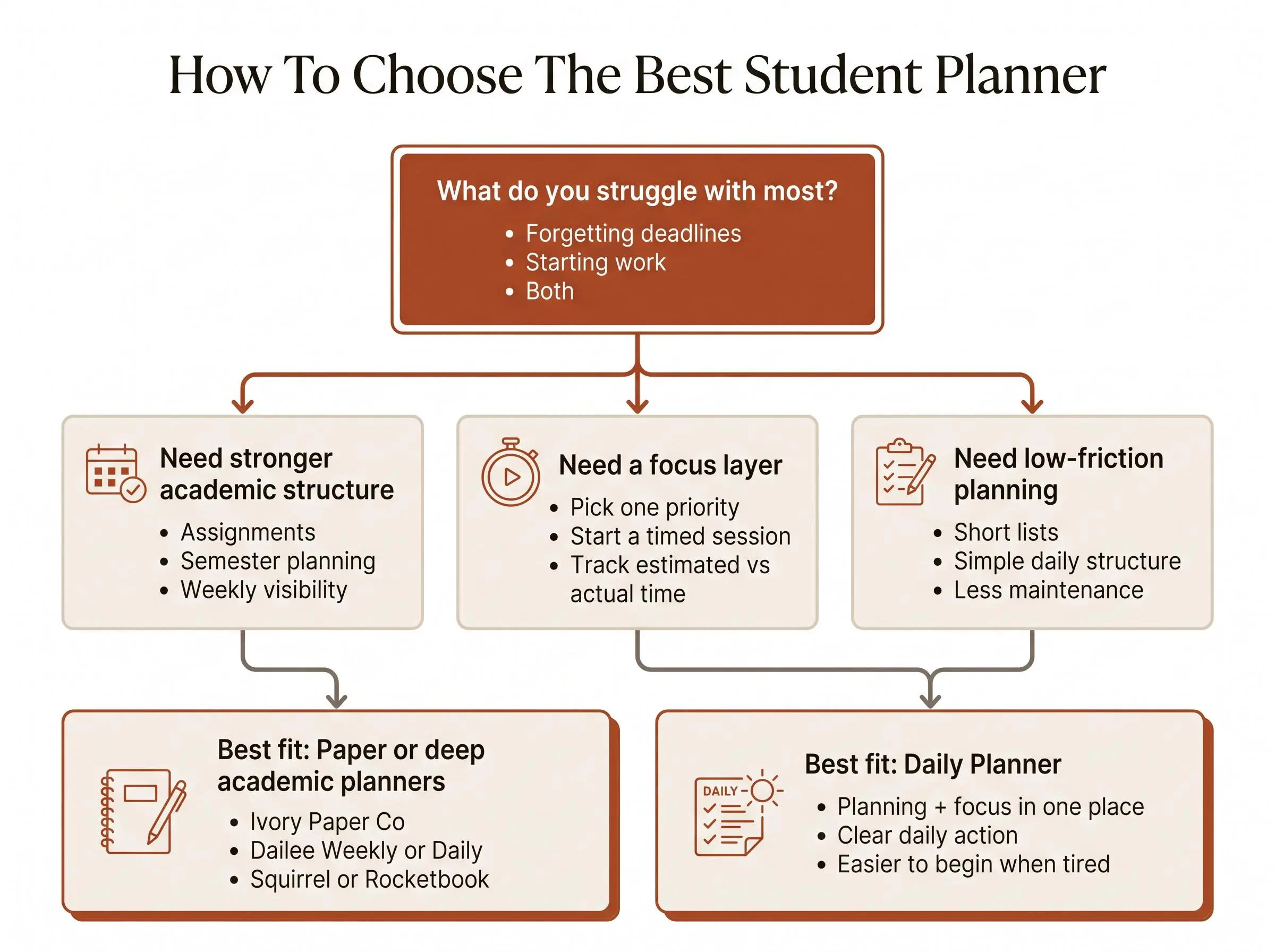
If you freeze when your list gets too long, choose something that narrows priorities. If you already know your priorities but miss deadlines, get a stronger academic planner. If you need help starting work, a focus app for college students may do more for you than another stack of planner pages.
Paper, Digital, and Hybrid Planners: What Actually Changes Day to Day
This isn't a philosophical choice. It's a workflow choice. The right format changes what happens at 7 a.m., between classes, and when you're trying to restart after a bad afternoon.
Paper planners help tactile thinkers. Writing things down can make the day feel more solid, and paper is often strong for semester mapping, assignments, and routine review. Ivory Paper Co and the Dailee paper planners fit here. Squirrel does too, though with a more reflective, undated style.
Digital planners cut clutter and move faster. If your notes, readings, and class files already live on devices, digital planning can remove a lot of needless transfer work. Daily Planner is the cleaner choice if you want planning tied directly to execution. The Dailee digital planner is better if you want a deep handwritten-style planner on an iPad.
Hybrid systems sit in the middle. Rocketbook is the obvious example here. You still write by hand, but the pages don't pile up and your notes can move to the cloud.
The main day-to-day question is simple: when it's time to study, does your planner help you begin, or does it just describe the fact that you should?
When a Planner Is Not Enough and You Need a Focus Layer
A lot of students aren't actually missing a planner. They're missing a bridge between planning and doing.
A planner can tell you that economics, chemistry, and a history reading all matter today. Useful, yes. But it doesn't always help you pick one, begin it, stay with it, or notice that "review chapter 6" somehow turned into 90 minutes of confusion and three snack breaks.
That's where a focus layer matters.
A simple decision test
- If you mostly forget deadlines, choose a stronger academic planner.
- If you mostly drift, procrastinate, or underestimate study time, look for planning tied to actual focus sessions.
This is why a plain timer often disappoints students. It measures minutes without clarifying priorities. You can spend 25 focused minutes on the wrong thing very efficiently.
Estimated vs actual time matters more than people think. Once you start logging both, your planning gets less fantasy-driven. You stop pretending a lab write-up is a "quick hour." That's useful data, even when it's rude.
Visible progress helps too:
- completed focus blocks
- streaks
- daily reflections
- weekly recaps based on real work
Those markers reduce the weird end-of-day feeling that nothing happened, even when you were working. For students comparing the best focus app for students, a student productivity app, or a study timer with planning, this is the real split in the market. Some tools count sessions. Better ones help you choose the right work and learn from it.
If you keep rewriting the same to-do list, you probably don't need a more complicated planner. You need a system that makes the next study block obvious.
Conclusion
The best planner for students is the one that turns intention into focused action with the least friction. That's the whole game. Not prettier spreads. Not more pages. Not a planner that makes you feel like a different person for two days.
Choose Daily Planner if you want digital planning tied straight to focus sessions and honest time tracking. Choose Ivory Paper Co if you want a structured paper academic planner with both assignment and hourly views. Choose one of the Dailee planners if you want an all-in-one student system and already know whether daily, weekly, digital, academic-year, or calendar-year planning fits you. Choose Rocketbook if reusability and cloud-connected notes matter most. Choose Squirrel if priorities, goals, and reflection matter more than dated pages.
If you're stuck, make the decision smaller. Ask whether your real bottleneck is planning, follow-through, or both. Then pick the option that makes starting your next study session feel easiest. That's usually the right answer.
Article Record
ReferencesPrimary sources used for this article
- 2026-2027 College Planner – The Dailee
- 2026-2027 Weekly College Planner – The Dailee
- 2026 Digital Planner for Students – The Dailee
- Academic Planner | Reusable School Planner | Rocketbook
- 2026-2027 Office Green Spiral Weekly Monthly Student Planner | Sugar Paper
- Academic Planners - Planner For Students 2026 / 2027 – Ivory Paper Co
- Squirrel Ultimate Student College Planner – Squirrel Ultimate College Planner
- 2026 Student Planner - Ladyn – Dayla Studio