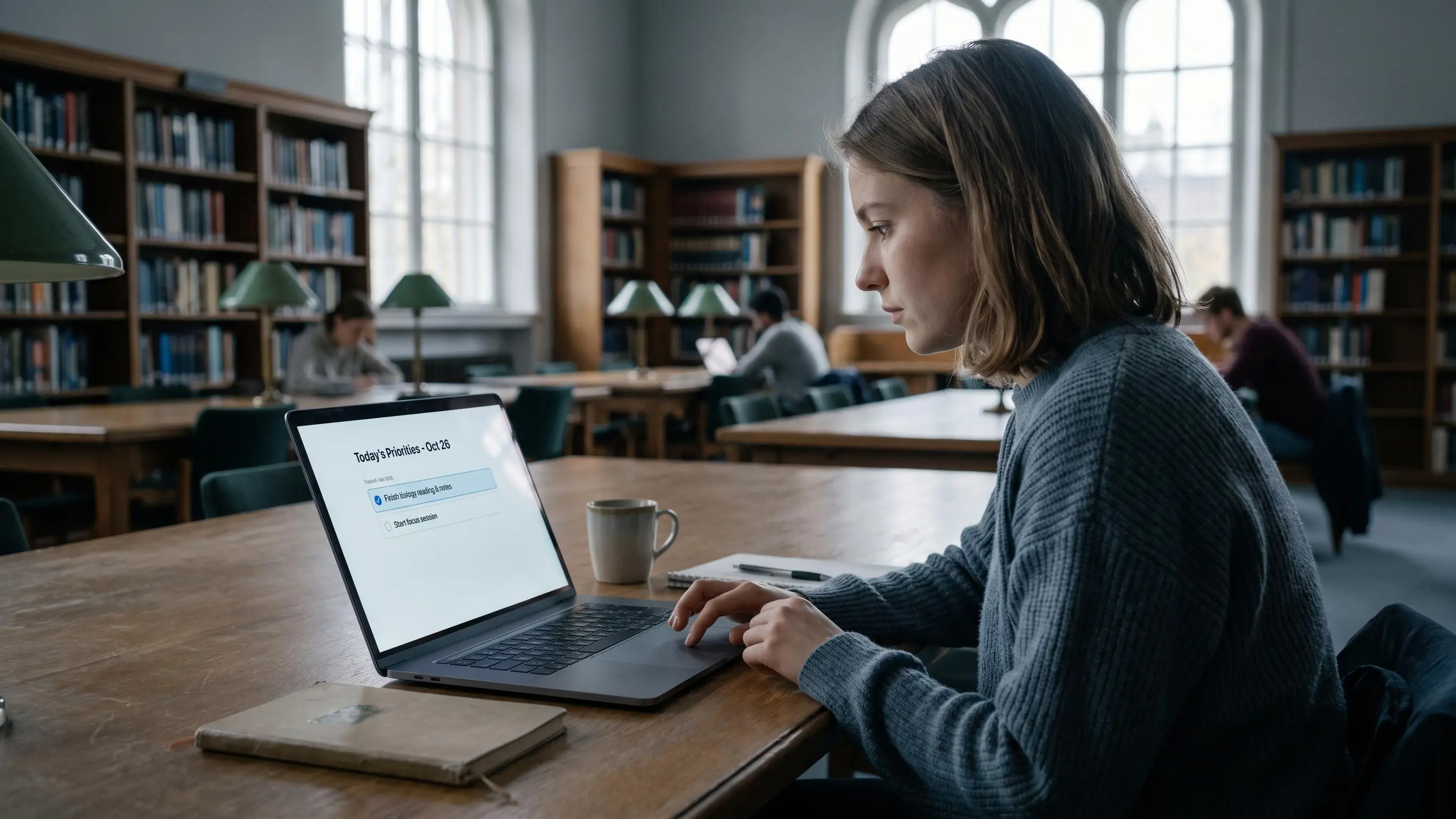
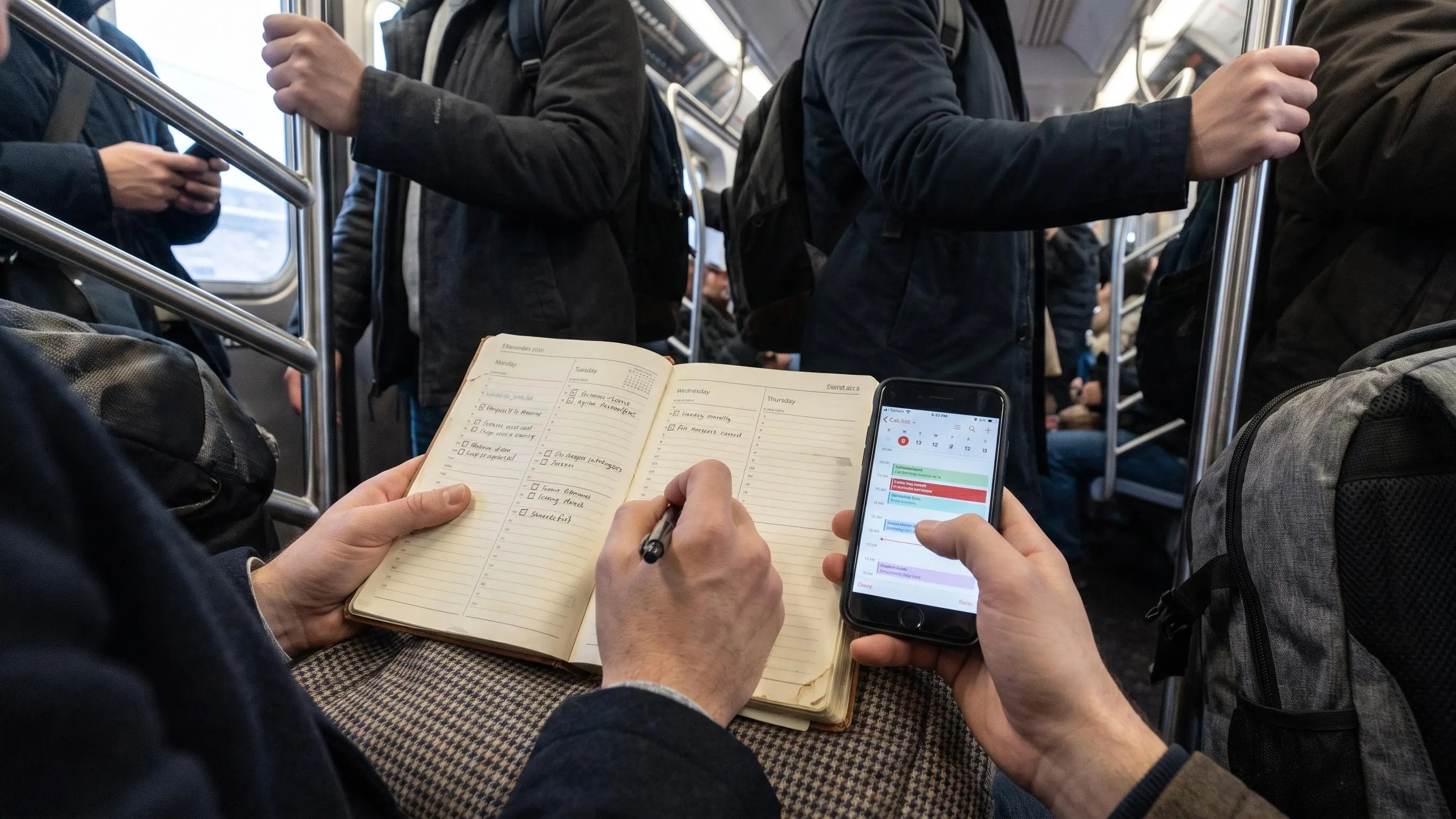
Most people turn the paper planner vs digital planner question into taste. That misses what wrecks your day: vague priorities, too many tasks, and a timer running on work you did not mean to do.
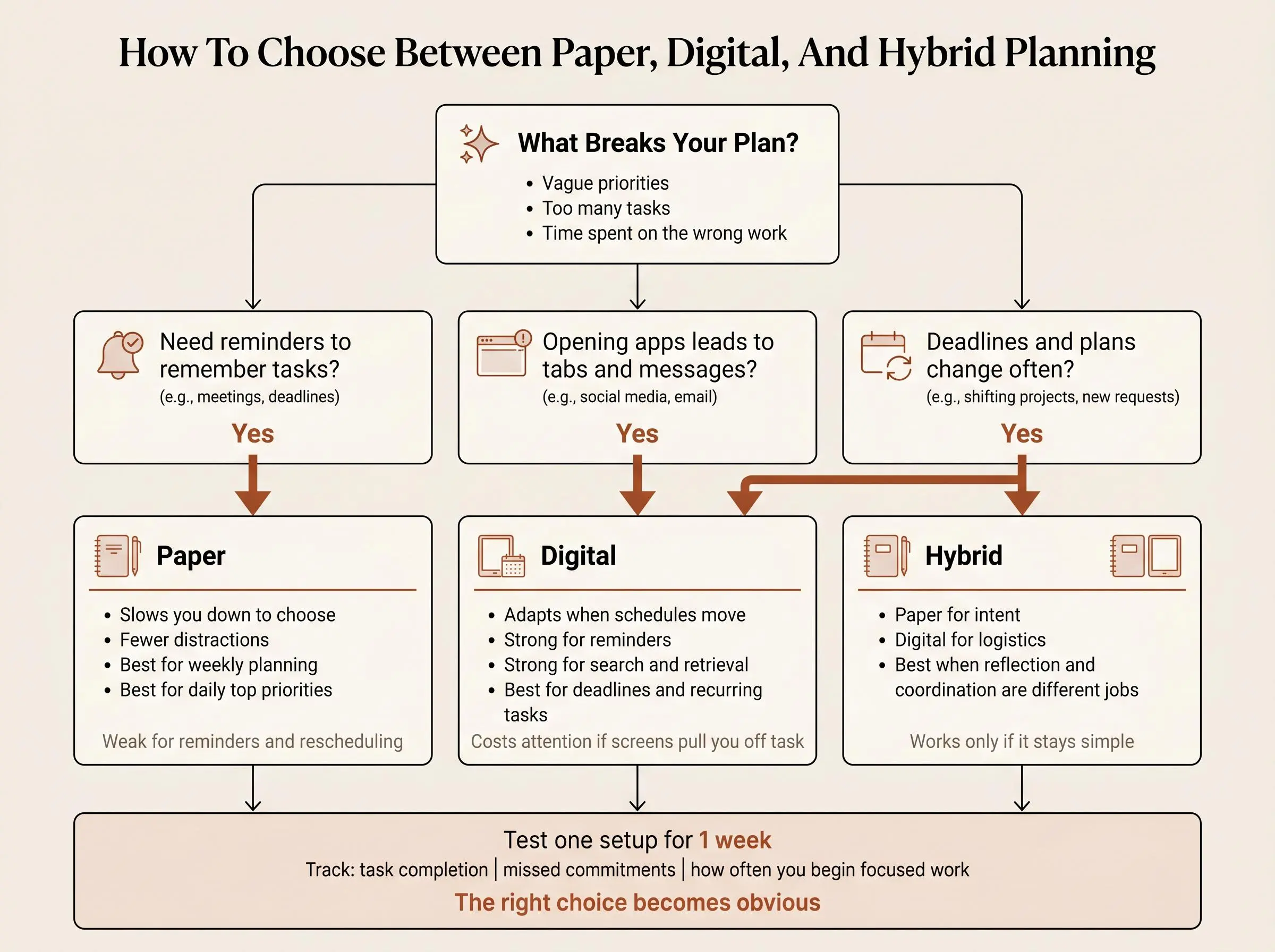
What matters is where your plan holds up when real life hits. We've seen paper slow you down to choose; digital helps when deadlines move.
Check these first:
- If you forget tasks unless something pings, paper will not save you.
- If opening your planner leads to tabs and messages, digital has a cost.
- Test one setup for a week, and the right choice gets obvious.
The Real Question Behind Paper Planner vs Digital Planner
Most people searching paper planner vs digital planner are not really asking about paper quality or app features. They're asking a harder question: which format will actually help them focus long enough to finish something that matters.
If you've ever set up a new notebook or downloaded a clean-looking planner app, you know the pattern. Day one feels organized. Day three gets busy. By the second afternoon, you're back to reacting to messages, tabs, deadlines, and whatever is loudest.
That drift tends to feel personal. As if you just lack discipline. Usually it's less dramatic than that. It's often a mismatch between the tool and the job you're asking it to do.
The paper planner or app debate gets stuck because both sides promise control. Neither one fixes vague priorities, overloaded days, or the habit of treating every task as equally urgent. A tool can't choose for you. It can only make certain behaviors easier.
So that's the frame for the rest of this piece:
- how paper and digital affect attention differently
- where each one helps with planning, execution, and reflection
- how to choose based on your actual friction, not your identity
- and when a simple hybrid setup makes more sense than picking a side
The question isn't which planner looks better on a desk. It's which one helps you decide what matters, begin it, and notice whether it actually got done.
What Focus Actually Requires From a Planner
Focus sounds abstract until you watch a normal workday fall apart. In practice, focus is simple enough. You need to know the next important task, protect time for it, and be able to tell whether progress happened.
A timer can measure minutes. It can't tell you what deserves those minutes.
That's the gap people miss when they compare digital vs paper planning. They treat planning as storage or scheduling, when the real job is attention management. A planner helps focus when it does three things well:
- It helps you clarify what deserves attention.
- It keeps that commitment visible when the day gets noisy.
- It prompts action at the moment you're most likely to drift.
When those three jobs are weak, the same failure modes keep showing up:
- long task lists with no real priority
- frequent context switching because everything feels half-started
- a busy day that ends with no clear point of completion
This is why focus planning methods matter more than the medium alone. A paper page with twelve unchecked priorities is still chaos. A polished app full of tags, filters, and recurring tasks can be chaos with sync.
People comparing a planner app compared to notebook often assume the difference is convenience. It isn't only that. The tool also shapes how you think. Some formats encourage deliberate choice. Others encourage easy capture and retrieval. Those are not the same thing.
Where Paper Planners Can Help You Focus Better

Paper has one big advantage that never goes out of style. It doesn't fight for your attention while you're trying to plan.
That sounds obvious, but it's not trivial. A phone can hold your task list, your calendar, your notes, your messages, and the exact distraction you were hoping not to open. A notebook mostly just sits there and waits for you to think.
Why paper often feels more grounding
Writing by hand slows you down enough to process what you're committing to. For some people, that makes intentions feel more real. Research from note-taking suggests handwriting may support deeper conceptual processing in some cases, though the evidence isn't perfectly consistent across studies. Planning is not note-taking, but the same pattern can still matter. If you remember and commit better when you write by hand, paper may help you focus more than an app ever will.
There are also plain practical benefits:
- no notifications
- no battery problems
- no accidental detour into email or messages
- a calmer planning ritual, especially in the morning or during a weekly reset
That ritual matters more than people admit. A planner you open with some intention often gets used differently from one you glance at between tabs.
Where paper is especially strong
Paper tends to work best for the parts of planning that benefit from slower thinking:
- weekly planning
- choosing a most-important task
- sketching a simple time block for the day
- habit tracking
- end-of-day reflection
It's also good for seeing the whole day at once. Not because paper is magical, but because you can't hide behind endless scroll.
Still, the pros and cons of paper planners are pretty clear. The pros are tactile engagement, simplicity, low friction for reflection, and fewer interruptions. The cons are weak searchability, poor portability if you forget the notebook, awkward rescheduling, and no automatic reminders.
One experienced-operator note here: forgetting your planner once is annoying, but forgetting it on the one day with three moving deadlines is how people quietly abandon paper altogether.
A small fix helps. Take photos of key pages, or keep a basic archive habit. Paper is easier to lose than people like to think.
Where Digital Planners Can Help You Focus Better
Digital planners win on speed, retrieval, and flexibility. If your schedule moves often, or your work spans devices, that's not a minor perk. It's the whole game.
You can capture an idea on your phone, edit it on your laptop, and check it later on a tablet. You can search old plans in seconds. You can move tasks around without turning today's page into a small crime scene.
What digital does well in real work
For students and knowledge workers, the practical advantages are hard to ignore:
- sync across phone, laptop, and tablet
- quick rescheduling when plans change
- recurring reminders for deadlines and appointments
- search and filtering when projects get dense
- backups that reduce the risk of losing important plans
This is where a planner app compared to notebook often does better. If your problem is remembering, retrieving, coordinating, or handling a changing schedule, digital has a real edge. It keeps commitments visible without asking you to rewrite the same thing over and over.
But digital has a cost. The same device that stores the plan also stores everything that fragments attention. Notifications, tabs, pings, news, messages, one quick check that somehow becomes twenty minutes.
And some planner apps become maintenance projects. Too many views. Too many custom fields. Too much sorting and organizing instead of starting.
A planning tool should reduce friction, not become your most carefully managed hobby.
Digital planners aren't automatically worse for focus. They just require better boundaries because they live inside attention-hungry environments. If your digital setup helps you start work faster and miss fewer commitments, it's doing its job. If it mostly helps you rearrange tasks with exquisite precision, that's different.
Why the Research Does Not Give a Simple Winner
People want science to settle this cleanly. It doesn't.
Some note-taking studies have found that handwriting is linked to stronger conceptual understanding or deeper processing. Later replication work has produced mixed results. So the useful takeaway is modest, not dramatic: handwriting may help some people think and remember differently, but the advantage is not universal enough to declare paper objectively better for everyone.
That matters because planning is not the same task as classroom note-taking. You're not trying to encode a lecture. You're trying to choose, commit, remember, and follow through.
So the research can point to likely benefits without handing us a final answer. A fair translation looks like this:
- if writing by hand makes your intentions feel more concrete, paper may support better focus
- if reminders and easy retrieval prevent dropped commitments, digital may support better focus
- if your attention breaks mostly because of your environment, the medium may matter less than your boundaries and method
This is less satisfying than a definitive winner. It's also more useful.
The better question is not "what does one study say?" It's "where does my system break under normal pressure?" That's where your answer is hiding.
Choose by Cognitive Job, Not by Identity
A lot of planner decisions go wrong because people choose by self-image. They decide they're a paper person or a digital person, then force every planning task into that identity.
That usually ends badly.
A better way is to match the tool to the cognitive job. Three questions help:
- How deeply do you need to process it?
- How often do you need to retrieve it?
- How time-sensitive is it?
If deeper encoding and reflection matter more than speed, paper often wins. If retrieval, reminders, and fast editing matter more, digital usually wins. The system should also fit how you learn and organize time. Leslie Josel, ADDitude's ADHD Family Coach, recommends choosing a planning tool that matches the user's needs; for people who find writing difficult, she suggests an electronic planner with weekly and monthly views so assignments and other time commitments remain visible.
Here is what that looks like in practice:
- Weekly reset and choosing top priorities often work well on paper.
- Appointments, deadlines, and recurring commitments usually work better digitally.
- Project archives and searchable notes generally belong in digital systems.
- If writing or frequent changes create friction, a structured digital layout may be the more usable choice.
This approach also prevents one of the biggest hybrid mistakes: duplicating everything in two places. Once you're copying the same task into a notebook, a task app, a sticky note, and your memory, the system is already tired.
Try a two-week pilot instead. Not a total productivity reinvention. Just enough time to see what actually improves attention and consistency.
The Best Setup for Many People Is a Hybrid, but Only if It Stays Simple
A hybrid system often makes the most sense because planning and coordination are not the same activity. One is about intention. The other is about logistics.
The danger is obvious. A messy hybrid setup creates duplicate tasks, unclear ownership, and too much upkeep. You end up spending your review session reconciling systems like a mildly annoyed accountant.
A clean division of labor works better:
- use paper for weekly intent, daily top priorities, and reflective notes
- use digital for calendar events, reminders, rescheduling, search, and backup
This split is not just theoretical. ADDitude's Leslie Josel describes using a physical planner for her personal schedule while relying on a shared digital calendar for family events and appointments, including events months in advance. That supports giving each format a defined job instead of duplicating every task everywhere.
Then keep the sync routine boring:
- one short morning check
- one end-of-day update
- one weekly review to clean up loose ends
That's enough.
A student might choose the day's hardest assignment on paper, then rely on a digital calendar for classes and due dates. A knowledge worker might map deep work priorities by hand, but keep meetings and follow-ups in a digital task system.
This solves the paper planner or app dilemma by giving each format one job instead of demanding that either one do everything well.
What Actually Makes Either Format Improve Focus
Here is the part that matters most. The medium helps, but the method does the real work.
A minimal planning system that supports focus looks like this:
- choose one most-important task
- define a realistic work block for it
- estimate how long it should take
- do the block without switching
- review what actually happened
That works better than long task lists for a few reasons. One clear priority reduces decision fatigue. A time block protects attention before the day fills up. Estimated versus actual time teaches you how your work really behaves, which is often humbling in a useful way. And visible completion reduces that vague, grim feeling that the day disappeared.
This is also where a lot of timer-based systems fall short. Basic Pomodoro use counts minutes. It doesn't necessarily connect those minutes to the right task or help you learn from the result.
The difference is small on paper. It's large in practice.
Focus isn't just timed effort. It's planned effort with feedback.
Most focus planning methods are just variations on the same structure: priority, protection, and review. The format matters. The sequence matters more.
If You Want a Digital Tool That Feels More Like a Planner Than a Timer
Some people like the clarity of paper planners but need digital convenience. That's a real gap. A lot of focus apps mostly give you a countdown clock and a nice background. Useful, to a point. But a timer alone doesn't create direction.
That's the problem we built Flocus to solve.
Flocus is a free, browser-based focus app and daily planner that starts with the planning layer. You choose what matters first, then run timed focus blocks against that plan. The structure is simple on purpose:
- a daily most-important-task approach
- a visible progress ring and streaks so completion feels concrete
- estimated versus actual time logging, which keeps planning honest over time
It suits people who want more than a timer but don't want a heavyweight productivity system living in twelve tabs. Calm beats complicated.
There's also an optional layer for a narrower group. If you use a Muse headband, Flocus can track your flow state in real time while you work. Not as gadget theater. More as observation. The point is to notice focus patterns, not to collect shiny metrics you'll never use.
For readers stuck between digital flexibility and paper-style structure, it's one practical way to keep the planner benefits without losing the convenience of digital.
How to Decide Which Planner Will Help You Focus This Week
You don't need a grand system decision. You need a useful one for the next two weeks.
Ask yourself:
- Do you forget commitments unless you get reminders?
- Do screens pull you off task the moment you open them?
- Do you need search and portability more than tactile clarity?
- Do you think better when you write by hand?
- Is your schedule stable or constantly changing?
- Do you need to collaborate, or are you mostly planning for yourself?
The answers point somewhere fairly quickly.
Choose paper first if distraction reduction and intentionality are your biggest needs. Choose digital first if retrieval, reminders, and changing schedules are the real bottleneck. Choose hybrid if your planning and execution needs are clearly split between reflection and coordination.
Don't optimize for aesthetics. Don't optimize for trendiness. And definitely don't choose based on features you'll never touch after the first week.
Run one simple setup for two weeks and measure three things:
- task completion
- missed commitments
- how often you actually begin focused work when you intended to
Those numbers will tell you more than your planner preference ever will.
Common Mistakes That Make Both Paper and Digital Feel Broken
Most planner failures are not medium failures. They're behavior failures wearing better packaging.
A few repeat offenders show up in both systems:
- listing too many priorities and calling it planning
- treating the planner as storage instead of a daily decision tool
- building a complex system before building a repeatable habit
- using paper for everything when reminders and rescheduling are clearly needed
- using digital for everything when distraction is the main enemy
- duplicating tasks across notebook, app, sticky notes, and memory
- skipping review, so you never learn how long work really takes or when focus is strongest
- assuming a better tool will solve unclear goals, weak boundaries, or overloaded days
The most common one is probably this: people confuse capture with clarity. Writing it down is useful. Deciding what matters is the actual work.
If your planner keeps feeling broken, check whether it's being asked to do too much, or too vaguely.
Conclusion
The honest answer to paper planner vs digital planner is that there isn't a universal winner. Paper supports depth, calm, and deliberate focus. Digital supports retrieval, reminders, and flexibility. Each helps with different parts of the same problem.
Better focus usually comes from a simpler method than people expect. Choose one important task. Protect it with a real work block. Review what happened. Do that consistently, and the format starts to matter in more practical ways and less emotional ones.
So stop looking for the perfect planner personality. Test the tool that matches your real friction points. Give it two weeks. Watch completion, missed commitments, and how often you actually begin.
And if you want a digital approach that feels calm, structured, and measurable rather than timer-only, try a paper-inspired focus planner like Flocus. Planning first changes the quality of attention more than most people realize.
Article Record
ReferencesPrimary sources used for this article
- Why handwriting still matters in the digital age
- Q: “What’s the Best Planner for a Student with ADHD and Dysgraphia?”
- Q: “What Are the Best Planners for ADHD Brains? Paper or Digital?”
- A single smartphone notification hijacks your focus for 7 seconds, new study finds
- What Is Attention Management? Protecting Focus in the Age of AI | GAIA
Update HistoryMeaningful revisions to this article
- Added a sourced section explaining how to choose between paper and digital planners based on the task you need to manage.
- Made the comparison more practical by connecting planner features with different focus and organization needs.
- Updated the hybrid-planner section with expert-backed guidance from ADDitude to help readers create a simpler planning setup that supports focus.